 Her Happy Kitchen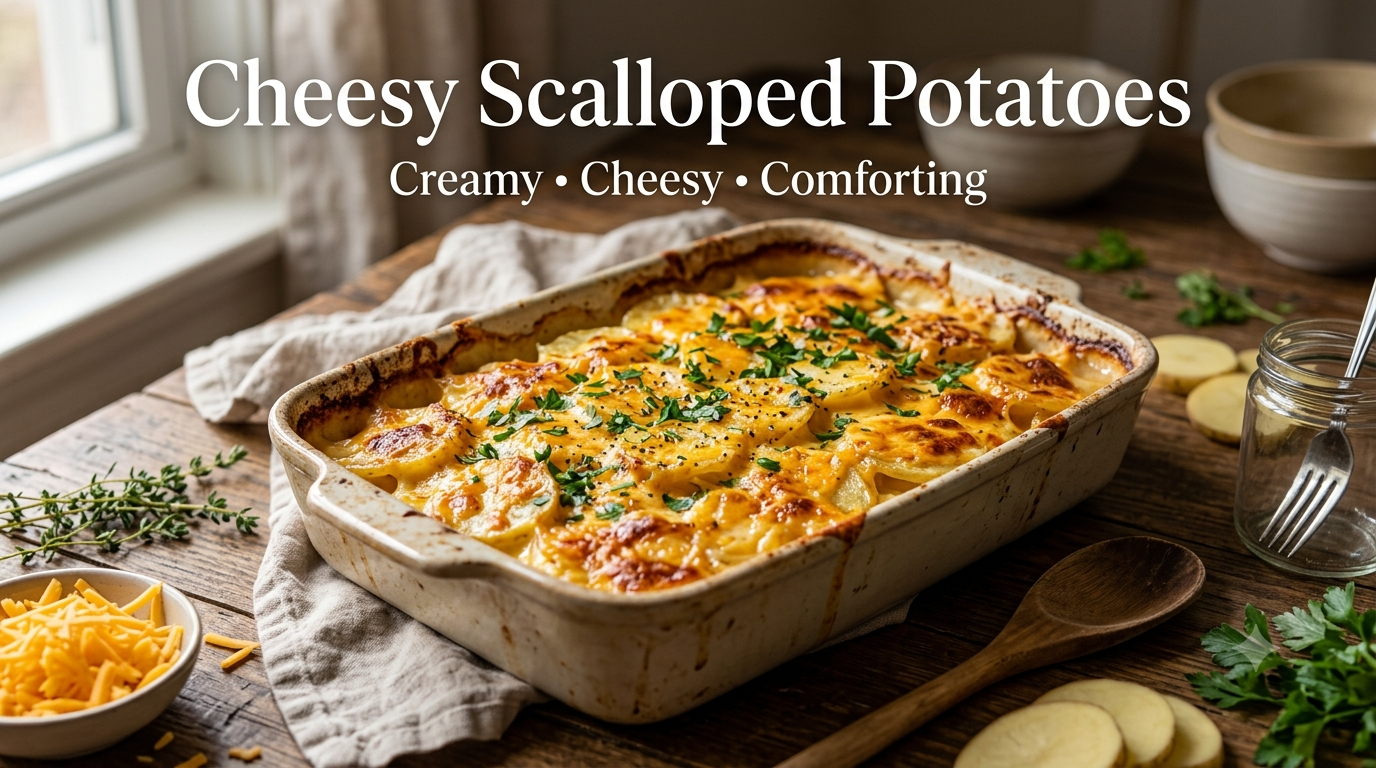
Creamy layers of tender potatoes baked with a rich, cheesy sauce until bubbling and beautifully golden—these Cheesy Scalloped Potatoes are the ultimate comfort-food side dish.
If you love potatoes and cheese, this recipe is one you’ll want to keep on repeat. Thinly sliced potatoes are layered with a smooth, creamy cheese sauce and baked until tender. The top becomes golden and bubbly while the potatoes underneath stay wonderfully soft and creamy.
Welcome to Her Happy Kitchen, where simple ingredients come together to create comforting homemade recipes your family will love.
Introduction
There is something incredibly comforting about a warm dish of cheesy potatoes coming straight from the oven. The combination of tender potato slices, creamy sauce, melted cheddar cheese, and a golden top makes Cheesy Scalloped Potatoes perfect for family dinners, holiday meals, weekend gatherings, and cozy nights at home.
Scalloped potatoes traditionally feature thinly sliced potatoes baked in a creamy sauce. Adding cheese makes the dish richer, more flavorful, and extra comforting. Different versions use milk, cream, butter, flour, cheddar, Parmesan, mozzarella, or a combination of cheeses.
For this Her Happy Kitchen version, the focus is on a creamy homemade cheese sauce and evenly sliced potatoes so every bite is delicious.
A number of established recipes use similar techniques: thin potato slices are layered with a creamy or cheese-based sauce and baked until tender and golden.
Why You’ll Love These Cheesy Scalloped Potatoes
There are plenty of reasons to make this recipe.
- Creamy and cheesy: The sauce coats every potato slice.
- Comforting: Perfect for cozy family meals.
- Simple ingredients: Most ingredients are easy to find.
- Great for gatherings: The dish can be prepared in a baking dish and served family-style.
- Customizable: You can change the cheese or add herbs and vegetables.
- Golden top: Baking gives the cheese a deliciously browned finish.
- Make-ahead friendly: You can prepare components ahead of time for easier entertaining.
Ingredients
For the Potatoes
- 2 pounds russet or Yukon Gold potatoes
- 1 medium yellow onion
- 2 tablespoons butter for greasing
- Salt, to taste
- Black pepper, to taste
For the Creamy Cheese Sauce
- 3 tablespoons unsalted butter
- 3 tablespoons all-purpose flour
- 2 cups whole milk
- 1 ½ cups shredded cheddar cheese
- ½ cup shredded mozzarella cheese
- ¼ cup grated Parmesan cheese
- ½ teaspoon garlic powder
- ¼ teaspoon black pepper
- Salt, to taste
Optional Garnishes
- Fresh parsley
- Fresh thyme
- Chives
- A little extra Parmesan
- Freshly ground black pepper
Choosing the Best Potatoes
The potatoes are the foundation of this recipe, so choosing the right variety makes a difference.
Russet potatoes are an excellent choice because they contain plenty of starch and become tender and creamy during baking.
Yukon Gold potatoes are another great option. They have a naturally buttery texture and hold their shape nicely when sliced.
Whichever variety you choose, try to select potatoes that are similar in size. This makes slicing and layering easier.
How Thin Should You Slice the Potatoes?
The potato slices should be thin and reasonably uniform.
A thickness of approximately ⅛ to ¼ inch works well for scalloped potatoes. Several established recipes use thin potato slices in this range.
If the slices are too thick, the potatoes may take longer to become tender.
If they are extremely thin, they can become fragile and may lose their shape during baking.
A mandoline slicer can help produce even slices, but a sharp kitchen knife works too.
Tip: Take your time while slicing. Consistent slices help the potatoes cook more evenly.
Preparing the Cheese Sauce
The homemade cheese sauce is what transforms ordinary potatoes into a rich and comforting side dish.
Start by melting butter in a saucepan over medium heat.
Add the flour and whisk continuously for about a minute. This creates a simple roux that helps thicken the sauce.
Slowly add the milk while whisking. Continue cooking until the mixture becomes smooth and slightly thickened.
Turn the heat down and add the cheddar and mozzarella. Stir until the cheese melts into the sauce.
Finally, add Parmesan, garlic powder, black pepper, and salt.
The result should be smooth, creamy, and rich.
How to Make Cheesy Scalloped Potatoes
Step 1: Preheat the Oven
Preheat your oven to 375°F (190°C).
Lightly butter a baking dish.
Depending on your oven and recipe variation, scalloped potatoes can also be baked at temperatures around 350°F–425°F.
Step 2: Prepare the Potatoes
Wash and peel the potatoes.
Slice them evenly into thin rounds.
Thin slices allow the potatoes to cook evenly and absorb the creamy sauce.
Step 3: Prepare the Onion
Thinly slice the onion.
You can use yellow onion for a mild sweetness or white onion for a slightly sharper flavor.
Step 4: Make the Cheese Sauce
Melt butter in a saucepan.
Whisk in flour and cook briefly.
Gradually add milk while whisking.
Cook until the sauce thickens.
Add cheddar, mozzarella, and Parmesan.
Stir until smooth.
Season with garlic powder, salt, and black pepper.
Step 5: Layer the Potatoes
Arrange half of the sliced potatoes in the prepared baking dish.
Spread some of the onion over the potatoes.
Season lightly with salt and pepper.
Pour approximately half of the cheese sauce over the first layer.
Repeat with the remaining potatoes, onion, and sauce.
Step 6: Add Extra Cheese
Sprinkle additional shredded cheddar and Parmesan over the top.
This creates the delicious golden cheese crust that makes the finished dish so appealing.
Step 7: Cover and Bake
Cover the baking dish loosely with foil.
Bake until the potatoes are tender.
The exact cooking time depends on the thickness of your potato slices and the depth of your baking dish. Recipes for scalloped potatoes commonly use covered baking followed by uncovered baking to finish the top.
Step 8: Brown the Top
Remove the foil during the final part of baking.
Continue baking until the cheese becomes bubbly and golden.
Watch the top carefully so the cheese doesn’t burn.
Step 9: Rest Before Serving
Allow the potatoes to rest for about 10–15 minutes before serving.
This gives the sauce time to settle and makes the dish easier to portion.
What Makes the Perfect Cheesy Scalloped Potatoes?
The secret is balance.
You want potatoes that are:
- Tender but not falling apart
- Creamy but not watery
- Cheesy but not overwhelmingly heavy
- Golden on top
- Well-seasoned throughout
The biggest factor is even potato slicing.
Another important factor is allowing the dish to rest after baking.
Best Cheese for Scalloped Potatoes
Cheddar
Cheddar is a classic choice because it melts well and provides a recognizable cheesy flavor.
Mozzarella
Mozzarella gives the dish a stretchy, mild cheese texture.
Parmesan
Parmesan adds a salty, nutty flavor and is especially useful as a topping.
Gruyère
For a more sophisticated flavor, Gruyère can be used.
Monterey Jack
Monterey Jack melts beautifully and has a mild flavor.
Cheese Combination
You don’t have to use only one cheese.
A combination such as cheddar + mozzarella + Parmesan creates different layers of flavor and texture.
Tips for Perfect Scalloped Potatoes
1. Slice the Potatoes Evenly
Uneven slices can result in some pieces being tender while others remain firm.
2. Don’t Make the Slices Too Thick
Thick potatoes require significantly more cooking time.
3. Season Every Layer Lightly
Seasoning only the sauce may leave the potatoes tasting bland.
4. Don’t Overload the Dish
Keep the potato layers reasonably even.
5. Give the Dish Enough Time
Scalloped potatoes are not usually a super-fast side dish. The potatoes need time to become tender.
6. Let Them Rest
Resting makes serving easier and allows the sauce to thicken slightly.
7. Shred Cheese Freshly
Freshly shredded cheese generally melts more smoothly than many pre-shredded varieties.
Common Mistakes to Avoid
Using Uneven Potato Slices
This is one of the most common problems.
Try to keep the slices approximately the same thickness.
Adding Too Much Liquid
Too much milk or cream can make the finished dish watery.
Skipping the Sauce
Simply sprinkling cheese between potato layers doesn’t provide the same creamy texture as a proper sauce.
Cutting Immediately
The dish is extremely hot when it comes out of the oven. Resting helps the layers settle.
Over-Browning the Cheese
A golden crust is delicious, but burnt cheese can taste bitter.
Can I Make These Ahead of Time?
Yes.
You can prepare the potatoes and cheese sauce ahead of time and assemble the dish before baking.
For best texture, keep the prepared dish properly covered and refrigerated if you are not baking it immediately.
When ready to bake, allow for additional cooking time if the dish is very cold.
How to Store Leftovers
Allow the potatoes to cool before transferring leftovers into an airtight container.
Store them in the refrigerator.
When reheating, use the oven or microwave depending on how much you are reheating.
For the best texture, reheating in the oven can help bring back some of the melted-cheese texture.
Can You Freeze Scalloped Potatoes?
Scalloped potatoes can be frozen, but the texture may change slightly after thawing because dairy-based sauces can sometimes separate.
For the best result, freshly baked scalloped potatoes are preferable.
If freezing, cool the dish completely, wrap it securely, and thaw it safely before reheating.
What to Serve with Cheesy Scalloped Potatoes
Cheesy scalloped potatoes work beautifully as a side dish.
Serve them alongside:
- Roasted vegetables
- Green beans
- Garden salad
- Grilled chicken
- Roasted chicken
- Baked fish
- Turkey
- Vegetarian main dishes
- Steamed vegetables
They are especially good for holiday-style dinners.
Variations
Garlic Cheesy Scalloped Potatoes
Add extra minced garlic or garlic powder to the cheese sauce.
Herb Scalloped Potatoes
Add fresh thyme, rosemary, or parsley.
Spicy Cheesy Potatoes
Add a small amount of crushed red pepper or paprika for extra warmth.
Three-Cheese Scalloped Potatoes
Use cheddar, mozzarella, and Parmesan.
Four-Cheese Version
Add another melting cheese such as Gruyère or Monterey Jack.
Onion Scalloped Potatoes
Add extra thinly sliced onions between the layers.
Frequently Asked Questions
Are scalloped potatoes the same as au gratin potatoes?
They are very similar, but traditional definitions often distinguish them by the presence of cheese. Scalloped potatoes are generally potatoes baked in a creamy sauce, while au gratin potatoes traditionally feature cheese and a browned topping. In modern cooking, however, the terms are frequently used interchangeably.
Why are my scalloped potatoes still hard?
The potato slices may be too thick, the dish may not have cooked long enough, or the oven temperature may vary from its setting.
Continue baking until the potatoes can be easily pierced with a knife.
Why are my scalloped potatoes watery?
Too much liquid, insufficient cooking, or cutting the dish before it has rested can contribute to a watery texture.
Can I use milk instead of heavy cream?
Yes. Milk creates a lighter sauce, while heavy cream produces a richer result.
Can I use Yukon Gold potatoes?
Absolutely. Yukon Gold potatoes are an excellent choice because of their creamy texture.
Do I need to peel the potatoes?
Peeling gives the dish a classic smooth appearance, but you can leave the skins on if you prefer and the potatoes are thoroughly cleaned.
Can I add bacon?
Yes, cooked crumbled bacon can be layered between the potatoes for a smoky variation.
Can I make this vegetarian?
Yes. This recipe can easily be served as a vegetarian side dish. If using packaged cheese or broth in variations, check the ingredients according to your dietary needs.
Recipe Card
Cheesy Scalloped Potatoes
Prep Time: 20 minutes
Cook Time: About 60–90 minutes
Resting Time: 10–15 minutes
Total Time: Approximately 1 hour 30 minutes
Servings: 6–8
Course: Side Dish
Cuisine: American-inspired comfort food
Ingredients
- 2 pounds potatoes
- 1 medium onion
- 3 tablespoons butter
- 3 tablespoons all-purpose flour
- 2 cups whole milk
- 1 ½ cups cheddar cheese
- ½ cup mozzarella
- ¼ cup Parmesan
- ½ teaspoon garlic powder
- Salt to taste
- Black pepper to taste
Instructions
- Preheat oven to 375°F (190°C).
- Grease a baking dish with butter.
- Peel and thinly slice the potatoes.
- Thinly slice the onion.
- Melt butter in a saucepan.
- Whisk in flour and cook for about 1 minute.
- Slowly whisk in milk.
- Cook until the sauce thickens.
- Add cheddar and mozzarella.
- Stir until melted.
- Add Parmesan, garlic powder, salt, and pepper.
- Layer half of the potatoes in the baking dish.
- Add onion and seasoning.
- Pour over half of the cheese sauce.
- Repeat the layers.
- Add extra cheese on top.
- Cover with foil.
- Bake until the potatoes are tender.
- Remove the foil.
- Continue baking until the top is golden and bubbling.
- Rest for 10–15 minutes.
- Garnish with parsley or chives.
- Serve warm.
Nutrition Information
Nutrition can vary significantly depending on the exact potatoes, cheese, milk, serving size, and other ingredients used. For that reason, calculate nutrition using the specific brands and quantities you use if precise nutritional information is important.
Final Thoughts
Cheesy Scalloped Potatoes are proof that simple ingredients can create an incredibly comforting dish.
Thin potato slices, creamy homemade sauce, plenty of melted cheese, and a golden baked topping come together beautifully. Whether you’re making Sunday dinner, preparing a holiday spread, or simply craving something warm and comforting, this recipe is a wonderful choice.
The best part is how customizable it is. You can experiment with different cheeses, herbs, seasonings, and toppings while keeping the basic method the same.
At Her Happy Kitchen, we believe homemade food doesn’t need to be complicated to be delicious. This cheesy potato recipe is simple enough for a family dinner and special enough for a celebration.
So grab some potatoes, your favorite melting cheese, and a baking dish—and make a bubbling, golden batch of Cheesy Scalloped Potatoes for your next meal. ❤️
Recipe Summary
Creamy: Yes
Cheesy: Extra cheesy
Difficulty: Easy to moderate
Best for: Family dinners, holidays, gatherings, comfort food
Main ingredient: Potatoes
Cooking method: Oven baked
Keywords: cheesy scalloped potatoes, cheesy scalloped potatoes recipe, easy scalloped potatoes, creamy scalloped potatoes, homemade scalloped potatoes, baked scalloped potatoes, scalloped potatoes with cheese, cheesy potato casserole, potato side dish, creamy potato recipe
Choosing the Best Ingredients
After understanding what makes Cheesy Scalloped Potatoes such a comforting dish, it’s time to take a closer look at the ingredients. Although this recipe uses simple everyday ingredients, each one has an important job.
The potatoes provide the creamy, hearty base. The cheese adds richness and flavor. Milk creates the smooth sauce, while butter and flour help create a sauce that coats the potatoes beautifully.
When making a baked potato dish like this, ingredient selection can make a noticeable difference in the final texture and flavor. You don’t necessarily need expensive ingredients. Instead, focus on using fresh potatoes, good-quality cheese, and properly measured ingredients.
The Main Ingredients at a Glance
For a classic batch of Cheesy Scalloped Potatoes, you’ll need:
- Potatoes
- Onion
- Butter
- All-purpose flour
- Whole milk
- Cheddar cheese
- Mozzarella cheese
- Parmesan cheese
- Garlic powder
- Salt
- Black pepper
You can also add fresh herbs such as parsley, thyme, or chives for a fresh finishing touch.
Let’s look at each ingredient in detail.
1. Potatoes
Potatoes are the star of this recipe, so choosing the right potatoes is especially important.
For Cheesy Scalloped Potatoes, you can use either Russet potatoes or Yukon Gold potatoes.
Both varieties can produce excellent results, but they have slightly different characteristics.
Russet Potatoes
Russet potatoes are naturally high in starch. When baked with a creamy sauce, they become tender and soft while helping create a rich overall texture.
Their mild flavor also allows the cheese sauce to shine.
Russet potatoes are particularly useful when you want scalloped potatoes that feel soft and comforting.
Yukon Gold Potatoes
Yukon Gold potatoes have a naturally buttery flavor and creamy texture.
They also tend to hold their shape nicely during cooking.
If you want potatoes with a slightly richer potato flavor, Yukon Gold is an excellent option.
Which Potato Should You Choose?
There isn’t one single correct answer.
Choose Russet potatoes when you want:
- Soft and creamy potatoes
- A traditional baked-potato texture
- More starch
- A hearty result
Choose Yukon Gold potatoes when you want:
- Naturally buttery flavor
- Creamy texture
- Potato slices that hold their shape
- A slightly more delicate result
You can also experiment with using a combination of potatoes.
How to Select Fresh Potatoes
When shopping for potatoes, look for potatoes that feel firm.
Avoid potatoes that are:
- Very soft
- Heavily wrinkled
- Green
- Moldy
- Severely damaged
A few small marks can usually be trimmed away, but potatoes that are significantly spoiled should not be used.
Choose potatoes that are reasonably similar in size. This makes them easier to slice into consistent pieces.
Should You Peel the Potatoes?
Peeling is optional.
For a classic, smooth-looking Cheesy Scalloped Potato casserole, peeled potatoes are a great choice.
However, if you enjoy the texture and appearance of potato skins, you can leave the skins on after washing and scrubbing the potatoes thoroughly.
If you are serving the dish at a holiday dinner or gathering, peeled potatoes often give the finished dish a more traditional appearance.
2. Onion
Onion may seem like a small ingredient, but it adds another layer of flavor.
Thinly sliced onion becomes soft and slightly sweet as it bakes between the potato layers.
Which Onion Works Best?
A yellow onion is a great all-purpose choice.
It has enough flavor to complement the cheese without overpowering the potatoes.
White onion can also be used if you prefer a sharper onion flavor.
For a sweeter variation, you could experiment with a sweet onion.
How to Prepare the Onion
Peel the onion and slice it very thinly.
Thin slices allow the onion to soften during baking.
Large chunks may remain firmer than the potatoes, which can affect the texture of the finished dish.
For an even distribution of flavor, separate the onion slices into small pieces before layering them between the potatoes.
3. Butter
Butter contributes both flavor and texture.
In this recipe, butter has two important jobs.
First, it can be used to grease the baking dish.
Second, it forms the base of the creamy sauce.
Unsalted butter is convenient because it allows you to control the amount of salt in the final recipe.
If you only have salted butter, you can still use it. Simply reduce the additional salt accordingly.
Why Butter Matters
Butter gives the sauce a rich, smooth character.
It also helps create the roux when combined with flour.
A small amount of butter can also prevent the potatoes from sticking to the baking dish.
4. All-Purpose Flour
Flour is used to thicken the cheese sauce.
When flour is combined with melted butter, it creates a roux.
The roux then combines with milk to create a thicker sauce.
This helps the sauce cling to the potato slices rather than remaining completely liquid at the bottom of the baking dish.
Don’t Add Too Much Flour
Too much flour can make the sauce excessively thick or give it a heavy texture.
The goal is a sauce that is thick enough to coat the back of a spoon but still flows easily over the potatoes.
5. Whole Milk
Whole milk creates the creamy base of the sauce.
It provides enough richness while still keeping the sauce relatively light compared with a sauce made entirely from heavy cream.
If you prefer a richer dish, you can replace some of the milk with cream.
For a lighter version, lower-fat milk can be used, although the finished sauce may be less rich.
Why Warm Milk Can Help
When making a roux-based sauce, gradually adding warm or room-temperature milk can make whisking easier and reduce the chance of lumps.
Pour the milk slowly while whisking continuously.
This creates a smoother sauce.
6. Cheddar Cheese
Cheddar is one of the most popular choices for cheesy potato dishes.
It provides a familiar cheesy flavor and melts beautifully when incorporated into a warm sauce.
Mild Cheddar
Mild cheddar provides a gentle cheese flavor.
It’s a good choice if you’re serving children or people who prefer subtle flavors.
Sharp Cheddar
Sharp cheddar creates a stronger cheese flavor.
Because potatoes have a relatively mild taste, sharp cheddar can give the dish more character.
White Cheddar
White cheddar can be used instead of yellow cheddar.
The flavor can be very similar, but the finished sauce will have a lighter appearance.
Freshly Shredded vs. Pre-Shredded Cheese
Freshly shredded cheese is often a good choice for homemade cheese sauces.
Some packaged shredded cheeses contain ingredients designed to prevent the shreds from sticking together.
These ingredients can sometimes affect how smoothly cheese melts.
For the smoothest homemade sauce, shredding cheese from a block can be worthwhile.
7. Mozzarella Cheese
Mozzarella is included primarily for its excellent melting qualities.
It has a mild flavor, allowing the cheddar to remain the main cheese flavor while contributing a creamy, stretchy texture.
You don’t need a huge amount.
A smaller quantity combined with cheddar and Parmesan creates a nice balance.
8. Parmesan Cheese
Parmesan brings a different flavor profile to the recipe.
While cheddar provides the main cheesy character and mozzarella contributes meltability, Parmesan adds a salty and slightly nutty flavor.
A small amount can make the sauce taste more complex.
It also works beautifully as a topping.
Sprinkling Parmesan over the top before baking can contribute to a flavorful golden crust.
9. Garlic Powder
Garlic powder provides subtle savory flavor throughout the cheese sauce.
You don’t need much.
The goal is to enhance the potatoes and cheese rather than make the dish taste strongly of garlic.
If you prefer fresh garlic, finely minced garlic can be cooked briefly with the butter before the flour is added.
10. Salt
Salt is essential.
Potatoes can taste quite bland without enough seasoning, especially when combined with a large amount of milk and cheese.
However, cheese itself can contain a considerable amount of salt.
That’s why it’s best to add salt gradually and taste the sauce before adding too much.
Seasoning the Potato Layers
Don’t rely entirely on the sauce for seasoning.
Lightly seasoning each potato layer helps distribute flavor throughout the dish.
The key word is lightly.
Too much salt between layers can make the finished dish overly salty.
11. Black Pepper
Freshly ground black pepper adds a gentle warmth and balances the richness of the cheese sauce.
You can use more or less depending on your taste.
For a milder version, use a small amount.
For a more savory version, add freshly ground black pepper directly to the sauce and a little over the finished dish.
12. Fresh Herbs
Fresh herbs are optional, but they make an excellent garnish.
Parsley
Parsley adds fresh color and a clean flavor.
Chives
Chives provide a mild onion-like flavor.
Thyme
Thyme pairs especially well with potatoes and creamy sauces.
A small amount is enough because fresh herbs can become overpowering if used heavily.
Understanding the Role of Each Ingredient
One of the easiest ways to improve your cooking is to understand why ingredients are included.
In this recipe:
Potatoes provide structure and the main body.
Onions add sweetness and savory flavor.
Butter contributes richness and forms the base of the sauce.
Flour thickens the sauce.
Milk provides the creamy liquid.
Cheddar delivers the main cheesy flavor.
Mozzarella improves the melted texture.
Parmesan adds salty, nutty depth.
Garlic adds savory flavor.
Salt and pepper balance the overall taste.
Fresh herbs provide freshness and color.
Together, these ingredients create a balanced casserole rather than a dish that tastes like only potatoes or only cheese.
Measuring Ingredients Correctly
For a recipe like this, accurate measurements are helpful.
Use measuring cups and spoons for ingredients such as:
- Flour
- Milk
- Butter
- Cheese
- Seasonings
For potatoes, the exact size can vary considerably.
If your potatoes are unusually large or small, the amount of sauce required may need slight adjustment.
The goal is to have enough sauce to coat the layers without creating a pool of liquid around the potatoes.
Can You Change the Ingredients?
Absolutely.
One of the best things about homemade Cheesy Scalloped Potatoes is flexibility.
You can change the cheese, herbs, seasonings, and even some of the dairy ingredients.
However, when making substitutions, keep the overall balance in mind.
For example, replacing all the milk with a much richer ingredient can make the dish heavier.
Similarly, using only a very mild cheese may result in a less noticeable cheese flavor.
Cheese Substitution Ideas
If you don’t have cheddar, consider:
- Colby
- Monterey Jack
- Gruyère
- Gouda
- White cheddar
You can also combine different cheeses.
For example:
Cheddar + Parmesan gives a classic savory combination.
Cheddar + mozzarella creates a creamy and stretchy result.
Gruyère + Parmesan gives a richer, more sophisticated flavor.
Cheddar + Monterey Jack creates a smooth and mild cheese profile.
Dairy-Free Possibilities
If you need a dairy-free version, you can experiment with plant-based butter, unsweetened plant milk, and dairy-free melting cheese.
However, different plant-based cheeses and milks behave differently when heated.
For a reliable result, choose unsweetened milk and a dairy-free cheese designed for cooking.
Always check product labels if dietary restrictions are important.
Gluten-Free Possibilities
The traditional sauce uses all-purpose flour.
For a gluten-free version, you can use a suitable gluten-free flour blend or another thickening method appropriate for your recipe.
Make sure all packaged ingredients are labeled according to your dietary requirements.
Adding Extra Flavor
Once you’ve mastered the basic recipe, you can experiment with additional flavors.
Consider adding:
- Smoked paprika
- Fresh thyme
- Rosemary
- Chives
- Garlic
- Caramelized onions
- A small amount of mustard
- Cooked vegetables
The important thing is not to add so many ingredients that the potato and cheese flavors disappear.
A Simple Rule for Ingredient Substitutions
When changing ingredients, ask three questions:
Will it melt properly?
Will it add too much liquid?
Will the flavor overpower the potatoes?
If the answer to these questions makes sense, the substitution is likely worth trying.
Final Ingredient Checklist
Before starting the recipe, make sure you have:
- Fresh potatoes
- Onion
- Butter
- Flour
- Milk
- Cheddar cheese
- Mozzarella cheese
- Parmesan cheese
- Garlic powder
- Salt
- Black pepper
- Optional fresh herbs
Having everything prepared before cooking makes the process much easier.
Part 2 Takeaway
The beauty of Cheesy Scalloped Potatoes is that the ingredient list is simple, but every ingredient contributes something important.
The potatoes create the foundation. The homemade cheese sauce brings everything together. Cheddar provides bold cheesy flavor, mozzarella adds a smooth melted texture, and Parmesan adds extra savory depth.
Choosing the right potatoes and slicing them evenly is especially important. From there, using properly measured butter, flour, milk, and cheese helps create a sauce that is creamy rather than watery or overly thick.
Once all the ingredients are selected and prepared, you’re ready for the next stage: assembling the potato layers and creating that perfectly creamy, golden baked finish.
Preparation and Cooking Method
Now that we have covered the ingredients in detail, it is time to prepare everything and turn those simple ingredients into a creamy, cheesy, golden-baked potato dish.
The preparation stage is just as important as the baking stage. Taking a little extra time to slice the potatoes evenly, prepare the cheese sauce properly, and arrange the layers carefully can make a big difference in the final result.
The goal is simple: tender potatoes, a smooth creamy sauce, melted cheese throughout, and a beautifully golden top.
Before You Begin
Before starting, gather all the ingredients and equipment you need.
For the recipe, you will need:
- A large baking dish
- A sharp knife or mandoline
- A cutting board
- A medium saucepan
- A whisk
- A wooden spoon or spatula
- Measuring cups and spoons
- Aluminum foil
- A cheese grater
- Oven mitts
Having everything ready before you start makes the cooking process smoother.
This is especially helpful when preparing the cheese sauce because you want to keep an eye on it while it thickens.
Step 1: Preheat the Oven
Begin by preheating your oven to 375°F (190°C).
Allow the oven to reach the correct temperature before placing the baking dish inside.
Preheating is important because the potatoes need consistent heat from the beginning.
If the oven is still warming up when you put the dish inside, the cooking time can become unpredictable.
Every oven is slightly different, so if your oven tends to run hot or cool, keep that in mind.
Step 2: Prepare the Baking Dish
Take a suitable baking dish and lightly grease the inside with butter.
Make sure you cover the bottom and sides.
This helps prevent the potatoes and sauce from sticking excessively to the dish.
The butter also adds a little extra flavor to the edges of the finished casserole.
A medium-to-large rectangular or square baking dish works well.
Avoid using a dish that is extremely shallow because the potato layers need enough depth.
At the same time, an excessively deep dish may require longer cooking.
Step 3: Wash the Potatoes
Wash the potatoes thoroughly under cool running water.
Even if you plan to peel them, washing them first is a good habit because it removes dirt from the outside.
Use a clean vegetable brush if necessary.
Once the potatoes are clean, dry them with a kitchen towel.
Step 4: Peel the Potatoes
Peel the potatoes if you want a classic smooth-textured scalloped potato dish.
Use a vegetable peeler and remove the skin in thin strips.
You don’t need to remove a thick layer of potato.
If you prefer leaving the skin on, simply scrub the potatoes very well before slicing.
The choice is completely up to you.
Peeled potatoes usually give the finished dish a more traditional appearance, while unpeeled potatoes can provide a slightly more rustic look.
Step 5: Slice the Potatoes
This is one of the most important steps.
Slice the potatoes into thin, even rounds.
Aim for approximately ⅛ to ¼ inch thickness.
The exact thickness isn’t as important as consistency.
If one slice is very thin and another is much thicker, they will cook at different speeds.
The thin slice may become extremely soft while the thicker slice is still firm.
Using a Knife
Place the potato securely on the cutting board.
Use a sharp knife and carefully cut thin slices.
Try to maintain the same thickness from beginning to end.
Using a Mandoline
A mandoline can make it easier to create consistent slices.
However, mandolines are extremely sharp, so use the safety guard and handle them carefully.
Never rush this step.
Step 6: Don’t Soak the Potatoes Unnecessarily
For this style of scalloped potato recipe, you generally don’t need to soak the sliced potatoes in water.
The starch from the potatoes can actually contribute to the creamy texture of the finished dish.
If you wash the slices after cutting, you may remove some of that surface starch.
Instead, focus on slicing them evenly and assembling the dish promptly.
Step 7: Prepare the Onion
Peel the onion.
Cut it in half and slice it thinly.
You want the onion pieces to be thin enough to soften during baking.
After slicing, gently separate the layers with your fingers.
This makes it easier to distribute the onion evenly between the potato layers.
You don’t want one section of the dish to contain almost all of the onion.
Step 8: Shred the Cheese
If you haven’t already shredded your cheese, now is a good time.
Grate the cheddar, mozzarella, and Parmesan.
Keep the cheeses separate.
This makes it easier to measure them and add them at the correct stage.
Freshly shredded cheese can melt smoothly into the sauce.
You can also reserve a small amount of cheddar and Parmesan for the top.
Step 9: Prepare the Cheese Sauce
The cheese sauce is the heart of this recipe.
A smooth sauce helps distribute cheese flavor throughout the potatoes.
Start by placing a medium saucepan over medium heat.
Add the butter.
Allow it to melt completely.
Avoid letting the butter become dark or burnt.
Step 10: Add the Flour
Once the butter has melted, add the all-purpose flour.
Whisk continuously.
The butter and flour will combine to create a paste-like mixture known as a roux.
Cook the mixture briefly.
This helps remove the raw flour taste.
You don’t need to brown the flour.
For this recipe, a light-colored roux is ideal.
Step 11: Add the Milk Slowly
This step requires a little attention.
Slowly pour the milk into the butter-and-flour mixture while whisking continuously.
Don’t pour all the milk in at once.
Adding it gradually helps create a smooth sauce.
Continue whisking until the mixture is evenly combined.
At first, the sauce will look relatively thin.
That’s normal.
Continue cooking over medium heat.
Step 12: Allow the Sauce to Thicken
As the milk heats, the flour will begin to thicken the mixture.
Keep stirring frequently.
You should eventually notice that the sauce becomes creamy and coats the back of a spoon.
Don’t let it become extremely thick.
Remember that the cheese will also thicken the sauce.
The ideal consistency is smooth and pourable.
Step 13: Add Garlic Powder
Once the basic white sauce has thickened, add the garlic powder.
Stir well.
Garlic powder distributes easily throughout the sauce and adds a subtle savory flavor.
If you’re using fresh garlic instead, cook it gently with the butter before adding flour.
Avoid burning the garlic.
Step 14: Add the Cheddar
Reduce the heat slightly.
Add the shredded cheddar cheese gradually.
Stir continuously as the cheese melts.
The sauce will become thicker and richer.
Keep stirring until the cheddar is fully incorporated.
Step 15: Add Mozzarella
Add the shredded mozzarella.
Continue stirring.
Mozzarella melts into the sauce and contributes a smooth texture.
Because mozzarella is mild, it won’t overpower the cheddar.
This combination gives you both flavor and meltability.
Step 16: Add Parmesan
Add the Parmesan cheese.
Stir until incorporated.
Parmesan can provide a slightly salty and nutty character.
At this point, the sauce should look creamy and smooth.
Step 17: Season the Sauce
Add black pepper.
Taste the sauce carefully.
Then add salt if needed.
Remember that cheddar and Parmesan can already contain salt, so don’t automatically add a large amount.
It is better to add a little, taste, and adjust.
What Should the Cheese Sauce Look Like?
The finished sauce should be:
- Smooth
- Creamy
- Thick enough to coat a spoon
- Easy to pour
- Free from large lumps
- Rich but not excessively heavy
If your sauce becomes too thick, a small amount of milk can help loosen it.
If it seems too thin, continue cooking gently for a little longer.
Step 18: Arrange the First Potato Layer
Now it’s time to assemble the dish.
Take the prepared baking dish.
Arrange approximately half of the sliced potatoes across the bottom.
Try to overlap them slightly.
You don’t need to arrange every slice perfectly, but aim for an even layer.
Avoid creating large empty spaces.
Step 19: Add Onion
Scatter half of the sliced onion over the potatoes.
Try to distribute it evenly.
This ensures every serving receives some onion flavor.
Step 20: Season the First Layer
Add a small amount of salt and black pepper.
Don’t over-season.
The cheese sauce already contains seasoning.
A light amount is enough.
Step 21: Add the Cheese Sauce
Pour approximately half of the cheese sauce over the first potato layer.
Use a spoon or spatula to spread it gently.
Try to cover as much of the potato surface as possible.
The sauce will naturally move between the slices during baking.
Step 22: Create the Second Layer
Arrange the remaining potato slices over the first layer.
Again, try to keep the layer relatively even.
Add the remaining onion.
Season lightly.
Then pour over the remaining cheese sauce.
Spread it gently across the surface.
Step 23: Add the Final Cheese Topping
Reserve some shredded cheddar and Parmesan for the top.
Sprinkle the cheese evenly across the surface.
This layer will melt and develop a beautiful golden finish during baking.
If you want an especially cheesy top, you can add a little extra cheese.
However, don’t cover the dish with an extremely thick layer because it can brown before the potatoes are completely tender.
Step 24: Cover the Baking Dish
Cover the baking dish with aluminum foil.
The foil helps trap heat and moisture during the initial stage of baking.
This helps the potatoes cook and become tender.
Try not to press the foil directly into the cheese topping.
Instead, create a loose cover.
Step 25: Bake the Potatoes
Place the covered baking dish in the preheated oven.
Bake until the potatoes begin to become tender.
The exact time depends on:
- Potato thickness
- Baking dish size
- Number of layers
- Oven temperature
- Type of potatoes
Start checking the potatoes after approximately 45–50 minutes.
Insert a thin knife or fork into the center.
If it passes through the potato with relatively little resistance, the potatoes are approaching doneness.
Step 26: Remove the Foil
Once the potatoes are becoming tender, carefully remove the foil.
Be cautious because hot steam may escape.
Use oven mitts.
Removing the foil allows the surface to brown.
Step 27: Continue Baking Uncovered
Return the dish to the oven.
Continue baking until the cheese on top is bubbling and golden.
This final stage is what gives Cheesy Scalloped Potatoes their beautiful appearance.
Keep an eye on the dish.
You want golden brown—not burnt.
Step 28: Check for Doneness
Before removing the dish from the oven, test the center.
Insert a knife into the thickest portion.
The knife should slide through the potato easily.
If the center is still firm, continue baking.
Don’t judge doneness only by the appearance of the cheese.
The cheese can become golden before the potatoes are fully cooked.
Step 29: Let the Dish Rest
Once the potatoes are completely tender, remove the baking dish from the oven.
Place it on a heat-safe surface.
Allow the dish to rest for approximately 10–15 minutes.
This step is worth the wait.
The sauce will settle slightly and become easier to serve.
If you cut into the dish immediately, the hot sauce may spread more freely.
Step 30: Add Fresh Garnish
Just before serving, add a little chopped fresh parsley or chives.
Fresh herbs provide color and a fresh contrast to the rich cheese sauce.
A small amount of freshly ground black pepper can also be sprinkled over the top.
How to Serve
Use a wide serving spoon or spatula to lift portions from the baking dish.
Try to scoop all the way down so each serving contains:
- Tender potatoes
- Creamy cheese sauce
- Soft onion
- Golden cheese topping
Serve while warm.
What the Finished Dish Should Look Like
Perfect Cheesy Scalloped Potatoes should have a golden, bubbling surface.
Underneath the crust, the potato layers should be tender and coated with creamy sauce.
The sauce shouldn’t look like a thin soup.
Instead, it should cling to the potato slices.
The onion should be soft and integrated into the layers.
If the Sauce Looks Too Thick
Don’t worry.
The sauce continues to change during baking.
If it was only slightly thick before assembling, it can still work beautifully.
However, if the sauce is extremely thick and difficult to spread, loosen it with a small amount of milk before layering.
If the Sauce Looks Too Thin
A slightly thin sauce isn’t necessarily a problem because the potatoes absorb some of the liquid while baking.
However, if the sauce is extremely watery, return it to the saucepan and cook it a little longer before assembling.
If the Cheese Starts Browning Too Quickly
If the top becomes very dark while the potatoes are still firm, cover the dish loosely with foil again.
Continue baking until the potatoes are tender.
You can uncover the dish again near the end if needed.
Why Patience Matters
Cheesy Scalloped Potatoes are not a recipe to rush.
The potatoes need enough time to become tender.
The sauce needs time to blend with the potato starch.
The cheese needs time to melt and develop a golden crust.
Allowing each stage to happen properly is what creates the final comforting texture.
A Simple Preparation Timeline
For easier planning, you can think of the process like this:
Prepare: Slice potatoes, onions, and cheese.
Sauce: Make the creamy cheese sauce.
Layer: Arrange potatoes, onions, sauce, and seasoning.
Cover: Add foil.
Bake: Cook until potatoes are tender.
Brown: Remove foil and finish uncovered.
Rest: Wait 10–15 minutes.
Serve: Garnish and enjoy.
Part 3 Takeaway
Preparing Cheesy Scalloped Potatoes is straightforward once you understand the purpose of each stage.
The most important things to remember are even potato slices, a smooth cheese sauce, balanced seasoning, proper layering, and enough baking time.
Don’t worry if the dish doesn’t look perfect before it goes into the oven. Once the potatoes bake with the creamy sauce and cheese, everything comes together.
The final result should be warm, creamy, cheesy, tender, and golden on top—a comforting side dish that looks just as inviting as it tastes.
Cheesy Scalloped Potatoes: Serving, Storage & Final Tips
When your cheesy scalloped potatoes come out of the oven, give them a few minutes to rest before serving. This short resting time allows the creamy sauce to settle and helps the potato layers hold together beautifully when sliced.
For the best presentation, garnish the top with a little fresh parsley or finely chopped green onion. The golden, cheesy top combined with the creamy potato layers makes this dish perfect for both everyday family dinners and special occasions.
What to Serve With Scalloped Potatoes
Cheesy scalloped potatoes pair wonderfully with many simple dishes. You can serve them alongside roasted vegetables, a fresh green salad, grilled chicken, or your favorite main course.
For a cozy vegetarian meal, serve them with sautéed vegetables and a crisp salad. The creamy potatoes are filling enough to make the meal satisfying without needing too many additional dishes.
How to Store Leftovers
Allow the potatoes to cool before transferring leftovers to an airtight container. Keep them refrigerated and enjoy them within a few days for the best taste and texture.
When reheating, warm them gently in the oven or microwave. Adding a small splash of milk before reheating can help bring back some of the creamy texture if the sauce has thickened.
Helpful Tips for Perfect Scalloped Potatoes
Slice the potatoes evenly: Thin and uniform slices help the potatoes cook at the same rate.
Don’t rush the baking: Cooking at the right temperature gives the potatoes enough time to become tender while allowing the cheese to turn beautifully golden.
Let them rest: A few minutes of resting after baking makes serving much easier.
Use flavorful cheese: A combination of cheeses can add extra depth and creaminess to the dish.
Season every layer: Proper seasoning throughout the dish makes every bite flavorful.
Final Thoughts
Cheesy Scalloped Potatoes are the kind of comforting side dish that can turn a simple meal into something special. With tender potato slices, creamy sauce, and a delicious golden cheese topping, this recipe is easy to love.
Whether you’re preparing a family dinner, holiday meal, or cozy weekend lunch, these scalloped potatoes are a warm and satisfying addition to the table.
Cheesy Scalloped Potatoes – Part 6: The Ultimate Comfort Food Guide
Cheesy Scalloped Potatoes are one of those comforting homemade dishes that can make an ordinary meal feel extra special. Tender potato slices are layered with a rich, creamy sauce and plenty of melted cheese, then baked until the potatoes become wonderfully soft and the top develops a beautiful golden finish. Every spoonful brings together creamy sauce, tender potatoes, melted cheese, and delicious seasoning.
What makes this dish especially appealing is its versatility. You can prepare it for a simple family dinner, a weekend meal, a holiday gathering, or a special occasion. It can be served as a side dish with vegetables, roasted dishes, or other favorite meals, but it can also be enjoyed on its own when you’re looking for something warm and satisfying.
The best part is that you don’t need complicated ingredients or advanced cooking skills. With a few basic ingredients and some simple preparation, you can create a dish that looks impressive and tastes homemade.
Why Everyone Loves Cheesy Scalloped Potatoes
There is something incredibly comforting about baked potatoes and melted cheese. Potatoes have a naturally mild flavor, which means they work beautifully with creamy sauces, herbs, spices, and cheese.
During baking, the potato slices slowly absorb the flavorful sauce. As they cook, they become tender while the sauce thickens around them. Meanwhile, the cheese on top melts and develops a delicious golden crust.
This combination creates several different textures in one dish. The inside is soft and creamy, while the top is rich and cheesy. The contrast makes every bite satisfying.
Another reason this recipe is so popular is that it can easily be adapted. You can use your favorite cheese, add herbs for extra flavor, or include vegetables if you want to make the dish more interesting.
Choosing the Right Potatoes
The potatoes you choose can make a noticeable difference in the final texture.
For scalloped potatoes, potatoes that hold their shape while becoming tender are a great choice. Russet or Yukon Gold potatoes can work well, depending on the texture you prefer.
Russet potatoes tend to become soft and fluffy, while Yukon Gold potatoes have a naturally creamy texture and a slightly buttery flavor.
Regardless of the variety, try to choose potatoes that are similar in size. This makes them easier to slice evenly.
Before slicing, wash and peel the potatoes if desired. Some people prefer peeled potatoes for a smoother texture, while others enjoy keeping a little of the skin for a more rustic appearance.
The Importance of Even Slices
One of the simplest but most important tips for making scalloped potatoes is slicing the potatoes evenly.
If some slices are very thick and others are extremely thin, they may not cook at the same rate. Thin pieces can become very soft before thicker pieces are fully tender.
Using a sharp knife can help you create more consistent slices. If you have a mandoline slicer and know how to use it safely, it can also help produce uniform slices.
The goal is not necessarily to make the slices paper-thin. You simply want them to be reasonably similar in thickness so they cook evenly.
Take your time during this step. Good preparation makes the baking process much easier.
Building the Creamy Sauce
The creamy sauce is what brings the whole dish together.
A simple sauce can be made with ingredients such as butter, flour, milk, salt, pepper, and cheese. The butter and flour help create a smooth base, while the milk provides creaminess.
Cheese can be added directly to the sauce or layered between the potatoes, depending on the recipe.
When preparing the sauce, stir continuously enough to keep it smooth. Avoid cooking it too aggressively. A gentle heat helps the ingredients come together without making the sauce overly thick too early.
Remember that the sauce will continue to thicken during baking, so it doesn’t need to be extremely thick before it goes into the oven.
Adding Cheese for Maximum Flavor
Cheese is the star ingredient that gives these potatoes their irresistible character.
Cheddar is a classic choice because it melts nicely and provides a rich, savory flavor. You can also experiment with other cheeses that melt well.
A combination of cheeses can create an even more interesting result. One cheese can provide sharpness while another adds smoothness and creaminess.
When adding cheese, don’t only think about the quantity. Flavor matters too.
A flavorful cheese can make the entire dish taste richer without requiring an excessive amount.
For the top layer, reserve some cheese so it can melt and turn golden during baking.
Layering the Potatoes
Once your potatoes and sauce are ready, it’s time to assemble the dish.
Start by lightly preparing your baking dish. Then arrange a layer of potato slices across the bottom.
Try not to stack the slices randomly. A fairly even layer helps the sauce reach all of the potatoes.
Add some creamy sauce and cheese, followed by another layer of potatoes. Continue building the layers until all the ingredients have been used.
Finish with sauce and cheese on top.
This final layer is important because it creates the beautiful golden surface that makes scalloped potatoes so appealing.
Seasoning Every Layer
Potatoes have a mild flavor, so proper seasoning is essential.
Salt and black pepper are the basic seasonings, but you can also use garlic, onion powder, paprika, parsley, thyme, or other herbs depending on your taste.
Instead of adding all the seasoning to one place, distribute it throughout the dish.
This helps prevent the top from tasting heavily seasoned while the middle remains bland.
A small amount of seasoning in each layer can make a big difference in the finished dish.
Adding Garlic and Herbs
Garlic can give the creamy sauce a wonderful savory flavor.
You can use fresh garlic or garlic powder depending on what you have available.
Fresh herbs can also make the dish feel brighter. Parsley, thyme, rosemary, and chives can all work nicely.
If you’re preparing the potatoes for a special dinner, a little fresh parsley sprinkled over the finished dish can make it look especially attractive.
Remember that herbs should complement the creamy and cheesy flavors rather than overpower them.
Baking the Potatoes Properly
Once assembled, the baking dish goes into a preheated oven.
The exact baking time can vary depending on the thickness of the potato slices, the size and depth of the baking dish, and your oven.
The potatoes are ready when a fork or knife can pass easily through the center.
If the top begins browning too quickly while the potatoes still need more time, you can cover the dish loosely and continue baking until the potatoes become tender.
Toward the end of baking, uncover the dish if necessary so the cheese can develop a beautiful golden finish.
Why Resting Time Matters
It can be tempting to serve the potatoes immediately after removing them from the oven.
However, allowing the dish to rest for a few minutes can improve the final texture.
During baking, the sauce is extremely hot and loose. As the dish rests, the sauce settles and thickens slightly.
This makes the potatoes easier to serve without everything sliding apart.
A short resting period also allows the flavors to come together.
Making the Recipe Ahead of Time
Cheesy Scalloped Potatoes can be convenient when you’re preparing a larger meal.
You can complete some of the preparation in advance and keep the assembled dish refrigerated until you’re ready to bake it, depending on the specific recipe and ingredients.
If preparing ahead, keep the potatoes properly covered and refrigerated.
When you’re ready to bake, allow for the fact that a chilled dish may need additional baking time compared with one that starts at room temperature.
Always make sure the center becomes properly hot and the potatoes are tender before serving.
Perfect for Family Dinners
This recipe is a wonderful addition to a family dinner.
It pairs naturally with vegetables and other savory dishes. Because potatoes are filling and comforting, even a relatively simple main course can feel more complete when served with a creamy potato side.
For a casual dinner, you can serve the potatoes with a fresh salad and roasted vegetables.
For a larger meal, they can become part of a table filled with different side dishes.
Perfect for Holidays and Gatherings
Cheesy Scalloped Potatoes also make an excellent choice for special occasions.
The golden cheese topping gives the dish an attractive appearance, while the creamy interior makes it feel indulgent and comforting.
When serving guests, presentation matters.
Use a baking dish that can go directly from the oven to the table if possible. Garnish the finished potatoes with fresh herbs for a simple but beautiful final touch.
Because the dish can be prepared in layers, it can also be convenient when you’re cooking several things at once.
How to Make It Extra Creamy
If you want especially creamy scalloped potatoes, focus on the sauce.
Make sure there is enough sauce to reach between the potato layers. However, avoid flooding the dish with too much liquid.
The potatoes should be coated with the sauce rather than swimming in it.
Using milk, cream, or a combination of dairy ingredients can change the richness of the final dish.
Cheese also contributes to the creamy texture, especially when it melts into the sauce.
How to Get a Golden Cheese Top
The golden top is one of the most delicious parts of this recipe.
Reserve enough cheese for the final layer.
During the last part of baking, the cheese should melt completely and begin developing a golden color.
Keep an eye on it because ovens can vary.
You want a beautifully melted and lightly golden topping rather than an overly dark one.
A little fresh parsley sprinkled over the top after baking can provide a lovely finishing touch.
Common Mistakes to Avoid
There are a few common mistakes that can affect scalloped potatoes.
Cutting the potatoes unevenly
Large differences in slice thickness can lead to uneven cooking.
Using too little sauce
If there isn’t enough sauce, the potatoes may not become as creamy as expected.
Baking at the wrong temperature
An oven that is too hot can brown the top before the potatoes are tender.
Not seasoning properly
Potatoes need enough seasoning to bring out their natural flavor.
Serving immediately
Allowing the dish to rest makes it easier to serve and helps the sauce settle.
Overloading the dish
A very deep dish filled with too many layers can require significantly more cooking time.
Choosing an appropriate baking dish helps the potatoes cook more evenly.
Easy Ways to Customize the Recipe
One of the best things about Cheesy Scalloped Potatoes is how easy they are to customize.
You can add caramelized onions for sweetness and depth.
You can add sautéed mushrooms for an earthy flavor.
You can add fresh herbs for a lighter, more aromatic taste.
You can experiment with different cheeses.
You can also add a little paprika for color and warmth.
If you enjoy garlic, increasing the garlic slightly can give the dish a stronger savory flavor.
The key is to make changes gradually so the flavors remain balanced.
Making It a Complete Meal
Although scalloped potatoes are usually served as a side dish, they can be made part of a more complete meal.
Serve them with a fresh green salad to add a crisp contrast to the creamy potatoes.
Roasted vegetables can add color and texture.
A simple vegetable soup can also work beautifully for a cozy meal.
Because the potatoes are rich and filling, lighter side dishes can help balance the meal.
Storing Leftovers
If you have leftovers, allow them to cool before storing them.
Place the potatoes in an airtight container and refrigerate them.
When reheating, use gentle heat.
Microwave reheating can be convenient for individual portions. For a larger amount, reheating in the oven can help maintain the texture.
The sauce may become thicker after refrigeration. A small amount of milk can sometimes help loosen it during reheating.
Always make sure leftovers are heated thoroughly before serving.
Why Homemade Is Worth It
Homemade Cheesy Scalloped Potatoes have a special quality that comes from preparing each component yourself.
You can control the seasoning, choose your favorite cheese, adjust the creaminess, and decide exactly how golden you want the top.
The aroma that fills the kitchen while the potatoes bake is another reason to make them from scratch.
There is something satisfying about taking simple ingredients such as potatoes, milk, butter, and cheese and turning them into a comforting dish that everyone can enjoy.
A Recipe the Whole Family Can Enjoy
The beauty of this dish is its simplicity.
You don’t need expensive ingredients or complicated techniques.
You need good potatoes, a flavorful creamy sauce, cheese, seasoning, and enough time for everything to bake together.
Once you’ve made the recipe a few times, you’ll become familiar with how your oven behaves and how your preferred potato thickness affects cooking time.
That makes it easier to create the dish exactly the way you like it.
Final Serving Ideas
For a beautiful serving presentation, place the baking dish in the center of the table.
Sprinkle fresh parsley over the top.
Use a large spoon or spatula to serve generous portions.
Try to include some of the golden cheese topping with every serving.
Serve the potatoes while they’re warm and creamy.
The combination of tender potato layers and melted cheese makes this dish especially comforting when served fresh from the oven.
Final Thoughts
Cheesy Scalloped Potatoes are more than just a simple potato side dish. They are a comforting homemade recipe that combines familiar ingredients into something rich, creamy, cheesy, and satisfying.
From choosing the right potatoes to slicing them evenly, preparing a smooth sauce, layering everything carefully, and baking until golden, every step contributes to the final result.
The recipe is flexible enough to fit different occasions and personal tastes. You can keep it simple with potatoes, cheese, and a creamy sauce, or add herbs, garlic, onions, mushrooms, and different cheeses to create your own version.
Whether you’re cooking for your family, preparing a weekend dinner, or planning a special gathering, these Cheesy Scalloped Potatoes can easily become one of those recipes everyone looks forward to.
So the next time you have potatoes in your kitchen and want something warm and comforting, give this recipe a try. Layer those potatoes, pour over the creamy sauce, add plenty of flavorful cheese, and let the oven do the work.
When the top turns beautifully golden and the potatoes are tender, let the dish rest for a few minutes before serving.
Then simply scoop, serve, and enjoy every creamy, cheesy bite. 🥔🧀❤️
CVariations, Serving Ideas & Complete Recipe Guide
Cheesy Scalloped Potatoes are one of those timeless comfort foods that can be enjoyed in countless ways. The classic version is already creamy, cheesy, and satisfying, but one of the best things about this recipe is how easily you can adapt it to your family’s preferences.
Once you understand the basic method, you can experiment with different cheeses, herbs, vegetables, sauces, and toppings. You can create a simple version for an everyday dinner or make a richer version for holidays and special gatherings.
The key is always the same: tender potato slices, flavorful seasoning, a creamy sauce, and a delicious layer of melted cheese.
Classic Cheesy Scalloped Potatoes
The classic version keeps things simple.
Thinly sliced potatoes are arranged in layers and covered with a creamy sauce. Cheese is added between the layers and generously over the top. The dish is then baked until the potatoes become tender and the cheese melts into a beautiful golden topping.
This traditional combination works because every ingredient has an important role.
The potatoes provide a soft and hearty base.
The creamy sauce adds moisture and richness.
The cheese brings savory flavor and a delicious melted texture.
Seasonings bring everything together.
The result is a dish that feels comforting without requiring complicated cooking techniques.
Garlic Cheesy Scalloped Potatoes
If you love garlic, this variation is an easy way to add more flavor.
Garlic can be added to the creamy sauce while it is being prepared. As the dish bakes, the garlic flavor spreads throughout the potatoes.
Fresh garlic gives a stronger, more aromatic flavor, while garlic powder provides a milder and more evenly distributed taste.
You can also add a little dried parsley or thyme to the sauce.
The combination of garlic, herbs, potatoes, creaminess, and cheese creates an especially cozy flavor profile.
Herb-Infused Scalloped Potatoes
Fresh or dried herbs can completely change the character of the dish.
Thyme is a great choice because its earthy flavor pairs beautifully with potatoes.
Parsley provides a fresher taste and works particularly well as a garnish.
Rosemary can add a stronger herbal aroma, so use it lightly.
You can also combine two or three herbs instead of relying on only one.
When using dried herbs, remember that they are generally more concentrated than fresh herbs. Start with a small amount and adjust according to your taste.
Extra Cheesy Scalloped Potatoes
For cheese lovers, you can make the dish extra cheesy by using cheese throughout the layers rather than saving most of it for the top.
A combination of cheeses can also create a more complex flavor.
For example, one cheese can provide a sharper flavor while another contributes a smoother texture.
Make sure the cheeses you choose melt well.
The top layer should have enough cheese to create that attractive golden finish.
When serving, try to scoop from the bottom so every portion gets a combination of potatoes, creamy sauce, and melted cheese.
Cheddar Scalloped Potatoes
Cheddar is one of the easiest cheeses to use for this recipe.
It has a familiar savory flavor and melts beautifully.
Mild cheddar creates a gentle flavor that works well for family meals.
A sharper cheddar gives the dish a stronger cheese taste.
You can choose according to your preference.
If you’re serving the potatoes alongside several other flavorful dishes, a milder cheese may work better.
If the potatoes are the star side dish, a stronger cheese can make them stand out.
Creamy Onion Scalloped Potatoes
Onions can add sweetness and depth to scalloped potatoes.
Thinly sliced onions can be layered between the potatoes or gently cooked before being added.
Cooking the onions first allows them to soften and develop a sweeter flavor.
This variation is especially good when you want the dish to have more texture and a deeper savory taste.
You can also use onion powder in the sauce if you prefer a smoother texture without visible onion pieces.
Mushroom Scalloped Potatoes
Mushrooms are another delicious addition.
Their earthy flavor pairs naturally with creamy sauces and cheese.
Before adding mushrooms to the dish, you can sauté them lightly to remove excess moisture and develop their flavor.
Then layer them between the potatoes.
This variation can be especially satisfying for a vegetarian dinner.
Add garlic and thyme for an even more flavorful combination.
Vegetable Scalloped Potatoes
If you want to add more vegetables, there are many possibilities.
Thinly sliced carrots, spinach, broccoli, or zucchini can be incorporated carefully.
However, remember that different vegetables release different amounts of moisture.
Too much moisture can make the sauce watery.
For this reason, vegetables with high water content should be prepared properly before adding them.
A small amount of vegetables can add color and variety without changing the overall character of the dish too much.
Spicy Cheesy Scalloped Potatoes
If you enjoy a little heat, you can give your scalloped potatoes a spicy twist.
A small amount of chili flakes or paprika can add warmth.
You can also use a mild chili powder depending on your preference.
Don’t add too much at once.
The goal is to complement the creamy sauce and cheese rather than overpower them.
A little spice can make the dish feel completely different while keeping the basic recipe unchanged.
Smoky Paprika Potatoes
Paprika can add both color and a subtle smoky flavor.
Sprinkle a little paprika into the creamy sauce or over the cheese topping before baking.
This creates a beautiful warm color on the surface.
Smoked paprika can provide a deeper flavor, while regular paprika keeps things milder.
This variation works particularly well with cheddar cheese.
How to Make the Top Extra Beautiful
The top layer is what people see first, so presentation can make a difference.
Make sure the cheese is distributed evenly.
Don’t pile all the cheese into the center.
Spread it toward the edges so the entire surface develops a delicious melted topping.
After baking, garnish with fresh parsley or chives.
A little green against the golden cheese makes the dish look fresh and inviting.
Choosing the Right Baking Dish
The size and shape of your baking dish can affect cooking time.
A wider dish creates thinner layers, while a deeper dish creates thicker layers.
Thicker layers may take longer to cook.
For even cooking, arrange the potato slices in reasonably consistent layers.
Avoid filling the dish all the way to the very top because the sauce can bubble during baking.
Leave a little room around the edges.
Why Preheating the Oven Matters
Always preheat your oven before baking the potatoes.
Starting in a properly heated oven helps the dish begin cooking immediately.
It also makes the cooking process more predictable.
If the oven is still warming up when you place the dish inside, the potatoes may take longer to cook and the final texture may not be as consistent.
Give the oven enough time to reach the required temperature before placing the baking dish inside.
Checking Potato Tenderness
The best way to know whether scalloped potatoes are finished is to check the potatoes themselves.
Insert a fork or thin knife into the center.
If it slides through easily, the potatoes are likely tender.
If there is resistance, they need more time.
Don’t judge only by the color of the cheese.
A beautifully golden top doesn’t necessarily mean the potatoes underneath are fully cooked.
If the top is already browned but the potatoes need additional time, cover the dish loosely and continue baking.
Letting the Dish Rest
Resting is a small step that can make serving easier.
After removing the dish from the oven, let it sit for several minutes.
The sauce will settle slightly.
The potato layers will become easier to portion.
The cheese will remain wonderfully melted but won’t be quite as runny as it is immediately after baking.
This makes the dish easier to serve neatly.
Serving Cheesy Scalloped Potatoes at Dinner
For an everyday dinner, keep the rest of the meal simple.
Serve a warm portion of scalloped potatoes with a fresh salad and roasted vegetables.
You don’t need several complicated dishes.
The creamy potatoes already provide plenty of richness.
A crisp vegetable side can provide a nice contrast.
Serving for a Special Occasion
For holidays and celebrations, scalloped potatoes can become one of the most attractive side dishes on the table.
Prepare them in a beautiful oven-safe baking dish.
Allow the cheese to become golden on top.
Garnish with fresh herbs just before serving.
Bring the dish to the table while it is still warm.
The creamy layers and golden topping make it visually appealing even before the first bite.
Portioning the Potatoes
When serving, use a large spoon or spatula.
Try to cut down through the layers rather than simply scooping from the surface.
This helps each serving contain potato slices, sauce, and cheese.
For larger gatherings, smaller portions can work well because the dish is rich and filling.
Guests can always come back for more.
Pairing With Fresh Salads
A fresh salad is an excellent companion for creamy scalloped potatoes.
Leafy greens, cucumber, tomatoes, carrots, and a light dressing can add freshness.
The crisp vegetables provide a pleasant contrast to the soft and creamy potato texture.
A simple salad is often all you need to balance the meal.
Pairing With Roasted Vegetables
Roasted vegetables are another excellent option.
Broccoli, cauliflower, carrots, bell peppers, and green beans can all complement the potatoes.
The roasted vegetables bring a slightly crisp texture and caramelized flavor.
Together, they create a colorful and satisfying plate.
Making It Kid-Friendly
The classic combination of potatoes and cheese is often easy to enjoy as a family meal.
If you’re cooking for children, keep the seasoning mild.
Avoid adding too much spice.
A simple cheddar cheese version with a smooth creamy sauce can be a great starting point.
Once you know what flavors your family likes, you can gradually experiment with herbs and other additions.
Budget-Friendly Comfort Food
One reason potatoes are such a useful ingredient is that they can turn simple pantry staples into a satisfying meal.
You don’t need a long list of expensive ingredients.
Potatoes, milk, butter, flour, cheese, and basic seasonings can create something delicious.
This makes scalloped potatoes a useful recipe when you’re cooking for several people without wanting to spend too much.
Preparing the Ingredients Efficiently
Good organization makes the recipe easier.
Before you begin, wash and prepare the potatoes.
Measure your sauce ingredients.
Grate the cheese.
Prepare your herbs and seasonings.
Have your baking dish ready.
Once everything is prepared, assembly becomes quick and straightforward.
This is especially helpful when you’re making several dishes at the same time.
A Simple Preparation Routine
Start by preheating the oven.
Prepare the potatoes.
Make the creamy sauce.
Grate or prepare the cheese.
Layer the potatoes, sauce, and cheese.
Finish with a generous cheese topping.
Bake until the potatoes are tender.
Allow the dish to rest.
Garnish and serve.
Following this order keeps the process organized and reduces the chance of forgetting an ingredient.
Making the Dish Your Own
Recipes are useful starting points, but the best home cooking often comes from personal adjustments.
Maybe you prefer extra garlic.
Maybe your family loves sharp cheddar.
Maybe you prefer a lighter sauce.
Maybe you want plenty of herbs.
Maybe you enjoy a little paprika.
There is no need to make every batch exactly the same.
Once you’ve learned the basic method, you can create your own signature version.
Final Recipe Reminder
For delicious Cheesy Scalloped Potatoes, remember these important points:
Use evenly sliced potatoes.
Prepare a smooth and flavorful sauce.
Season the layers properly.
Choose cheese that melts well.
Don’t rush the baking process.
Check the center for tenderness.
Allow the dish to rest before serving.
Garnish with fresh herbs for a beautiful finish.
These small details can make a big difference.
Final Thoughts
Cheesy Scalloped Potatoes are proof that simple ingredients can create something incredibly comforting.
The combination of tender potatoes, creamy sauce, flavorful seasoning, and golden melted cheese is difficult to resist.
Whether you prepare the classic version or experiment with garlic, herbs, onions, mushrooms, paprika, or different cheeses, the basic method remains simple.
Take your time with the preparation, slice the potatoes evenly, season thoughtfully, and give the dish enough time to bake until tender.
Once it comes out of the oven, let it rest for a few minutes before serving.
Then garnish it, bring it to the table, and enjoy the warm, creamy, cheesy goodness with your favorite meal.
This is the kind of recipe worth saving because it can become a reliable favorite for family dinners, celebrations, holidays, and cozy weekends.
If you love creamy potatoes and melted cheese, Cheesy Scalloped Potatoes deserve a permanent place in your recipe collection. 🥔🧀✨
Cheesy Scalloped Potatoes – Complete Recipe, Expert Tips & Final Guide
Cheesy Scalloped Potatoes are the perfect example of how a handful of simple ingredients can come together to create something incredibly comforting. Thinly sliced potatoes, a creamy sauce, flavorful seasonings, and melted cheese are transformed in the oven into a warm and satisfying dish with tender layers and a beautifully golden top.
After exploring the preparation methods, variations, serving ideas, storage suggestions, and useful cooking tips, this final part brings everything together into one complete guide.
Whether you’re making this recipe for your family, preparing a holiday dinner, or simply craving a cozy homemade side dish, these Cheesy Scalloped Potatoes are a wonderful recipe to keep in your collection.
What Makes This Recipe Special?
The beauty of scalloped potatoes comes from the way the ingredients work together.
Potatoes provide a hearty and naturally comforting base.
The creamy sauce works its way between the layers, keeping the potatoes moist and flavorful.
Cheese adds richness and creates the golden topping that makes the dish so inviting.
Seasonings bring out the natural flavor of the potatoes.
The oven slowly brings everything together, allowing the potatoes to become tender while the sauce thickens.
The finished dish has a wonderful combination of textures. The center is soft and creamy, while the top has a delicious melted-cheese finish.
Complete Ingredient Overview
For a basic batch of Cheesy Scalloped Potatoes, you’ll need potatoes, butter, milk or another suitable dairy ingredient, flour for thickening, cheese, salt, black pepper, and optional herbs or garlic.
The exact quantities can be adjusted depending on the size of your baking dish and the number of people you’re serving.
Potatoes
Choose firm potatoes that are suitable for baking.
Try to select potatoes that are similar in size so you can create evenly sliced pieces.
Butter
Butter adds richness and helps form the base of the creamy sauce.
Milk
Milk gives the sauce its smooth consistency.
You can adjust the richness according to your preference.
Flour
A small amount of flour can help thicken the sauce and give it a creamy texture.
Cheese
Cheddar is a classic choice, but you can use another cheese that melts well or combine different cheeses.
Seasonings
Salt and black pepper are essential.
Garlic, paprika, thyme, parsley, onion powder, or other herbs can be added according to your taste.
Preparing the Potatoes
Begin by washing the potatoes thoroughly.
Peel them if you prefer a smoother texture.
Then slice them into reasonably thin and even pieces.
Consistency is more important than making the slices extremely thin.
If the slices vary greatly in thickness, some pieces may become tender while others remain firm.
Take your time with this step because evenly sliced potatoes help the entire dish cook more consistently.
Preparing the Creamy Sauce
Melt butter gently in a saucepan.
Add flour and stir until the mixture becomes smooth.
Gradually add milk while stirring.
Continue cooking gently until the mixture begins to thicken.
Season with salt and pepper.
If you’re using garlic or herbs, add them according to your preference.
The sauce should be creamy but still pourable.
Remember that it will continue thickening during baking.
Preparing the Cheese
Grating the cheese before assembly makes the process easier.
Keep some cheese aside specifically for the top.
The cheese between the layers adds flavor throughout the dish, while the cheese on top creates the golden finish.
If you’re using more than one type of cheese, combine them or distribute them between different layers.
Assembling the Dish
Prepare your baking dish.
Arrange a layer of sliced potatoes across the bottom.
Pour or spoon some creamy sauce over the potatoes.
Add a portion of cheese.
Repeat the process until the ingredients are used.
Finish with a layer of sauce and plenty of cheese.
Try to make the layers reasonably even.
This helps the sauce distribute more consistently.
The Final Cheese Layer
The top layer deserves special attention.
Spread the cheese evenly over the surface.
Make sure the corners and edges receive some cheese as well.
As the dish bakes, the cheese will melt and create a delicious golden topping.
This top layer is also what gives the finished recipe its beautiful appearance.
Baking the Potatoes
Place the assembled dish into a preheated oven.
Bake until the potatoes become tender and the cheese develops a golden appearance.
The exact cooking time can vary because every oven is different.
The thickness of the potato slices and the depth of your baking dish also affect cooking time.
Instead of relying only on a timer, check the potatoes toward the end of baking.
Insert a fork or thin knife into the center.
It should slide through the potatoes easily when they’re done.
What If the Top Browns Too Quickly?
Sometimes the cheese can become golden before the potatoes are completely tender.
If this happens, don’t worry.
Cover the dish loosely and continue baking.
The cover helps protect the top while the potatoes continue cooking.
Once the potatoes are tender, you can uncover the dish for a short time if you want the top to become more golden.
Why the Center Matters
The center of the dish is usually the best place to check for doneness.
The outside edges can cook faster than the middle.
Insert a fork into the center.
If it goes through without much resistance, the potatoes are ready.
If the center is still firm, give the dish more time.
This simple check is more reliable than judging the dish only by its appearance.
Rest Before Serving
Once the potatoes are finished baking, remove them from the oven and let them rest.
This allows the sauce to settle and gives the potato layers time to become slightly firmer.
Resting also makes it easier to serve attractive portions.
If you cut or scoop the dish immediately, the hot sauce may be very loose.
After a short rest, the layers become easier to handle.
Garnishing the Finished Dish
A simple garnish can make the dish look even better.
Fresh parsley is an easy choice.
Chives or green onions can also add a fresh touch.
A small sprinkle of herbs over the golden cheese creates a nice contrast.
Keep the garnish simple so it complements rather than hides the beautiful cheese topping.
How to Serve
Serve Cheesy Scalloped Potatoes warm.
Use a spatula or large spoon to portion the layers.
Try to include some of the golden top with every serving.
The ideal bite combines tender potato, creamy sauce, and melted cheese.
For a balanced meal, serve the potatoes alongside fresh vegetables or a light salad.
Family Dinner Idea
For a simple family dinner, pair the potatoes with roasted vegetables and a fresh salad.
You can keep the other dishes lightly seasoned because the scalloped potatoes already provide plenty of richness.
A simple meal can feel special when the potatoes are served warm from the oven.
Holiday Dinner Idea
For a holiday meal, prepare the scalloped potatoes in an attractive baking dish.
The golden topping can make them one of the most appealing side dishes on the table.
Fresh herbs added just before serving can give the dish a festive appearance.
If you’re preparing several dishes, organizing your ingredients in advance can make the cooking process much easier.
Make-Ahead Preparation
When planning a larger meal, preparation ahead of time can be useful.
You can prepare the ingredients and assemble the dish according to the recipe’s requirements.
Keep any prepared dish properly covered and refrigerated if it isn’t being baked immediately.
A chilled dish may require additional cooking time, so check the center carefully before serving.
Food should be heated thoroughly and handled safely.
Leftover Storage
If you have leftovers, allow them to cool before transferring them into a suitable airtight container.
Store them in the refrigerator.
When you’re ready to eat them, reheat only the amount you need.
A microwave works well for individual portions.
For larger portions, gentle oven reheating can help maintain the texture.
Because the sauce can thicken after refrigeration, a small splash of milk may help loosen it when reheating.
How to Keep Leftovers Tasty
Avoid overheating the potatoes for too long.
Gentle reheating helps prevent the edges from becoming excessively dry.
Covering the dish loosely during oven reheating can also help retain moisture.
If you’re reheating a large amount, check the center to make sure it has become thoroughly hot before serving.
Best Cheese Combinations
There are many possibilities when choosing cheese.
Cheddar gives a familiar savory flavor.
A mild melting cheese can add smoothness.
A stronger cheese can add more character.
Combining two cheeses can create an interesting balance between flavor and texture.
When experimenting, choose cheeses that melt well.
Adding More Flavor
There are several easy ways to make the dish more flavorful.
Garlic can add a savory aroma.
Onions can bring sweetness and depth.
Thyme can provide an earthy herbal note.
Parsley can add freshness.
Paprika can contribute warmth and color.
Black pepper adds a little sharpness.
The best approach is to add flavors gradually and keep the overall dish balanced.
Keeping the Sauce Smooth
A smooth sauce is important for creamy scalloped potatoes.
When making the sauce, add the milk gradually and stir continuously enough to prevent lumps.
Gentle heat is useful.
If the sauce becomes too thick before assembly, a little additional milk can help loosen it.
If it seems too thin, allow it to cook gently for a little longer.
Remember that the sauce will thicken during baking.
Avoiding Watery Scalloped Potatoes
A watery final dish can happen for several reasons.
Too much liquid may have been added.
Vegetables with high water content may have released moisture.
The sauce may not have been thickened enough.
The potatoes may also have released some moisture during cooking.
To reduce the chance of excess liquid, use a balanced amount of sauce and avoid adding too many watery vegetables.
Allowing the finished dish to rest also gives the sauce time to settle.
Avoiding Dry Potatoes
Dry scalloped potatoes can be caused by too little sauce or overbaking.
Make sure the potato layers are adequately coated.
Don’t bake significantly longer than necessary once the potatoes are tender.
If the top is browning quickly, cover it loosely while the center finishes cooking.
Creating the Perfect Texture
Texture is one of the most important parts of this recipe.
You want the potatoes to be tender but not completely falling apart.
The sauce should be creamy and rich without being overly watery.
The cheese should be melted and golden.
Achieving this balance mostly comes down to even slicing, proper sauce preparation, and careful baking.
Simple Troubleshooting Guide
Potatoes are still hard
Continue baking until the center becomes tender.
If the top is already browned, cover the dish loosely.
Sauce is too thick
Add a small amount of milk and stir gently.
Sauce is too thin
Allow it to cook slightly longer before assembling, keeping in mind that it will thicken during baking.
Cheese is browning too quickly
Cover the dish loosely and continue baking.
Dish looks too dry
Make sure future batches have enough creamy sauce between the potato layers.
Layers are difficult to serve
Allow the dish to rest longer before portioning.
Tips for First-Time Cooks
If you’ve never made scalloped potatoes before, don’t worry.
Start with the classic version.
Use evenly sliced potatoes.
Keep the seasoning simple.
Prepare a smooth sauce.
Don’t overload the dish with too many additions.
Check the center for tenderness.
Let the finished dish rest.
Once you’ve successfully made the basic recipe, you can experiment with different flavors.
Tips for Experienced Home Cooks
If you’re already comfortable with the recipe, try creating your own signature version.
Experiment with cheese combinations.
Add caramelized onions.
Try roasted garlic.
Use different herbs.
Add mushrooms.
Create a mildly spicy version.
You can also change the presentation by using individual baking dishes for smaller portions.
The possibilities are extensive while the basic technique remains straightforward.
Making Smaller Portions
If you’re cooking for fewer people, you don’t necessarily need to prepare a large baking dish.
Use a smaller oven-safe dish and reduce the ingredient quantities accordingly.
Because the depth and size of the dish can affect cooking time, keep an eye on the potatoes as they bake.
Always check the center for tenderness.
Making a Larger Batch
For a larger gathering, use a larger baking dish or prepare multiple dishes.
Avoid creating extremely deep layers because they can take longer to cook evenly.
If you’re serving a crowd, preparing two medium-sized dishes can sometimes be easier than one very deep dish.
Presentation Tips
Food presentation doesn’t need to be complicated.
A golden cheese topping already makes scalloped potatoes attractive.
Add a small amount of fresh parsley.
Serve the dish in an oven-to-table baking dish.
Wipe the edges of the dish before serving if sauce has bubbled over.
Simple details can make homemade food look polished.
Why This Recipe Belongs in Your Collection
A great recipe should be useful as well as delicious.
Cheesy Scalloped Potatoes meet both requirements.
They use familiar ingredients.
They can be customized.
They work for everyday meals.
They can be served at special occasions.
They are comforting during colder days.
They can be prepared in different styles.
And most importantly, they bring together flavors that are easy to love.
Complete Cooking Checklist
Before starting, make sure you have:
Potatoes
Butter
Milk or your preferred dairy ingredient
Flour
Cheese
Salt
Black pepper
Optional garlic
Optional herbs
A suitable baking dish
Having everything ready before you begin makes the process much smoother.
Final Step-by-Step Summary
Start by preheating the oven.
Wash and prepare the potatoes.
Slice them evenly.
Prepare the creamy sauce.
Season the sauce.
Prepare the cheese.
Arrange the first layer of potatoes.
Add sauce and cheese.
Continue layering.
Finish with sauce and cheese.
Bake until the potatoes are tender.
Protect the top with a loose cover if it browns too quickly.
Check the center for doneness.
Remove from the oven.
Allow the dish to rest.
Garnish with fresh herbs.
Serve warm.
Enjoy!
Final Thoughts
After all the preparation, layering, baking, and waiting, the best part is finally sitting down and enjoying the finished dish.
Cheesy Scalloped Potatoes are comforting, creamy, cheesy, and incredibly versatile. They can be simple enough for a regular family dinner and impressive enough for a holiday table.
The recipe doesn’t require complicated ingredients or advanced techniques. What matters most is paying attention to the small details: slicing the potatoes evenly, preparing a smooth sauce, seasoning properly, choosing a good melting cheese, baking patiently, and allowing the finished dish to rest.
Once you understand these basics, you can confidently make your own variations.
Try garlic and herbs for extra flavor.
Add onions for sweetness.
Use mushrooms for an earthy twist.
Experiment with cheese combinations.
Add a little paprika for warmth.
Or keep everything classic and simple.
However you prepare them, the result should be a warm dish filled with tender potato layers, creamy sauce, and delicious melted cheese.
Cheesy Scalloped Potatoes are the kind of recipe that can become a family favorite and a dependable addition to your dinner table.
So save this recipe, gather your ingredients, and give it a try the next time you’re looking for a comforting homemade side dish.
Tender potatoes + creamy sauce + golden melted cheese = the ultimate comfort food. 🥔🧀❤️
Recipe Complete
Thank you for following this complete Cheesy Scalloped Potatoes recipe guide.
From preparation and layering to variations, serving ideas, storage, troubleshooting, and final tips, you now have everything you need to make this comforting dish at home.
Enjoy your homemade Cheesy Scalloped Potatoes, and don’t forget to save this recipe for later!