 Her Happy Kitchen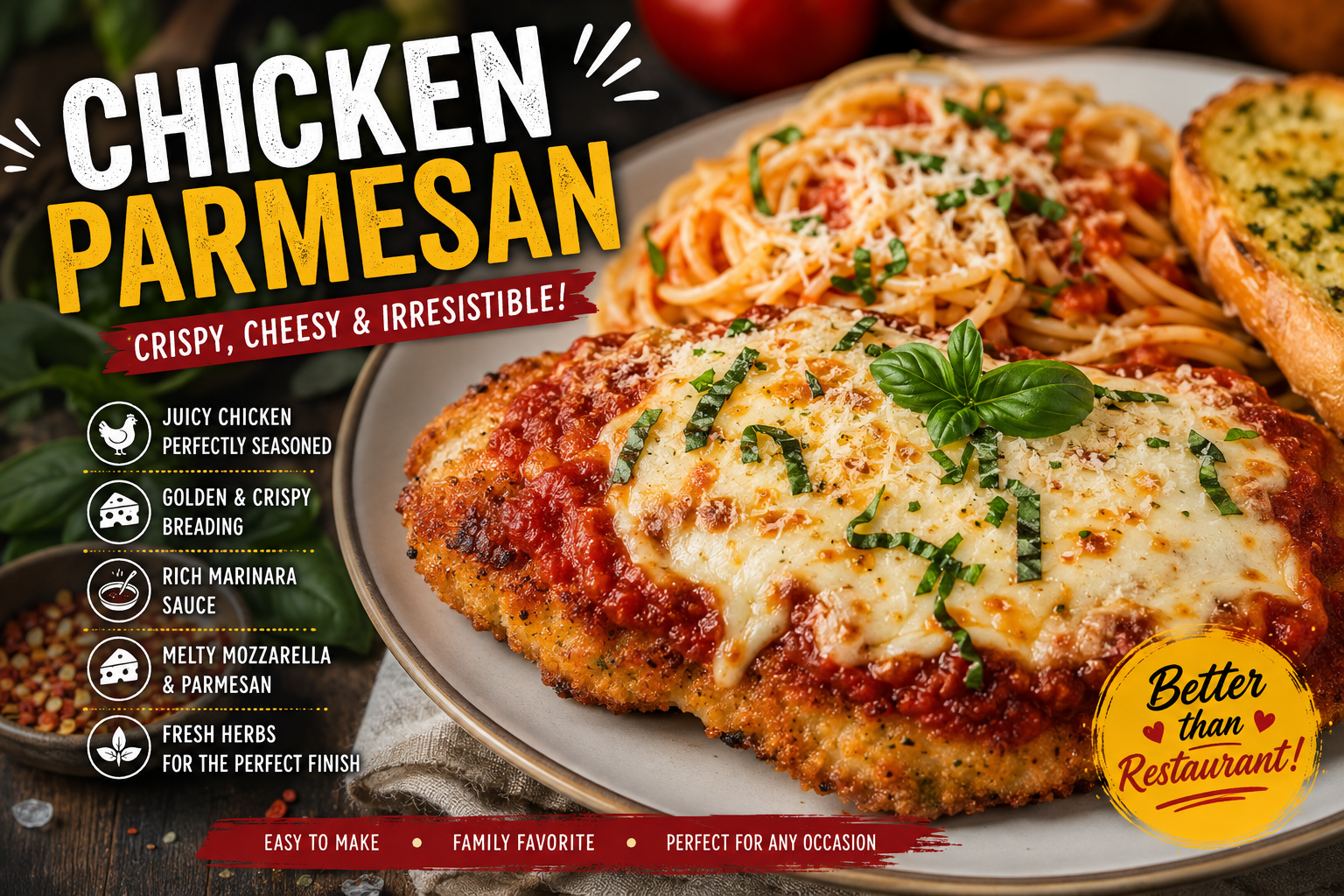
Introduction
If you’re looking for a comforting, crispy, cheesy, and restaurant-style dinner that the whole family will love, this Chicken Parmesan Recipe is exactly what you need. Made with tender chicken breasts, a crispy golden coating, rich tomato marinara sauce, and plenty of melted mozzarella and Parmesan cheese, this classic Italian-American dish is packed with delicious flavor in every bite.
Chicken Parmesan, also known as Chicken Parmigiana, has become one of the most popular chicken dishes around the world. It combines several simple ingredients into one incredibly satisfying meal. The chicken is seasoned and coated in breadcrumbs, fried or baked until golden and crispy, topped with flavorful marinara sauce, covered with cheese, and finished until the cheese becomes beautifully melted and bubbly.
One of the best things about homemade Chicken Parmesan is that it looks impressive but is surprisingly easy to prepare. You don’t need complicated cooking techniques or expensive ingredients. With a few pantry staples, fresh chicken, good-quality cheese, and a flavorful tomato sauce, you can create a dinner that tastes like it came straight from your favorite Italian-American restaurant.
The secret to great Chicken Parmesan is getting the texture right. The chicken should remain tender and juicy inside while developing a crisp golden crust on the outside. The marinara sauce should be flavorful without making the breading soggy, and the cheese should melt beautifully over the top. When these elements come together, every bite has the perfect combination of crispy, juicy, saucy, and cheesy textures.
This recipe is also incredibly versatile. You can fry the chicken for an extra-crispy crust, bake it for a lighter preparation, or use an air fryer for a convenient option. You can also customize the dish with different cheeses, homemade marinara sauce, fresh herbs, or your favorite pasta.
Chicken Parmesan is perfect for many occasions. Serve it for a cozy family dinner, weekend meal, date night, birthday celebration, dinner party, or special occasion. It also makes excellent leftovers and can be prepared ahead of time when you’re planning a busy weeknight meal.
In this complete recipe guide, you’ll learn everything you need to know about making perfect homemade Chicken Parmesan. We’ll cover how to choose the best chicken, prepare the crispy coating, make a flavorful marinara sauce, cook the chicken properly, melt the cheese, assemble the dish, and serve it with delicious side dishes.
You’ll also discover expert cooking tips, common mistakes to avoid, healthier preparation methods, storage and reheating instructions, recipe variations, meal-prep ideas, and frequently asked questions.
Whether you’re a beginner in the kitchen or an experienced home cook, this Chicken Parmesan recipe will help you create a delicious, crispy, cheesy, and satisfying dinner every time.
What Is Chicken Parmesan?
Chicken Parmesan is an Italian-American dish made from breaded chicken that’s cooked until golden and crispy, topped with tomato sauce and cheese, and then baked or broiled until the cheese melts.
The dish is commonly served with pasta, making it a complete and hearty meal.
A traditional homemade version usually includes:
- Boneless chicken breasts
- Breadcrumbs
- Parmesan cheese
- Mozzarella cheese
- Marinara sauce
- Italian herbs
- Garlic
- Eggs
- Flour
- Olive oil
The combination creates a wonderful contrast between the crispy chicken coating and the rich, cheesy tomato topping.
Why You’ll Love This Chicken Parmesan Recipe
There are plenty of reasons to add this recipe to your dinner rotation.
- Crispy golden chicken with a tender center.
- Rich marinara sauce adds delicious tomato flavor.
- Melted mozzarella creates a creamy, cheesy topping.
- Parmesan cheese adds a salty, nutty flavor.
- Simple ingredients are easy to find.
- Family-friendly and satisfying.
- Perfect for weeknight dinners.
- Great for special occasions.
- Can be fried, baked, or air-fried.
- Pairs perfectly with pasta.
- Excellent for leftovers.
- Easy to customize.
Every bite delivers crispy chicken, flavorful tomato sauce, and melted cheese.
Ingredients You’ll Need
For the Chicken
- 4 boneless, skinless chicken breasts
- ½ cup all-purpose flour
- 2 large eggs
- 1 tablespoon milk
- 1½ cups Italian-seasoned breadcrumbs
- ½ cup freshly grated Parmesan cheese
- 1 teaspoon garlic powder
- 1 teaspoon Italian seasoning
- ½ teaspoon paprika
- Salt, to taste
- Black pepper, to taste
For Cooking
- 3–4 tablespoons olive oil
- Additional oil if frying
For the Sauce
- 2 cups marinara sauce
- 2 cloves garlic, minced
- 1 teaspoon Italian seasoning
- ½ teaspoon dried oregano
- Black pepper, to taste
For the Cheese Topping
- 1½ cups shredded mozzarella cheese
- ½ cup freshly grated Parmesan cheese
- Fresh basil or parsley for garnish
Choosing the Best Chicken
Chicken breasts are the most common choice for Chicken Parmesan because they are easy to slice, flatten, bread, and cook.
Choose chicken breasts that are similar in size so they cook evenly.
If the breasts are very thick, slice them horizontally into thinner cutlets.
You can also gently pound them between sheets of parchment or plastic wrap until they’re an even thickness.
An even chicken thickness is important because it prevents the thinner portions from becoming dry while the thicker sections are still cooking.
Avoid pounding the chicken too aggressively. The goal is simply to create an even thickness.
Why Even Chicken Thickness Matters
One of the most common problems with Chicken Parmesan is unevenly cooked chicken.
If one part of the chicken is very thick while another part is thin, the thinner area can become overcooked before the center of the thicker area is fully cooked.
Making the chicken evenly thick helps provide:
- More consistent cooking
- Better texture
- More even browning
- Juicier chicken
- Easier breading
It also makes the finished Chicken Parmesan easier to serve.
Choosing the Best Breadcrumbs
Breadcrumbs create the signature crispy coating.
You can use:
- Italian-seasoned breadcrumbs
- Plain breadcrumbs
- Panko breadcrumbs
- A combination of regular breadcrumbs and panko
Panko creates a particularly crunchy texture, while Italian breadcrumbs provide additional herbs and seasoning.
For an especially flavorful coating, combine breadcrumbs with freshly grated Parmesan cheese.
The Parmesan becomes golden and nutty during cooking, adding another layer of flavor.
Why Freshly Grated Parmesan Is Better
Freshly grated Parmesan melts and blends more naturally with the breadcrumb mixture.
It also provides a stronger savory flavor than many pre-grated alternatives.
Fresh Parmesan can be used in:
- The breadcrumb coating
- The marinara sauce
- The cheese topping
- The final garnish
Using it in multiple layers helps create a deeper overall flavor.
Choosing the Best Mozzarella
Mozzarella is responsible for the classic stretchy, melted cheese topping.
You can use:
- Low-moisture mozzarella
- Fresh mozzarella
- Pre-shredded mozzarella
Low-moisture mozzarella is particularly convenient because it melts beautifully without releasing too much moisture.
Fresh mozzarella gives the dish a softer, creamier finish.
Whichever type you choose, use enough cheese to cover the chicken without completely overwhelming the crispy crust.
Choosing the Best Marinara Sauce
The marinara sauce adds acidity, sweetness, and rich tomato flavor.
You can use:
- Homemade marinara
- Your favorite jarred marinara
- Tomato basil sauce
- Garlic tomato sauce
For the best results, choose a sauce with a balanced flavor rather than one that’s extremely sweet.
A flavorful marinara should complement the crispy chicken and cheese rather than overpower them.
Essential Kitchen Equipment
You don’t need professional equipment to make Chicken Parmesan.
You’ll need:
- Large skillet
- Baking dish
- Cutting board
- Sharp knife
- Meat mallet or rolling pin
- Three shallow bowls
- Tongs
- Measuring cups
- Measuring spoons
- Baking sheet or wire rack
- Oven-safe dish
A wire rack can be especially helpful because it allows air to circulate around the breaded chicken, helping the crust stay crisp.
Preparing Everything Before Cooking
Chicken Parmesan involves several quick steps, so preparing everything beforehand makes the process much easier.
Before starting:
- Slice or flatten the chicken.
- Season the chicken.
- Measure the flour.
- Beat the eggs.
- Prepare the breadcrumb mixture.
- Grate the Parmesan.
- Shred the mozzarella.
- Prepare the marinara sauce.
- Preheat the oven.
- Set out the cooking utensils.
Once everything is organized, the recipe becomes much smoother and less stressful.
The Three-Step Breading System
The classic breading process uses three separate stages.
First: Flour
The chicken is lightly coated in flour.
This removes excess moisture from the surface and helps the egg mixture adhere.
Second: Egg
The floured chicken is dipped into beaten egg.
The egg acts as a binding layer.
Third: Breadcrumbs
Finally, the chicken is pressed into the seasoned breadcrumb and Parmesan mixture.
This creates the crispy outer coating.
Avoid skipping the flour because it can make the egg coating less consistent.
How to Keep the Breading Attached
For a coating that stays firmly attached:
- Pat the chicken dry first.
- Don’t use too much flour.
- Shake off excess flour.
- Coat the chicken completely in egg.
- Press the breadcrumbs gently onto the surface.
- Don’t move the breaded chicken around excessively before cooking.
After breading, allow the chicken to rest for a few minutes before cooking.
This gives the coating time to adhere properly.
The Secret to Crispy Chicken Parmesan
The biggest secret is controlling moisture.
Too much moisture can make the breading soft.
For a crispier result:
- Keep the chicken dry before breading.
- Don’t add too much marinara sauce.
- Cook the breaded chicken until golden before adding sauce.
- Use moderate amounts of cheese.
- Bake until the cheese melts rather than leaving the chicken submerged in sauce.
The sauce should sit primarily on top of the chicken rather than surrounding the entire piece.
What Makes This Recipe Special?
The beauty of Chicken Parmesan comes from its layers.
The first layer is the tender chicken.
The second is the crispy Parmesan breadcrumb crust.
The third is the flavorful marinara sauce.
The fourth is the melted mozzarella.
Finally, fresh herbs and Parmesan add a bright finishing touch.
Together, these layers create a comforting dish with a wonderful combination of textures and flavors.
Once you’ve prepared the ingredients, you’re ready to move on to the cooking process and turn these simple ingredients into a crispy, cheesy, restaurant-style Chicken Parmesan.
How to Make Chicken Parmesan – Step-by-Step Cooking Instructions for Crispy Chicken, Rich Marinara Sauce, and Perfectly Melted Cheese
Now that all the ingredients are prepared, it’s time to cook the Chicken Parmesan. The process is straightforward, but following the correct order is important. The chicken needs to become golden and crispy without drying out, while the marinara sauce should remain rich and flavorful and the cheese should melt beautifully without making the breading soggy.
The best approach is to prepare the chicken first, create a crisp golden crust, warm the sauce, and then finish everything in the oven. This gives you the classic combination of crispy chicken, savory tomato sauce, and melted cheese.
Step 1: Prepare the Chicken
Place the chicken breasts on a clean cutting board.
If they’re thick, carefully slice them horizontally to create thinner cutlets.
Alternatively, place each chicken breast between two sheets of parchment paper and gently pound it until it reaches an even thickness of approximately ½ inch.
Avoid pounding too aggressively. You only need to make the chicken uniform so it cooks evenly.
Pat both sides dry with paper towels.
Season with:
- Salt
- Black pepper
- Garlic powder
- Italian seasoning
- Paprika
Rub the seasoning gently over both sides.
Allow the chicken to rest for approximately 10 minutes while you prepare the breading station.
Step 2: Prepare the Breading Station
Set up three shallow bowls.
Bowl 1 – Flour
Add:
- ½ cup all-purpose flour
- A small pinch of salt
- A little black pepper
Mix together.
Bowl 2 – Egg Mixture
Whisk together:
- 2 large eggs
- 1 tablespoon milk
Whisk until smooth.
The milk helps loosen the egg mixture and makes dipping easier.
Bowl 3 – Breadcrumb Mixture
Combine:
- 1½ cups Italian-seasoned breadcrumbs
- ½ cup freshly grated Parmesan
- 1 teaspoon garlic powder
- 1 teaspoon Italian seasoning
Mix thoroughly.
Make sure the Parmesan is evenly distributed throughout the breadcrumbs.
Step 3: Coat the Chicken in Flour
Take one seasoned chicken cutlet.
Place it into the flour mixture.
Turn it over and coat both sides lightly.
Shake off any excess flour.
The chicken should have a thin, even layer rather than a thick coating.
This flour layer helps the egg adhere properly.
Repeat with the remaining chicken.
Step 4: Dip the Chicken into the Egg
Take the floured chicken and place it into the egg mixture.
Turn it over so both sides are completely covered.
Allow excess egg to drip back into the bowl.
Don’t leave the chicken sitting in the egg for too long.
A complete but relatively thin coating is ideal.
Step 5: Coat with Breadcrumbs
Immediately transfer the egg-coated chicken into the breadcrumb mixture.
Press the breadcrumbs gently onto both sides.
Make sure the edges are coated as well.
The chicken should now have a complete golden breadcrumb coating.
Don’t press so hard that the coating becomes dense.
A light, even coating produces a better crust.
Place the breaded chicken on a clean plate or wire rack.
Repeat with all the chicken cutlets.
Step 6: Let the Breading Set
Allow the breaded chicken to rest for approximately 5–10 minutes before cooking.
This small step helps the coating adhere to the chicken.
While the breading rests, you can prepare the marinara sauce and preheat the oven.
Step 7: Prepare the Marinara Sauce
Place a medium saucepan over medium heat.
Add:
- 2 cups marinara sauce
- 2 cloves minced garlic
- 1 teaspoon Italian seasoning
- ½ teaspoon dried oregano
- A small amount of black pepper
Stir everything together.
Allow the sauce to simmer gently for approximately 5–7 minutes.
Stir occasionally.
The sauce should become hot and aromatic.
Don’t boil it aggressively.
A gentle simmer helps preserve the fresh tomato flavor while allowing the garlic and herbs to blend into the sauce.
Step 8: Heat the Skillet
Place a large skillet over medium to medium-high heat.
Add approximately:
- 3–4 tablespoons olive oil
Allow the oil to become hot before adding the chicken.
You can test the temperature by adding a tiny breadcrumb to the oil.
If it immediately begins to sizzle, the pan is ready.
Avoid letting the oil smoke heavily.
Step 9: Cook the Breaded Chicken
Carefully place the breaded chicken cutlets into the hot skillet.
Don’t overcrowd the pan.
If necessary, cook the chicken in batches.
Cook the first side for approximately 3–4 minutes, or until the bottom becomes golden brown and crisp.
Carefully turn the chicken over.
Cook the second side for another 3–4 minutes.
The coating should become:
- Golden brown
- Crisp
- Evenly cooked
- Firm enough to hold the sauce
The chicken doesn’t need to become deeply dark brown.
The goal is a beautiful golden crust.
Step 10: Avoid Pressing the Chicken
While the chicken is cooking, avoid pressing it down with a spatula.
Pressing the chicken can force juices out of the meat and disturb the crispy coating.
Instead, let it cook undisturbed until the crust develops.
Use tongs or a spatula to turn it carefully.
Step 11: Check the Chicken
Because chicken is a poultry product, it should be cooked to a safe internal temperature.
Use an instant-read thermometer to check the thickest part.
The chicken should reach 165°F (74°C).
If the coating is already deeply golden but the chicken needs more cooking, transfer it to the oven to finish rather than continuing to fry it for a long time.
This helps prevent the crust from becoming overly dark.
Step 12: Transfer the Chicken to a Wire Rack
Once golden and cooked, transfer the chicken to a wire rack.
A wire rack is preferable to placing the chicken directly on paper towels because air can circulate underneath.
This helps keep the bottom of the breading crisp.
Let the chicken rest briefly while you prepare the baking dish.
Step 13: Prepare the Baking Dish
Preheat the oven to approximately 400°F (200°C).
Spread a thin layer of marinara sauce across the bottom of a baking dish.
Don’t use too much.
The sauce should provide flavor without creating a deep layer of moisture around the chicken.
Step 14: Arrange the Chicken
Place the golden chicken cutlets into the baking dish.
Leave a little space between each piece if possible.
This prevents the chicken from becoming completely surrounded by sauce.
Step 15: Add the Marinara Sauce
Spoon a moderate amount of warm marinara sauce over each chicken cutlet.
Focus the sauce primarily on the center of each piece.
Avoid completely covering the crispy edges.
Keeping some of the crust exposed helps preserve its texture.
Step 16: Add Mozzarella Cheese
Sprinkle shredded mozzarella over each piece.
Aim for an even layer.
Don’t pile the cheese excessively high.
A moderate amount melts more evenly and allows the marinara flavor and crispy chicken to remain noticeable.
Step 17: Add Parmesan Cheese
Sprinkle freshly grated Parmesan over the mozzarella.
The Parmesan adds:
- Nutty flavor
- Saltiness
- Richness
- Beautiful browning
You can also add a small pinch of Italian seasoning.
Step 18: Bake the Chicken Parmesan
Place the baking dish into the preheated oven.
Bake for approximately 10–15 minutes.
The exact time depends on the thickness of the chicken and how hot the chicken was before entering the oven.
The goal is for the cheese to become:
- Completely melted
- Bubbling around the edges
- Lightly golden in spots
Avoid baking for much longer than necessary.
Overbaking can dry out the chicken and soften the crispy coating.
Step 19: Broil for a Golden Cheese Topping
For an especially beautiful finish, switch the oven to broil for approximately 1–2 minutes.
Watch the dish carefully.
The cheese can brown very quickly under a broiler.
Remove it once the mozzarella develops a lightly golden surface.
Don’t walk away during this step.
Step 20: Rest Before Serving
Remove the Chicken Parmesan from the oven.
Allow it to rest for approximately 3–5 minutes.
This gives the cheese time to settle and allows the juices inside the chicken to redistribute.
It also makes the dish easier to serve without the cheese sliding immediately off the chicken.
Step 21: Garnish the Chicken Parmesan
Finish with:
- Fresh basil
- Chopped parsley
- Freshly grated Parmesan
- Cracked black pepper
- A small drizzle of olive oil, optional
Fresh basil adds a bright contrast to the rich cheese and tomato sauce.
How to Serve Chicken Parmesan
Chicken Parmesan is traditionally served with pasta.
Excellent choices include:
- Spaghetti
- Linguine
- Fettuccine
- Penne
- Angel hair pasta
Place the pasta on a plate and add a little marinara sauce.
Place one Chicken Parmesan cutlet on top or beside the pasta.
Finish with extra Parmesan and fresh basil.
How to Keep Chicken Parmesan Crispy
The crispy coating is one of the best parts of the dish.
To protect it:
- Don’t drown the chicken in sauce.
- Use a moderate amount of mozzarella.
- Cook the breaded chicken until properly golden.
- Place it on a wire rack after frying.
- Don’t leave it sitting in sauce for a long time.
- Serve soon after baking.
These small details make a major difference.
How to Make Baked Chicken Parmesan
If you prefer not to fry the chicken, you can bake it.
Place the breaded chicken on a lightly greased baking sheet or wire rack.
Lightly spray or brush the coating with olive oil.
Bake at approximately 425°F (220°C) until golden and the chicken reaches 165°F (74°C) internally.
Then add marinara and cheese and return it to the oven until the cheese melts.
This method reduces the amount of oil while still producing a delicious Chicken Parmesan.
How to Make Air Fryer Chicken Parmesan
An air fryer can also produce a crispy coating.
Arrange the breaded chicken in a single layer.
Avoid overlapping the pieces.
Lightly spray the coating with oil.
Air-fry according to your appliance’s instructions until golden and the chicken reaches 165°F (74°C) internally.
Add marinara and cheese near the end and continue cooking until the cheese melts.
Common Problems During Cooking
Chicken Is Brown Outside but Undercooked Inside
The chicken may be too thick or the pan may be too hot.
Use thinner cutlets and finish them gently in the oven if necessary.
Breading Falls Off
The chicken may have been too wet or the breading wasn’t pressed onto the surface.
Pat the chicken dry and allow the breaded chicken to rest before cooking.
Chicken Is Dry
The chicken may have been overcooked.
Use thinner cutlets and monitor the internal temperature.
Breading Is Soggy
Too much sauce or moisture is usually the cause.
Use a moderate amount of marinara and serve soon after finishing.
Cheese Burns
The oven may be too hot or the chicken was left under the broiler too long.
Watch the cheese carefully during the final stage.
Expert Cooking Tips
For the best Chicken Parmesan every time:
- Keep chicken cutlets evenly thick.
- Pat chicken dry before breading.
- Use freshly grated Parmesan.
- Don’t skip the flour stage.
- Let breading rest before cooking.
- Don’t overcrowd the skillet.
- Don’t press the chicken while frying.
- Use moderate marinara sauce.
- Don’t overload the chicken with cheese.
- Bake only until the cheese melts.
- Check chicken with a thermometer.
- Garnish immediately before serving.
Following these steps will give you tender chicken, a crispy golden crust, rich marinara sauce, and beautifully melted cheese—the essential qualities of an excellent homemade Chicken Parmesan.
Best Side Dishes, Serving Ideas, Storage, Meal Prep, and Creative Ways to Enjoy Chicken Parmesan
A freshly prepared Chicken Parmesan is delicious on its own, but choosing the right side dishes can turn it into a complete restaurant-style meal. The crispy chicken, rich marinara sauce, and melted cheese pair beautifully with pasta, vegetables, salads, bread, and other comforting sides.
This section covers the best ways to serve Chicken Parmesan, how to plate it beautifully, what to serve alongside it, and how to store and reheat leftovers without losing too much of the delicious texture.
Best Pasta to Serve with Chicken Parmesan
Pasta is the classic companion for Chicken Parmesan.
Some excellent choices include:
- Spaghetti
- Linguine
- Fettuccine
- Penne
- Rigatoni
- Angel hair pasta
- Rotini
Spaghetti is especially popular because its long strands combine beautifully with marinara sauce.
For the best result, toss freshly cooked pasta with a small amount of marinara sauce before placing the Chicken Parmesan on top.
Classic Spaghetti and Chicken Parmesan
For a traditional restaurant-style presentation:
- Cook spaghetti until tender but still slightly firm.
- Drain thoroughly.
- Toss with warm marinara sauce.
- Place the pasta on a serving plate.
- Add one crispy Chicken Parmesan cutlet.
- Spoon a little extra sauce around the chicken.
- Finish with Parmesan and fresh basil.
The combination of crispy chicken, tomato sauce, melted cheese, and pasta creates an incredibly satisfying meal.
Garlic Bread
Garlic bread is another excellent choice.
The crispy bread is perfect for scooping up extra marinara sauce.
You can prepare simple garlic bread using:
- French bread
- Butter
- Fresh garlic
- Parsley
- Parmesan cheese
Toast until golden and serve warm.
Fresh Garden Salad
Because Chicken Parmesan is rich and cheesy, a fresh salad can provide a refreshing contrast.
Combine:
- Romaine lettuce
- Cherry tomatoes
- Cucumber
- Red onion
- Carrots
- Parmesan
- Olive oil
- Lemon juice
A simple lemon-based dressing works particularly well because its acidity balances the richness of the cheese.
Caesar Salad
A classic Caesar salad is another excellent pairing.
Serve it with:
- Crisp romaine lettuce
- Parmesan cheese
- Croutons
- Caesar dressing
The crunchy lettuce and croutons create a pleasant contrast with the soft chicken and melted cheese.
Roasted Vegetables
For a more vegetable-focused meal, serve Chicken Parmesan with roasted vegetables.
Great options include:
- Broccoli
- Zucchini
- Bell peppers
- Asparagus
- Carrots
- Cauliflower
- Brussels sprouts
Lightly season the vegetables with olive oil, black pepper, garlic, and herbs before roasting.
Mashed Potatoes
Although pasta is the most traditional side, mashed potatoes can also work beautifully.
Creamy potatoes pair wonderfully with the tomato sauce and melted cheese.
For extra flavor, add:
- Butter
- Milk
- Roasted garlic
- Black pepper
- Fresh herbs
Best Drinks to Serve
Refreshing beverages can balance the rich flavors of Chicken Parmesan.
Good options include:
- Sparkling water
- Lemonade
- Iced tea
- Lemon-infused water
- Apple juice
- Orange juice
A refreshing drink helps cleanse the palate between bites.
How to Plate Chicken Parmesan Like a Restaurant
Presentation can make a homemade dinner feel much more special.
Start with a layer of pasta or vegetables.
Place the Chicken Parmesan slightly on top or beside the side dish.
Spoon a small amount of marinara sauce around the plate.
Finish with:
- Fresh basil
- Grated Parmesan
- Cracked black pepper
- A few drops of olive oil
Avoid covering the entire plate with sauce.
Keeping some of the crispy chicken visible makes the dish look much more appetizing.
Best Garnishes
Simple garnishes can make a major difference.
Try:
- Fresh basil leaves
- Chopped parsley
- Fresh Parmesan
- Cracked black pepper
- Red pepper flakes
- A small drizzle of olive oil
Use garnishes sparingly so they complement rather than overpower the main dish.
How to Serve Chicken Parmesan for a Family Dinner
For a family-style meal, place the finished Chicken Parmesan in a large serving dish.
Serve pasta separately.
Put additional toppings on the table, such as:
- Parmesan cheese
- Fresh basil
- Red pepper flakes
- Extra marinara sauce
Everyone can customize their own plate.
Chicken Parmesan for a Dinner Party
Chicken Parmesan can also be prepared for guests.
For a dinner party, serve it with:
Main
Chicken Parmesan
Side
Garlic butter pasta
Vegetable
Roasted broccoli or asparagus
Fresh Side
Garden salad
Bread
Garlic bread
This creates a complete Italian-inspired dinner without requiring too many separate dishes.
How to Store Leftover Chicken Parmesan
If you have leftovers, allow them to cool appropriately before refrigerating.
Place the chicken in an airtight container.
For best quality, refrigerate leftovers and use them within approximately 3–4 days.
If possible, store pasta separately from the chicken.
This helps prevent the crispy coating from becoming excessively soft.
Can Chicken Parmesan Be Frozen?
Yes.
Chicken Parmesan can be frozen, although the breading may lose some crispness after thawing.
For better results:
- Allow the cooked chicken to cool.
- Place individual portions in freezer-safe containers.
- Separate pieces with parchment if necessary.
- Seal tightly.
- Label the container with the date.
For best texture, use frozen portions within about 2–3 months.
How to Reheat Chicken Parmesan
The oven is generally the best option when you want to preserve the crispy coating.
Oven Method
Preheat the oven to approximately 375°F (190°C).
Place the Chicken Parmesan on a baking sheet or oven-safe dish.
Heat until warmed through.
If the cheese begins browning too quickly, cover loosely with foil.
Avoid adding a large amount of extra sauce before reheating because excess moisture can soften the crust.
Air Fryer Reheating
An air fryer can help restore some crispness.
Place the Chicken Parmesan in the basket without overlapping.
Heat according to your appliance’s instructions until hot throughout.
Check the center before serving.
The air circulation helps improve the texture of the breading compared with reheating in a microwave.
Microwave Reheating
The microwave is the quickest method, but it can soften the crispy coating.
Place one portion on a microwave-safe plate.
Heat in short intervals until thoroughly warmed.
If possible, re-crisp the chicken afterward in a skillet, oven, or air fryer.
Meal Prep Chicken Parmesan
Chicken Parmesan can be prepared ahead of time.
You can prepare:
- Breaded chicken
- Marinara sauce
- Shredded cheese
- Pasta
- Salad ingredients
Store the components appropriately and assemble the meal closer to serving time.
For the best texture, cook or reheat the chicken shortly before eating.
Make-Ahead Chicken Parmesan
If you’re preparing the dish for a busy evening, bread the chicken earlier in the day and refrigerate it appropriately.
Prepare the marinara sauce separately.
When you’re ready to cook:
- Cook the breaded chicken.
- Add marinara.
- Add cheese.
- Bake until the cheese melts.
- Garnish.
- Serve immediately.
This can make dinner preparation much faster.
How to Keep Leftovers Crispy
The biggest challenge with leftover Chicken Parmesan is maintaining the crispy coating.
To improve the texture:
- Store sauce separately when practical.
- Refrigerate promptly.
- Reheat in the oven or air fryer.
- Avoid excessive sauce.
- Don’t microwave for too long.
Freshly cooked Chicken Parmesan will always have the crispiest crust, but these techniques can help leftovers remain enjoyable.
Creative Chicken Parmesan Variations
Once you’ve mastered the classic recipe, you can experiment with different versions.
Spicy Chicken Parmesan
Add:
- Red pepper flakes
- Chili powder
- Spicy marinara
- Pepper Jack cheese
This creates a hotter, more flavorful version.
Chicken Parmesan Sandwich
Place a crispy Chicken Parmesan cutlet inside a toasted Italian roll.
Add:
- Marinara sauce
- Mozzarella
- Parmesan
- Fresh basil
Toast until the cheese melts.
This transforms the classic dinner into an incredible sandwich.
Chicken Parmesan Pasta Bake
Cut the cooked chicken into smaller pieces.
Combine with:
- Pasta
- Marinara sauce
- Mozzarella
- Parmesan
Bake until bubbling.
This is an excellent option for feeding a larger family.
Mini Chicken Parmesan Sliders
Cut the chicken into smaller portions and place them inside soft dinner rolls.
Top with:
- Marinara
- Mozzarella
- Parmesan
- Basil
Bake until the cheese melts.
These are ideal for parties and casual gatherings.
Baked Chicken Parmesan
For a lighter preparation, skip pan-frying.
Bake the breaded chicken until golden and fully cooked, then add marinara and cheese.
This reduces the amount of oil while maintaining the classic flavors.
Air Fryer Chicken Parmesan
Air frying creates a crisp coating with less oil than traditional frying.
The important points are:
- Don’t overcrowd the basket.
- Lightly coat the breading with oil.
- Turn if needed.
- Add sauce and cheese near the end.
- Cook chicken to 165°F (74°C) internally.
Best Occasions to Serve Chicken Parmesan
Chicken Parmesan is suitable for almost any occasion.
Serve it for:
- Family dinners
- Weekend lunches
- Date nights
- Birthday dinners
- Holiday meals
- Dinner parties
- Special celebrations
- Comfort-food nights
Its combination of crispy chicken, tomato sauce, and melted cheese makes it a reliable crowd-pleaser.
Expert Serving Tips
For the best final result:
- Serve the chicken soon after the cheese melts.
- Keep pasta lightly coated with sauce.
- Add fresh basil immediately before serving.
- Don’t drown the chicken in marinara.
- Use freshly grated Parmesan.
- Serve warm garlic bread alongside.
- Keep extra sauce available at the table.
These details help preserve the crispy crust while making the entire meal feel fresh and restaurant-quality.
Chicken Parmesan Variations, Healthy Options, Expert Tips, Common Mistakes, and Flavor Upgrades
Once you’ve mastered the classic Chicken Parmesan, you can easily customize it to create different versions for different tastes and occasions. The basic combination of crispy chicken, marinara sauce, Parmesan, and mozzarella is incredibly versatile, which means you can make the dish spicier, lighter, cheesier, crunchier, or even transform it into a sandwich or pasta bake.
This section explores some of the best ways to customize Chicken Parmesan while keeping the essential flavors that make the original recipe so delicious.
Classic Chicken Parmesan
The classic version keeps everything simple:
- Breaded chicken breast
- Marinara sauce
- Mozzarella cheese
- Parmesan cheese
- Italian herbs
- Fresh basil
This is the best version to start with if you’re making Chicken Parmesan for the first time.
The crispy chicken provides texture, while the marinara and melted cheese create the rich, comforting flavor that makes the dish so popular.
Extra-Crispy Chicken Parmesan
If you love crunchy chicken, you can make the coating even crispier.
Try using:
- Panko breadcrumbs
- Fresh Parmesan
- A small amount of garlic powder
- Italian seasoning
- Paprika
Panko creates larger, lighter crumbs that become especially crunchy during cooking.
For maximum crispness, avoid covering the entire chicken with a thick layer of sauce.
Extra-Cheesy Chicken Parmesan
For serious cheese lovers, increase the cheese layers.
Use a combination of:
- Mozzarella
- Parmesan
- Provolone
- Fontina
Mozzarella provides the classic stretchy texture, while Parmesan and Provolone add stronger flavor.
Don’t add excessive cheese, though, because too much can overwhelm the crispy chicken.
Spicy Chicken Parmesan
If you enjoy heat, turn the classic recipe into a spicy version.
Add:
- Crushed red pepper flakes
- Spicy marinara
- Fresh chili
- Cayenne pepper
- Pepper Jack cheese
You can also add a little chili-infused olive oil before serving.
Start with a small amount of spicy ingredients and adjust according to your preference.
Garlic Herb Chicken Parmesan
For extra aromatic flavor, add more herbs to the breadcrumb mixture.
Try:
- Garlic powder
- Dried oregano
- Basil
- Thyme
- Parsley
- Italian seasoning
Fresh herbs can also be sprinkled over the finished dish.
The combination of garlic and herbs works beautifully with tomato sauce and Parmesan.
Mushroom Chicken Parmesan
Mushrooms are an excellent addition.
Sauté sliced mushrooms separately until golden brown.
Then place them over the marinara before adding mozzarella.
The mushrooms contribute an earthy, savory flavor and create another layer of texture.
Spinach Chicken Parmesan
For a vegetable-rich version, add sautéed spinach.
Cook fresh spinach with:
- Garlic
- Olive oil
- Black pepper
Place the spinach between the chicken and cheese before baking.
This adds freshness and color without changing the basic preparation method.
Healthy Chicken Parmesan
If you’re looking for a lighter version, there are several simple adjustments you can make.
Bake Instead of Fry
Baking reduces the amount of oil used during cooking.
Use Less Cheese
You can reduce the cheese slightly while still keeping the dish flavorful.
Add Vegetables
Serve the chicken with:
- Broccoli
- Green beans
- Zucchini
- Asparagus
- Salad
Choose Lean Chicken
Chicken breast provides a lean protein option.
These changes can make the overall meal lighter while preserving the familiar flavors.
Whole-Wheat Chicken Parmesan
For an extra-fiber option, use whole-wheat breadcrumbs.
Serve the chicken with:
- Whole-wheat pasta
- Roasted vegetables
- Fresh salad
The nutty flavor of whole-wheat breadcrumbs pairs surprisingly well with Parmesan.
Low-Carb Chicken Parmesan
You can reduce the carbohydrate content by replacing traditional breadcrumbs with alternatives such as:
- Crushed pork rinds
- Almond flour
- Finely ground nuts
Serve with:
- Zucchini noodles
- Roasted vegetables
- Green salad
The marinara and cheese still provide the classic Chicken Parmesan flavor.
Chicken Parmesan Without Frying
If you don’t want to fry the chicken, oven-baking is an excellent alternative.
Place the breaded chicken on a lightly greased wire rack over a baking sheet.
Lightly spray the coating with oil.
Bake until golden and the chicken reaches 165°F (74°C) internally.
Then add marinara and cheese and return it to the oven until the cheese melts.
How to Make Chicken Parmesan in an Air Fryer
Air frying is another convenient method.
Arrange the breaded chicken in a single layer.
Avoid overlapping pieces.
Lightly spray the coating with oil.
Cook according to your air fryer’s instructions until the chicken reaches 165°F (74°C).
Add marinara and mozzarella near the end and continue cooking until the cheese is melted.
Common Chicken Parmesan Mistakes
Even a simple recipe can go wrong if a few important details are overlooked.
Mistake 1: Using Very Thick Chicken
Thick chicken breasts can cook unevenly.
Solution: Slice or pound them to an even thickness.
Mistake 2: Skipping the Flour
The flour helps the egg adhere to the chicken.
Solution: Follow the flour → egg → breadcrumb sequence.
Mistake 3: Wet Chicken Before Breading
Excess moisture can make the coating fall off.
Solution: Pat the chicken dry before starting.
Mistake 4: Overcrowding the Pan
Too many pieces can lower the cooking temperature.
Solution: Cook in batches.
Mistake 5: Adding Too Much Sauce
Excess marinara can soften the crispy crust.
Solution: Spoon a moderate layer over each chicken cutlet.
Mistake 6: Overbaking
Leaving the chicken in the oven too long can make it dry.
Solution: Bake only until the cheese melts and the chicken is heated through.
Mistake 7: Burning the Cheese
Cheese can brown very quickly under the broiler.
Solution: Watch it closely during the final minute or two.
How to Make the Marinara More Flavorful
If you’re using a basic tomato sauce, you can easily improve it.
Add:
- Fresh garlic
- Dried oregano
- Basil
- Black pepper
- A small amount of olive oil
Simmer gently for several minutes to allow the flavors to combine.
Taste before using it on the chicken.
How to Balance the Marinara
A good marinara should have a balanced combination of:
- Tomato acidity
- Natural sweetness
- Garlic
- Herbs
- Salt
If it tastes too acidic, a small amount of sweetness can balance it.
If it tastes flat, adjust the seasoning and add fresh herbs or garlic.
How to Make the Breadcrumbs More Flavorful
The breadcrumb mixture is an opportunity to build extra flavor.
Combine breadcrumbs with:
- Parmesan
- Garlic powder
- Italian seasoning
- Oregano
- Paprika
- Black pepper
Mix thoroughly so the seasoning is distributed evenly.
How to Get a Beautiful Golden Crust
The crust should be evenly golden rather than dark brown.
For better browning:
- Use enough oil.
- Don’t overcrowd the skillet.
- Let the chicken cook undisturbed.
- Turn it carefully.
- Don’t constantly flip it.
Allowing the breading to develop properly creates a much better texture.
How to Keep Chicken Parmesan Juicy
The chicken should be tender and juicy inside.
The most important factors are:
- Even thickness
- Proper cooking temperature
- Avoiding overcooking
- Short resting time
- Using a thermometer when possible
The chicken should reach 165°F (74°C) internally.
Professional Chef Tips
For restaurant-quality results:
- Use freshly grated Parmesan.
- Use good-quality marinara sauce.
- Flatten chicken evenly.
- Season every layer.
- Let breading rest before cooking.
- Fry until golden rather than dark.
- Use moderate sauce.
- Don’t overload with cheese.
- Finish under the broiler briefly.
- Garnish with fresh basil.
- Serve immediately.
These small details make a noticeable difference in the final dish.
Final Flavor Upgrade
For an especially impressive Chicken Parmesan, combine:
Crispy Parmesan breadcrumb coating + rich garlic marinara + melted mozzarella + fresh Parmesan + fresh basil + cracked black pepper.
This combination delivers the perfect balance of crispy, creamy, savory, tangy, and herby flavors.
Once you’ve mastered these variations and techniques, you can confidently create Chicken Parmesan for everything from a quick family dinner to a special restaurant-style meal.
Chicken Parmesan Nutrition, Health Benefits, Meal Prep, Storage, Reheating, and Frequently Asked Questions
Chicken Parmesan is a comforting and satisfying meal that combines protein-rich chicken, tomato-based marinara sauce, cheese, and a crispy breadcrumb coating. Because the recipe can be prepared in several different ways, its nutritional profile can vary depending on the amount of oil, cheese, breadcrumbs, and pasta served alongside it.
Making Chicken Parmesan at home gives you control over these ingredients. You can choose lean chicken, adjust the amount of cheese, bake instead of fry, add vegetables, and select the sides that best suit your meal.
Approximate Nutrition Information
The exact nutritional value depends on the ingredients and portion size, but one homemade Chicken Parmesan serving may provide approximately:
- Calories: 500–700 kcal
- Protein: 40–50 g
- Carbohydrates: 25–40 g
- Fat: 20–35 g
- Fiber: 3–5 g
- Calcium: Moderate to high
- Iron: Moderate
- Vitamin B12: Moderate
Adding pasta, garlic bread, or other sides will increase the total calories and carbohydrates of the meal.
These numbers are estimates rather than laboratory-tested values, so exact nutrition will depend on the products and quantities you use.
Protein from Chicken
Chicken is the primary source of protein in this recipe.
Protein contributes to:
- Normal muscle maintenance
- Tissue repair
- Healthy bones
- Overall satiety
Using chicken breast creates a leaner option, while chicken thighs provide a richer flavor and softer texture.
Nutrients from Tomatoes
Marinara sauce adds more than just flavor.
Tomatoes naturally provide nutrients such as:
- Vitamin C
- Potassium
- Folate
- Lycopene
Lycopene is a naturally occurring plant compound that gives tomatoes their red color.
Using a tomato-based sauce also adds acidity that helps balance the richness of cheese and breading.
Calcium from Cheese
Mozzarella and Parmesan contribute calcium and protein.
Parmesan also adds a concentrated savory flavor, meaning you don’t necessarily need a huge amount to make the dish taste rich.
Using freshly grated Parmesan can provide strong flavor throughout the recipe.
How to Make Chicken Parmesan Lighter
If you want a lighter preparation, consider these simple changes.
Bake Instead of Fry
Baking reduces the amount of oil needed to cook the breaded chicken.
Use Less Cheese
A moderate layer of mozzarella and Parmesan can still provide plenty of flavor.
Add More Vegetables
Serve the chicken with:
- Broccoli
- Green beans
- Asparagus
- Zucchini
- Salad
- Roasted vegetables
Choose Lean Chicken
Chicken breast is a convenient lean option.
These changes allow you to maintain the classic flavor while changing the overall nutritional profile of the meal.
How to Make a Balanced Chicken Parmesan Meal
Instead of serving a large portion of pasta and bread together, create a balanced plate.
A simple combination is:
Chicken Parmesan + moderate pasta portion + large serving of vegetables + fresh salad.
This provides a variety of textures and flavors while making the meal more complete.
Chicken Parmesan Meal Prep
Chicken Parmesan works well for meal preparation.
You can prepare several components ahead of time:
- Chicken cutlets
- Marinara sauce
- Breadcrumb mixture
- Shredded mozzarella
- Parmesan cheese
- Pasta
- Vegetables
For the best texture, keep the crispy chicken separate from excess sauce whenever possible.
How to Prepare Chicken Parmesan Ahead of Time
If you’re planning dinner in advance, prepare the breaded chicken earlier in the day.
You can also prepare the marinara sauce separately.
When you’re ready to eat:
- Cook the chicken.
- Add marinara.
- Add cheese.
- Bake until the cheese melts.
- Garnish.
- Serve immediately.
This approach helps preserve the crisp texture better than assembling everything many hours ahead.
How to Store Leftovers
Allow leftover Chicken Parmesan to cool appropriately before refrigeration.
Place the chicken in an airtight container.
Refrigerated leftovers are generally best consumed within 3–4 days.
If storing pasta separately, keep it in its own container.
This prevents excess sauce from making the pasta and chicken unnecessarily soft.
Can Chicken Parmesan Be Frozen?
Yes.
Chicken Parmesan can be frozen in individual portions.
For best results:
- Allow the cooked chicken to cool.
- Place portions in freezer-safe containers.
- Separate pieces if necessary.
- Seal tightly.
- Label with the date.
For best quality, use frozen portions within approximately 2–3 months.
The breading may not be quite as crisp after freezing and thawing, but reheating in an oven or air fryer can improve the texture.
Best Way to Reheat Chicken Parmesan
The oven is usually the best option for maintaining the texture.
Preheat the oven to approximately 375°F (190°C).
Place the chicken on an oven-safe baking sheet or dish.
Heat until the center is thoroughly hot.
If the cheese begins browning too quickly, cover loosely with foil.
Avoid adding large amounts of additional sauce before reheating because moisture can soften the breading.
Air Fryer Reheating
An air fryer is another excellent option.
Place the Chicken Parmesan in a single layer.
Heat according to your appliance’s instructions until warmed through.
The circulating hot air helps restore some of the crispness lost during refrigeration.
Check that the center is thoroughly heated before serving.
Microwave Reheating
The microwave is convenient when you’re short on time.
Place one serving on a microwave-safe plate.
Heat in short intervals until hot throughout.
The coating will usually become softer than when reheated in an oven or air fryer.
For better texture, you can finish the chicken briefly in an oven or air fryer after microwaving.
How to Prevent Leftovers from Becoming Soggy
The main enemy of crispy Chicken Parmesan is excess moisture.
To protect the crust:
- Store sauce separately when practical.
- Don’t drown the chicken in marinara.
- Use an airtight container.
- Reheat using dry heat when possible.
- Avoid excessive microwaving.
These simple habits can significantly improve leftover texture.
Frequently Asked Questions
Can I use chicken thighs instead of chicken breasts?
Yes.
Chicken thighs work very well and tend to remain juicy because they contain more fat.
Make sure they are evenly flattened so they cook consistently.
Can I make Chicken Parmesan without frying?
Absolutely.
Bake the breaded chicken until golden and cooked through, then add marinara and cheese and return it to the oven until the cheese melts.
Air frying is another excellent alternative.
Can I use panko breadcrumbs?
Yes.
Panko creates a particularly crunchy coating.
You can combine panko with Italian breadcrumbs for a balance of crunch and seasoning.
Can I use fresh mozzarella?
Yes.
Fresh mozzarella creates a softer and creamier topping.
However, because it contains more moisture, use a moderate amount and allow excess moisture to drain before using.
Can I make Chicken Parmesan without Parmesan cheese?
Yes.
The dish can still be made with mozzarella or another cheese, although Parmesan contributes an important nutty and savory flavor.
Can I use store-bought marinara sauce?
Absolutely.
A good-quality jarred marinara can save time.
Choose one with a balanced tomato, garlic, and herb flavor rather than one that’s excessively sweet.
Why does my breading fall off?
Possible reasons include:
- Chicken was too wet.
- Flour layer was too thick.
- Egg coating was uneven.
- Breadcrumbs weren’t pressed onto the chicken.
- Chicken was moved too much while cooking.
Pat the chicken dry and allow the breaded cutlets to rest briefly before cooking.
Why is my Chicken Parmesan soggy?
Usually, there’s too much moisture.
Common causes include:
- Too much marinara sauce
- Very wet mozzarella
- Undercooked breading
- Overbaking in sauce
- Poor drainage after frying
Use a moderate amount of sauce and keep the crispy edges exposed.
Why is my chicken dry?
Chicken becomes dry when it is cooked for too long.
To prevent this:
- Keep the cutlets evenly thick.
- Avoid excessive frying.
- Monitor the internal temperature.
- Don’t leave the chicken in the oven longer than necessary.
The chicken should reach 165°F (74°C) internally.
Can I prepare Chicken Parmesan for a large group?
Yes.
For a crowd, cook the breaded chicken in batches and arrange the pieces in large baking dishes.
Add marinara and cheese shortly before serving.
Bake until the cheese is melted and serve immediately.
This method allows you to prepare many portions efficiently without overcrowding the skillet.
Final Expert Tips
For consistently excellent Chicken Parmesan:
- Use evenly thick chicken cutlets.
- Season every layer.
- Use freshly grated Parmesan.
- Don’t skip the flour step.
- Let the breading rest before cooking.
- Maintain the correct cooking temperature.
- Avoid overcrowding the skillet.
- Use moderate marinara sauce.
- Don’t overload the cheese.
- Bake only until the cheese melts.
- Garnish with fresh basil.
- Serve immediately for the best texture.
Chicken Parmesan is ultimately about balance: crispy chicken, flavorful marinara, melted cheese, and fresh herbs.
Once you understand how each component works, you can confidently adapt the recipe to your preferred cooking method, dietary needs, serving style, and flavor preferences.
Chicken Parmesan for Every Occasion – Sandwiches, Pasta Bakes, Party Ideas, Creative Variations, and Advanced Serving Techniques
Chicken Parmesan is one of those recipes that can easily become much more than a traditional plated dinner. Once you’ve mastered the crispy chicken, flavorful marinara, and melted cheese combination, you can transform the same ingredients into sandwiches, sliders, pasta bakes, wraps, appetizers, and family-style meals.
These creative ideas are especially useful when you have leftover Chicken Parmesan or want to serve the dish in a completely different way.
Chicken Parmesan Sandwich
A Chicken Parmesan sandwich is one of the easiest and most delicious ways to transform the classic recipe.
Start with a crispy Chicken Parmesan cutlet and place it inside a toasted Italian roll.
Add:
- Marinara sauce
- Mozzarella cheese
- Parmesan
- Fresh basil
- Cracked black pepper
Toast the assembled sandwich briefly until the cheese becomes melted.
The result is a crispy, cheesy sandwich with rich tomato flavor in every bite.
Chicken Parmesan Sliders
Mini Chicken Parmesan sliders are perfect for parties and gatherings.
Use soft dinner rolls and cut the chicken into smaller portions.
Fill each slider with:
- Crispy chicken
- Marinara
- Mozzarella
- Parmesan
- Basil
Arrange the sliders in a baking dish and warm them until the cheese melts.
These are excellent for:
- Birthday parties
- Family gatherings
- Game nights
- Casual dinners
- Potlucks
Chicken Parmesan Pasta Bake
Turn the classic recipe into a hearty baked pasta dish.
Combine:
- Cooked pasta
- Marinara sauce
- Chopped Chicken Parmesan
- Mozzarella
- Parmesan
- Italian seasoning
Transfer everything to a baking dish.
Bake until the cheese is melted and bubbling.
This version is especially convenient when you’re cooking for a larger family because everything can be prepared in one dish.
Chicken Parmesan Stuffed Shells
For a more creative Italian-inspired meal, combine Chicken Parmesan flavors with stuffed pasta shells.
Fill cooked pasta shells with a mixture of:
- Ricotta
- Chopped chicken
- Parmesan
- Mozzarella
- Italian herbs
Place the shells over marinara sauce.
Top with additional mozzarella and Parmesan.
Bake until the cheese melts completely.
Chicken Parmesan Lasagna
Chicken Parmesan can also inspire a delicious lasagna.
Layer:
- Lasagna noodles
- Marinara
- Breaded chicken pieces
- Mozzarella
- Parmesan
- Ricotta
Repeat the layers and bake until bubbling.
This is a rich and comforting option for special family dinners.
Chicken Parmesan Wrap
For a lighter and more portable option, place sliced Chicken Parmesan inside a soft tortilla.
Add:
- Lettuce
- Tomato
- Marinara
- Mozzarella
- Fresh basil
Roll tightly and serve immediately.
For better texture, use only a moderate amount of sauce.
Chicken Parmesan Quesadilla
You can even combine Chicken Parmesan with a quesadilla.
Fill a tortilla with:
- Chopped crispy chicken
- Mozzarella
- Parmesan
- Marinara
Fold and cook in a skillet until the tortilla becomes golden and the cheese melts.
Cut into wedges and serve warm.
Chicken Parmesan Pizza
Use Chicken Parmesan as a pizza topping.
Spread marinara over pizza dough.
Add:
- Mozzarella
- Chopped crispy chicken
- Parmesan
- Italian herbs
- Fresh basil
Bake until the crust is golden and the cheese melts.
This creates a fun combination of two classic comfort foods.
Mini Chicken Parmesan Bites
For appetizers, cut the chicken into small pieces before breading.
Cook until crispy.
Top each piece with:
- A small amount of marinara
- Mozzarella
- Parmesan
Bake briefly until the cheese melts.
Finish with fresh basil.
These bite-sized portions are convenient for parties and entertaining.
Chicken Parmesan Bowl
Create a complete bowl by combining:
- Sliced Chicken Parmesan
- Pasta or rice
- Roasted vegetables
- Marinara
- Fresh herbs
- Parmesan
This format is particularly useful for meal preparation because individual portions can be assembled in separate containers.
Chicken Parmesan with Different Cheeses
Mozzarella is traditional, but you can experiment with other cheeses.
Try:
Provolone
Adds a stronger savory flavor.
Fontina
Creates a creamy, smooth topping.
Gouda
Adds richness and a slightly smoky flavor.
Parmesan
Provides concentrated nutty and salty flavor.
Pepper Jack
Adds a mild spicy element.
Combining mozzarella with one additional cheese can create a more complex flavor without making the dish overly heavy.
Chicken Parmesan with Different Sauces
Marinara is the classic choice, but other tomato-based sauces can create interesting variations.
Try:
- Arrabbiata sauce
- Roasted garlic tomato sauce
- Basil tomato sauce
- Spicy tomato sauce
- Tomato and mushroom sauce
Each sauce changes the character of the dish while keeping the crispy chicken and cheese combination intact.
Fresh Herb Variations
Fresh herbs make Chicken Parmesan taste brighter.
Excellent choices include:
- Basil
- Parsley
- Oregano
- Thyme
Add delicate herbs after cooking rather than exposing them to high heat for too long.
Chicken Parmesan for Kids
For a family-friendly version, keep the flavors simple.
Use:
- Mild marinara
- Mozzarella
- Lightly seasoned breadcrumbs
- Thin chicken cutlets
Serve with pasta and a vegetable your family enjoys.
Avoid adding spicy ingredients if you’re preparing the dish for people who prefer mild flavors.
Chicken Parmesan for Special Occasions
For a special dinner, focus on presentation.
Serve each chicken cutlet with:
- A small portion of pasta
- Fresh basil
- Grated Parmesan
- Roasted vegetables
- Warm garlic bread
Use warmed plates and add the final garnishes immediately before serving.
Simple presentation can make a homemade meal feel much more elegant.
Chicken Parmesan Party Menu
For a casual gathering, create a Chicken Parmesan-inspired menu.
Main
Chicken Parmesan sliders
Side
Garlic bread
Fresh Side
Italian garden salad
Additional Side
Roasted vegetables
Dip
Warm marinara sauce
This menu lets guests enjoy familiar flavors in an easy-to-serve format.
How to Make Chicken Parmesan More Flavorful
If you want stronger flavor, season every component rather than relying only on the sauce.
Season:
- Chicken
- Flour
- Egg mixture
- Breadcrumbs
- Marinara
- Cheese
Don’t over-salt each layer, especially because Parmesan and marinara can already contain sodium.
Balanced seasoning produces much better results than simply adding more salt.
How to Improve the Texture
Texture is one of the most important aspects of Chicken Parmesan.
You want:
Crispy crust → tender chicken → rich sauce → melted cheese.
To achieve this:
- Don’t soak the chicken in sauce.
- Avoid overbaking.
- Use fresh breadcrumbs.
- Keep the crust exposed around the edges.
- Serve shortly after finishing.
The contrast between crispy and creamy textures is what makes the dish so satisfying.
How to Make the Recipe More Efficient
If you’re making Chicken Parmesan regularly, organize your process into stages.
Stage 1: Preparation
Slice chicken and prepare ingredients.
Stage 2: Breading
Set up the flour, egg, and breadcrumb stations.
Stage 3: Cooking
Cook the chicken in batches.
Stage 4: Assembly
Add marinara and cheese.
Stage 5: Finishing
Bake until the cheese melts.
Stage 6: Serving
Garnish and serve immediately.
Following the same sequence every time makes the recipe faster and more consistent.
Advanced Restaurant-Style Tip
For an especially crisp crust, don’t place the fried chicken directly into a pool of marinara sauce.
Instead, place a thin layer of sauce underneath and a moderate spoonful on top.
This gives the chicken the tomato flavor it needs while preserving more of the crispy coating.
Add additional marinara at the table if desired.
Another Important Tip: Don’t Overcrowd the Oven Dish
When several chicken pieces are packed tightly together, steam can build up between them.
This can soften the breading.
Leave a little space between each cutlet whenever possible.
This helps maintain better texture while the cheese melts.
Final Serving Formula
For a beautifully balanced plate, use this simple formula:
Crispy Chicken + Marinara + Melted Mozzarella + Parmesan + Fresh Basil + Pasta + Fresh Vegetable
This combination provides:
- Protein
- Carbohydrates
- Richness
- Freshness
- Crunch
- Creaminess
- Savory flavor
It’s a complete and satisfying homemade meal.
Final Thoughts
The classic Chicken Parmesan recipe is only the beginning. Once you understand the basic technique, you can turn it into sandwiches, sliders, pasta bakes, wraps, pizza, appetizers, and many other creative dishes.
The most important thing is to protect the crispy chicken while adding enough marinara and cheese to create the signature flavor.
Whether you’re preparing a simple family dinner, planning a party, or looking for a creative way to use leftovers, these ideas give you plenty of options.
Chicken Parmesan remains at its best when the chicken is crispy, the sauce is flavorful, the cheese is perfectly melted, and everything is served fresh.
Chicken Parmesan Expert Secrets – Restaurant Techniques, Perfect Marinara, Crispy Breading, Cheese Selection, and Troubleshooting
Making Chicken Parmesan at home is straightforward, but a few professional techniques can make a noticeable difference. Restaurant kitchens focus on texture, timing, seasoning, and moisture control to create chicken that stays crisp underneath a rich layer of sauce and cheese.
This section brings together advanced techniques that can help you improve the recipe even after you’ve already mastered the basic method.
The Secret to Restaurant-Style Chicken Parmesan
A great Chicken Parmesan depends on four elements:
- Tender chicken
- Crispy breading
- Flavorful marinara
- Perfectly melted cheese
If even one element is poorly prepared, the finished dish can feel disappointing.
The goal isn’t simply to make the chicken crispy. It’s to create a contrast between the crisp coating and the soft, juicy chicken underneath while adding enough sauce and cheese to make the dish rich without making the crust soggy.
How Restaurants Prepare Chicken
Professional kitchens often prepare chicken cutlets in advance.
The chicken is:
- Trimmed
- Flattened evenly
- Seasoned
- Breaded
- Refrigerated appropriately
- Cooked shortly before serving
Preparing the cutlets ahead can make service much faster.
At home, you can use the same organizational approach when preparing Chicken Parmesan for guests.
How to Make the Chicken Extra Tender
Tender chicken begins before cooking.
Try these techniques:
- Use evenly thick cutlets.
- Avoid over-pounding.
- Season the chicken evenly.
- Don’t overcook it.
- Let it rest briefly after cooking.
Some cooks also use a short buttermilk marinade, which can add tenderness and flavor.
If you use a marinade, pat the chicken dry before beginning the breading process so the coating adheres properly.
The Best Way to Season Every Layer
Instead of relying entirely on the marinara sauce, build flavor throughout the recipe.
Season the:
Chicken
Salt, pepper, garlic, and Italian herbs.
Flour
A small amount of salt and pepper.
Egg Mixture
A little seasoning can be added if desired.
Breadcrumbs
Parmesan, garlic powder, oregano, basil, and paprika.
Marinara
Garlic, herbs, and black pepper.
This layered approach creates a much deeper flavor.
How to Make the Breading Extra Crunchy
For maximum crunch, use a mixture of:
- Panko breadcrumbs
- Italian breadcrumbs
- Fresh Parmesan
The panko creates larger crispy pieces, while Italian breadcrumbs add seasoning.
Parmesan adds savory flavor and helps the coating develop a beautiful golden color.
Should You Double-Bread Chicken Parmesan?
You can double-bread the chicken if you prefer a particularly thick crust.
For double breading:
- Flour the chicken.
- Dip into egg.
- Coat with breadcrumbs.
- Dip into egg again.
- Coat with breadcrumbs again.
Press the final coating gently onto the chicken.
Keep in mind that a thicker crust absorbs more oil and can become heavy, so a single well-applied coating is often enough.
How to Prevent Excess Oil
If you’re frying the chicken, maintaining the correct cooking temperature is important.
If the oil is too cool, the breading can absorb excessive oil.
If the oil is excessively hot, the crust may brown before the chicken cooks properly.
Cook in batches and allow the oil to return to the proper temperature between batches.
Why a Wire Rack Helps
After frying, place the chicken on a wire rack rather than directly on a flat plate.
A rack allows air to circulate underneath the cutlet.
This helps prevent the hot steam from softening the bottom crust.
It’s a simple technique that can noticeably improve the final texture.
How to Make Better Marinara Sauce
A flavorful marinara can elevate the entire dish.
For homemade marinara, start with:
- Crushed tomatoes
- Garlic
- Olive oil
- Italian herbs
- Black pepper
- Salt
Simmer gently until the flavors combine.
Avoid cooking it aggressively for too long because fresh tomato flavor can become dull.
How to Improve Store-Bought Marinara
If you’re using jarred sauce, you can customize it.
Add:
- Fresh minced garlic
- Dried oregano
- Fresh basil
- Black pepper
- A small drizzle of olive oil
Warm it gently before adding it to the chicken.
This can make a basic sauce taste much more homemade.
The Best Cheese Combination
For a classic result, use:
Mozzarella + Parmesan
For a richer version, try:
Mozzarella + Provolone + Parmesan
For a slightly different flavor, use:
Mozzarella + Fontina + Parmesan
The important thing is to maintain balance.
Too many strong cheeses can overpower the tomato sauce and chicken.
How to Get Perfectly Melted Cheese
Spread the cheese evenly over the chicken.
Bake until it has melted completely.
If you want golden spots on top, use the broiler briefly.
Keep the oven door open or stay nearby during broiling and watch carefully because cheese can go from golden to burnt very quickly.
How to Prevent Cheese from Sliding Off
If the cheese slides off the chicken while baking, the surface may have too much sauce or oil.
Try:
- Using a moderate amount of marinara.
- Spreading cheese evenly.
- Avoiding excessive oil.
- Allowing the chicken to cool slightly before adding the cheese if needed.
The cheese should sit directly on the sauce-covered chicken.
Troubleshooting Common Problems
The Chicken Is Bland
Possible causes:
- Insufficient seasoning.
- Bland breadcrumbs.
- Weak marinara.
Solution: Season every layer and use flavorful Parmesan and marinara.
The Chicken Is Too Salty
This can happen when multiple ingredients contain salt.
Possible sources include:
- Parmesan
- Breadcrumbs
- Marinara
- Salted seasonings
Solution: Use less added salt and taste the sauce before seasoning further.
The Crust Is Too Dark
The cooking temperature may be too high.
Solution: Reduce the heat and cook until golden rather than dark brown.
The Chicken Is Still Raw Inside
The cutlets may be too thick.
Solution: Flatten them evenly and finish cooking gently in the oven if necessary.
Always verify that poultry reaches 165°F (74°C) internally.
The Crust Is Falling Apart
Possible causes include:
- Chicken was wet.
- Breading wasn’t pressed on.
- Chicken was moved too much.
- Breading didn’t rest.
Solution: Pat the chicken dry, press the breadcrumbs gently onto the surface, and allow the breaded chicken to rest briefly before cooking.
The Marinara Is Too Acidic
Some tomato sauces naturally have strong acidity.
Balance it gradually with a small amount of sweetness or additional ingredients rather than adding large amounts at once.
The Dish Is Too Heavy
Chicken Parmesan can become very rich when there’s excessive oil, cheese, sauce, and pasta.
Create better balance by:
- Using less oil.
- Choosing baked chicken.
- Using moderate cheese.
- Adding vegetables.
- Serving a reasonable pasta portion.
How to Make Chicken Parmesan Ahead for Guests
If you’re entertaining:
Several Hours Before
Prepare and bread the chicken.
Before Dinner
Prepare the marinara and sides.
Shortly Before Serving
Cook the chicken, add sauce and cheese, and finish in the oven.
Immediately Before Serving
Add basil and Parmesan.
This approach helps you serve hot, crispy Chicken Parmesan without rushing through the preparation.
Professional Finishing Touches
Right before serving, add:
- Fresh basil
- Fresh Parmesan
- Cracked black pepper
- A small drizzle of quality olive oil
These simple finishing touches make the dish look and taste fresher.
The Golden Rule of Chicken Parmesan
The most important principle is:
Protect the crispy crust from unnecessary moisture.
Use enough marinara to provide flavor, but don’t completely drown the chicken.
Let the cheese melt over the top while keeping some of the golden crust exposed.
That contrast between crispy, tender, saucy, and cheesy is what makes Chicken Parmesan so satisfying.
Final Expert Checklist
Before serving, make sure:
- Chicken is evenly thick.
- Breading is golden and crisp.
- Chicken reaches 165°F (74°C).
- Marinara is flavorful.
- Sauce isn’t excessive.
- Cheese is fully melted.
- Fresh herbs are added at the end.
- Pasta and vegetables are ready.
- The dish is served immediately.
Follow these professional techniques and your homemade Chicken Parmesan can achieve the same comforting combination of texture, flavor, and presentation that makes the dish so popular in Italian-American restaurants.
Chicken Parmesan for Different Diets, Family Meals, Party Serving, Budget Cooking, and Complete Meal Planning
Chicken Parmesan is one of those recipes that can easily be adapted to different lifestyles, budgets, cooking preferences, and occasions. The classic recipe is already delicious, but with a few thoughtful changes, you can create versions that are lighter, more budget-friendly, kid-friendly, meal-prep friendly, or perfect for entertaining a large group.
The most important thing is to preserve the basic structure of the dish: tender chicken, flavorful coating, tomato sauce, melted cheese, and fresh finishing herbs. Once you understand that foundation, there are countless ways to make Chicken Parmesan your own.
Family-Friendly Chicken Parmesan
Chicken Parmesan is naturally a great family meal because it combines familiar ingredients that many people already enjoy.
For a family-friendly version, keep the seasoning mild.
Use:
- Lightly seasoned breadcrumbs
- Mild marinara sauce
- Mozzarella cheese
- Parmesan cheese
- Thin chicken cutlets
Serve it with spaghetti or another favorite pasta.
For children who prefer simple flavors, you can serve the chicken and pasta separately and allow them to add sauce and cheese according to their preference.
This makes dinner more interactive while allowing everyone to customize their plate.
Chicken Parmesan for a Large Family
If you’re cooking for a large family, prepare the chicken in batches rather than trying to cook everything simultaneously.
A practical approach is:
- Prepare all the chicken cutlets.
- Set up the breading station.
- Bread everything before cooking.
- Cook the chicken in batches.
- Arrange the cooked pieces in large baking dishes.
- Add marinara and cheese shortly before serving.
- Finish everything in the oven.
This approach is much easier than trying to assemble individual portions one at a time.
It also ensures that all the chicken reaches the table hot and covered with freshly melted cheese.
Chicken Parmesan for Meal Prep
Chicken Parmesan can work well as part of a weekly meal-prep routine.
Prepare several chicken portions and divide them into individual containers.
You can pair them with:
- Pasta
- Rice
- Roasted vegetables
- Green beans
- Salad
- Zucchini noodles
For the best texture, keep the sauce separate when practical.
Add it when reheating or serving rather than allowing the crispy coating to sit in sauce for several days.
Five-Day Meal Planning Idea
You can use the same basic Chicken Parmesan components in different meals throughout the week.
Day 1 – Classic Dinner
Chicken Parmesan with spaghetti and salad.
Day 2 – Chicken Parmesan Bowl
Sliced chicken with rice and roasted vegetables.
Day 3 – Chicken Parmesan Sandwich
Chicken cutlet inside a toasted Italian roll with marinara and mozzarella.
Day 4 – Chicken Parmesan Pasta Bake
Chopped leftover chicken combined with pasta, sauce, and cheese.
Day 5 – Chicken Parmesan Salad
Sliced chicken served over fresh greens with tomatoes and a light dressing.
This approach helps prevent leftovers from becoming repetitive.
Budget-Friendly Chicken Parmesan
You don’t need expensive ingredients to make a delicious Chicken Parmesan.
To reduce the cost:
- Buy chicken in larger packages when practical.
- Use regular breadcrumbs instead of specialty varieties.
- Choose a good-quality affordable mozzarella.
- Use store-brand marinara if you enjoy its flavor.
- Buy Parmesan in a larger block and grate it as needed.
- Serve with seasonal vegetables.
- Prepare pasta at home instead of buying prepared side dishes.
The biggest flavor improvements usually come from proper seasoning and cooking technique rather than expensive ingredients.
How to Make Restaurant-Style Chicken on a Budget
Even inexpensive ingredients can taste impressive when handled correctly.
Focus on:
- Properly flattening the chicken.
- Seasoning the meat.
- Creating an even breadcrumb coating.
- Cooking until golden.
- Using flavorful marinara.
- Melting the cheese properly.
- Garnishing with fresh herbs.
These techniques can make a simple dinner feel much more special.
Chicken Parmesan for a Romantic Dinner
Chicken Parmesan can also be an excellent choice for a special dinner at home.
For an elegant presentation, serve one beautifully browned chicken cutlet with:
- A small portion of pasta
- Roasted asparagus
- Fresh basil
- Grated Parmesan
- Warm garlic bread
Keep the plate relatively simple.
Instead of adding many toppings, focus on clean presentation and contrasting colors.
Chicken Parmesan Dinner Party Menu
For guests, you can create a complete Italian-inspired menu.
Starter
Fresh garden salad or a light vegetable appetizer.
Main Course
Chicken Parmesan.
Side Dish
Garlic butter pasta.
Vegetable
Roasted asparagus or broccoli.
Bread
Warm garlic bread.
Dessert
A simple fruit-based dessert or another light sweet option.
This creates a satisfying meal without requiring dozens of complicated recipes.
Chicken Parmesan for a Party
For a casual party, transform the recipe into smaller portions.
Chicken Parmesan sliders and mini Chicken Parmesan bites are particularly convenient because guests can eat them without needing a knife and fork.
Prepare:
- Small chicken pieces
- Mini rolls
- Marinara
- Mozzarella
- Parmesan
- Fresh basil
Arrange everything on a large serving tray.
Keep extra warm marinara available for dipping.
Chicken Parmesan Appetizer Board
You can create a fun appetizer-style spread using Chicken Parmesan components.
Arrange:
- Mini crispy chicken pieces
- Marinara dipping sauce
- Mozzarella
- Parmesan
- Garlic bread slices
- Fresh basil
- Roasted vegetables
Guests can combine the components in different ways.
This is especially useful for informal gatherings where people prefer small portions.
Chicken Parmesan for Game Night
For game nights, avoid large plated portions.
Instead, prepare:
- Chicken Parmesan sliders
- Mini chicken bites
- Garlic bread
- Marinara dipping sauce
- Small salad cups
This makes the food easier to serve while people are moving around and socializing.
How to Keep Party Chicken Parmesan Crispy
When serving Chicken Parmesan to a group, moisture control becomes especially important.
Don’t cover the chicken with sauce too far in advance.
Instead:
- Cook the chicken.
- Add a moderate amount of marinara.
- Add cheese.
- Melt the cheese shortly before serving.
- Garnish immediately.
This keeps the crust in better condition.
Chicken Parmesan Picnic Idea
A traditional saucy Chicken Parmesan isn’t always the easiest picnic food because the breading can soften.
Instead, prepare Chicken Parmesan sandwiches.
Use:
- Toasted Italian rolls
- Crispy chicken
- A thin layer of marinara
- Mozzarella
- Fresh basil
Wrap each sandwich individually.
For the best texture, assemble them as close to serving time as practical.
Chicken Parmesan Sandwich Bar
For a larger gathering, create a Chicken Parmesan sandwich station.
Provide:
Bread
- Italian rolls
- Brioche-style buns
- Sub rolls
Chicken
- Crispy Chicken Parmesan cutlets
Sauces
- Marinara
- Spicy marinara
- Garlic tomato sauce
Cheese
- Mozzarella
- Provolone
- Parmesan
Toppings
- Basil
- Parsley
- Red pepper flakes
- Sautéed mushrooms
- Roasted peppers
Guests can build their own sandwiches.
Vegetarian-Inspired Companion Options
If you’re serving people with different preferences, pair Chicken Parmesan with several vegetable-based sides.
Good options include:
- Garlic roasted broccoli
- Parmesan zucchini
- Roasted cauliflower
- Italian green beans
- Fresh tomato salad
- Mixed greens
These sides complement the chicken without competing with its flavor.
How to Make Chicken Parmesan More Vegetable-Focused
Increase the vegetable portion of the meal rather than dramatically changing the chicken.
Serve the chicken with:
- Large garden salad
- Roasted zucchini
- Grilled peppers
- Steamed broccoli
- Sautéed spinach
This creates a meal with a broader range of textures and flavors.
Chicken Parmesan with Homemade Marinara
If you have extra time, homemade marinara can make the dish even more special.
A simple marinara can include:
- Crushed tomatoes
- Garlic
- Olive oil
- Oregano
- Basil
- Black pepper
- Salt
Simmer gently until the sauce becomes fragrant and flavorful.
Fresh basil added near the end provides a bright finishing flavor.
Quick Homemade Marinara
For a fast version, combine:
- Crushed tomatoes
- Minced garlic
- Italian seasoning
- Black pepper
- Olive oil
Simmer for approximately 10–15 minutes.
Taste and adjust the seasoning.
This quick sauce can be prepared while the chicken is being breaded.
How to Make Chicken Parmesan Less Heavy
Chicken Parmesan can feel rich because it contains fried breading, cheese, and tomato sauce.
To create a lighter meal:
- Bake instead of fry.
- Use moderate cheese.
- Choose chicken breast.
- Serve with vegetables.
- Reduce the amount of pasta.
- Use a lighter side salad.
- Avoid excessive oil.
The goal isn’t to remove all the enjoyable elements but to create better balance across the entire plate.
Chicken Parmesan with Zucchini Noodles
For a vegetable-based pasta alternative, serve the chicken with zucchini noodles.
Cook the zucchini briefly so it remains slightly firm.
Top with a small amount of marinara and Parmesan.
Place the Chicken Parmesan alongside it.
This gives you the familiar tomato-and-cheese flavor while adding a fresh vegetable component.
Chicken Parmesan Rice Bowl
A rice bowl is another easy way to serve the dish.
Combine:
- Steamed rice
- Sliced Chicken Parmesan
- Marinara
- Roasted vegetables
- Mozzarella
- Fresh basil
This format works particularly well for packed lunches and meal preparation.
Chicken Parmesan Wrap for Lunch
For a portable lunch, slice the chicken into strips.
Place inside a tortilla with:
- Marinara
- Mozzarella
- Lettuce
- Fresh basil
Wrap tightly and serve immediately.
Use only enough sauce to provide flavor without making the tortilla soggy.
How to Organize a Chicken Parmesan Cooking Session
If you’re preparing several meals at once, organize the kitchen into stations.
Station 1 – Chicken
Slice and season the chicken.
Station 2 – Breading
Set up flour, egg, and breadcrumbs.
Station 3 – Cooking
Keep the skillet ready.
Station 4 – Sauce
Warm the marinara.
Station 5 – Assembly
Prepare cheese and baking dishes.
Station 6 – Finishing
Bake and garnish.
This organization makes the entire process faster and reduces mistakes.
Final Tips for Any Occasion
Whether you’re making Chicken Parmesan for one person, your family, or a large gathering, remember:
- Prepare ingredients before cooking.
- Keep chicken evenly thick.
- Don’t overcrowd the pan.
- Protect the crispy coating from excess moisture.
- Use flavorful marinara.
- Melt cheese shortly before serving.
- Garnish with fresh herbs.
- Serve while hot.
Chicken Parmesan is incredibly adaptable, which is one of the reasons it has remained such a beloved comfort-food classic. Once you know the basic technique, you can create an impressive meal for almost any occasion without completely changing the recipe.
Chicken Parmesan Frequently Asked Questions, Troubleshooting Guide, Preparation Timeline, and Final Expert Secrets
Chicken Parmesan may look like a simple recipe, but several small details can affect the final result. From the thickness of the chicken to the amount of sauce and cheese, every step plays a role in creating the perfect balance of crispy, juicy, cheesy, and flavorful textures.
This section answers the most common questions about Chicken Parmesan and provides practical solutions to problems that can happen during preparation.
Frequently Asked Questions About Chicken Parmesan
What is Chicken Parmesan?
Chicken Parmesan is an Italian-American dish made with breaded chicken cutlets that are cooked until golden and crispy, topped with marinara sauce and melted cheese, and usually served with pasta.
The combination of crispy chicken, tomato sauce, mozzarella, and Parmesan creates its signature flavor.
Why is it called Chicken Parmesan?
The name comes from the use of Parmesan cheese and the Italian-American style of preparation.
The dish is related to Italian dishes such as eggplant Parmesan, but the chicken version became especially popular in Italian-American restaurants.
Can I use chicken thighs instead of chicken breasts?
Yes.
Chicken thighs can produce a particularly juicy result because they contain more fat.
If using thighs, flatten them to a relatively even thickness so they cook consistently.
How thick should the chicken be?
Approximately ½ inch is a useful target for even cooking.
Very thick pieces may brown before the center is fully cooked.
Thin, evenly sized cutlets cook more predictably and are easier to bread.
Should I marinate the chicken?
Marinating isn’t required.
The basic seasoning and breading already provide plenty of flavor.
However, a short buttermilk marinade can be used if you want extra tenderness and flavor.
If you marinate the chicken, pat it dry before breading.
Can I prepare the chicken the night before?
Yes.
You can prepare and bread the chicken ahead of time and refrigerate it properly.
Keep the pieces separated so the breading doesn’t become compressed.
Cook the chicken closer to serving time for the best texture.
Can I make the marinara sauce ahead of time?
Absolutely.
Marinara can be prepared a day or two in advance and stored in the refrigerator.
Reheat it gently before assembling the Chicken Parmesan.
This can save considerable time on busy evenings.
Can I Use Store-Bought Breadcrumbs?
Yes.
Italian-seasoned breadcrumbs are convenient and work very well.
For extra crunch, combine them with panko breadcrumbs.
Adding freshly grated Parmesan to the mixture creates even more flavor.
Can I Use Gluten-Free Breadcrumbs?
Yes.
Gluten-free breadcrumbs can replace regular breadcrumbs.
Make sure the flour used for the breading is also gluten-free if you need the entire dish to avoid gluten.
Can I Make Chicken Parmesan Without Eggs?
Yes.
The egg helps the breadcrumbs adhere, but alternatives can be used.
Depending on your recipe and dietary needs, you can use another suitable coating liquid that helps the breadcrumbs stick.
The important thing is to create a consistent layer before applying the breadcrumbs.
Can I Make It Dairy-Free?
A dairy-free version requires replacing the traditional cheese ingredients.
You can use suitable dairy-free alternatives for:
- Parmesan
- Mozzarella
Check the ingredients of your breadcrumbs and marinara as well, because some prepared products may contain dairy.
Can I Make It Without Breadcrumbs?
Yes, although the result will no longer have the classic crispy coating.
You can prepare simply seasoned pan-seared chicken and top it with marinara and cheese.
This creates a different but still flavorful chicken dinner.
Can I Use Fresh Tomatoes Instead of Marinara?
You can.
However, fresh tomatoes contain more moisture and may not provide the same concentrated flavor as marinara.
For a quick alternative, cook chopped tomatoes with garlic, olive oil, oregano, and black pepper until they soften and become saucy.
Can I Use Tomato Paste?
Tomato paste can be used as part of a sauce, but it is too concentrated to replace marinara by itself.
Combine it with tomatoes or another suitable liquid and season it with garlic and herbs.
What Is the Best Cheese for Chicken Parmesan?
Mozzarella is the classic choice because it melts beautifully.
Parmesan adds a stronger nutty and savory flavor.
For a richer combination, you can also use:
- Provolone
- Fontina
- Parmesan
- Mozzarella
A combination of mozzarella and Parmesan remains the simplest and most reliable option.
Why Does My Cheese Not Melt Properly?
Several things can cause this.
Possible reasons include:
- Cheese pieces are too large.
- Oven temperature is too low.
- Cheese is too cold.
- Chicken isn’t hot enough.
Use shredded or thinly sliced cheese and finish the dish in a properly preheated oven.
Why Is My Breading Not Crispy?
Common reasons include:
- Oil temperature is too low.
- Pan is overcrowded.
- Chicken wasn’t drained properly.
- Too much sauce was added.
- Chicken was covered for too long.
Cook the chicken in batches and allow air to circulate around the crust after frying.
Why Does My Chicken Become Soggy After Adding Sauce?
This is one of the most common problems.
The marinara naturally contains moisture, which can soften the breading.
To reduce this problem:
- Use a moderate amount of sauce.
- Keep the edges of the chicken exposed.
- Avoid letting the chicken sit in sauce for a long time.
- Melt the cheese shortly before serving.
Why Is My Chicken Dry?
Dry chicken usually means it has been cooked too long.
The best solution is to use evenly thick cutlets and monitor the internal temperature.
Remove the chicken from heat once it reaches 165°F (74°C).
Why Does the Breading Fall Off?
The coating can detach if the chicken is wet or if the breading doesn’t adhere properly.
Try this sequence:
Dry chicken → flour → egg → breadcrumbs → short resting period → cooking.
Avoid moving the chicken unnecessarily while the crust is developing.
Why Does My Chicken Taste Bland?
Chicken Parmesan should have flavor throughout the entire dish.
If it tastes bland, check:
- Chicken seasoning
- Breadcrumb seasoning
- Marinara seasoning
- Parmesan quantity
- Final garnish
Fresh basil, Parmesan, garlic, and Italian herbs can make a significant difference.
How Much Marinara Should I Use?
There is no single perfect amount.
Use enough to provide tomato flavor while leaving some crispy crust exposed.
A moderate spoonful over each cutlet is generally better than completely covering it.
Keep additional marinara on the side for anyone who wants more.
How Long Should I Bake Chicken Parmesan?
The final baking stage is mainly for heating the sauce and melting the cheese.
If the chicken is already fully cooked, approximately 10–15 minutes at 400°F (200°C) is often sufficient.
Always consider the starting temperature and thickness of your chicken.
Can I Broil the Cheese?
Yes.
A brief broil can create attractive golden spots on the mozzarella.
Stay nearby and watch carefully because cheese can burn quickly under direct heat.
What Should I Serve with Chicken Parmesan?
Classic choices include:
- Spaghetti
- Garlic bread
- Caesar salad
- Garden salad
- Roasted vegetables
- Mashed potatoes
- Steamed vegetables
Pasta remains the most traditional pairing.
How Long Does Chicken Parmesan Last in the Refrigerator?
Properly refrigerated leftovers are generally best consumed within 3–4 days.
Store them in airtight containers.
If possible, keep pasta and chicken separate.
Can Chicken Parmesan Be Frozen?
Yes.
Freeze individual portions in freezer-safe containers.
For best quality, use them within approximately 2–3 months.
The crust may become softer after freezing, but an oven or air fryer can help restore some crispness.
Best Reheating Method
For the best texture, use an oven or air fryer.
Avoid excessive microwave heating because it can make the breading soft.
If using a microwave for convenience, re-crisp the chicken afterward if possible.
Chicken Parmesan Preparation Timeline
If you want a smooth cooking process, follow this timeline.
30–40 Minutes Before Serving
Prepare the chicken.
25–30 Minutes Before Serving
Bread the chicken.
20 Minutes Before Serving
Begin cooking the chicken.
15 Minutes Before Serving
Warm the marinara.
10 Minutes Before Serving
Add sauce and cheese.
5 Minutes Before Serving
Finish in the oven.
Immediately Before Serving
Add basil and Parmesan.
This organized approach helps prevent rushing.
Final Troubleshooting Checklist
Before serving, check the following:
Chicken
- Tender
- Fully cooked
- Evenly browned
Breading
- Golden
- Crisp
- Firm
Sauce
- Flavorful
- Warm
- Not excessively watery
Cheese
- Completely melted
- Lightly golden
- Not burned
Garnish
- Fresh basil
- Parmesan
- Cracked black pepper
Sides
- Warm pasta
- Fresh salad
- Garlic bread or vegetables
When all these elements come together, you get the ideal Chicken Parmesan experience.
Final Expert Secrets
The best Chicken Parmesan isn’t necessarily the one with the most ingredients. It’s the one where every component is prepared correctly.
Remember these key principles:
1. Keep the chicken evenly thick.
2. Season every layer.
3. Create a strong breadcrumb crust.
4. Cook the chicken without overcooking it.
5. Use flavorful marinara.
6. Don’t drown the crispy coating in sauce.
7. Use enough cheese to create a creamy topping without overwhelming the chicken.
8. Finish with fresh herbs.
9. Serve immediately whenever possible.
10. Use an oven or air fryer when reheating leftovers to improve texture.
Chicken Parmesan is a perfect example of how simple ingredients can become an impressive meal when they’re prepared carefully. Once you understand the importance of texture, seasoning, moisture, and timing, you’ll be able to make a delicious version every time.
Final Guide to Perfect Chicken Parmesan – Complete Cooking Checklist, Serving Secrets, Recipe Summary, and Final Thoughts
After learning the preparation techniques, cooking methods, variations, storage instructions, serving ideas, and troubleshooting tips, you’re now ready to make a truly delicious homemade Chicken Parmesan.
The recipe may have several steps, but the basic idea is simple: create tender chicken, build a flavorful crispy coating, prepare a rich tomato sauce, add melted cheese, and finish everything at the right moment.
The secret isn’t complicated ingredients. It’s proper preparation, balanced seasoning, controlled cooking, and careful timing.
Complete Chicken Parmesan Cooking Checklist
Before you begin, make sure you have everything ready.
Chicken
- Chicken breasts or thighs
- Salt
- Black pepper
- Garlic powder
- Italian seasoning
- Paprika
Breading
- All-purpose flour
- Eggs
- Milk
- Italian breadcrumbs
- Panko breadcrumbs, optional
- Fresh Parmesan
Sauce
- Marinara sauce
- Garlic
- Italian herbs
- Black pepper
Cheese
- Mozzarella
- Parmesan
Garnishes
- Fresh basil
- Fresh parsley
- Cracked black pepper
- Red pepper flakes, optional
Having everything prepared before cooking makes the entire process much easier.
The Perfect Chicken Parmesan Formula
A great Chicken Parmesan follows a simple structure:
Seasoned Chicken → Flour → Egg → Breadcrumbs → Golden Crust → Marinara → Mozzarella → Parmesan → Oven Finish → Fresh Basil
Each step has a specific purpose.
The flour helps the egg adhere.
The egg helps the breadcrumbs stick.
The breadcrumbs create the crispy crust.
The marinara adds acidity and savory tomato flavor.
The mozzarella provides the creamy melted topping.
The Parmesan adds nutty, salty depth.
Fresh basil provides a bright finishing flavor.
When these components are balanced properly, the final dish becomes incredibly satisfying.
The Most Important Step: Preparing the Chicken
The chicken should be evenly thick.
If one end is extremely thick while the other is thin, the thinner part can become dry before the thickest section finishes cooking.
To prevent this:
- Slice thick chicken breasts horizontally.
- Pound them gently to an even thickness.
- Don’t overwork the meat.
- Season both sides.
- Allow the seasoning to rest briefly.
Uniform chicken creates much more consistent results.
The Perfect Breading Technique
The correct breading sequence is:
1. Flour
Creates the first dry layer.
2. Egg
Provides moisture for the breadcrumbs to adhere.
3. Breadcrumbs
Create the crispy outer coating.
Press the breadcrumbs gently onto the chicken.
Don’t crush the coating.
You want the crumbs to remain light enough to become crisp during cooking.
How to Get the Best Golden Crust
The crust should be deep golden rather than very dark.
Use moderate heat and enough oil to encourage even browning.
Avoid constantly turning the chicken.
Let one side develop its crust before carefully flipping it.
Cooking in batches is better than overcrowding the skillet.
When too many pieces are added at once, the temperature can drop and the chicken may absorb more oil.
The Perfect Marinara Balance
Marinara should complement the chicken rather than overwhelm it.
A good sauce should have:
- Tomato flavor
- Garlic
- Italian herbs
- Balanced acidity
- Moderate seasoning
Warm the sauce before adding it to the chicken.
This allows the final baking stage to focus primarily on melting the cheese rather than heating everything from cold.
The Perfect Cheese Layer
Mozzarella should create a smooth melted layer.
Parmesan should add stronger savory flavor.
A useful combination is:
Mozzarella + freshly grated Parmesan
For extra richness, you can add a small amount of Provolone.
Avoid piling the cheese excessively high.
Too much cheese can make the dish heavy and can also cover the crispy coating completely.
The Final Oven Stage
The oven should mainly be used to:
- Warm the chicken
- Heat the marinara
- Melt the cheese
- Create light golden spots
If the chicken is already fully cooked, there’s no reason to leave it in the oven for an unnecessarily long time.
Overbaking can dry out the chicken and soften the crust.
How to Get Beautiful Golden Cheese
Once the mozzarella has melted, you can use the broiler briefly.
Watch carefully.
The difference between beautifully browned cheese and burnt cheese can happen very quickly.
Remove the dish once you see light golden spots across the surface.
Fresh Garnishes Make a Difference
Don’t underestimate the finishing touches.
Fresh basil provides:
- Bright color
- Fresh aroma
- Herbal flavor
Fresh Parmesan adds another layer of savory richness.
Cracked black pepper adds a subtle spicy note.
A small amount of red pepper flakes can provide additional heat if desired.
Best Complete Meal Combination
For a classic restaurant-style dinner, serve:
Main
Chicken Parmesan
Pasta
Spaghetti with marinara
Vegetable
Roasted broccoli or asparagus
Fresh Side
Garden or Caesar salad
Bread
Warm garlic bread
This combination creates a satisfying meal with contrasting textures and flavors.
Simple Family Dinner Combination
If you want something easier, serve Chicken Parmesan with:
- Spaghetti
- Marinara
- Simple salad
- Garlic bread
You don’t need to prepare multiple complicated side dishes.
The Chicken Parmesan itself provides the main flavor and protein for the meal.
Special Dinner Presentation
For a more elegant presentation:
- Warm the serving plates.
- Add a small portion of pasta.
- Place the Chicken Parmesan slightly over the pasta.
- Spoon a little marinara around the plate.
- Add fresh basil.
- Sprinkle Parmesan.
- Finish with cracked black pepper.
Keep the plate clean and avoid excessive sauce.
Simple presentation often looks more professional than an overloaded plate.
Best Way to Serve a Crowd
When cooking for a large group, prepare the components separately.
Cook the chicken in batches.
Keep the marinara warm.
Arrange the chicken in large baking dishes.
Add sauce and cheese shortly before serving.
Finish everything in the oven.
Garnish immediately before bringing the dishes to the table.
This method allows you to serve a large number of people while maintaining better texture and temperature.
Chicken Parmesan Meal Prep Summary
For meal prep:
- Prepare the chicken.
- Cook the marinara.
- Portion the sides.
- Store components separately when possible.
- Refrigerate promptly.
- Reheat using an oven or air fryer.
- Add fresh garnish after reheating.
This keeps the meal more enjoyable throughout the week.
Quick Recipe Summary
If you want to remember the entire recipe without reading all ten sections, use this simple summary:
Step 1
Flatten and season the chicken.
Step 2
Prepare flour, egg, and breadcrumb stations.
Step 3
Coat chicken with flour, egg, and breadcrumbs.
Step 4
Cook until golden and fully cooked.
Step 5
Prepare warm marinara sauce.
Step 6
Place chicken in a baking dish.
Step 7
Add a moderate amount of marinara.
Step 8
Top with mozzarella and Parmesan.
Step 9
Bake until the cheese melts.
Step 10
Garnish with fresh basil and serve immediately.
That’s the entire Chicken Parmesan process in ten simple stages.
Top 15 Tips to Remember
- Use evenly thick chicken cutlets.
- Pat the chicken dry before breading.
- Season every layer carefully.
- Use fresh Parmesan whenever possible.
- Combine panko with Italian breadcrumbs for extra crunch.
- Don’t overcrowd the skillet.
- Allow the breading to rest briefly.
- Don’t constantly move the chicken while cooking.
- Use moderate marinara sauce.
- Don’t overload the chicken with cheese.
- Check the chicken’s internal temperature.
- Finish the cheese under the broiler only briefly.
- Add fresh basil immediately before serving.
- Reheat leftovers in an oven or air fryer when possible.
- Serve Chicken Parmesan while it’s hot and fresh.
Why Homemade Chicken Parmesan Is Worth Making
Homemade Chicken Parmesan gives you complete control over the meal.
You can choose:
- The chicken cut
- The seasoning
- The breadcrumbs
- The amount of oil
- The marinara
- The cheese
- The side dishes
- The spice level
You can also adjust the recipe depending on the occasion.
Make it simple for a weekday dinner.
Make it extra cheesy for a weekend comfort meal.
Turn it into sliders for a party.
Prepare a lighter baked version for a balanced meal.
The basic recipe remains the same while the presentation and ingredients can change according to your needs.
The Secret to Truly Great Chicken Parmesan
The biggest secret is balance.
Don’t focus only on making the chicken crispy.
Don’t focus only on making the sauce rich.
Don’t add cheese simply because more cheese is available.
Instead, think about how every component works together.
The chicken should remain tender.
The crust should provide crunch.
The marinara should add moisture and acidity.
The mozzarella should provide creamy richness.
The Parmesan should add savory depth.
Fresh basil should provide brightness.
When these elements are balanced, every bite becomes more enjoyable.
Final Thoughts
Chicken Parmesan is a perfect example of how simple ingredients can create an impressive homemade meal.
With properly prepared chicken, a flavorful crispy coating, rich marinara sauce, melted mozzarella, freshly grated Parmesan, and fresh herbs, you can create a dish that feels comforting enough for a casual family dinner while still being impressive enough for guests.
The most important techniques to remember are keeping the chicken evenly thick, building a strong breadcrumb coating, avoiding excessive moisture, using moderate sauce, and finishing the cheese at the right temperature.
Once you master these fundamentals, don’t be afraid to experiment.
Try different cheeses.
Add mushrooms or spinach.
Make it spicy.
Turn it into a sandwich.
Prepare mini sliders.
Bake it into pasta.
Serve it with roasted vegetables.
There are countless ways to enjoy the same delicious combination.
Whether you’re making Chicken Parmesan for the first time or improving a recipe you’ve cooked many times before, these techniques will help you achieve better flavor, texture, and presentation.
The final goal is simple:
Tender chicken, crispy golden breading, rich marinara, perfectly melted cheese, fresh herbs, and a meal everyone wants to enjoy again.
With the right preparation and a little attention to detail, homemade Chicken Parmesan can become one of the most reliable and satisfying recipes in your kitchen.