
 Her Happy Kitchen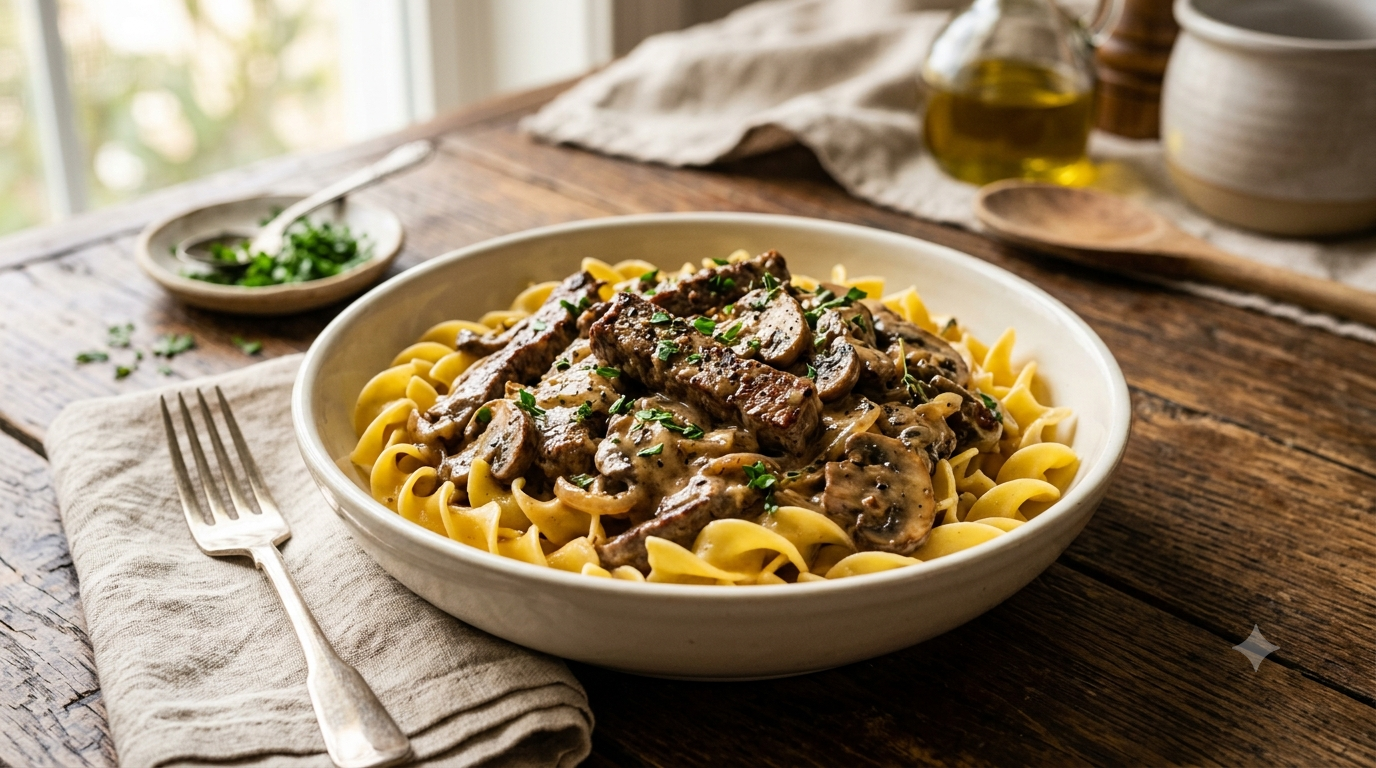
𝗜𝗻𝘁𝗿𝗼𝗱𝘂𝗰𝘁𝗶𝗼𝗻
Beef Stroganoff is a comforting and flavorful dish made with tender beef, mushrooms, onions, and a creamy savory sauce. Traditionally served over egg noodles, this classic recipe is loved for its rich texture, satisfying flavor, and simple combination of ingredients. It is a wonderful choice when you want to prepare a hearty homemade dinner that feels special without requiring an extremely complicated cooking process.
The beauty of Beef Stroganoff lies in the way its ingredients work together. Tender beef provides a rich and savory foundation, mushrooms contribute an earthy flavor, and onions add a gentle sweetness. The creamy sauce brings everything together while a little mustard can provide a subtle tangy note that balances the richness. When the finished sauce is served over warm egg noodles, every bite becomes comforting and satisfying.
Although Beef Stroganoff has a long history and is associated with Russian cuisine, the recipe has evolved considerably over time. Different countries and families have created their own versions using different cuts of beef, mushrooms, dairy ingredients, seasonings, and serving options. Some versions are simple and traditional, while others are richer and more modern.
In this article, we will take a detailed look at Beef Stroganoff, including its background, ingredients, preparation methods, cooking tips, sauce-making techniques, serving ideas, variations, and common mistakes. Whether you are preparing this dish for your family or simply exploring classic comfort foods, understanding each step can help you create a delicious result.
What Is Beef Stroganoff?
Beef Stroganoff is a creamy beef dish traditionally prepared with sliced beef, mushrooms, onions, and a sour-cream-based sauce. It is commonly served over egg noodles, although mashed potatoes, rice, pasta, and other accompaniments can also be used.
The dish is particularly recognizable because of its creamy sauce. Sour cream provides a characteristic tanginess, while beef broth or another savory liquid helps create the base. Mustard may also be included to add additional depth.
The beef is usually cut into thin strips so that it cooks relatively quickly. Cooking the meat carefully is important because overcooked beef can become tough. The mushrooms and onions are generally cooked separately or alongside the beef before the sauce is developed.
A good Beef Stroganoff should have a balanced flavor. It should be creamy and rich without becoming excessively heavy, while the beef and mushrooms should remain noticeable rather than being completely hidden by the sauce.
A Brief History of Beef Stroganoff
Beef Stroganoff is widely associated with nineteenth-century Russia and is traditionally connected with the Stroganov family, an influential Russian family. The exact origin of the modern recipe is not completely certain, and several historical explanations have been suggested.
As the dish became known outside Russia, it was adapted by cooks in different countries. Ingredients and cooking methods changed depending on local traditions and availability.
Over time, Beef Stroganoff became a popular international comfort food. In some places, it was prepared as a simple family meal, while restaurants sometimes created more elaborate versions using premium beef and richer sauces.
Today, Beef Stroganoff has many variations. Some recipes emphasize sour cream, while others use additional cream. Some include mustard or Worcestershire sauce, while others keep the seasoning simple. Mushrooms are common in modern versions, although historical preparations may differ.
The adaptability of the dish is one reason it has remained popular. Despite regional differences, the basic combination of beef and a creamy savory sauce remains at the heart of most versions.
Why Beef Stroganoff Is So Popular
There are several reasons why Beef Stroganoff continues to be a favorite dinner recipe.
First, it is comforting. Warm noodles covered with creamy sauce and tender beef create a satisfying meal, especially on cooler days.
Second, the ingredients complement each other naturally. Beef and mushrooms are both rich in savory flavor, while onions add sweetness. The creamy sauce softens and connects those flavors.
Third, the dish is flexible. You can change the serving base, use different mushrooms, adjust the seasoning, or modify the sauce according to your preferences.
Finally, Beef Stroganoff can feel like a restaurant-style meal while still being achievable in a home kitchen.
Ingredients You Will Need
Before beginning, prepare all the ingredients so that the cooking process is organized and easy to follow.
Beef
Choose a tender beef cut that is suitable for relatively quick cooking. The beef should be sliced into thin strips or small pieces.
Cutting across the grain can help improve tenderness.
Mushrooms
Fresh mushrooms provide an earthy and savory flavor. Button mushrooms and cremini mushrooms are commonly used.
Slice them evenly so that they cook at approximately the same rate.
Onion
Onion provides sweetness and depth. Yellow or white onions work well.
You can slice the onion thinly or chop it, depending on your preferred texture.
Garlic
Garlic adds aroma and savory flavor. Freshly minced garlic is a good option.
Butter or Cooking Oil
Butter adds richness, while cooking oil can be useful for cooking at a higher temperature.
Beef Broth
Beef broth contributes savory flavor and provides liquid for the sauce.
Sour Cream
Sour cream gives the sauce its creamy consistency and characteristic tangy flavor.
Mustard
A small amount of mustard can balance the richness of the sauce.
Flour
Flour may be used to help thicken the sauce.
Salt and Black Pepper
These basic seasonings enhance the natural flavors of the beef and mushrooms.
Egg Noodles
Egg noodles are a traditional and popular accompaniment because their shape and texture work particularly well with creamy sauce.
Preparing the Beef
Start by preparing the beef carefully.
Keep raw beef properly refrigerated until you are ready to use it. Use clean utensils and a suitable cutting board, and wash your hands and preparation surfaces after handling raw meat.
Trim any unwanted excess fat and cut the beef into thin strips. Try to keep the pieces similar in size so they cook evenly.
Season the beef lightly with salt and black pepper.
When cooking the beef, avoid overcrowding the pan. If too much meat is added at once, the temperature of the pan can drop and the beef may release moisture instead of developing a browned surface.
For food safety, beef should be cooked according to appropriate safe internal-temperature guidance for the specific cut being used. A food thermometer is the best way to verify temperature.
Cooking the Beef
Heat a suitable skillet over an appropriate cooking temperature and add a small amount of cooking fat.
Add the beef in manageable batches rather than filling the pan completely.
Allow the beef to cook until it develops the desired browning and reaches a safe internal temperature appropriate for the cut.
Once cooked, transfer the beef to a clean plate.
Temporarily removing the beef is useful because it prevents the meat from continuing to cook while the vegetables and sauce are prepared.
This technique can help maintain a better texture.
Cooking the Mushrooms and Onion
After the beef has been removed, add the onion to the pan.
Cook until the onion begins to soften. Some of the flavorful residue left from cooking the beef can combine with the onion and contribute additional depth.
Add the sliced mushrooms.
Mushrooms naturally release moisture while cooking. Allowing that moisture to evaporate helps the mushrooms become more flavorful and develop better texture.
Add garlic toward the later stage of cooking the vegetables. Garlic can burn if cooked at excessive heat for too long, so adding it later helps preserve its aroma.
Making the Creamy Sauce
Once the onions and mushrooms are cooked, begin developing the sauce.
If using flour, sprinkle it over the vegetables and stir thoroughly. This helps distribute the flour before adding liquid.
Gradually pour in the beef broth while stirring continuously.
The liquid should combine with the flour and vegetables to form a smooth sauce.
Allow the mixture to cook gently until it begins to thicken.
Add mustard according to taste. The mustard should complement the beef and cream rather than dominate the dish.
Sour cream should generally be incorporated carefully toward the end of the cooking process. Avoid aggressive boiling after adding sour cream, as excessive heat can affect the texture.
Combining Everything
Once the sauce has reached a creamy consistency, return the cooked beef to the pan.
Stir gently so the beef becomes coated in the sauce.
Taste the dish and adjust the seasoning if necessary.
At this stage, the sauce should have a rich, savory, creamy flavor with a subtle tanginess.
Avoid unnecessarily prolonged cooking after the beef has been returned to the sauce. Once everything is heated through and properly combined, the Stroganoff can be prepared for serving.
Serving Beef Stroganoff
Egg noodles are one of the most traditional choices for serving Beef Stroganoff.
Cook the noodles according to their package directions and drain them properly.
Place the warm noodles on a serving plate or bowl and spoon the creamy Beef Stroganoff over the top.
You can garnish the dish with fresh parsley or another suitable herb if desired.
For a balanced meal, Beef Stroganoff can also be served with a simple green salad or cooked vegetables.
Final Thoughts
Beef Stroganoff is a timeless comfort food because it combines simple ingredients with rich and satisfying flavors. Tender beef, earthy mushrooms, sweet onions, and a creamy sauce create a meal that is both comforting and versatile.
The most important elements are careful preparation, proper cooking of the beef, well-browned mushrooms, and a smooth, balanced sauce. Once you understand these basic techniques, you can confidently adapt the recipe to suit your preferences.
Whether served over egg noodles, mashed potatoes, rice, or another favorite side, Beef Stroganoff can make an ordinary dinner feel special. Its creamy texture and savory flavor make it an excellent choice for anyone looking for a hearty homemade meal.
Beef Stroganoff is a comforting dish that becomes truly delicious when each ingredient is cooked with care. While the basic recipe is simple, a few small techniques can make a noticeable difference in the final flavor and texture. The beef should remain tender, the mushrooms should develop a deep savory taste, and the sauce should be creamy without becoming too heavy. In this section, we will explore the cooking process in greater detail and discuss practical tips that can help you prepare a satisfying homemade Beef Stroganoff.
CHOOSING THE RIGHT BEEF
The choice of beef can have a major effect on the final result. Since Beef Stroganoff is generally prepared using relatively quick cooking methods, a tender cut of beef is a good choice. The meat should be fresh and suitable for the cooking method being used.
Before cutting the beef, remove any unwanted excess fat or tough connective tissue. Slice the meat into thin strips, preferably across the grain. Cutting across the grain shortens the muscle fibers and can make the cooked beef easier to chew.
Try to cut the pieces into similar sizes. Uneven pieces may cook at different rates, meaning some pieces could become overcooked while others are not ready at the same time.
PREPARING THE MUSHROOMS
Mushrooms are an important part of many Beef Stroganoff recipes. Their earthy flavor works especially well with beef and creamy sauces.
Clean the mushrooms appropriately and slice them into reasonably even pieces. Avoid cutting them extremely thin because they can lose too much texture during cooking.
One of the most important mushroom-cooking tips is to avoid overcrowding the pan. Mushrooms contain a significant amount of water and release moisture as they heat. If too many mushrooms are placed in a crowded pan, they may steam rather than brown.
Allowing enough space can encourage the moisture to evaporate and help the mushrooms develop a deeper flavor. Once they begin to brown and become tender, they are ready to be incorporated into the sauce.
PREPARING THE ONIONS
Onions add natural sweetness and depth to Beef Stroganoff. They can be thinly sliced or finely chopped depending on the texture you prefer.
Cook the onions gently until they become soft and translucent. Avoid burning them because burnt onions can introduce a bitter taste.
If you want a deeper flavor, allow the onions to cook slowly until they develop a light golden color. However, remember that the final dish should still have a balanced flavor, so the onions should complement rather than overpower the beef and mushrooms.
BEEF STROGANOFF VARIATIONS
Beef Stroganoff is a versatile dish, and there are many ways to adapt it while keeping its familiar creamy and savory character. Different cuts of beef, mushrooms, sauces, seasonings, and serving options can create unique versions of the recipe.
The most important thing is to maintain a balance between the main ingredients. Beef should remain the central flavor, while mushrooms, onions, and the creamy sauce should complement it.
CLASSIC-STYLE BEEF STROGANOFF
A classic-style Beef Stroganoff generally focuses on beef, mushrooms, onions, a creamy sauce, and simple seasonings. Sour cream is an important ingredient in many versions.
This approach is ideal for people who enjoy traditional comfort food without too many additional flavors.
The sauce should be smooth and savory, with a gentle tang from the sour cream and mustard. The beef should remain tender, and the mushrooms should provide an earthy contrast.
CREAMY BEEF STROGANOFF
For an especially creamy version, the sauce can include a combination of sour cream and cream.
This creates a richer texture and a softer mouthfeel. However, because the dish can become heavy when too much dairy is used, it is important to keep the ingredients balanced.
A creamy version pairs particularly well with egg noodles because the noodles absorb and carry the sauce.
MUSHROOM-LOVER’S BEEF STROGANOFF
If you enjoy mushrooms, you can increase their quantity and use a mixture of different edible mushrooms.
Button mushrooms provide a mild flavor, while cremini mushrooms offer a deeper earthy taste. A combination can add variety to each bite.
Cook the mushrooms properly before combining them with the sauce. Allowing excess moisture to evaporate can help concentrate their flavor.
EXTRA-ONION BEEF STROGANOFF
Onions can also become a more prominent part of the dish.
Thinly sliced onions can be cooked slowly until soft and lightly golden. This creates natural sweetness and additional depth.
The onions should complement the beef rather than overpower it.
MUSTARD BEEF STROGANOFF
Mustard can provide a pleasant tangy note.
Dijon mustard is commonly used because its flavor is noticeable without necessarily becoming overwhelming.
Start with a modest amount and taste the sauce before adding more.
The purpose of mustard is to balance the richness of the creamy sauce, not to turn the dish into a strongly mustard-flavored meal.
GARLIC-STYLE BEEF STROGANOFF
Garlic can add a warm, aromatic character.
Freshly minced garlic can be added while cooking the onions and mushrooms. Because garlic can burn quickly, it should be watched carefully.
A small amount can be enough to provide noticeable flavor.
HERB-INFUSED STROGANOFF
Fresh herbs can add freshness to a rich sauce.
Parsley is one of the simplest choices and can be added near the end or used as a garnish.
Other herbs may also be used depending on personal preference, but the flavor should remain balanced.
DIFFERENT BEEF CUTS
Different beef cuts can be used depending on availability and cooking method.
Tender cuts are particularly suitable when the beef is sliced thinly and cooked quickly.
Some tougher cuts can also work when prepared using longer cooking methods, but the recipe and technique may need to be adjusted.
Always consider the characteristics of the specific cut before choosing a cooking method.
ONE-PAN BEEF STROGANOFF
A one-pan approach can simplify cleanup and make the cooking process convenient.
In this method, the beef, vegetables, and sauce are prepared using the same suitable pan.
The beef can be browned first and temporarily removed. The mushrooms and onions can then be cooked in the same pan, allowing the flavorful cooking residue to contribute to the sauce.
After the sauce is prepared, the beef can be returned.
One-pan cooking can be especially useful for busy weeknight meals because it reduces the number of dishes that need to be cleaned afterward.
However, it is still important to avoid overcrowding the pan. If necessary, cook the beef in batches.
STOVETOP BEEF STROGANOFF
The stovetop method is one of the most common approaches.
It gives you direct control over the cooking temperature and allows you to monitor the beef and sauce closely.
Begin by preparing the beef and vegetables.
Cook the beef appropriately and remove it from the pan.
Cook the onions and mushrooms.
Add the broth and other sauce ingredients.
Once the sauce reaches the desired consistency, return the beef.
This method is relatively straightforward and works well when you want to control each stage of cooking.
SLOWER COOKING METHODS
Longer cooking methods may be appropriate for certain beef cuts that benefit from extended cooking.
However, traditional quick-cooking Beef Stroganoff often uses tender beef, so it does not necessarily require a long cooking period.
If using a slow-cooking approach, consider the texture of the beef and the behavior of dairy ingredients.
Creamy ingredients may be better incorporated toward the end rather than being cooked for an extended period.
BEGINNER-FRIENDLY BEEF STROGANOFF
If you are making Beef Stroganoff for the first time, preparation is the key to keeping the process manageable.
Measure your ingredients before starting.
Cut the beef and vegetables ahead of time.
Keep the broth and sauce ingredients nearby.
Use moderate cooking temperatures when appropriate.
Do not rush the mushrooms.
Avoid adding sour cream to an aggressively boiling sauce.
Taste the sauce before serving.
These simple habits can make the recipe much easier to manage.
HOW TO PREVENT TOUGH BEEF
Tough beef is one of the most common concerns when preparing this dish.
Several factors can contribute to toughness.
The cut of beef matters.
The thickness of the slices matters.
The cooking temperature matters.
The cooking time matters.
Cutting across the grain can help improve tenderness.
Avoid prolonged cooking when using a tender cut intended for quick cooking.
Also avoid repeatedly reheating the beef because each additional heating cycle can affect texture.
HOW TO PREVENT WATERY SAUCE
A watery sauce can make Beef Stroganoff less satisfying.
One common reason is excess moisture from mushrooms.
Allow mushrooms to cook long enough for excess moisture to evaporate.
Another possibility is adding too much broth.
Add liquid gradually and monitor the consistency.
If the sauce is thinner than desired, gentle cooking can help reduce excess moisture.
If flour is being used, make sure it is properly incorporated.
HOW TO PREVENT LUMPY SAUCE
Lumps can occur when flour is added incorrectly.
Mix flour thoroughly with the cooking fat and vegetables before adding liquid.
When adding broth, pour it gradually while stirring.
This allows the thickening ingredient to disperse evenly.
If you still notice small lumps, continued gentle stirring may help smooth the sauce.
HOW TO PREVENT SOUR CREAM FROM SEPARATING
Sour cream can be sensitive to high heat.
Avoid adding it while the sauce is boiling aggressively.
Lower the heat before incorporating it.
Stir gently and heat the finished dish without prolonged boiling.
Some cooks also allow the sour cream to warm slightly before adding it to the sauce.
These techniques can help maintain a smoother appearance.
BEEF STROGANOFF FOR A SPECIAL DINNER
Although Beef Stroganoff is often considered comfort food, it can also be presented as a special dinner.
Use attractive serving dishes.
Arrange the noodles neatly.
Spoon the sauce over the center.
Add a small garnish of fresh parsley.
Serve with a simple vegetable side or salad.
Presentation does not change the flavor, but a thoughtfully arranged plate can make the meal feel more inviting.
FAMILY-STYLE SERVING
For a relaxed family meal, Beef Stroganoff can be placed in a large serving dish with noodles served alongside.
This allows everyone to choose their preferred amount.
A bowl of vegetables or salad can be placed on the table as an additional side.
Family-style serving works particularly well for casual dinners and gatherings.
WHAT TO SERVE WITH BEEF STROGANOFF
There are many possible side dishes.
Egg noodles are a classic choice.
Mashed potatoes provide a creamy and comforting alternative.
Steamed rice is simple and mild.
Roasted vegetables provide texture.
Green beans add freshness.
A simple green salad can provide a lighter contrast.
Crusty bread can also be useful for enjoying extra sauce.
The best side depends on your preferences and the overall balance of the meal.
BEEF STROGANOFF AND NOODLE TEXTURE
The texture of the noodles can affect the entire dish.
Avoid overcooking them.
Noodles should be tender but still maintain enough structure to hold the sauce.
If they become excessively soft, they may break apart when combined with the Stroganoff.
Cook according to package instructions and drain thoroughly.
If the noodles will sit for a short period before serving, keep them warm and avoid allowing them to become excessively dry.
LEFTOVER STORAGE
If you have leftover Beef Stroganoff, store it promptly in a suitable airtight container and refrigerate it according to standard food-safety practices.
Keep the noodles separate when possible because they can absorb sauce during storage.
Labeling the container with the preparation date can also make it easier to keep track of leftovers.
When reheating, warm the food thoroughly and gently.
Do not repeatedly reheat the same portion.
FREEZING BEEF STROGANOFF
Freezing creamy dishes can sometimes affect their texture.
The sauce may separate slightly after thawing and reheating.
If you intend to freeze the dish, consider how the dairy ingredients may respond.
Store it in a suitable freezer-safe container and leave appropriate space for expansion.
Thaw safely and reheat gently.
If the texture changes, stirring thoroughly and adding a small amount of suitable liquid may help improve the consistency.
REHEATING TIPS
Gentle reheating is generally preferable.
Use moderate heat and stir occasionally.
If the sauce becomes very thick, add a small amount of broth or another suitable liquid.
Heat until the food is thoroughly hot and follow appropriate food-safety practices.
Avoid boiling the sauce aggressively.
BEEF STROGANOFF FOR MEAL PLANNING
Beef Stroganoff can be incorporated into a meal-planning routine.
Prepare the vegetables ahead of time.
Measure the sauce ingredients.
Keep the beef properly refrigerated until cooking.
Cook the noodles separately.
When ready to eat, prepare or reheat the components appropriately.
Meal planning can make dinner preparation more organized and reduce last-minute stress.
PORTIONING THE MEAL
Portion size depends on individual needs, appetite, and the other foods being served.
A balanced plate can include a reasonable serving of Beef Stroganoff, a suitable portion of noodles or another starch, and vegetables.
Serving the dish with vegetables can add variety to the meal.
COMMON QUESTIONS ABOUT BEEF STROGANOFF
IS BEEF STROGANOFF ALWAYS MADE WITH MUSHROOMS?
Many modern Beef Stroganoff recipes include mushrooms, and they are a very popular ingredient. However, recipes can vary, and not every historical or modern version uses exactly the same ingredients.
CAN I USE A DIFFERENT TYPE OF MUSHROOM?
Yes, different edible mushrooms can be used according to availability and preference.
CAN I SERVE BEEF STROGANOFF WITH RICE?
Yes. Rice is a practical alternative to egg noodles and works well with the creamy sauce.
CAN I SERVE IT WITH MASHED POTATOES?
Yes. Mashed potatoes pair particularly well with creamy beef sauces.
WHY IS MY BEEF TOUGH?
The beef may have been overcooked, cut incorrectly, or prepared using a cut that requires a different cooking method.
WHAT MAKES THE SAUCE CREAMY?
Sour cream is commonly responsible for the characteristic creamy texture in many Beef Stroganoff recipes. Other dairy ingredients may also be used.
WHY IS MY SAUCE TOO THICK?
Too much thickening ingredient or excessive reduction can make the sauce too thick. A small amount of suitable liquid can help loosen it.
WHY IS MY SAUCE TOO THIN?
Excess liquid can make the sauce thin. Gentle cooking can allow some moisture to evaporate. A suitable thickening technique can also be used.
CAN I ADD MORE MUSTARD?
You can adjust mustard according to taste. Add it gradually so that it does not overpower the other ingredients.
CAN I ADD GARLIC?
Yes. Garlic can add a pleasant savory aroma.
CAN I ADD FRESH HERBS?
Yes. Parsley is a simple and popular choice for garnish.
WHAT IS THE BEST WAY TO SERVE BEEF STROGANOFF?
Egg noodles are a classic option, but mashed potatoes, rice, pasta, and vegetables can also work well.
HOW CAN I MAKE IT MORE FLAVORFUL?
Proper browning of the beef and mushrooms, balanced seasoning, good-quality broth, and careful sauce preparation can all contribute to better flavor.
FINAL THOUGHTS
Beef Stroganoff is a flexible recipe that can be adapted in many ways while preserving its comforting character. You can change the mushrooms, adjust the creaminess, experiment with serving options, or create a simpler version for a busy evening.
The most important principles are to cook the beef appropriately, develop flavor in the mushrooms and onions, build the sauce gradually, and handle the dairy ingredients carefully.
Once these techniques are understood, Beef Stroganoff becomes more than just a recipe. It becomes a useful foundation for creating a variety of comforting beef meals.
Whether you are preparing a traditional-style dinner or experimenting with your own variation, careful cooking and balanced flavors will help create a satisfying result.
Beef Stroganoff is a versatile comfort-food recipe that can be adapted to different ingredients, budgets, cooking preferences, and meal occasions. While the traditional combination of beef, mushrooms, onions, and creamy sauce remains popular, small changes can create a version that fits your kitchen and personal preferences.
In this part, we will explore ingredient substitutions, budget-friendly approaches, meal-planning ideas, cooking tips, texture improvements, flavor adjustments, and practical answers to common questions about preparing Beef Stroganoff at home.
UNDERSTANDING THE MAIN INGREDIENTS
Every ingredient in Beef Stroganoff has a purpose. Understanding what each one contributes can make it easier to modify the recipe without losing its overall character.
Beef provides the primary savory flavor and satisfying texture. Mushrooms contribute earthiness and additional umami. Onions add sweetness and depth. Beef broth provides liquid and savory flavor, while sour cream creates the creamy and slightly tangy character associated with many versions of the dish.
Mustard is often used in a small quantity to provide brightness. Flour or another thickening ingredient can help create a sauce that coats the beef and noodles rather than remaining watery.
Because each ingredient contributes something different, substitutions should be made thoughtfully.
BUDGET-FRIENDLY BEEF STROGANOFF
You do not necessarily need expensive ingredients to prepare a satisfying Beef Stroganoff.
A budget-friendly approach begins with selecting an appropriate beef cut that is suitable for the cooking method. Rather than choosing the most expensive option available, focus on using a cut that can be cooked properly and sliced appropriately.
Mushrooms can provide a lot of flavor without requiring a large quantity of meat. Increasing the amount of mushrooms and onions can create a hearty dish while keeping the overall ingredient cost more manageable.
Egg noodles are also a practical accompaniment because they are filling and pair naturally with creamy sauce.
Buying ingredients that are already common in your kitchen can further simplify the recipe.
BEEF SUBSTITUTIONS
Beef is the defining ingredient of Beef Stroganoff, but different cuts can be used depending on availability.
When using a tender cut, quick cooking is generally appropriate.
If using a tougher cut, a longer cooking method may be more suitable. However, the recipe may need to be adapted because traditional quick-cooking Stroganoff is designed around relatively tender beef.
Always consider the characteristics of the meat before deciding how long to cook it.
MUSHROOM SUBSTITUTIONS
If you do not have button mushrooms, other edible mushrooms can be used.
Cremini mushrooms provide a deeper flavor.
A mixture of mushrooms can add complexity.
Different mushrooms may release different amounts of moisture, so adjust the cooking time accordingly.
If using fresh mushrooms, clean and prepare them appropriately before cooking.
SOUR CREAM SUBSTITUTIONS
Sour cream is a defining ingredient in many versions of Beef Stroganoff, but some cooks may need an alternative.
Depending on the recipe, other dairy ingredients may provide creaminess. However, changing the dairy ingredient can also change the flavor and texture.
If using a substitute, consider whether it has the same level of tanginess and thickness.
A very mild substitute may require another ingredient to provide the brightness normally contributed by sour cream.
BROTH SUBSTITUTIONS
Beef broth provides savory depth, but other suitable cooking liquids can be used depending on availability.
A homemade broth can provide excellent flavor.
A suitable prepared broth can also work well.
When using a broth that already contains salt, taste the sauce before adding additional salt.
The goal is to create a flavorful sauce without making it excessively salty.
FLOUR AND THICKENING
Flour is sometimes used to thicken the Stroganoff sauce.
It should be incorporated carefully so that it does not form lumps.
If you prefer a sauce that is naturally thicker, reducing the amount of liquid gradually can help.
However, excessive reduction can concentrate salt and other flavors, so taste as you go.
The finished sauce should be thick enough to coat the beef and noodles but still remain smooth and spoonable.
HOW TO GET RESTAURANT-STYLE FLAVOR
Restaurant-style flavor often comes from developing flavor at each stage rather than simply adding large quantities of seasoning.
Begin by properly browning the beef.
Cook the mushrooms until they develop a deeper flavor.
Allow onions to soften and develop sweetness.
Use a flavorful broth.
Add mustard carefully.
Finish with sour cream or another creamy ingredient.
Taste and adjust the seasoning before serving.
This layered approach creates greater depth than relying on a large amount of salt or seasoning.
THE IMPORTANCE OF BROWNING
Browning is one of the most useful techniques for developing flavor.
When the surface of the beef is cooked appropriately, it can develop a deeper savory character.
The same principle applies to mushrooms and onions.
However, browning requires sufficient pan space. If the pan is overcrowded, ingredients can release moisture and steam instead.
Cooking in batches may take slightly longer, but it can improve the final result.
HOW TO CONTROL HEAT
Heat management is important throughout the recipe.
Higher heat can be useful when initially browning appropriate ingredients.
Moderate heat is often better when cooking onions and mushrooms.
Gentler heat is preferable when incorporating dairy ingredients.
Understanding when to increase or reduce heat helps prevent burning, overcooking, and sauce problems.
WHY THE ORDER OF INGREDIENTS MATTERS
Cooking ingredients in a logical sequence allows each one to develop its best flavor.
The beef can be browned first.
The mushrooms and onions can then be cooked using the flavorful residue left in the pan.
The sauce can be developed afterward.
Finally, the beef can be returned to the finished sauce.
This order helps protect the texture of the beef while allowing the sauce to develop complexity.
HOW TO MAKE THE SAUCE LESS HEAVY
If you find traditional Beef Stroganoff too rich, you can adjust the balance.
Use a moderate amount of sour cream.
Increase the quantity of mushrooms and onions.
Serve with vegetables.
Choose a lighter accompaniment rather than a large serving of noodles.
Use enough sauce to coat the ingredients without creating an excessively large portion.
These changes can make the overall meal feel lighter while preserving the recognizable flavors.
HOW TO MAKE THE SAUCE MORE RICH
If you prefer a richer dish, additional creaminess can be introduced through suitable dairy ingredients.
Butter can also contribute richness.
However, richness should be balanced with acidity and seasoning.
Mustard or the natural tang of sour cream can help prevent the sauce from becoming flat or overly heavy.
ADDING WORCESTERSHIRE SAUCE
Some modern Beef Stroganoff recipes include Worcestershire sauce.
A small quantity can contribute savory depth and a slightly complex flavor.
Because it can be strong, use it carefully and taste the sauce before adding more.
This is an optional variation rather than a requirement for a classic preparation.
ADDING PAPRIKA
Paprika can provide mild warmth and additional color.
Depending on the variety used, paprika can be sweet, smoky, or more pronounced.
If you choose to use it, add a moderate amount so that it complements rather than dominates the creamy sauce.
ADDING BLACK PEPPER
Freshly ground black pepper can provide a pleasant contrast to the creamy sauce.
It can be added during cooking and adjusted again before serving.
The amount should depend on personal preference.
Because black pepper is noticeable in a mild cream sauce, add it gradually.
MAKING THE DISH MORE VEGETABLE-FORWARD
Mushrooms and onions are already important vegetables in many Beef Stroganoff recipes.
You can also serve additional vegetables on the side.
Broccoli, green beans, carrots, peas, or leafy greens can provide color and texture.
Adding vegetables to the overall meal can also create a more varied plate.
PAIRING WITH A SALAD
A simple salad can work particularly well with a creamy beef dish.
Fresh greens, cucumber, tomatoes, or other preferred salad ingredients can provide a crisp contrast.
Avoid making the salad excessively heavy if the main dish is already rich.
A simple preparation with a light dressing can be enough.
BREAD AS A SIDE
Crusty bread can be served alongside Beef Stroganoff.
It can be useful for enjoying leftover sauce from the plate.
Choose bread with enough structure to hold its shape.
This option works particularly well for casual family dinners.
MEAL PREPARATION TIPS
If you plan to make Beef Stroganoff during a busy week, preparation can make the process easier.
Slice the mushrooms and onions ahead of time.
Measure the broth and seasonings.
Prepare the beef shortly before cooking.
Keep dairy ingredients refrigerated until needed.
Cook noodles according to the time required.
Having everything ready allows you to focus on cooking rather than searching for ingredients.
SAFE FOOD HANDLING
Food safety is an important part of preparing any meal containing meat and dairy products.
Keep raw beef refrigerated until preparation.
Use separate or properly cleaned utensils and cutting boards for raw meat and ready-to-eat ingredients.
Wash hands and kitchen surfaces after handling raw beef.
Cook beef according to appropriate food-safety guidance for the specific cut.
Refrigerate leftovers promptly in suitable containers.
When reheating leftovers, heat them thoroughly.
These practices help reduce the risk of foodborne illness.
HOW TO STORE LEFTOVER STROGANOFF
Place leftover Beef Stroganoff in an airtight container and refrigerate it promptly.
If possible, store noodles separately because they can absorb sauce and become very soft.
When ready to eat, reheat gently.
If the sauce has thickened in the refrigerator, a small amount of suitable liquid can help restore its consistency.
Avoid repeatedly reheating the entire batch. Instead, heat only the portion you plan to eat.
FREEZING CONSIDERATIONS
Creamy sauces can change texture after freezing and thawing.
If you decide to freeze Beef Stroganoff, use a suitable freezer-safe container and follow standard food-storage practices.
Thaw safely before reheating.
After thawing, the sauce may appear slightly separated. Gentle reheating and thorough stirring can help improve its consistency.
For best texture, some cooks prefer preparing the beef and sauce fresh rather than freezing the finished creamy dish.
BEEF STROGANOFF FOR A WEEKDAY DINNER
The recipe can be adapted for a weekday schedule by preparing the ingredients in advance.
Keep the process organized.
Cook the beef efficiently.
Prepare the sauce while the noodles are cooking.
Combine the components near the end.
This workflow can make the meal feel much easier to manage.
BEEF STROGANOFF FOR GUESTS
For guests, presentation becomes more important.
Serve the Stroganoff in a suitable dish.
Arrange the noodles neatly.
Add the sauce carefully.
Garnish with fresh parsley if desired.
Serve a simple salad or vegetables alongside.
The creamy sauce and warm noodles naturally create an inviting presentation.
HOW TO IMPROVE TEXTURE
Texture is just as important as flavor.
The beef should be tender.
Mushrooms should be cooked but retain some structure.
Onions should be soft without becoming completely mushy.
The sauce should be creamy and thick enough to coat the ingredients.
The noodles should be tender but not excessively soft.
When all these textures work together, the dish becomes more satisfying.
HOW TO IMPROVE FLAVOR
Flavor develops in layers.
Season the beef appropriately.
Brown it carefully.
Cook mushrooms until their flavor develops.
Allow onions to soften.
Use a flavorful broth.
Add mustard gradually.
Taste before serving.
Do not rely solely on salt to create flavor.
These simple techniques can produce a much more balanced result.
FREQUENTLY ASKED QUESTIONS
CAN I USE FROZEN MUSHROOMS?
Fresh mushrooms are often preferred for texture, but suitable frozen mushrooms may be used if necessary. They may release additional moisture, so allow enough cooking time for excess liquid to evaporate.
CAN I PREPARE THE BEEF IN ADVANCE?
The beef can be prepared shortly before cooking. Keep raw beef refrigerated and follow appropriate food-safety practices.
CAN I MAKE BEEF STROGANOFF WITHOUT MUSHROOMS?
Yes. While mushrooms are common in modern versions, the recipe can be adapted. Keep in mind that removing mushrooms changes the traditional flavor profile.
CAN I MAKE IT WITHOUT MUSTARD?
Yes. Mustard is optional in many versions. The dish can still be flavorful without it.
CAN I USE DIFFERENT NOODLES?
Yes. Egg noodles are traditional in many recipes, but other pasta varieties can also work.
CAN I SERVE IT WITH POTATOES?
Yes. Mashed potatoes are particularly suitable because they pair well with creamy sauces.
CAN I ADD MORE VEGETABLES?
Yes. Additional vegetables can be served alongside the dish or incorporated into a customized version.
HOW DO I KNOW WHEN THE SAUCE IS READY?
The sauce should be smooth and thick enough to coat the back of a spoon or cling lightly to the beef and noodles.
WHY DOES MY SAUCE TASTE FLAT?
The dish may need better seasoning or acidity. Taste carefully and adjust salt, pepper, mustard, or another suitable flavor component gradually.
WHY DOES MY STROGANOFF TASTE TOO SOUR?
Too much sour cream or mustard can create excessive acidity. Additional sauce ingredients can help balance the flavor, but changes should be made gradually.
WHY DOES MY STROGANOFF TASTE TOO SALTY?
Broth and seasoning may both contribute salt. Taste before adding additional salt. If the finished sauce is too salty, increasing unsalted ingredients may help dilute the overall concentration.
FINAL COOKING CHECKLIST
Before serving Beef Stroganoff, check the following:
The beef has been cooked safely.
The beef remains appropriately tender.
The mushrooms are cooked and flavorful.
The onions are soft.
The sauce is creamy and smooth.
The seasoning is balanced.
The noodles or other accompaniment are properly cooked.
The dish is served warm.
A simple garnish has been added if desired.
FINAL CONCLUSION
Beef Stroganoff is a flexible and comforting meal that can easily be adapted to different kitchens and preferences. From choosing different mushrooms to adjusting the creaminess of the sauce, there are many ways to make the recipe your own.
The best results come from paying attention to the fundamentals: use appropriate ingredients, control the heat, avoid overcrowding the pan, cook the beef carefully, develop flavor in the vegetables, and handle the creamy sauce gently.
Whether you prepare a traditional-style version with egg noodles or create your own variation with rice, mashed potatoes, extra mushrooms, or additional vegetables, Beef Stroganoff remains a satisfying homemade dinner.
With practice, the cooking process becomes easier, and you can adjust the recipe confidently according to the ingredients available in your kitchen. The result is a warm, creamy, savory meal that works equally well for an ordinary family dinner or a more special occasion.
BEEF STROGANOFF: A COMPLETE STEP-BY-STEP COOKING GUIDE
Beef Stroganoff is a dish that rewards patience and careful cooking. Although the ingredient list is straightforward, the way each ingredient is handled can make a significant difference to the finished meal. The goal is to create tender beef, flavorful mushrooms and onions, and a smooth creamy sauce that brings everything together.
In this part, we will go through the cooking process in greater detail, from preparing the ingredients to serving the finished dish. We will also explore ways to improve flavor, texture, appearance, and consistency.
GETTING ORGANIZED BEFORE COOKING
Before turning on the stove, prepare everything you need.
Slice the beef into thin strips.
Clean and slice the mushrooms.
Chop or slice the onions.
Prepare the garlic.
Measure the broth.
Measure the sour cream.
Prepare the mustard.
Keep salt, black pepper, butter or cooking oil, and any optional herbs nearby.
Preparing ingredients in advance makes the cooking process easier because you will not need to stop repeatedly to measure or chop something.
This is especially useful when cooking beef because the meat may need to be removed from the pan at the correct moment.
PREPARING THE BEEF FOR COOKING
Use a clean cutting board and knife when preparing the beef.
Trim unwanted excess fat or tough connective tissue if necessary.
Slice the beef into relatively thin pieces.
Whenever practical, cut across the grain. This can make the finished meat easier to chew.
Try to keep the slices relatively similar in thickness.
Season the beef with salt and black pepper shortly before cooking.
Avoid leaving raw beef at room temperature for unnecessary periods. Keep it refrigerated until you are ready to cook it.
HEATING THE PAN
Choose a suitable skillet or sauté pan.
The pan should be large enough to allow the beef to cook without excessive crowding.
Preheat the pan appropriately before adding the cooking fat.
A properly heated pan helps the beef develop a browned surface.
However, avoid excessive heat that could burn the cooking fat or cause the outside of the beef to burn before the inside reaches an appropriate temperature.
COOKING THE BEEF IN BATCHES
If you have a large quantity of beef, cooking it in batches can produce better results.
Place a manageable amount of beef in the pan.
Allow the pieces to cook without moving them constantly.
Once the appropriate side has developed some browning, turn the pieces and continue cooking.
Cook according to the specific cut and thickness.
For food safety, use an appropriate food thermometer to verify that the beef has reached a safe internal temperature.
Once cooked, transfer the beef to a clean plate.
Repeat the process with the remaining beef if necessary.
WHY BATCH COOKING MATTERS
When too much beef is added to a pan at once, the temperature can fall.
The meat then releases moisture, and instead of browning, it may steam.
Steamed beef can still be edible and flavorful, but it will not have the same developed surface flavor that properly browned beef can provide.
Batch cooking creates more space and allows better contact between the meat and the hot cooking surface.
PREPARING THE ONIONS
After the beef is removed, add the onions to the pan.
The onions can pick up flavorful browned residue left behind by the beef.
Cook them gently until they become soft.
If you prefer a deeper flavor, allow them to develop some golden color.
Stir occasionally to prevent burning.
If the pan becomes too dry, a small amount of appropriate cooking fat can be added.
PREPARING THE MUSHROOMS
Add the mushrooms once the onions have started to soften.
Spread them across the pan as much as practical.
Avoid piling them into a very thick layer.
Mushrooms contain water and naturally release moisture as they cook.
Allowing that moisture to evaporate can help the mushrooms become more flavorful.
Continue cooking until the mushrooms become tender and develop a deeper savory character.
ADDING GARLIC
Once the mushrooms and onions are sufficiently cooked, add the minced garlic.
Stir continuously for a short period.
Garlic should become fragrant without becoming dark or burnt.
Burned garlic can introduce bitterness, so temperature control is important.
BUILDING THE SAUCE BASE
Once the vegetables are ready, the sauce can be developed.
If using flour as a thickener, sprinkle it evenly over the vegetables.
Stir thoroughly so the flour combines with the cooking fat and vegetables.
This step helps prevent the formation of flour lumps when liquid is added.
ADDING BEEF BROTH
Add the beef broth gradually while stirring.
Do not pour everything in at once if you can avoid it.
Gradual addition makes it easier to create a smooth sauce.
Continue stirring until the broth has combined with the flour and vegetables.
Allow the mixture to cook gently.
As it heats, the sauce should begin to thicken.
USING MUSTARD
Add mustard according to your preferred flavor.
Mustard contributes acidity and depth.
It can also help balance the richness of the sour cream.
Start with a small amount.
You can always add more after tasting.
Avoid adding too much at once because strong mustard flavor can dominate the sauce.
ADDING SOUR CREAM
Reduce the heat before incorporating sour cream.
This is an important step because sour cream can react poorly to very high heat.
Stir it into the sauce gradually.
Mix until the sauce becomes smooth.
Avoid vigorous boiling after the sour cream has been added.
The finished sauce should look creamy and cohesive.
RETURNING THE BEEF
Once the sauce is ready, return the cooked beef to the pan.
Stir gently so the sauce coats the beef.
Allow everything to heat together for a short period as appropriate.
Avoid prolonged cooking.
The beef has already been cooked, so excessive additional heat can affect its texture.
TASTING THE SAUCE
Before serving, taste the sauce.
Check the salt level.
Check the black pepper.
Consider whether it needs a little more mustard.
Make adjustments gradually.
Remember that the noodles or other accompaniment will also affect the overall balance.
If the sauce tastes overly rich, a small amount of tangy flavor may help balance it.
If it tastes too sharp, additional creamy ingredients may soften it.
The exact balance depends on the ingredients used.
PREPARING THE NOODLES
Egg noodles are a popular choice for Beef Stroganoff.
Bring an appropriate amount of water to a boil.
Cook the noodles according to the package instructions.
Avoid overcooking.
The noodles should remain tender enough to hold their shape.
Drain thoroughly.
If the noodles are prepared before the Stroganoff is ready, keep them appropriately warm and avoid allowing them to become excessively dry.
COMBINING NOODLES AND SAUCE
There are two main serving styles.
The first is to place the noodles on the plate and spoon the Beef Stroganoff over them.
This creates an attractive presentation and allows the diner to control how much sauce is mixed into each bite.
The second option is to combine the noodles and Stroganoff before serving.
This distributes the sauce more evenly.
Both approaches work well.
PLATING THE DISH
Presentation can make a homemade meal feel more special.
Place a suitable portion of noodles in the center of the plate.
Add the Beef Stroganoff on top.
Make sure the beef and mushrooms are visible rather than completely covered by sauce.
Add a small amount of fresh parsley if desired.
A light garnish can provide color and freshness.
PAIRING WITH VEGETABLES
A creamy dish such as Beef Stroganoff can be paired with vegetables for additional texture.
Steamed broccoli is a simple option.
Green beans provide a fresh contrast.
Roasted carrots can add natural sweetness.
A basic green salad can provide crispness.
Choose one or two vegetables rather than creating an overly complicated side selection.
PAIRING WITH BREAD
Crusty bread can also be served with Beef Stroganoff.
The bread can be useful for enjoying remaining sauce.
Choose a bread with enough structure to hold up when dipped into the creamy sauce.
This is especially suitable for casual dinners.
CREATING A BALANCED MEAL
A balanced meal does not need to be complicated.
Beef Stroganoff provides protein and rich flavors.
Noodles, rice, or potatoes provide carbohydrates.
Vegetables provide additional variety.
A simple meal might consist of Beef Stroganoff over noodles with a small side salad.
This keeps the main dish as the focus while adding freshness to the plate.
TROUBLESHOOTING: TOUGH BEEF
If the beef turns out tough, consider the following possibilities.
The beef may have been cooked for too long.
The cut may not have been suitable for quick cooking.
The slices may have been cut with the grain.
The pan may have been too crowded, leading to uneven cooking.
For future attempts, use a suitable tender cut, slice it across the grain, avoid overcrowding, and monitor cooking time carefully.
TROUBLESHOOTING: WATERY SAUCE
If the sauce is too thin, there may be too much liquid.
Allow the sauce to cook gently so some moisture can evaporate.
If using a thickening ingredient, make sure it has been incorporated correctly.
Avoid adding large quantities of additional thickener at once.
Make gradual adjustments.
TROUBLESHOOTING: TOO THICK
If the sauce is excessively thick, add a small amount of broth or another appropriate liquid.
Stir thoroughly.
Add liquid gradually until the desired consistency is reached.
Avoid making the sauce overly thin because it should coat the beef and noodles.
TROUBLESHOOTING: TOO SALTY
If the sauce tastes too salty, do not immediately add more liquid without considering the overall balance.
Increasing unsalted ingredients may help dilute the salt concentration.
Adding more cooked mushrooms, onions, or unsalted sauce components can sometimes help.
Taste again after each adjustment.
TROUBLESHOOTING: TOO SOUR
Too much sour cream or mustard can make the sauce overly tangy.
Additional creamy ingredients can soften the acidity.
You can also increase other components of the sauce.
Make adjustments gradually rather than trying to correct the flavor with one large addition.
TROUBLESHOOTING: SAUCE HAS SEPARATED
A dairy-based sauce may separate when exposed to excessive heat.
If this happens, remove it from intense heat and stir gently.
Adding a small amount of suitable liquid may help restore a smoother consistency.
For future preparation, incorporate sour cream at lower heat and avoid aggressive boiling.
TROUBLESHOOTING: MUSHROOMS ARE WATERY
Mushrooms release moisture naturally.
If the pan is crowded, the moisture may not evaporate quickly.
Cook mushrooms in batches if necessary.
Allow the excess liquid to evaporate before continuing with the sauce.
TROUBLESHOOTING: DISH TASTES BLAND
Blandness can result from insufficient seasoning or insufficient browning.
Check the salt and black pepper.
Consider whether the beef and mushrooms were properly browned.
A small amount of mustard can add brightness.
A flavorful broth can also make a noticeable difference.
Always taste before making adjustments.
HOW TO MAKE THE DISH MORE AROMATIC
Fresh garlic, onions, mushrooms, and herbs can contribute strong aromas.
Cooking garlic briefly until fragrant can add a noticeable difference.
Fresh parsley can be used as a finishing garnish.
The aroma should complement the creamy sauce rather than dominate it.
HOW TO MAKE THE DISH LOOK BETTER
Color contrast can improve presentation.
The creamy sauce is naturally pale, so brown beef, golden mushrooms, green parsley, and colorful vegetables can make the plate more visually appealing.
Avoid excessive garnish.
Simple presentation often looks more appetizing than an overcrowded plate.
SERVING FOR CHILDREN
If preparing Beef Stroganoff for a family, seasoning can be adjusted according to individual preferences.
Children may prefer a milder sauce.
Serve the
Beef Stroganoff is a classic recipe, but its versatility makes it an excellent foundation for creative cooking. While the traditional combination of beef, mushrooms, onions, and creamy sauce remains popular, cooks around the world have developed different ways to serve and customize the dish. These variations can change the texture, flavor, presentation, or cooking method while keeping the comforting spirit of Beef Stroganoff.
In this part, we will explore creative variations, international-inspired ideas, different serving combinations, advanced cooking techniques, and practical ways to make the recipe more interesting without losing its familiar character.
CREATIVE BEEF STROGANOFF VARIATIONS
A classic recipe is a great starting point, but there is no need to prepare it exactly the same way every time. Small changes can create a completely different dining experience.
You can experiment with different mushrooms, herbs, vegetables, starches, and sauce combinations. The key is to make changes gradually and taste the dish as you go.
CREAMY GARLIC BEEF STROGANOFF
Garlic lovers can create a more aromatic version by adding a little extra fresh garlic.
Garlic should be cooked carefully so that it becomes fragrant without burning. It can be added after the onions and mushrooms have softened.
The resulting sauce has a deeper savory aroma while still maintaining the creamy character of traditional Beef Stroganoff.
HERB AND MUSHROOM STROGANOFF
Fresh herbs can add brightness to a rich sauce.
Parsley is an easy choice because its fresh flavor works well with beef and mushrooms.
A small amount of thyme can also complement earthy mushrooms.
Herbs should be used thoughtfully. Too many strong herbs can overpower the delicate balance of the creamy sauce.
PEPPERED BEEF STROGANOFF
Black pepper can be emphasized for a warmer and more pronounced flavor.
Freshly ground black pepper generally provides a more noticeable aroma than pre-ground pepper.
Add it gradually and taste before adding more.
A stronger pepper flavor can be particularly enjoyable when the sauce is creamy and mild.
MUSTARD-FOCUSED STROGANOFF
Mustard can become a more noticeable part of the sauce.
Dijon mustard is a popular option because it adds tanginess and complexity.
The amount should still be controlled. The goal is to create a balanced sauce rather than a sauce that tastes primarily like mustard.
A small increase can make the dish feel brighter and less heavy.
MUSHROOM MIX STROGANOFF
Using several types of edible mushrooms can create a more interesting texture.
Mild mushrooms can provide the base, while deeper-flavored varieties can add complexity.
Because different mushrooms contain different amounts of moisture, they may need slightly different cooking times.
Cook them until their excess moisture has reduced and their flavor has developed.
VEGETABLE-ENRICHED STROGANOFF
Vegetables can be served alongside Beef Stroganoff or incorporated into a customized version.
Peas can add sweetness.
Carrots can provide color.
Broccoli can add texture.
Green beans can provide freshness.
If vegetables are added directly to the sauce, consider their cooking time so that they do not become excessively soft.
BEEF STROGANOFF WITH ROASTED VEGETABLES
Roasted vegetables can create an appealing contrast to the creamy sauce.
Carrots, broccoli, cauliflower, or other suitable vegetables can be roasted separately.
The roasted surface develops a deeper flavor and firmer texture.
Serve the vegetables alongside the Stroganoff rather than mixing everything into the sauce.
This allows each component to retain its own character.
BEEF STROGANOFF WITH MASHED POTATOES
Mashed potatoes provide a soft and comforting base.
The creamy Stroganoff sauce can spread naturally over the potatoes.
For a balanced meal, pair the dish with a simple vegetable.
The mild flavor of potatoes also allows the beef and mushrooms to remain the focus.
BEEF STROGANOFF WITH RICE
Rice is a practical alternative to noodles.
Steamed white rice provides a neutral base.
Brown rice can provide a slightly more robust texture.
The sauce should be thick enough to sit comfortably over the rice without becoming excessively watery.
BEEF STROGANOFF WITH PASTA
If egg noodles are unavailable, another pasta shape can be used.
Wide pasta shapes can hold creamy sauces particularly well.
Short pasta shapes can also work.
The important thing is to avoid overcooking the pasta.
BEEF STROGANOFF WITH CRUSTY BREAD
Bread is a simple option for casual serving.
A crusty loaf can be sliced and served alongside the Stroganoff.
The bread can absorb extra sauce and provide a pleasant textural contrast.
This combination is especially suitable for relaxed family dinners.
MAKING A MORE ELEGANT PRESENTATION
For a special occasion, presentation can be improved without changing the recipe.
Use a clean white or neutral plate.
Arrange the noodles neatly.
Place the beef and mushrooms in the center.
Spoon the sauce around and over the main ingredients.
Finish with a small amount of fresh parsley.
Keep the garnish simple.
The creamy sauce and browned beef naturally create an attractive contrast.
BUILDING FLAVOR IN LAYERS
Advanced cooking is often about developing flavor at different stages.
Season the beef before cooking.
Brown the beef appropriately.
Cook onions until soft.
Allow mushrooms to develop a deeper flavor.
Add garlic briefly.
Build the sauce with flavorful broth.
Add mustard carefully.
Finish with sour cream.
Taste before serving.
Each step contributes something different, creating greater depth than simply cooking everything together from the beginning.
WHY PAN RESIDUE MATTERS
After beef is browned, small flavorful pieces may remain on the cooking surface.
These browned bits can contribute depth to the sauce when the onions, mushrooms, and broth are added.
This is one reason cooking the sauce in the same pan can be beneficial.
However, burned residue should not be incorporated because it can introduce bitterness.
DEGLAZING THE PAN
Adding broth to the pan after cooking the beef and vegetables can help loosen flavorful browned residue.
Stir gently as the liquid enters the pan.
This process helps combine those flavors with the developing sauce.
It is a simple technique that can improve the depth of the finished dish.
CHOOSING THE RIGHT PAN
A wide skillet can be particularly useful because it provides more surface area.
This makes it easier to brown beef and cook mushrooms without overcrowding.
A heavy pan can also help maintain a more stable cooking temperature.
Choose cookware appropriate for the cooking method and quantity of ingredients.
CONTROLLING MOISTURE
Moisture management is important in Beef Stroganoff.
Too much moisture can prevent browning.
Too little liquid can make the sauce overly thick.
Mushrooms naturally release water.
Broth adds liquid.
Sour cream changes the sauce texture.
Understanding these factors helps you control the final consistency.
THE PERFECT SAUCE CONSISTENCY
The ideal Stroganoff sauce should be creamy and smooth.
It should coat the beef and noodles without being so thick that it becomes difficult to stir.
At the same time, it should not be so thin that it runs like broth.
If the sauce is too thick, add a small amount of suitable liquid.
If it is too thin, allow some moisture to evaporate through gentle cooking.
Make adjustments gradually.
FLAVOR BALANCE
A successful sauce balances richness, saltiness, acidity, and savory flavor.
Sour cream contributes acidity and creaminess.
Beef broth contributes savory depth.
Mustard contributes brightness.
Salt enhances the overall flavor.
Black pepper adds warmth.
If one element becomes too strong, the entire dish can feel unbalanced.
Taste before serving and make small adjustments.
BEEF STROGANOFF FOR A COZY WEEKEND
This dish can be ideal for a relaxed weekend dinner.
Take your time preparing the ingredients.
Allow the mushrooms and onions to develop flavor.
Serve the finished dish with warm noodles and a simple salad.
A comfortable meal does not need an elaborate menu.
BEEF STROGANOFF FOR A FAMILY GATHERING
For a family gathering, prepare enough noodles and sauce for everyone.
Keep the components warm and serve promptly.
Offer vegetables and salad on the side.
If guests have different preferences, serving the noodles separately can allow everyone to choose their preferred combination.
BEEF STROGANOFF AS A LEFTOVER MEAL
Leftover Stroganoff can provide a convenient second meal when stored safely.
Reheat only the amount you plan to eat.
The sauce may become thicker after refrigeration.
A small amount of suitable liquid can help restore its consistency during gentle reheating.
Do not repeatedly reheat the entire batch.
CREATING A STROGANOFF BOWL
For a modern presentation, Beef Stroganoff can be served as a bowl meal.
Start with rice, noodles, or mashed potatoes.
Add the beef and mushrooms.
Spoon the creamy sauce over the top.
Add a small amount of fresh herbs.
Serve vegetables on the side or place them alongside the beef.
This creates a convenient and visually appealing meal.
STROGANOFF WITH A FRESH SALAD
A crisp salad can balance the richness of the main dish.
Use fresh greens and simple vegetables.
A light dressing can provide additional acidity.
Avoid overly creamy dressings if the Stroganoff is already very rich.
The contrast between the fresh salad and warm creamy beef can make the overall meal feel more balanced.
DRINK PAIRING CONSIDERATIONS
When planning a complete meal, a simple non-alcoholic beverage can accompany Beef Stroganoff.
Sparkling water with lemon, chilled water, or a fruit-based drink can provide freshness.
Choose a beverage that does not overwhelm the savory flavors of the dish.
ADVANCED PREPARATION STRATEGY
For a smoother cooking experience, organize the recipe into stages.
Stage one: prepare all ingredients.
Stage two: cook the beef.
Stage three: cook onions and mushrooms.
Stage four: build the sauce.
Stage five: return the beef.
Stage six: prepare the noodles.
Stage seven: plate and garnish.
This structure makes the process easier to follow and reduces the chance of forgetting an ingredient.
HOW TO IMPROVE YOUR RESULTS OVER TIME
The first time you make Beef Stroganoff, focus on following the basic method.
After becoming comfortable with the process, experiment with seasoning and ingredients.
Take note of what you liked.
Maybe you prefer more mushrooms.
Maybe you prefer a thicker sauce.
Maybe you like extra black pepper.
Maybe you prefer rice instead of noodles.
Cooking becomes more enjoyable when you understand how to adjust a recipe according to your own preferences.
FREQUENTLY ASKED QUESTIONS
CAN I USE MORE MUSHROOMS?
Yes. Increasing mushrooms is an easy way to create a more mushroom-forward version.
CAN I USE LESS SOUR CREAM?
Yes. Reducing sour cream will create a less creamy and less tangy sauce.
CAN I ADD EXTRA ONIONS?
Yes. Additional onions can provide sweetness and depth.
CAN I MAKE THE SAUCE THICKER?
Yes. Appropriate thickening techniques can be used, or the sauce can be gently reduced.
CAN I MAKE THE SAUCE THINNER?
Yes. Add a small amount of suitable broth or liquid gradually.
CAN I USE RICE INSTEAD OF NOODLES?
Yes. Rice works well as an alternative.
CAN I USE MASHED POTATOES?
Yes. Mashed potatoes are a popular and comforting pairing.
CAN I ADD HERBS?
Yes. Parsley and other suitable herbs can be used in moderation.
CAN I MAKE A SPICY VERSION?
You can adjust seasoning according to preference, but strong spices should be added gradually so that they do not overwhelm the creamy sauce.
HOW DO I MAKE IT LOOK MORE PROFESSIONAL?
Focus on neat plating, visible beef and mushrooms, a smooth sauce, and a simple fresh garnish.
WHAT IS THE MOST IMPORTANT COOKING TIP?
One of the most important principles is to avoid overcooking the beef. Properly managing heat and cooking time can have a major effect on texture.
FINAL THOUGHTS
Beef Stroganoff is more than a simple creamy beef recipe. It is a flexible dish that can be adapted to different ingredients, cooking styles, and occasions.
The traditional combination of beef, mushrooms, onions, and creamy sauce provides a reliable foundation, while small changes can create new versions.
Whether you prefer extra mushrooms, more mustard, a richer sauce, rice instead of noodles, or a large serving of vegetables on the side, the dish can be customized without losing its comforting identity.
The most important lesson is to focus on technique. Brown the beef appropriately, cook the mushrooms thoroughly, control moisture, build the sauce gradually, and handle dairy ingredients carefully.
With these principles in mind, Beef Stroganoff can become a dependable homemade favorite that is suitable for ordinary weeknight meals as well as special family dinners.
BEEF STROGANOFF: UNDERSTANDING THE RECIPE FROM START TO FINISH
Beef Stroganoff is a comforting dish that combines tender beef, mushrooms, onions, and a creamy savory sauce. While the recipe may look simple, understanding how each ingredient behaves during cooking can help you achieve a much better result.
A successful Beef Stroganoff depends on several basic principles: selecting suitable beef, controlling moisture, developing flavor through browning, cooking the sauce gently, and balancing richness with acidity.
In this section, we will explore these principles in detail and explain how they can help you prepare a more flavorful and satisfying Beef Stroganoff at home.
WHY INGREDIENT QUALITY MATTERS
The quality and freshness of ingredients can influence the final result.
Fresh mushrooms usually provide better texture than mushrooms that have been stored for too long.
Fresh onions and garlic contribute stronger aromas.
A flavorful broth can make the sauce more satisfying.
Freshly ground black pepper can provide more aroma than older pre-ground pepper.
Good ingredients do not necessarily have to be expensive. Freshness, proper storage, and careful preparation often matter more than choosing premium products.
SELECTING BEEF FOR STROGANOFF
Choosing an appropriate beef cut is one of the most important decisions.
Tender cuts are commonly preferred because the dish is generally prepared using relatively quick cooking.
The beef should be suitable for slicing and quick preparation.
When purchasing beef, look for meat that is fresh and properly stored.
If you are uncertain about a particular cut, check its recommended cooking method or ask a qualified butcher.
SLICING BEEF CORRECTLY
How you slice beef can influence its texture.
Look at the direction of the muscle fibers.
Whenever possible, slice across the grain rather than along it.
This shortens the muscle fibers and can make the cooked beef easier to chew.
Try to maintain a consistent thickness.
Very thick pieces may require longer cooking, while extremely thin pieces can cook very quickly.
PREPARING MUSHROOMS
Mushrooms should be prepared carefully.
Clean them appropriately and remove any unwanted material.
Slice them evenly.
Avoid soaking mushrooms unnecessarily because they can absorb water.
The exact cleaning method can depend on the type of mushroom.
Once prepared, keep them ready for cooking.
WHY MUSHROOMS ARE IMPORTANT
Mushrooms contribute an earthy and savory flavor that works naturally with beef.
They also provide texture.
When cooked correctly, mushrooms become tender while developing a deeper flavor.
If they are undercooked, they may retain excess moisture and a raw texture.
If they are overcooked, they can become excessively soft.
The goal is a pleasant balance.
THE ROLE OF ONIONS
Onions provide sweetness and depth.
They can be sliced or chopped.
Slow cooking allows their natural sugars to develop.
However, burning onions can create bitterness.
Cook them carefully and stir when necessary.
THE ROLE OF GARLIC
Garlic contributes aroma and savory flavor.
Because it cooks quickly, it should generally be added later than onions.
Keep an eye on the heat.
If garlic becomes very dark or burned, its flavor can become bitter.
A short period of cooking is often enough to release its aroma.
THE ROLE OF BUTTER OR OIL
Butter and cooking oil serve several purposes.
They help transfer heat.
They prevent ingredients from sticking excessively.
Butter can contribute richness.
Oil can be useful when a higher cooking temperature is needed.
The choice depends on your preferred flavor and cooking method.
BUILDING A FLAVORFUL PAN BASE
After cooking beef, the pan may contain browned residue.
This residue can provide additional flavor.
When onions and mushrooms are cooked in the same pan, they can absorb some of those flavors.
Adding broth later can help loosen the browned bits and incorporate them into the sauce.
This creates a deeper flavor without requiring excessive seasoning.
UNDERSTANDING DEGLAZING
Deglazing is the process of adding liquid to a hot pan to loosen flavorful browned material from the cooking surface.
In Beef Stroganoff, beef broth can serve this purpose.
Add the broth carefully and stir the pan.
The liquid combines with the browned residue and becomes part of the sauce.
This technique is useful in many other savory recipes as well.
THE SCIENCE OF SAUCE THICKENING
A sauce needs enough structure to coat the beef and noodles.
Flour can help provide that structure.
When flour is properly dispersed and heated with liquid, the sauce can become thicker.
The amount of thickening ingredient should be appropriate for the quantity of liquid.
Too much can make the sauce pasty.
Too little can leave it watery.
Adjust gradually rather than making large changes.
WHY SOUR CREAM SHOULD BE HANDLED CAREFULLY
Sour cream contains dairy proteins that can be affected by high heat.
Aggressive boiling may cause the sauce to separate or develop an uneven texture.
For this reason, sour cream is generally incorporated toward the end and heated gently.
Stir continuously but carefully.
This helps maintain a smoother sauce.
BALANCING RICHNESS WITH ACIDITY
Creamy sauces can sometimes taste heavy.
Acidity provides balance.
Sour cream naturally contributes tanginess.
Mustard can add another layer of acidity and brightness.
The amount should be adjusted according to the other ingredients.
A balanced sauce should taste rich but not overwhelmingly heavy.
THE IMPORTANCE OF TASTING
One of the most useful cooking habits is tasting before serving.
Taste the sauce once the main ingredients are combined.
Ask yourself:
Does it need more salt?
Does it need more pepper?
Is the sauce too rich?
Is it too tangy?
Does it need more savory depth?
Make only small adjustments.
Taste again after each change.
This approach is more reliable than adding large quantities of seasoning at once.
CREATING A SMOOTH SAUCE
A smooth Stroganoff sauce should have an even consistency.
Stir thoroughly when adding broth.
Make sure flour is properly incorporated.
Avoid extremely high heat after adding sour cream.
If the sauce becomes too thick, add a small amount of liquid.
If it becomes too thin, gentle cooking can help reduce excess moisture.
PREPARING THE NOODLES
Egg noodles should be cooked separately according to their package directions.
Do not overcook them.
Properly cooked noodles should retain enough structure to hold the sauce.
Drain them well.
If you plan to combine them with the sauce, do so shortly before serving.
WHY NOODLES WORK SO WELL
Noodles provide a neutral base for the rich sauce.
Their shape allows them to hold creamy sauce.
The mild flavor does not compete with beef and mushrooms.
Although egg noodles are traditional in many modern versions, other pasta or starches can also work.
CREATING A COMPLETE DINNER
Beef Stroganoff can be the centerpiece of a complete meal.
Serve it with noodles.
Add a simple vegetable.
Include a fresh salad if desired.
A light dessert can finish the meal.
The goal is to balance the richness of the main dish with fresh and lighter components.
SERVING WITH GREEN VEGETABLES
Green vegetables provide color and freshness.
Broccoli, green beans, peas, or leafy vegetables can be suitable options.
Steam or roast them according to preference.
Avoid heavily creamy vegetable sides because the main dish already contains a rich sauce.
SERVING WITH ROASTED VEGETABLES
Roasting can create deeper flavors.
Carrots, broccoli, cauliflower, or other suitable vegetables can develop browned edges when roasted appropriately.
The roasted vegetables can be served separately so their texture remains distinct from the creamy Stroganoff.
SERVING WITH A SIMPLE SALAD
A salad can provide crispness.
Use fresh greens and vegetables.
A light dressing can add acidity.
This creates a useful contrast with the warm creamy sauce.
HOW TO MAKE THE MEAL LOOK APPETIZING
Presentation begins with clean plating.
Use an appropriate serving plate.
Place noodles or another starch neatly.
Add Beef Stroganoff in a controlled portion.
Keep some beef and mushrooms visible.
Add a small amount of parsley or another suitable garnish.
Avoid overcrowding the plate.
FOOD-SAFETY CONSIDERATIONS
Because Beef Stroganoff contains meat and dairy ingredients, proper food handling is important.
Keep raw beef refrigerated until preparation.
Use clean equipment.
Avoid cross-contamination between raw meat and ready-to-eat foods.
Cook the beef according to appropriate safe internal-temperature guidance.
Refrigerate leftovers promptly.
Reheat leftovers thoroughly.
These basic practices help keep the meal safe.
STORING THE COMPONENTS SEPARATELY
If you know you will have leftovers, storing noodles separately can be useful.
Noodles can absorb sauce during refrigeration.
Keeping them separate can help preserve their texture.
Store the Stroganoff in a suitable airtight container.
Reheat gently.
WHY THE SAUCE CHANGES AFTER REFRIGERATION
Creamy sauces often become thicker when chilled.
This is normal.
During reheating, a small amount of broth or another suitable liquid can help restore the original consistency.
Stir gently while warming.
Avoid aggressive boiling.
CAN BEEF STROGANOFF BE PREPARED IN ADVANCE?
Some preparation can be completed in advance.
Vegetables can be prepared and stored appropriately.
Sauce ingredients can be measured.
The beef can be prepared shortly before cooking.
However, the final combination is often best when prepared relatively close to serving.
This helps maintain the texture of the beef and noodles.
COMMON BEGINNER MISTAKES
One common mistake is rushing the mushrooms.
Another is overcrowding the beef.
Another is adding too much liquid.
Another is boiling sour cream aggressively.
Another is adding too much salt before tasting.
Avoiding these mistakes can make the recipe much easier.
HOW TO IMPROVE THE DISH EACH TIME
If you are learning to make Beef Stroganoff, treat each attempt as an opportunity to improve.
After preparing it, consider the texture.
Was the beef tender?
Were the mushrooms flavorful?
Was the sauce too thick or too thin?
Was the seasoning balanced?
Was the noodle texture good?
Use these observations to adjust the next preparation.
SMALL CHANGES CAN MAKE A BIG DIFFERENCE
You do not need to completely change the recipe to improve it.
Cooking mushrooms a little longer can deepen their flavor.
Slicing beef correctly can improve texture.
Using a better-quality broth can improve the sauce.
Adding mustard gradually can improve balance.
Serving with fresh vegetables can improve the overall meal.
These small changes can create noticeable improvements.
CREATING A SIGNATURE STROGANOFF
Once you understand the basic recipe, you can develop your own preferred version.
Perhaps you prefer extra mushrooms.
Perhaps you enjoy a stronger mustard flavor.
Maybe you like more onions.
Maybe you prefer mashed potatoes instead of noodles.
Your signature version can be based on the flavors you enjoy most.
The important thing is to maintain a balanced combination of savory, creamy, tangy, and earthy flavors.
FREQUENTLY ASKED QUESTIONS
WHAT IS THE MAIN FLAVOR OF BEEF STROGANOFF?
The main flavor is savory and creamy, with beef and mushrooms providing much of the depth.
IS BEEF STROGANOFF SPICY?
Traditional-style Beef Stroganoff is generally not considered spicy. Black pepper provides mild warmth, and additional spices can be adjusted according to preference.
WHAT MAKES BEEF STROGANOFF CREAMY?
Sour cream is commonly used to create the creamy texture. Some variations use additional dairy ingredients.
WHY ARE MUSHROOMS USED?
Mushrooms add earthy flavor and texture that complement beef and creamy sauce.
WHAT CAN I USE INSTEAD OF EGG NOODLES?
Rice, mashed potatoes, pasta, or other suitable starches can be used.
CAN I ADD MORE VEGETABLES?
Yes. Vegetables can be served alongside or incorporated into a customized version.
HOW DO I KEEP THE BEEF TENDER?
Use an appropriate beef cut, slice it across the grain when practical, avoid overcrowding the pan, and avoid overcooking.
HOW DO I MAKE
BEEF STROGANOFF: FROM CLASSIC RECIPE TO MODERN COMFORT FOOD
Beef Stroganoff is one of those dishes that has traveled far beyond the place where its name first became associated with it. Over time, different countries, restaurants, home cooks, and food traditions have adapted the dish according to locally available ingredients and cooking preferences.
Today, Beef Stroganoff is widely recognized as a creamy beef dish commonly prepared with mushrooms, onions, and a flavorful sauce and served with noodles, rice, potatoes, or other accompaniments.
Understanding how the dish evolved can make cooking it even more interesting because it explains why there are so many different versions.
THE ORIGIN OF THE NAME
The name Stroganoff is generally associated with the influential Stroganov family of Russia.
Historical accounts connect the dish to Russian cuisine, although the exact story of its creation is not completely settled.
As with many famous recipes, there are several stories about how the dish developed.
What is clear is that Beef Stroganoff became associated with Russian culinary traditions and later spread internationally.
EARLY VERSIONS
Earlier versions of the dish were not necessarily identical to the creamy mushroom-and-noodle preparation that many people recognize today.
Recipes change over time.
Ingredients become more available.
Cooking methods change.
Restaurants modify dishes according to customer preferences.
Home cooks adapt recipes based on what they have in their kitchens.
As a result, the modern Beef Stroganoff is better understood as a recipe with a long history of adaptation rather than a dish with one completely fixed formula.
HOW THE RECIPE BECAME INTERNATIONAL
As international travel and cultural exchange increased, Beef Stroganoff appeared in different countries.
Each culinary tradition influenced the way the dish was prepared.
Some versions emphasized sour cream.
Others changed the type of mushrooms.
Some used different starches.
Some added mustard or other seasonings.
Others simplified the recipe for everyday home cooking.
This international adaptation is one reason Beef Stroganoff has remained popular.
BEEF STROGANOFF IN MODERN HOME COOKING
Modern home cooks often appreciate recipes that can be prepared using ingredients that are easy to find.
Beef Stroganoff fits this idea well.
Beef can be combined with mushrooms, onions, broth, and creamy ingredients to create a filling meal without requiring a huge number of ingredients.
The dish can also be scaled for different family sizes.
It can be served with noodles, rice, or potatoes depending on what is available.
WHY COMFORT FOOD IS POPULAR
Comfort foods are often associated with warmth, familiarity, and satisfying flavors.
Beef Stroganoff fits naturally into this category.
The creamy sauce provides richness.
The beef provides savory flavor.
Mushrooms contribute earthy notes.
Noodles or potatoes make the meal filling.
Together, these elements create a dish that feels substantial and satisfying.
THE ROLE OF MUSHROOMS
Mushrooms are now strongly associated with many modern Beef Stroganoff recipes.
They provide a savory quality that complements beef.
They also contribute texture.
When cooked correctly, mushrooms become tender while developing a deeper flavor.
The key is to give them enough space and time to cook properly.
THE ROLE OF SOUR CREAM
Sour cream is one of the ingredients that gives many versions of Beef Stroganoff their recognizable character.
It contributes creaminess and acidity.
The acidity is particularly useful because it balances the richness of the sauce.
However, sour cream must be handled carefully.
Excessive heat can cause dairy-based sauces to separate.
For this reason, sour cream is usually incorporated toward the end of cooking.
THE ROLE OF MUSTARD
Mustard is another ingredient found in many versions.
It provides tanginess and complexity.
A small amount can make the sauce taste brighter.
The amount should be adjusted according to preference.
If too much mustard is used, it can overpower the beef and mushroom flavors.
THE ROLE OF BROTH
Broth provides the liquid foundation for the sauce.
Beef broth naturally complements the main ingredient.
It can also help loosen browned residue from the pan.
When selecting prepared broth, remember that different products contain different amounts of salt.
Taste before adding additional seasoning.
CHOOSING THE RIGHT ACCOMPANIMENT
Egg noodles are one of the most recognizable modern pairings.
Their shape allows them to hold creamy sauce.
However, they are not the only option.
Mashed potatoes create an especially comforting combination.
Rice provides a simple alternative.
Other pasta varieties can also be used.
The best choice depends on personal preference and what is available.
BEEF STROGANOFF WITH EGG NOODLES
Egg noodles provide a soft and slightly chewy texture.
They can be cooked separately and topped with the Stroganoff.
This presentation allows the sauce to remain concentrated around the beef.
The noodles should be cooked carefully so they do not become too soft.
BEEF STROGANOFF WITH MASHED POTATOES
Mashed potatoes are an excellent choice when you want an especially comforting meal.
The sauce spreads naturally over the potatoes.
The mild potato flavor allows the beef and mushrooms to remain the focus.
A vegetable side can provide freshness.
BEEF STROGANOFF WITH RICE
Rice offers a convenient alternative.
Its neutral flavor allows the sauce to stand out.
White rice provides a soft texture.
Other rice varieties can create a slightly different experience.
The sauce should have enough thickness to sit comfortably over the rice.
MODERN ONE-PAN VERSIONS
Modern home cooking often focuses on convenience.
One-pan Beef Stroganoff recipes reduce cleanup and simplify preparation.
The beef can be browned first.
The vegetables can then be cooked in the same pan.
The sauce can be developed afterward.
The beef is returned near the end.
This approach can save time while still allowing the ingredients to develop flavor.
However, pan size remains important.
A crowded pan can make browning more difficult.
SLOW-COOKING VARIATIONS
Some modern recipes use slow-cooking methods.
These versions can be useful when using beef cuts that benefit from longer cooking.
However, creamy ingredients may need to be added later.
This prevents the dairy components from being exposed to prolonged high temperatures.
Slow cooking can create a different texture from traditional quick-cooking Stroganoff.
BEEF STROGANOFF FOR BUSY DAYS
A simplified version can be useful for busy evenings.
Prepare ingredients ahead of time.
Use a practical beef cut.
Keep the ingredient list manageable.
Cook the beef and vegetables efficiently.
Prepare noodles while the sauce is finishing.
Serve immediately.
The goal is not to make the recipe complicated.
Good organization can make a simple recipe feel much easier.
WEEKEND BEEF STROGANOFF
On a relaxed weekend, you can spend more time developing flavor.
Brown the beef carefully.
Cook mushrooms slowly.
Allow onions to become soft and fragrant.
Build the sauce gradually.
Taste repeatedly.
Serve with a fresh salad and vegetables.
This approach turns a familiar recipe into a more complete dining experience.
BEEF STROGANOFF FOR SPECIAL OCCASIONS
The dish can also be presented for special occasions.
Use neat plating.
Choose attractive serving dishes.
Prepare the noodles carefully.
Garnish with fresh herbs.
Serve appropriate side dishes.
The recipe does not need expensive ingredients to feel special.
Attention to detail can make a large difference.
CREATING A RESTAURANT-STYLE PRESENTATION
Presentation starts with portion control.
Avoid filling the entire plate with sauce.
Arrange the noodles or starch neatly.
Place the beef and mushrooms where they remain visible.
Add sauce carefully.
Finish with a simple garnish.
A clean presentation can make the dish look more polished.
THE IMPORTANCE OF TEMPERATURE
Serving temperature affects the overall experience.
The Stroganoff should be warm.
The noodles or other accompaniment should also be warm.
Avoid letting the finished dish sit for an unnecessarily long time before serving.
Proper food handling should always be maintained.
COMMON RECIPE MISCONCEPTIONS
One misconception is that Beef Stroganoff must always contain exactly the same ingredients.
In reality, recipes vary.
Another misconception is that more cream automatically means a better sauce.
Too much creaminess can hide the flavor of the beef and mushrooms.
Another misconception is that high heat is always better for browning.
High heat must be controlled carefully to avoid burning.
BALANCING TRADITION AND CREATIVITY
A good modern recipe can respect traditional flavors while allowing creative changes.
Keep the central combination of beef and creamy savory sauce.
Then experiment with mushrooms, herbs, serving options, and vegetables.
This approach allows you to create a personal version without completely losing the identity of the dish.
HOW TO MAKE A FAMILY-FRIENDLY VERSION
Keep seasoning moderate.
Serve the noodles separately.
Offer vegetables on the side.
Allow each person to add more sauce if desired.
This makes the meal flexible for different preferences.
HOW TO MAKE A MORE SAVORY VERSION
Use a flavorful broth.
Brown the beef properly.
Cook mushrooms until their moisture has reduced.
Use onions for additional depth.
A small amount of mustard or another savory seasoning can also contribute complexity.
Avoid simply adding large quantities of salt.
HOW TO MAKE A LIGHTER-TASTING VERSION
Use a moderate amount of creamy ingredients.
Increase mushrooms and vegetables.
Serve with a reasonable portion of noodles or rice.
Add a fresh salad.
This can make the overall meal feel less heavy.
HOW TO MAKE A RICHER VERSION
A richer version can use additional creamy ingredients.
Butter can also contribute richness.
However, balance is important.
Include enough acidity and seasoning so the dish does not become overly heavy.
BEEF STROGANOFF FOR MEAL PREP
Meal preparation can make the recipe more convenient.
Prepare the vegetables in advance.
Measure seasonings.
Organize the sauce ingredients.
Keep raw beef properly refrigerated.
Cook the final dish when you are ready to serve.
For leftovers, store components properly and reheat gently.
REHEATING WITHOUT RUINING THE SAUCE
Creamy sauces should be reheated gently.
Use moderate heat.
Stir periodically.
Avoid aggressive boiling.
If the sauce becomes very thick, add a small amount of suitable liquid.
Heat only the portion you plan to eat.
FINAL CHECK BEFORE SERVING
Before bringing the dish to the table, check the following:
The beef is cooked safely.
The beef has a pleasant texture.
The mushrooms are tender.
The onions are soft.
The sauce is smooth.
The seasoning is balanced.
The noodles or other accompaniment are properly cooked.
The food is warm.
The plate looks neat.
A small garnish has been added if desired.
FINAL THOUGHTS
Beef Stroganoff has survived and remained popular because it is adaptable.
Its history connects it with Russian culinary traditions, while its modern versions demonstrate how recipes evolve when they move across cultures and kitchens.
Today, you can find many interpretations of the dish, from simple home-style preparations to restaurant-inspired versions.
The heart of the recipe remains the same: flavorful beef combined with a rich, creamy sauce and complementary ingredients.
Whether served with noodles, rice, or potatoes, Beef Stroganoff can be customized to suit different tastes.
The best approach is to understand the basic principles first and then experiment.
Choose suitable beef.
Cook it carefully.
Develop flavor in the mushrooms and onions.
Build the sauce gradually.
Control the heat.
Balance richness with acidity.
Taste before serving.
With these principles, you can create a Beef Stroganoff that is comforting, flavorful, and uniquely your own.
BEEF STROGANOFF: THE ULTIMATE HOMEMADE GUIDE
Beef Stroganoff is a comforting dish that brings together tender beef, mushrooms, onions, and a creamy savory sauce. Its combination of rich flavors and simple ingredients has made it a favorite in many kitchens.
Although the recipe can be prepared in a relatively straightforward way, understanding the details behind each step can help you achieve better results.
The quality of the final dish depends on several factors, including the beef cut, slicing technique, cooking temperature, mushroom preparation, sauce consistency, seasoning, and serving method.
This guide brings these ideas together into one practical resource.
PREPARING YOUR KITCHEN
Before cooking, make sure your kitchen workspace is organized.
Gather the necessary cookware.
Prepare a cutting board.
Use a sharp knife.
Measure the ingredients.
Keep raw beef refrigerated until you are ready to prepare it.
Having everything available before cooking makes the process smoother.
INGREDIENT PREPARATION
Begin by preparing the beef.
Slice it into thin, manageable pieces.
Prepare the mushrooms.
Slice the onions.
Mince the garlic.
Measure the broth and other sauce ingredients.
Prepare your noodles or preferred accompaniment.
Once everything is ready, cooking becomes much easier.
CHOOSING THE BEEF
The beef should be suitable for the cooking method.
Tender cuts are often preferred for quick-cooking versions.
If you use a tougher cut, the cooking technique may need to change.
The most important consideration is matching the beef cut with the cooking time.
A cut that is excellent for quick cooking may not produce the same result when cooked for a long period.
SLICING THE BEEF
Slice the beef consistently.
Thin slices can cook quickly.
Look at the direction of the muscle fibers and, when practical, cut across the grain.
This can improve the eating texture.
Avoid creating pieces with dramatically different thicknesses because they may cook unevenly.
SEASONING THE BEEF
Simple seasoning can be enough.
Salt and black pepper provide a basic foundation.
Additional seasonings can be added according to your preferred variation.
Do not over-season before cooking.
Remember that the broth and sauce may also contain salt.
BROWNING THE BEEF
Browning is one of the most important stages.
Heat a suitable pan.
Add an appropriate amount of cooking fat.
Place the beef into the pan without overcrowding.
Allow it to cook until an appropriate browned surface develops.
Turn the pieces as needed.
Cook according to the cut and thickness, using appropriate food-safety practices.
Transfer the cooked beef to a clean plate.
WHY BROWNING IMPROVES FLAVOR
Browning creates complex savory flavors on the surface of the meat.
This is one reason properly browned beef often tastes deeper and more satisfying.
The browned residue left in the pan can also contribute flavor to the sauce.
COOKING THE ONIONS
Use the same pan when appropriate.
Add the onions.
Cook them until they soften.
The onions can absorb some of the flavorful residue left from the beef.
If you prefer more sweetness, allow them to develop light golden color.
Do not allow them to burn.
COOKING THE MUSHROOMS
Add the mushrooms.
Give them enough space.
If necessary, cook them in batches.
Mushrooms release moisture as they cook.
Allow that moisture to evaporate.
Continue cooking until the mushrooms become tender and flavorful.
This step can have a major effect on the final result.
ADDING GARLIC
Add garlic after the mushrooms and onions have started cooking.
Cook briefly until fragrant.
Avoid burning it.
Burned garlic can introduce an unpleasant bitter flavor.
BUILDING THE SAUCE
If using a flour-based thickening method, incorporate the flour carefully.
Stir thoroughly.
Add broth gradually.
Continue stirring.
The mixture should become smooth as the liquid combines with the thickening ingredient.
Allow the sauce to cook gently until it reaches the desired consistency.
ADDING MUSTARD
Mustard can add brightness and complexity.
Add a small amount.
Stir thoroughly.
Taste the sauce.
Add more only if needed.
The mustard should support the beef and mushroom flavors rather than dominate them.
ADDING SOUR CREAM
Lower the heat before adding sour cream.
Stir gently.
Avoid aggressive boiling.
The sauce should become creamy and smooth.
If the dairy begins to separate, remove the pan from intense heat and stir carefully.
RETURNING THE BEEF
Return the cooked beef to the sauce.
Stir gently.
Heat everything together only as long as necessary.
Avoid excessive cooking because the beef can become tougher.
TASTING AND ADJUSTING
Taste the sauce before serving.
Check salt.
Check black pepper.
Check acidity.
Check creaminess.
If necessary, make small adjustments.
Do not make several large changes at the same time.
Small adjustments are easier to control.
PREPARING THE NOODLES
Egg noodles are a classic serving option.
Cook according to package directions.
Avoid overcooking.
Drain properly.
Serve while warm.
If the noodles sit for a while, they may absorb some moisture, so timing can affect texture.
SERVING THE STROGANOFF
Place the noodles on a plate.
Add a suitable portion of Beef Stroganoff.
Make sure the beef and mushrooms remain visible.
Add a small garnish if desired.
Serve immediately.
A simple presentation can look elegant.
SERVING WITH MASHED POTATOES
Mashed potatoes provide a soft base.
The creamy sauce works naturally with them.
Add a vegetable side for contrast.
This combination creates a particularly comforting meal.
SERVING WITH RICE
Rice provides a neutral base.
The creamy sauce can be spooned over the rice.
Choose a rice variety that fits your preference.
The rice should be cooked properly and not excessively wet.
SERVING WITH VEGETABLES
Vegetables can balance the richness of the dish.
Green beans.
Broccoli.
Carrots.
Peas.
Leafy greens.
A simple salad.
These can all work well depending on the meal.
CREATING A BEAUTIFUL PLATE
Presentation does not need to be complicated.
Use a clean plate.
Keep portions organized.
Place the starch neatly.
Add the Stroganoff carefully.
Keep some beef and mushrooms visible.
Add fresh herbs if desired.
Avoid excessive garnish.
COMMON PROBLEM: DRY BEEF
Dry beef can result from overcooking.
It can also result from using an unsuitable cut for a quick-cooking method.
Monitor cooking carefully.
Return the beef to the sauce only near the end.
COMMON PROBLEM: RUBBERY MUSHROOMS
Mushrooms may become unpleasant if cooked incorrectly.
Avoid overcrowding.
Allow moisture to evaporate.
Cook them until tender.
Do not leave them sitting in excessive liquid.
COMMON PROBLEM: LUMPY SAUCE
Lumps can occur when flour is not properly incorporated.
Mix the flour with the cooking fat and vegetables.
Add broth gradually.
Stir continuously.
This helps create a smoother sauce.
COMMON PROBLEM: BROKEN SAUCE
High heat can cause dairy-based sauces to separate.
Keep the temperature moderate.
Add sour cream near the end.
Avoid aggressive boiling.
COMMON PROBLEM: OVERLY THICK SAUCE
If the sauce is too thick, add a small amount of broth or another suitable liquid.
Stir well.
Continue adjusting gradually until the desired consistency is reached.
COMMON PROBLEM: OVERLY THIN SAUCE
If the sauce is too thin, allow some moisture to evaporate through gentle cooking.
If needed, use an appropriate thickening method.
Avoid adding too much thickener at once.
COMMON PROBLEM: BLAND FLAVOR
Blandness can come from insufficient browning, weak broth, or inadequate seasoning.
Taste the sauce.
Adjust salt and pepper gradually.
Consider a small amount of mustard.
Make sure the mushrooms and onions were properly cooked.
COMMON PROBLEM: TOO MUCH ACIDITY
Too much sour cream or mustard can make the sauce taste overly sharp.
Add more suitable creamy ingredients or other unsalted components to restore balance.
Make adjustments slowly.
BUDGET-FRIENDLY APPROACH
Beef Stroganoff does not have to be expensive.
Choose a practical beef cut.
Use mushrooms generously.
Use onions to add flavor and sweetness.
Select noodles or rice that are already common in your pantry.
A flavorful broth can make a simple ingredient list taste more developed.
MEAL PREPARATION
Prepare vegetables ahead of time.
Measure ingredients.
Organize your cooking area.
Keep meat refrigerated.
Cook the final dish close to serving time when possible.
This can make weekday cooking much easier.
STORAGE
Place leftovers in suitable airtight containers.
Refrigerate promptly.
Keep noodles separate when practical.
Label containers if you are preparing multiple meals.
Follow standard food-safety recommendations for storing and reheating leftovers.
REHEATING
Reheat gently.
Stir occasionally.
Avoid aggressive boiling.
If the sauce becomes too thick, add a small amount of suitable liquid.
Heat only the portion you plan to eat.
CREATIVE VARIATIONS
You can create many variations.
Add extra mushrooms.
Increase onions.
Add garlic.
Use different edible mushrooms.
Experiment with herbs.
Adjust mustard.
Serve with rice.
Serve with mashed potatoes.
Add roasted vegetables.
The possibilities are flexible.
INTERNATIONAL-INSPIRED SERVING
Because Beef Stroganoff has been adapted in many places, there is no need to limit yourself to one serving style.
A noodle-based version feels classic.
A rice-based version can feel simple and practical.
A potato-based version can feel especially comforting.
The sauce remains the connecting element.
FAMILY DINNER IDEA
For a family dinner, serve Beef Stroganoff with egg noodles, steamed vegetables, and a simple salad.
Keep additional sauce on the side if different family members prefer different amounts.
This creates an easy and flexible meal.
WEEKEND DINNER IDEA
For a weekend meal, take extra time to brown the beef and mushrooms.
Serve with mashed potatoes or noodles.
Add roasted vegetables.
Finish with a fresh garnish.
The extra attention to preparation can make the dish feel more special.
SPECIAL OCCASION IDEA
For a special occasion, focus on presentation.
Use attractive serving dishes.
Arrange the food neatly.
Serve a fresh salad.
Add simple herbs.
Avoid excessive decoration.
The rich sauce and browned beef already provide plenty of visual appeal.
IMPORTANT COOKING PRINCIPLES
Do not overcrowd the pan.
Do not overcook the beef.
Do not burn the garlic.
Allow mushrooms to release excess moisture.
Add broth gradually.
Control heat around sour cream.
Taste before serving.
Serve while warm.
These simple rules can dramatically improve consistency.
FINAL FAQ
CAN I MAKE BEEF STROGANOFF WITHOUT MUSHROOMS?
Yes. You can prepare a mushroom-free variation, although the flavor will be different from the commonly known version.
CAN I USE CHICKEN INSTEAD?
A chicken-based Stroganoff-style dish can be prepared using similar techniques, but it would be a variation rather than traditional Beef Stroganoff.
CAN I USE GROUND BEEF?
Ground beef can be used for a simplified Stroganoff-style recipe. The texture will be different from sliced beef.
CAN I USE LEFTOVER COOKED BEEF?
Yes, provided it has been stored safely. Add it near the end so it does not become overcooked.
CAN I ADD EXTRA SAUCE?
Yes. If you enjoy a saucier dish, adjust the sauce quantity while maintaining the proper balance of ingredients.
CAN I MAKE IT LESS CREAMY?
Yes. Reduce the quantity of creamy ingredients and adjust the broth accordingly.
CAN I MAKE IT MORE TANGY?
A little additional mustard or another suitable acidic ingredient can increase brightness, but add it gradually.
CAN I MAKE IT MORE SAVORY?
Better browning, flavorful broth, mushrooms, onions, and carefully balanced seasoning can all contribute to deeper savory flavor.
FINAL CONCLUSION
Beef Stroganoff is a recipe that combines simple ingredients with thoughtful cooking techniques.
The most important part is not using a huge number of ingredients. It is understanding how to cook each ingredient properly.
Good beef selection provides a strong foundation.
Correct slicing helps texture.
Proper browning develops flavor.
Well-cooked mushrooms provide earthy depth.
Soft onions add sweetness.
Broth creates the sauce base.
Mustard adds brightness.
Sour cream creates creaminess.
Noodles, rice, or potatoes complete the meal.
When these elements are balanced, the result is a comforting dish that can easily become a family favorite.
The recipe is also flexible enough to change according to your preferences. You can make it simpler, richer, lighter-tasting, more mushroom-focused, or serve it with a completely different accompaniment.
That flexibility is one of the reasons Beef Stroganoff continues to be popular in home kitchens.
With practice and attention to detail, you can develop your own reliable method and create a delicious Beef Stroganoff whenever you want a warm and satisfying meal.
BEEF STROGANOFF: A COMPLETE GUIDE FOR HOME COOKS
Beef Stroganoff is a classic comfort-food dish known for its rich combination of beef, mushrooms, onions, and creamy sauce. It is often served with egg noodles, although rice, potatoes, and other accompaniments can also work beautifully.
One of the best things about Beef Stroganoff is its flexibility. You can prepare a traditional version, create a quick weeknight meal, or experiment with different ingredients to develop your own variation.
In this guide, we will explore more practical ideas for preparing Beef Stroganoff, improving its flavor and texture, serving it attractively, storing leftovers, and adapting the recipe to different occasions.
THE BASIC CHARACTER OF BEEF STROGANOFF
A good Beef Stroganoff should have several elements working together.
The beef should be tender and flavorful.
The mushrooms should have a pleasant earthy taste.
The onions should provide sweetness and depth.
The sauce should be creamy and smooth.
The seasoning should be balanced.
The accompanying noodles, rice, or potatoes should complement rather than overpower the main dish.
When these elements are balanced, the result is a satisfying and comforting meal.
WHY BEEF STROGANOFF WORKS SO WELL
The popularity of Beef Stroganoff comes partly from the contrast between its ingredients.
Beef provides a rich savory flavor.
Mushrooms add earthy notes.
Onions contribute sweetness.
Sour cream provides creaminess and tanginess.
Mustard can add brightness.
Noodles provide a soft and satisfying base.
Each component contributes something different, creating a complete flavor profile.
CHOOSING THE RIGHT COOKING METHOD
The cooking method should match the beef and the amount of time available.
A skillet method is convenient for a quick meal.
A one-pan method can reduce cleanup.
A slower cooking method may work better with certain tougher cuts.
A traditional stovetop preparation provides good control over the sauce and beef.
Choose the method that suits your ingredients and schedule.
PREPARING THE BEEF
Before cooking, remove the beef from refrigeration only when you are ready to prepare it.
Use a clean cutting board and knife.
Slice the beef into manageable pieces.
When possible, cut across the grain.
Season it appropriately.
Avoid leaving raw beef at room temperature for unnecessary periods.
The preparation stage is simple, but it has a major influence on the final texture.
THE IMPORTANCE OF PAN SPACE
Pan space is often overlooked.
When ingredients are packed tightly together, moisture can accumulate.
Instead of browning, the beef or mushrooms may begin to steam.
A larger pan can make cooking easier.
If your pan is not large enough, work in batches.
This takes a little more time but can produce better flavor.
COOKING THE BEEF PROPERLY
Heat the pan appropriately.
Add a suitable cooking fat.
Place the beef in the pan without excessive crowding.
Allow it to brown appropriately.
Turn the pieces as needed.
Cook according to the specific cut and thickness.
For food safety, verify doneness using appropriate guidance and a food thermometer when appropriate.
Transfer the cooked beef to a clean plate.
Do not continue cooking it unnecessarily.
WHY RESTING THE BEEF CAN HELP
Allowing cooked beef to rest briefly before it is incorporated into the sauce can help maintain its texture.
The beef does not need to sit for a very long time.
The important point is to avoid cooking it repeatedly.
The final sauce should bring the beef back together near the end of the process.
COOKING THE ONIONS
Onions should be cooked until soft.
You can cook them relatively quickly or allow them more time to develop additional sweetness.
The choice depends on your preferred flavor.
Avoid burning them.
If they begin sticking, adjust the heat and use an appropriate amount of cooking fat.
COOKING MUSHROOMS FOR MAXIMUM FLAVOR
Mushrooms benefit from proper cooking.
Spread them across the pan.
Allow them to release moisture.
Continue cooking until the excess liquid has reduced.
As they cook, their flavor becomes deeper and more savory.
This is an important step because mushrooms contribute much of the earthy character associated with many versions of Beef Stroganoff.
ADDING GARLIC
Garlic should generally be added after the onions and mushrooms have begun cooking.
It cooks quickly.
Stir it through the mixture and cook until fragrant.
Avoid burning.
If the garlic becomes dark and bitter, it can negatively affect the entire sauce.
CREATING A SMOOTH SAUCE
A smooth sauce depends on good technique.
If using flour, incorporate it evenly.
Add broth gradually.
Stir continuously as the liquid is introduced.
Allow the sauce to thicken gently.
Once the desired consistency is reached, reduce the heat.
Add the creamy ingredients carefully.
BALANCING THE SAUCE
A good sauce should not taste like only one ingredient.
If it tastes too creamy, a little acidity can help.
If it tastes too tangy, additional creamy ingredients may balance it.
If it tastes bland, seasoning or a flavorful broth may help.
If it tastes too salty, increase unsalted ingredients rather than adding more seasoning.
Taste and adjust gradually.
THE ROLE OF MUSTARD
Mustard is an excellent way to add brightness.
It can help prevent the sauce from tasting overly heavy.
Start with a small quantity.
Stir thoroughly.
Taste.
Then decide whether more is necessary.
This gradual approach makes it easier to control the flavor.
THE ROLE OF SOUR CREAM
Sour cream provides the characteristic creamy and slightly tangy quality found in many Beef Stroganoff recipes.
It should generally be incorporated at lower heat.
Avoid vigorous boiling once it has been added.
A gentle cooking temperature helps maintain a smoother sauce.
HOW TO CREATE A THICKER SAUCE
If you prefer a thicker Stroganoff sauce, you can use an appropriate thickening method.
Flour can be incorporated during the sauce-building stage.
Another option is allowing some moisture to evaporate through gentle cooking.
Do not reduce the sauce excessively because it can become too concentrated.
HOW TO CREATE A THINNER SAUCE
If the sauce becomes too thick, add a small amount of broth or another suitable liquid.
Stir thoroughly.
Continue adding liquid gradually until the desired consistency is reached.
The sauce should still be thick enough to coat the beef and noodles.
CREAMY DOES NOT MEAN OVERLY HEAVY
It can be tempting to add large quantities of cream or sour cream.
However, more is not always better.
A balanced sauce should allow the beef, mushrooms, onions, and seasoning to remain noticeable.
Creaminess should connect the ingredients rather than hide their flavors.
ADDING FRESH HERBS
Fresh herbs can brighten the finished dish.
Parsley is a particularly simple option.
Add a small amount just before serving or use it as a garnish.
Fresh herbs can also make the plate look more attractive.
USING DIFFERENT MUSHROOMS
Different edible mushrooms can produce different flavors.
Mild mushrooms provide a familiar taste.
More intensely flavored mushrooms can provide additional depth.
A combination can create a more complex dish.
When changing mushrooms, remember that moisture levels can vary.
COOKING WITH EXTRA ONIONS
If you enjoy sweeter flavors, additional onions can be used.
Cook them until soft.
For deeper flavor, allow them to develop some golden color.
They should complement the beef rather than overpower it.
ADDING VEGETABLES
Additional vegetables can make the overall meal more varied.
Green beans, broccoli, peas, carrots, or leafy greens can be served alongside.
If adding vegetables directly to the sauce, consider their cooking time.
Some vegetables should be cooked separately to preserve their texture.
SERVING WITH EGG NOODLES
Egg noodles remain one of the most popular accompaniments.
Their shape allows the creamy sauce to cling to them.
Cook them according to package instructions.
Avoid overcooking.
Drain thoroughly.
Serve them while warm.
SERVING WITH RICE
Rice provides a simple alternative.
It works particularly well when you want a neutral base.
The sauce can be spooned directly over the rice.
A vegetable side can add color and texture.
SERVING WITH POTATOES
Mashed potatoes are especially comforting with Beef Stroganoff.
The sauce blends naturally with the potatoes.
Roasted potatoes can also work if you prefer a firmer texture.
Choose the potato preparation according to the overall style of the meal.
SERVING WITH BREAD
Crusty bread can be served alongside the dish.
It provides a pleasant textural contrast.
It can also be used to enjoy extra sauce.
This is a simple option for casual family meals.
CREATING A COMPLETE DINNER
A complete dinner does not need to be complicated.
Serve Beef Stroganoff with noodles.
Add steamed vegetables.
Include a simple salad.
Serve water or another preferred non-alcoholic drink.
This creates a balanced and satisfying meal.
BEEF STROGANOFF FOR A WEEKDAY
For busy weekdays, prepare the vegetables ahead of time.
Measure the sauce ingredients.
Keep everything organized.
Cook the beef efficiently.
Prepare the noodles while the sauce is finishing.
This can reduce the amount of time spent actively cooking.
BEEF STROGANOFF FOR WEEKEND DINNERS
On weekends, you can take more time.
Brown the beef carefully.
Allow the mushrooms to develop deeper flavor.
Cook onions slowly.
Taste the sauce several times.
Serve with a fresh salad and vegetables.
This creates a more relaxed dining experience.
BEEF STROGANOFF FOR GUESTS
When serving guests, presentation can make a difference.
Use a large serving dish.
Arrange the noodles or rice neatly.
Keep the beef and mushrooms visible.
Add a small amount of fresh parsley.
Serve vegetables separately.
This keeps the meal attractive without requiring complicated decoration.
STORING LEFTOVERS
Store leftover Beef Stroganoff promptly in a suitable airtight container.
Refrigerate it according to standard food-safety practices.
If possible, keep noodles separate.
This prevents them from absorbing too much sauce.
When reheating, warm the food gently.
REHEATING THE SAUCE
Creamy sauces can become thicker after refrigeration.
Add a small amount of suitable liquid if necessary.
Stir gently.
Avoid aggressive boiling.
Heat until the food is thoroughly hot.
Only reheat the portion you plan to eat.
FREEZING CONSIDERATIONS
Cream-based sauces can change texture after freezing.
The sauce may separate slightly after thawing.
If freezing is necessary, use an appropriate freezer-safe container.
Thaw safely.
Reheat gently.
Stir thoroughly.
For the best texture, freshly prepared Stroganoff is generally preferable.
COMMON QUESTIONS
CAN I USE GROUND BEEF?
Yes. Ground beef can be used to create a simplified Stroganoff-style dish. The texture will differ from the traditional sliced-beef preparation.
CAN I ADD EXTRA MUSHROOMS?
Yes. Extra mushrooms are an easy way to make the dish more mushroom-focused.
CAN I ADD MORE GARLIC?
Yes, but add it gradually because garlic can become overpowering.
CAN I MAKE IT WITHOUT ONIONS?
Yes. However, removing onions will reduce some of the sweetness and depth they normally provide.
CAN I MAKE IT WITHOUT MUSTARD?
Yes. Mustard is optional in many versions.
CAN I USE ANOTHER TYPE OF PASTA?
Yes. Wide pasta shapes often work particularly well with creamy sauces.
CAN I USE LEFTOVER COOKED BEEF?
Yes, provided it has been stored safely. Add it near the end of cooking to avoid excessive reheating.
HOW DO I MAKE IT MORE FLAVORFUL?
Focus on proper browning, well-cooked mushrooms, flavorful broth, balanced seasoning, and careful sauce preparation.
HOW DO I MAKE IT LESS RICH?
Use a moderate amount of creamy ingredients and serve the dish with vegetables or a fresh salad.
HOW DO I MAKE IT MORE CREAMY?
Adjust the amount of suitable dairy ingredients while keeping the sauce balanced.
WHY DID MY BEEF BECOME TOUGH?
Overcooking is one possible cause. The beef cut and slicing technique can also affect texture.
WHY DID MY SAUCE SEPARATE?
High heat can cause dairy-based sauces to separate. Lower heat and gentle stirring can help maintain a smoother texture.
FINAL COOKING CHECKLIST
Before serving your Beef Stroganoff, check:
The beef is safely cooked.
The beef
BEEF STROGANOFF: THE ULTIMATE GUIDE TO A PERFECT HOMEMADE MEAL
Beef Stroganoff is a classic comfort dish that combines flavorful beef with mushrooms, onions, and a creamy savory sauce. It is usually served over egg noodles, although rice, potatoes, pasta, and other accompaniments can also be used.
The beauty of Beef Stroganoff is that it does not require complicated ingredients to create an impressive meal. The real secret is learning how to treat each ingredient properly.
From choosing the beef to preparing the final plate, every step contributes to the finished dish.
In this guide, we will explore practical cooking techniques, flavor-building methods, ingredient substitutions, presentation ideas, meal planning, and common mistakes.
UNDERSTANDING THE FOUNDATION
Before experimenting with Beef Stroganoff, it is useful to understand the foundation of the dish.
The beef provides the main savory flavor.
Mushrooms provide earthy depth.
Onions contribute sweetness.
Garlic adds aroma.
Broth creates the liquid foundation of the sauce.
Mustard can provide brightness.
Sour cream contributes creaminess and tanginess.
Noodles or another starch complete the meal.
When these ingredients are properly balanced, the dish becomes rich without feeling overwhelmingly heavy.
SELECTING FRESH INGREDIENTS
Fresh ingredients can make preparation easier and improve flavor.
Choose beef that has been properly refrigerated and appears fresh.
Mushrooms should be firm and suitable for cooking.
Onions should be fresh and free from significant spoilage.
Garlic should have a pleasant aroma and firm cloves.
Use fresh herbs when possible.
Check dairy products for freshness and storage instructions.
Good ingredient preparation begins before the pan is even heated.
PREPARING THE BEEF IN ADVANCE
If you want a smoother cooking process, prepare the beef before starting the rest of the recipe.
Trim unwanted portions when appropriate.
Slice the beef consistently.
Season it according to the recipe.
Keep it refrigerated until you are ready to cook.
Do not leave raw meat sitting at room temperature unnecessarily.
This organization allows you to focus on cooking rather than trying to prepare everything simultaneously.
WHY CONSISTENT SLICING MATTERS
Consistent slices help the beef cook more evenly.
If some pieces are very thick while others are extremely thin, they will finish cooking at different times.
Cutting across the grain can also improve the texture of suitable cuts.
Use a sharp knife and stable cutting board.
Take your time during this stage.
THE FIRST COOKING STAGE: BROWNING
Browning the beef is one of the most important flavor-building steps.
Use a suitable skillet.
Preheat it appropriately.
Add a small amount of cooking fat.
Place the beef into the pan without overcrowding.
Allow the surface to brown before turning.
Cook according to the beef cut and food-safety guidance.
Once appropriately cooked, transfer the beef to a clean plate.
WHY OVERCROWDING IS A PROBLEM
When too much beef is placed in a pan at once, the temperature can drop.
The meat may release moisture.
Instead of developing a browned surface, it can begin to steam.
Cooking in batches can solve this problem.
Although it may take slightly longer, the improved browning can be worth the extra step.
BUILDING FLAVOR AFTER THE BEEF
Once the beef has been removed, the same pan can be used for the vegetables.
This allows the onions and mushrooms to interact with flavorful browned residue.
The result can be more complex than cooking each ingredient in a completely separate pan.
COOKING THE ONIONS
Add the onions to the pan.
Cook them until they become soft and fragrant.
If you prefer a slightly sweeter flavor, allow them to develop a light golden color.
Stir as needed.
Avoid burning.
Burned onions can introduce bitterness.
COOKING THE MUSHROOMS
Mushrooms contain a significant amount of water.
As they cook, they release moisture.
Do not be concerned if the pan initially becomes wetter.
Continue cooking until the excess moisture reduces.
The mushrooms should become tender and flavorful.
Proper mushroom cooking can make a noticeable difference in the final dish.
ADDING GARLIC AT THE RIGHT TIME
Garlic should not usually be cooked for as long as onions.
Add it after the onions and mushrooms have begun softening.
Cook briefly until fragrant.
Immediately continue with the next stage.
This helps preserve the pleasant aroma of garlic.
CREATING THE SAUCE BASE
A good sauce should be developed gradually.
If using flour as a thickener, combine it evenly with the cooking mixture.
Add broth little by little.
Stir continuously.
This helps prevent lumps.
Continue cooking gently until the sauce begins to develop a smooth consistency.
ADDING SEASONING
Seasoning should be adjusted throughout the cooking process.
Salt enhances flavor.
Black pepper adds warmth.
Mustard can provide acidity and complexity.
The broth may already contain salt, so taste before adding additional salt.
Avoid seasoning blindly.
Tasting is one of the most useful cooking techniques.
ADDING SOUR CREAM
Once the sauce has developed, reduce the heat.
Add sour cream carefully.
Stir until it is incorporated.
Avoid vigorous boiling.
The goal is a smooth, creamy sauce.
If necessary, remove the pan from direct heat while incorporating the dairy.
RETURNING THE BEEF
Once the sauce is ready, return the cooked beef.
Stir gently.
Allow the beef to warm through.
Avoid prolonged cooking.
The purpose of this stage is to combine the beef with the sauce rather than cook it repeatedly.
PREPARING THE FINAL ACCOMPANIMENT
Egg noodles are a traditional modern pairing.
Cook them separately.
Follow the package instructions.
Drain thoroughly.
Do not overcook.
If you are using rice, potatoes, or another starch, prepare it so that it is ready when the Stroganoff is finished.
TIMING THE MEAL
Timing can improve the final texture.
Try to have the noodles or other accompaniment ready around the same time as the sauce.
If the noodles are prepared too early, they may become cold or absorb too much moisture.
If the sauce sits too long, it may thicken excessively.
Freshly combined ingredients generally provide the best texture.
HOW TO MAKE A MORE FLAVORFUL STROGANOFF
Flavor can be improved through technique rather than simply adding more seasoning.
Brown the beef properly.
Cook mushrooms until their moisture reduces.
Allow onions to soften.
Use flavorful broth.
Add mustard thoughtfully.
Balance the sour cream.
Taste before serving.
These steps build flavor naturally.
HOW TO MAKE A MILDER VERSION
For a milder version, keep the seasoning simple.
Use moderate black pepper.
Avoid strong spicy additions.
Use a balanced amount of mustard.
Serve with plain noodles or rice.
This allows the creamy sauce and beef to remain the primary flavors.
HOW TO MAKE A MORE INTENSE VERSION
A deeper version can emphasize browned beef and mushrooms.
Allow mushrooms enough cooking time.
Use a flavorful broth.
Add a moderate amount of mustard.
Freshly ground black pepper can also add additional aroma.
Be careful not to turn the dish overly salty.
MUSHROOM VARIATIONS
You can experiment with different edible mushrooms.
A mild mushroom provides a familiar flavor.
A mixture of mushrooms can create additional depth.
When using several types, cook them according to their individual moisture levels and textures.
The final result should still have recognizable mushroom pieces rather than becoming an overly wet mixture.
HERB VARIATIONS
Parsley is a simple garnish.
Thyme can provide an earthy aroma.
Other mild herbs can also be explored.
Use herbs carefully.
The goal is to support the beef and mushroom flavors.
CREAMY VARIATIONS
Different recipes may use different dairy ingredients.
Sour cream is a common choice.
Other suitable creamy ingredients can create different textures and flavors.
When changing the dairy component, remember that acidity and thickness may change as well.
Adjust the sauce gradually.
SERVING WITH VEGETABLES
Vegetables are an excellent way to complement the richness of Beef Stroganoff.
Steamed broccoli provides freshness.
Green beans provide a crisp texture.
Carrots provide natural sweetness.
Peas provide color.
A simple salad provides acidity and crunch.
Choose one or two vegetable sides rather than making the plate overly complicated.
SERVING FOR CHILDREN OR FAMILY MEALS
For a family-style meal, keep the seasoning moderate.
Serve the noodles separately if different people prefer different sauce quantities.
Place vegetables on the side.
This makes it easier for everyone to build a plate according to their preferences.
CREATING A BUFFET-STYLE PRESENTATION
If serving several people, Beef Stroganoff can be placed in a suitable serving dish.
Keep the noodles or rice in a separate serving bowl.
Provide vegetables separately.
Add fresh herbs near the end.
This allows guests to choose their preferred portions.
SPECIAL DINNER PRESENTATION
For a more polished meal, use individual plates.
Arrange the noodles neatly.
Place the Stroganoff over the center.
Keep mushrooms visible.
Add a small herb garnish.
Avoid covering the entire plate with sauce.
Simple presentation often looks better than excessive decoration.
LEFTOVER MANAGEMENT
Leftovers should be stored properly.
Transfer them into suitable containers.
Refrigerate promptly.
If possible, store noodles separately from the sauce.
This helps prevent the noodles from becoming excessively soft.
When reheating, use gentle heat.
REHEATING THE PERFECT PORTION
Instead of reheating the entire container, take out only the amount you plan to eat.
Place it in a suitable pan or microwave-safe container.
Heat gently.
Stir as needed.
If the sauce is too thick, add a small amount of suitable liquid.
Continue heating until properly hot.
WHY LEFTOVERS MAY TASTE DIFFERENT
After refrigeration, flavors can become more concentrated.
The sauce can also become thicker.
Noodles may absorb liquid.
These changes are normal.
A little liquid and gentle reheating can help restore the sauce.
SERVING LEFTOVER STROGANOFF DIFFERENTLY
Leftovers do not have to be served exactly the same way.
Day one can be traditional Beef Stroganoff with noodles.
The next meal could use rice.
Another serving could use mashed potatoes.
Adding fresh vegetables can also make the leftover meal feel different.
BUDGET-FRIENDLY TIPS
You can make a satisfying Beef Stroganoff without using expensive ingredients.
Choose a practical beef cut appropriate for your cooking method.
Use plenty of onions and mushrooms.
Use pantry staples such as noodles or rice.
Choose a suitable broth.
Avoid unnecessary ingredients that do not contribute significantly to the flavor.
Good technique can make simple ingredients taste excellent.
TIME-SAVING TIPS
Prepare ingredients before turning on the stove.
Use one large skillet when appropriate.
Cook noodles while preparing the sauce.
Keep seasonings measured.
Use pre-sliced mushrooms if necessary for convenience.
Clean utensils as you cook when practical.
Good organization can reduce both cooking time and kitchen mess.
COMMON MISTAKE: TOO MUCH LIQUID
Too much liquid can make the sauce thin.
Remember that mushrooms release water.
Broth should be added according to the desired consistency.
If the sauce is thin, allow some moisture to evaporate gently.
COMMON MISTAKE: TOO MUCH SALT
Broth and dairy ingredients can already contribute flavor.
Taste before adding additional salt.
If the finished sauce is too salty, increasing unsalted ingredients may help balance it.
COMMON MISTAKE: TOO MUCH MUSTARD
Mustard should complement the sauce.
If the dish becomes dominated by mustard flavor, additional creamy or unsalted ingredients may help restore balance.
COMMON MISTAKE: OVERCOOKED BEEF
Beef can become tough if cooked excessively.
Choose a suitable cut and avoid repeatedly cooking it.
Return the beef near the end of the process.
COMMON MISTAKE: OVERCOOKED NOODLES
Soft noodles can make the entire dish feel less appealing.
Follow package instructions.
Check the noodles before draining.
Do not leave them sitting in hot water after they have reached the desired texture.
FINAL EXPERT TIPS
Prepare everything before cooking.
Use a suitable pan.
Avoid overcrowding.
Brown the beef properly.
Cook mushrooms thoroughly.
Add garlic at the appropriate stage.
Build the sauce gradually.
Control the heat when adding dairy.
Taste throughout the process.
Adjust seasoning slowly.
Serve immediately when possible.
Store leftovers safely.
Reheat gently.
FINAL CONCLUSION
Beef Stroganoff is a wonderful example of how simple ingredients can create a rich and satisfying meal when they are handled properly.
The recipe offers plenty of room for creativity, but its foundation remains straightforward.
Start with good ingredients.
Prepare them carefully.
Develop flavor through browning.
Control moisture.
Build a balanced sauce.
Combine everything at the right time.
Serve it with a complementary starch and fresh vegetables.
Once you understand these fundamentals, you can confidently adjust Beef Stroganoff to suit your own kitchen and preferences.
Whether you enjoy a classic noodle-based version, a rice variation, a mushroom-heavy recipe, or a vegetable-rich interpretation, the possibilities are extensive.
The best Beef Stroganoff is not necessarily the most complicated one.
It is the one where every ingredient has been prepared carefully and the final flavors work together naturally.
That is what turns a simple homemade dinner into a memorable comfort-food experience.
BEEF STROGANOFF: THE COMPLETE FINAL MASTER GUIDE
Beef Stroganoff is a timeless comfort-food recipe that combines tender beef, mushrooms, onions, and a creamy savory sauce. It is simple enough for a family dinner but can also be presented beautifully for guests and special occasions.
The recipe has become popular because it offers a wonderful combination of textures and flavors. Tender beef provides richness, mushrooms add earthy depth, onions bring sweetness, and the creamy sauce ties everything together.
Although there are many versions of Beef Stroganoff, the most important thing is to understand the basic cooking principles. Once you understand those principles, you can confidently create your own version.
THE PERFECT BEEF STROGANOFF
A great Beef Stroganoff should have tender beef, flavorful mushrooms, soft onions, and a creamy sauce with a pleasant balance of richness and acidity.
The sauce should not be excessively thin.
It should not be so thick that it becomes difficult to stir.
The beef should remain noticeable rather than becoming lost inside the sauce.
The mushrooms should retain some texture.
The final dish should be served warm with a suitable accompaniment.
ESSENTIAL INGREDIENTS
The main ingredients commonly used include beef, mushrooms, onions, garlic, broth, sour cream, mustard, cooking fat, and seasonings.
Egg noodles are a popular accompaniment.
Depending on the recipe, flour or another suitable thickening ingredient may also be used.
Fresh herbs can be added at the end.
The exact quantities can be adjusted according to the number of servings and personal preferences.
PREPARING THE INGREDIENTS
Good preparation makes cooking easier.
Slice the beef into suitable pieces.
Prepare the mushrooms.
Slice the onions.
Mince the garlic.
Measure the broth.
Prepare the sour cream and mustard.
Keep seasonings ready.
Prepare the noodles or other accompaniment separately.
Once everything is ready, the actual cooking process becomes much more organized.
COOKING THE BEEF
Heat a suitable skillet.
Add cooking fat.
Place the beef into the pan without overcrowding.
Allow it to brown appropriately.
Turn the pieces as needed.
Cook according to the specific cut, thickness, and appropriate food-safety guidance.
Transfer the beef to a clean plate once it has been cooked appropriately.
Avoid unnecessary additional cooking.
COOKING THE VEGETABLES
Use the same skillet when practical.
Add the onions.
Cook until they become soft.
Add the mushrooms.
Allow their moisture to reduce.
Continue cooking until they become tender and flavorful.
Add garlic toward the end of this stage.
Cook briefly until fragrant.
BUILDING THE SAUCE
The sauce should be built gradually.
If using flour, incorporate it properly.
Add broth slowly while stirring.
Allow the mixture to develop a smooth consistency.
Add mustard.
Taste the sauce.
Reduce the heat.
Add sour cream carefully.
Stir until the sauce becomes creamy.
Avoid aggressive boiling after adding dairy.
COMBINING THE INGREDIENTS
Return the cooked beef to the sauce.
Stir gently.
Allow it to warm through.
Do not cook the beef unnecessarily for a long period.
Taste the finished sauce.
Adjust seasoning gradually.
THE PERFECT TEXTURE
Texture is one of the most important parts of Beef Stroganoff.
The beef should be tender enough to chew comfortably.
The mushrooms should be cooked but not completely mushy.
The onions should be soft.
The sauce should be creamy and smooth.
The noodles should retain enough structure.
Each component should remain recognizable.
BALANCING THE FLAVOR
Flavor balance is more important than simply adding more ingredients.
If the sauce tastes too rich, a little acidity can help.
If it tastes too sharp, additional creamy ingredients may soften the flavor.
If it tastes bland, check seasoning and the depth of the broth.
If it tastes too salty, increase suitable unsalted components rather than adding more seasoning.
Taste carefully before serving.
CHOOSING THE RIGHT SIDE
Egg noodles are a classic choice.
Rice is a practical alternative.
Mashed potatoes create an especially comforting meal.
Roasted potatoes can provide additional texture.
Bread can be served alongside.
Choose the accompaniment based on the style of meal you want.
ADDING VEGETABLES
Vegetables can make the meal more colorful and balanced.
Broccoli provides a firm texture.
Green beans provide freshness.
Carrots provide natural sweetness.
Peas add color.
A simple green salad provides crunch and acidity.
There is no need to use every vegetable.
Choose one or two sides that complement the richness of the Stroganoff.
CREATING A RESTAURANT-STYLE PLATE
Restaurant-style presentation is mostly about organization.
Place the noodles or other starch neatly.
Add the beef and mushrooms.
Spoon the sauce carefully.
Keep the main ingredients visible.
Add a small amount of fresh parsley or another suitable herb.
Avoid excessive garnish.
A clean and simple plate can look more professional than an overcrowded one.
FAMILY-STYLE SERVING
For a casual family meal, place the Stroganoff in a large serving dish.
Serve noodles or rice separately.
Place vegetables on the table.
Allow everyone to choose their preferred amount.
This style is easy and practical.
SPECIAL OCCASION SERVING
For a special dinner, serve individual portions.
Warm the plates if appropriate and safe to do so.
Arrange the starch carefully.
Add the Stroganoff.
Garnish lightly.
Serve immediately.
Small details can make an ordinary recipe feel more special.
MAKING A QUICK VERSION
When time is limited, preparation becomes important.
Use ingredients that are easy to prepare.
Slice the beef before starting.
Use pre-cleaned or pre-sliced mushrooms if convenient.
Measure the sauce ingredients beforehand.
Cook noodles while the sauce is being prepared.
Keep the cooking process organized.
The goal is to save time without sacrificing the most important cooking steps.
MAKING A MORE FLAVORFUL VERSION
For deeper flavor, focus on browning.
Brown the beef properly.
Cook mushrooms until their excess moisture has reduced.
Allow onions to soften and develop flavor.
Use a flavorful broth.
Add mustard carefully.
Finish with fresh herbs.
These techniques can create greater depth without requiring a complicated ingredient list.
MAKING A MUSHROOM-LOVER’S VERSION
If mushrooms are your favorite part, increase their quantity.
You can also experiment with different edible mushroom varieties.
Cook them in batches if necessary.
Give them enough time to release moisture and develop flavor.
The final dish can become especially earthy and savory.
MAKING A GARLIC-LOVER’S VERSION
Garlic can be increased according to preference.
Add it toward the end of vegetable cooking.
Cook until fragrant.
Avoid burning it.
Fresh garlic can provide a stronger aroma than older garlic.
Use enough to complement the dish rather than overpower it.
MAKING A MUSTARD-FOCUSED VERSION
Mustard can be increased slightly for a brighter flavor.
Add it gradually.
Taste after each addition.
The final sauce should still taste creamy and savory.
Mustard should provide complexity rather than dominate the entire dish.
MAKING A VEGETABLE-RICH VERSION
A vegetable-rich version can include mushrooms, onions, peas, carrots, broccoli, or green beans.
Some vegetables are better cooked separately.
This allows them to retain their texture.
Serve them alongside the Stroganoff for a more colorful meal.
BEEF STROGANOFF FOR MEAL PREPARATION
The recipe can be useful for meal preparation.
Prepare the vegetables in advance.
Measure the seasonings.
Cook the beef and sauce according to the recipe.
Store leftovers properly.
Keep noodles separate when practical.
Reheat only the portion you plan to consume.
This can make the dish convenient for busy schedules.
SAFE FOOD HANDLING
Raw beef should be handled carefully.
Use separate equipment for raw meat and ready-to-eat ingredients when appropriate.
Wash hands and surfaces after handling raw meat.
Keep perishable ingredients refrigerated.
Cook beef according to appropriate food-safety guidance.
Store leftovers promptly.
Reheat leftovers thoroughly.
These practices are just as important as flavor and presentation.
STORING LEFTOVER STROGANOFF
Place leftovers into suitable airtight containers.
Refrigerate promptly.
If possible, keep noodles separate from the sauce.
The sauce may become thicker when chilled.
This is normal.
During reheating, add a small amount of suitable liquid if needed.
REHEATING TIPS
Use gentle heat.
Stir occasionally.
Avoid aggressive boiling.
If the sauce becomes too thick, add a little broth or another suitable liquid.
Heat the food thoroughly.
Do not repeatedly reheat the entire batch.
WHY HOMEMADE STROGANOFF IS SPECIAL
Homemade Beef Stroganoff allows you to control the ingredients and flavors.
You can adjust the amount of mushrooms.
You can choose the beef.
You can control the seasoning.
You can select your favorite accompaniment.
You can make the sauce thicker or thinner.
You can add vegetables.
This flexibility makes homemade cooking enjoyable.
CREATING YOUR OWN SIGNATURE RECIPE
Once you have prepared Beef Stroganoff several times, you can start developing your own version.
Maybe you prefer extra mushrooms.
Maybe you enjoy a stronger mustard flavor.
Maybe you like more garlic.
Maybe you prefer mashed potatoes.
Maybe you enjoy additional vegetables.
There is no need to make every batch identical.
Cooking is also about learning what works best for you.
HOW TO IMPROVE WITH EVERY ATTEMPT
After making the dish, think about the result.
Was the beef tender?
Were the mushrooms flavorful?
Was the sauce too thick?
Was it too thin?
Was the seasoning balanced?
Were the noodles cooked correctly?
Was the dish too rich?
These observations can help you improve the next batch.
SMALL DETAILS MATTER
Great cooking often comes from small details.
Cutting beef properly.
Giving mushrooms enough pan space.
Avoiding burned garlic.
Adding broth gradually.
Controlling heat.
Adding sour cream carefully.
Tasting before serving.
These small steps can have a significant impact on the final result.
A SIMPLE FINAL CHECKLIST
Before serving, ask:
Is the beef cooked safely?
Is the beef tender?
Are the mushrooms properly cooked?
Are the onions soft?
Is the sauce smooth?
Is the consistency correct?
Is the seasoning balanced?
Are the noodles or other sides ready?
Is the food warm?
Does the plate look neat?
If the answer to these questions is yes, your Beef Stroganoff is ready to enjoy.
FREQUENTLY ASKED QUESTIONS
WHAT IS BEEF STROGANOFF?
Beef Stroganoff is a creamy beef dish commonly prepared with mushrooms, onions, and a savory sauce and served with noodles or another starch.
WHAT DOES BEEF STROGANOFF TASTE LIKE?
It is generally savory, creamy, earthy, and slightly tangy.
IS BEEF STROGANOFF DIFFICULT TO MAKE?
It can be quite manageable for home cooks when the ingredients are prepared in advance and the cooking steps are followed carefully.
WHAT IS THE BEST SIDE FOR BEEF STROGANOFF?
Egg noodles are a classic choice, but rice, mashed potatoes, pasta, and other suitable starches can also work.
CAN I ADD MORE MUSHROOMS?
Yes. Additional mushrooms can create a stronger earthy flavor.
CAN I ADD VEGETABLES?
Yes. Vegetables can be served alongside or incorporated into customized versions.
CAN I MAKE IT WITHOUT MUSTARD?
Yes. Mustard is optional in many versions.
CAN I MAKE IT WITHOUT MUSHROOMS?
Yes, although the flavor will be different from the commonly recognized version.
CAN I USE RICE?
Yes. Rice is a practical alternative to noodles.
CAN I USE POTATOES?
Yes. Mashed or roasted potatoes can work well.
CAN I PREPARE IT AHEAD OF TIME?
Some preparation can be done ahead, but the final dish is generally best when served soon after cooking.
HOW DO I KEEP THE SAUCE CREAMY?
Control the heat, especially after adding sour cream, and avoid vigorous boiling.
HOW DO I MAKE THE SAUCE THICKER?
Use an appropriate thickening technique or allow some moisture to reduce gently.
HOW DO I MAKE THE SAUCE THINNER?
Add a small amount of suitable liquid gradually.
HOW DO I PREVENT TOUGH BEEF?
Choose an appropriate cut, slice it correctly, avoid overcrowding the pan, and avoid unnecessary overcooking.
FINAL TIPS FOR THE BEST BEEF STROGANOFF
Prepare all ingredients before cooking.
Use a suitable beef cut.
Slice the beef consistently.
Cook in batches if necessary.
Brown the beef properly.
Cook mushrooms until their moisture reduces.
Do not burn the garlic.
Build the sauce gradually.
Add sour cream carefully.
Taste before serving.
Adjust seasoning slowly.
Serve with a suitable accompaniment.
Garnish simply.
Store leftovers safely.
Reheat gently.
FINAL THOUGHTS
Beef Stroganoff is a recipe that proves great comfort food does not need to be complicated.
Its combination of beef, mushrooms, onions, and creamy sauce creates a satisfying meal with familiar flavors.
The recipe can be adapted for different tastes, occasions, budgets, and cooking styles.
You can keep it simple for a weekday dinner or spend more time developing flavors for a special meal.
You can serve it with noodles, rice, potatoes, or another suitable accompaniment.
You can add vegetables, herbs, or additional mushrooms.
The possibilities are extensive.
The most important thing is to understand the basic cooking principles.
Brown the beef.
Cook the vegetables properly.
Control moisture.
Build the sauce gradually.
Balance richness and acidity.
Control the heat.
Taste before serving.
Once these techniques become familiar, Beef Stroganoff becomes much easier to prepare confidently.
A carefully cooked Beef Stroganoff can be more than just dinner. It can become a comforting family recipe, a weekend favorite, or a dish that you return to whenever you want something warm and satisfying.
The best recipes are often the ones that can be adapted while still maintaining their identity.
Beef Stroganoff is exactly that kind of recipe.
It combines simple ingredients, practical cooking techniques, and plenty of opportunities for creativity.
With patience, careful preparation, and attention to flavor, you can create a homemade Beef Stroganoff that is creamy, savory, comforting, and memorable.
Enjoy your homemade Beef Stroganoff!