 Her Happy Kitchen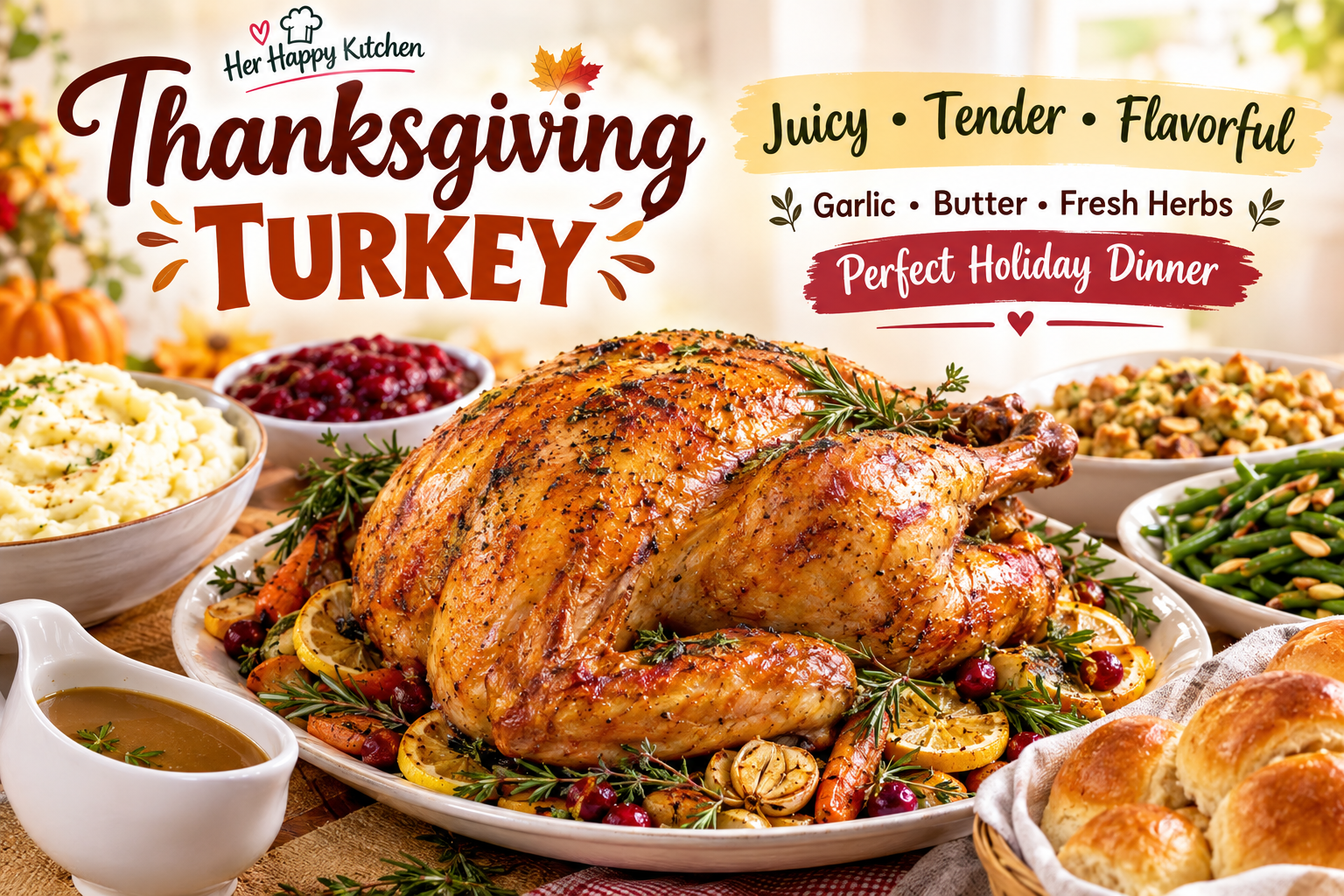
INTRODUCTION
Thanksgiving Turkey is one of the most well-known dishes associated with Thanksgiving dinner in the United States. A beautifully roasted whole turkey placed in the center of the dining table makes the meal feel special, festive and comforting.
A good Thanksgiving turkey should have flavorful, golden-brown skin on the outside while the meat remains tender and juicy inside. The turkey can be seasoned with simple ingredients such as butter, garlic, herbs, salt and black pepper. Aromatic vegetables and fresh herbs can also be added to bring more flavor to the roasting pan.
This homemade Thanksgiving Turkey recipe is designed to make the process easier to understand, even if you are preparing a whole turkey for the first time. From preparing the turkey and making the herb butter to roasting, resting, carving and serving, every important step is explained below.
Whether you are preparing a traditional Thanksgiving meal or simply want to try an American holiday-style roasted turkey, this recipe can become the centerpiece of a memorable family dinner.
- WHAT IS THANKSGIVING TURKEY?
Thanksgiving Turkey is a roasted whole turkey commonly served as part of Thanksgiving meals in the United States.
The turkey is usually seasoned before roasting and cooked until the meat reaches a safe internal temperature. It is often served with side dishes such as mashed potatoes, stuffing, gravy, cranberry sauce, roasted vegetables and dinner rolls.
The combination of tender turkey, crispy skin, flavorful gravy and comforting side dishes makes Thanksgiving dinner a popular holiday meal.
- WHY IS TURKEY ASSOCIATED WITH THANKSGIVING?
Turkey has become strongly associated with Thanksgiving in the United States because it became a common centerpiece for large holiday meals.
A whole turkey is also practical for serving a gathering because one bird can provide multiple portions.
Today, Thanksgiving dinner traditions vary from family to family. Some families serve turkey, while others choose ham, chicken, vegetarian dishes or other main courses.
- WHAT MAKES A GOOD ROASTED TURKEY?
A delicious roasted turkey depends on several important things:
- Proper seasoning
- Even roasting
- Enough cooking time
- Maintaining moisture
- Avoiding overcooking
- Allowing the turkey to rest before carving
The goal is to develop flavorful, browned skin while keeping the meat tender.
- INGREDIENTS FOR THANKSGIVING TURKEY
For the turkey:
- 1 whole turkey
- Unsalted butter
- Garlic
- Salt
- Black pepper
- Fresh rosemary
- Fresh thyme
- Fresh sage
- Lemon
- Onion
- Carrots
- Celery
For the roasting pan:
- Onion
- Carrots
- Celery
- Garlic
- Fresh herbs
- A little water or low-sodium broth
Optional:
- Paprika
- Garlic powder
- Onion powder
- Fresh parsley
- Lemon zest
- CHOOSING THE TURKEY
Choosing the right turkey is the first important step.
Fresh and frozen turkeys can both work well.
If using a frozen turkey, it needs to be completely thawed before roasting. Thawing in the refrigerator is generally the safest approach.
The size of the turkey depends on the number of people you are serving.
A larger turkey will naturally require more cooking time than a smaller one, so always follow a reliable cooking-temperature guide rather than depending only on time.
- PREPARING A FROZEN TURKEY
If your turkey is frozen, place it in the refrigerator in advance so it can thaw safely.
Keep the turkey in its original packaging while thawing and place it on a tray to catch any liquid.
Never leave a large frozen turkey sitting at room temperature for an extended period.
Once completely thawed, remove the packaging and prepare the turkey according to the recipe.
- PREPARING THE TURKEY
Before seasoning, remove the turkey from its packaging.
Check the main cavity and neck area for any packaged parts that may be included with the turkey.
Remove those pieces if present.
Pat the turkey dry using paper towels.
Drying the surface helps the butter and seasonings stick better and also helps the skin brown during roasting.
- MAKING HERB BUTTER
Herb butter gives the turkey wonderful flavor.
To make it, combine:
- Softened butter
- Minced garlic
- Chopped rosemary
- Chopped thyme
- Chopped sage
- Black pepper
- A small amount of salt
- Optional lemon zest
Mix everything until evenly combined.
The butter should be soft enough to spread easily.
- SEASONING THE TURKEY
Season the outside of the turkey generously with herb butter.
Gently separate the skin from the breast meat and spread some seasoned butter underneath the skin as well.
This helps flavor the meat while the turkey roasts.
Rub the remaining butter over the outside of the turkey.
Season with additional salt and black pepper if needed.
- ADDING AROMATIC INGREDIENTS
Place aromatics inside the turkey cavity.
You can use:
- Onion
- Lemon
- Garlic
- Rosemary
- Thyme
- Sage
These ingredients add aroma and flavor while the turkey cooks.
They are mainly used for flavoring rather than as a stuffing replacement.
- PREPARING THE ROASTING PAN
Arrange chopped onions, carrots and celery around the turkey.
Add a few garlic cloves and fresh herbs.
Pour a small amount of broth or water into the bottom of the pan.
The vegetables and liquid can contribute flavor to the roasting juices, which can later be used to make gravy.
- POSITIONING THE TURKEY
Place the turkey breast-side up on a roasting rack if you have one.
The rack allows hot air to circulate around the turkey.
If you do not have a rack, the turkey can be placed over a bed of vegetables.
Make sure the turkey is positioned securely inside the roasting pan.
- ROASTING THE TURKEY
Preheat the oven according to your turkey’s size and your trusted roasting guide.
Place the prepared turkey into the oven.
The exact cooking time depends on the turkey’s weight and whether it is stuffed.
Instead of relying only on a clock, use a food thermometer to check doneness.
- WHY A FOOD THERMOMETER IS IMPORTANT
A food thermometer is one of the most useful tools when cooking a whole turkey.
The thickest parts of the meat should reach a safe internal temperature.
Check the temperature in the thickest part of the breast and the innermost part of the thigh, avoiding contact with the bone.
For food safety, poultry should reach 165°F (74°C).
- GETTING GOLDEN-BROWN SKIN
Beautiful golden skin is one of the best parts of roasted turkey.
The key factors include:
- Drying the turkey before seasoning
- Using butter or oil
- Proper oven temperature
- Avoiding excessive moisture on the skin
- Allowing enough roasting time
If the skin becomes too dark before the turkey is fully cooked, loosely cover the darker areas with foil.
- BASTING THE TURKEY
Some cooks like to baste turkey during roasting.
Basting involves spooning pan juices over the turkey.
It can add flavor, but repeatedly opening the oven can reduce the oven temperature and extend cooking time.
For this reason, frequent basting is not always necessary.
A well-seasoned turkey can roast beautifully without constantly opening the oven.
- HOW TO KNOW WHEN TURKEY IS DONE
The safest method is checking the internal temperature.
The turkey should reach 165°F (74°C) in the appropriate thickest areas.
Do not judge doneness only by the color of the skin.
A turkey can look beautifully browned while the inside still needs more cooking.
Likewise, cooking far beyond the safe temperature can lead to drier meat.
- RESTING THE TURKEY
After removing the turkey from the oven, allow it to rest before carving.
Resting gives the juices time to redistribute throughout the meat.
Cover the turkey loosely with foil while it rests.
A resting period of around 20–30 minutes is commonly useful for a large roasted turkey.
- WHY YOU SHOULD NOT CUT THE TURKEY IMMEDIATELY
Cutting the turkey immediately after removing it from the oven can cause more juices to escape.
Allowing the turkey to rest makes carving easier and can help keep the meat moist.
Use the resting time to prepare gravy, warm side dishes and arrange the serving table.
- MAKING TURKEY GRAVY
The flavorful juices left in the roasting pan can be used to make gravy.
You can combine:
- Turkey drippings
- Butter
- Flour
- Turkey stock or broth
- Black pepper
- Salt as needed
Cook the butter and flour together to create a smooth base.
Gradually whisk in the broth and pan juices.
Continue cooking until the gravy thickens.
Taste and adjust the seasoning.
- CARVING THE TURKEY
Carving a whole turkey may look difficult, but it becomes easier with a sharp carving knife.
Start by removing the legs.
Separate the thighs and drumsticks.
Then remove the breast meat by slicing along the breastbone.
Cut the breast meat into even slices.
Arrange the meat on a large serving platter.
- SERVING THANKSGIVING TURKEY
Thanksgiving Turkey is often served with several comforting side dishes.
Popular choices include:
- Mashed potatoes
- Turkey gravy
- Stuffing
- Cranberry sauce
- Green beans
- Roasted vegetables
- Dinner rolls
- Sweet potatoes
- Corn
- Mac and cheese
You can choose a combination based on your family’s preferences.
- THANKSGIVING TURKEY WITH MASHED POTATOES
Creamy mashed potatoes are a classic companion for roasted turkey.
Boil peeled potatoes until tender.
Drain them well and mash them with butter.
Add warm milk or cream gradually until the desired consistency is reached.
Season with salt and black pepper.
Serve warm with turkey and gravy.
- TURKEY WITH CRANBERRY SAUCE
Cranberry sauce provides a sweet and slightly tangy contrast to savory roasted turkey.
You can use homemade cranberry sauce or a prepared version.
Serve a small amount alongside sliced turkey.
The sweet-tart flavor can balance the richness of the meal.
- TURKEY WITH ROASTED VEGETABLES
Roasted vegetables are another easy side dish.
Try roasting:
- Carrots
- Potatoes
- Brussels sprouts
- Broccoli
- Cauliflower
- Sweet potatoes
Season with olive oil, salt, pepper and herbs.
Roast until tender and lightly browned.
- THANKSGIVING STUFFING
Stuffing is another popular Thanksgiving side.
A simple stuffing can be made using bread cubes, onion, celery, herbs and broth.
For food safety, stuffing cooked inside a turkey needs careful temperature control.
An easier approach is to prepare stuffing separately in a baking dish.
- HOW TO KEEP TURKEY MOIST
To keep turkey moist:
- Avoid overcooking
- Use a thermometer
- Season properly
- Add herb butter under the skin
- Allow the turkey to rest
- Slice only when ready to serve
- Store leftovers properly
Overcooking is one of the most common reasons turkey becomes dry.
- HOW TO ADD MORE GARLIC FLAVOR
Garlic lovers can increase the garlic flavor by adding minced garlic to the herb butter.
Whole garlic cloves can also be placed around the roasting pan.
Garlic, rosemary, thyme and lemon create a delicious aromatic combination.
- LEMON HERB TURKEY
For a fresh flavor, add extra lemon.
Mix lemon zest into the herb butter.
Place lemon wedges inside the turkey cavity.
Fresh lemon can add brightness to the rich roasted turkey.
- GARLIC BUTTER TURKEY
Garlic butter turkey is one of the easiest flavor variations.
Combine:
- Butter
- Garlic
- Rosemary
- Thyme
- Black pepper
- Salt
Spread the mixture over and underneath the turkey skin.
Roast according to the turkey’s size and temperature requirements.
- HERB ROASTED TURKEY
For a classic herb flavor, use:
- Rosemary
- Thyme
- Sage
- Parsley
Chop the herbs finely and combine them with softened butter.
Rub the mixture over the turkey before roasting.
- SPICY TURKEY
If you enjoy mild heat, add a small amount of paprika, chili powder or cayenne pepper to the seasoning mixture.
Adjust the amount according to your taste.
The spice should complement the turkey rather than overpower its natural flavor.
- CAN YOU PREPARE TURKEY AHEAD OF TIME?
Yes, some preparation can be done in advance.
You can prepare the herb butter and chop the vegetables ahead of time.
The turkey itself should remain properly refrigerated until cooking.
Preparing ingredients ahead of time can make Thanksgiving dinner much less stressful.
- THANKSGIVING MORNING PREPARATION
On the day of the meal:
- Prepare the roasting pan
- Prepare the herb butter
- Season the turkey
- Prepare vegetables
- Preheat the oven
- Check your thermometer
- Prepare side dishes
Organizing everything before the turkey goes into the oven makes the cooking process easier.
- HOW TO HANDLE TURKEY LEFTOVERS
Leftover turkey can be used in many recipes.
Try making:
- Turkey sandwiches
- Turkey soup
- Turkey wraps
- Turkey salad
- Turkey pasta
- Turkey rice bowls
- Turkey quesadillas
Always refrigerate leftovers promptly and store them in suitable airtight containers.
- TURKEY SANDWICH
Use slices of leftover turkey with bread, lettuce, tomato and your favorite sauce.
You can also add cranberry sauce for a sweet and savory combination.
This is an easy way to turn Thanksgiving leftovers into another meal.
- TURKEY SOUP
Leftover turkey can also be added to soup.
Combine turkey with vegetables, broth and herbs.
Add noodles, rice or potatoes if desired.
Simmer until everything is hot and flavorful.
- TURKEY PASTA
Chopped cooked turkey can be mixed into pasta.
Add vegetables and a creamy or tomato-based sauce.
This creates a simple leftover meal without wasting food.
- TURKEY RICE BOWL
Add sliced turkey to cooked rice.
Top with roasted vegetables and gravy.
You can also add cranberry sauce or a fresh salad on the side.
- TIPS FOR A SUCCESSFUL THANKSGIVING TURKEY
Here are some important tips:
- Thaw the turkey completely if frozen.
- Pat it dry before seasoning.
- Use flavorful herb butter.
- Season underneath the skin when possible.
- Use a reliable food thermometer.
- Avoid opening the oven too frequently.
- Do not overcook the turkey.
- Let the turkey rest before carving.
- Prepare side dishes in advance.
- Store leftovers safely.
- COMMON TURKEY COOKING MISTAKES
Some common mistakes include:
- Cooking a partially frozen turkey
- Guessing doneness by appearance
- Skipping the thermometer
- Overcooking the meat
- Cutting immediately after roasting
- Using too much salt
- Frequently opening the oven
- Forgetting to prepare side dishes ahead of time
Avoiding these mistakes can make the cooking process easier.
- WHY RESTING MATTERS
Resting is a simple step but an important one.
When the hot turkey comes out of the oven, the meat is still very hot.
Allowing it to rest gives the juices time to settle.
This also gives you time to finish the gravy and arrange your side dishes.
- HOW TO MAKE THE DINNER TABLE BEAUTIFUL
A Thanksgiving dinner can be made more inviting with simple presentation.
Use a large serving platter for the turkey.
Arrange sliced turkey neatly.
Place colorful vegetables around the platter if desired.
Serve gravy in a separate bowl or gravy boat.
Add fresh herbs for decoration.
Keep the presentation simple and warm.
- FAMILY-STYLE THANKSGIVING DINNER
For a family-style dinner, place the turkey in the center of the table.
Arrange side dishes around it.
This allows everyone to serve themselves.
Popular combinations include:
Turkey + mashed potatoes + gravy
Turkey + stuffing + cranberry sauce
Turkey + roasted vegetables + dinner rolls
Turkey + sweet potatoes + green beans
- HOW TO MAKE TURKEY LOOK BEAUTIFUL
Presentation matters, especially for a holiday meal.
After carving, arrange the turkey slices in overlapping rows.
Add roasted vegetables around the meat.
Place herbs around the platter.
Serve gravy separately.
The result looks festive without requiring complicated decoration.
- BEST HERBS FOR TURKEY
The most useful herbs for turkey include:
- Rosemary
- Thyme
- Sage
- Parsley
Rosemary provides a strong aromatic flavor.
Thyme adds a gentle herbal note.
Sage gives turkey a classic savory flavor.
Parsley provides freshness and color.
- BEST SPICES FOR TURKEY
Simple seasonings work beautifully.
Use:
- Salt
- Black pepper
- Garlic powder
- Onion powder
- Paprika
You can adjust the seasoning according to your taste.
- CAN TURKEY BE COOKED WITHOUT BUTTER?
Yes.
Olive oil can be used instead of butter.
Brush the turkey with olive oil and season with herbs and spices.
Butter provides a rich flavor, while olive oil can help create nicely browned skin.
- CAN YOU USE FRESH OR DRIED HERBS?
Both can work.
Fresh herbs provide a bright aroma.
Dried herbs are convenient and have a concentrated flavor.
When replacing fresh herbs with dried herbs, use a smaller quantity because dried herbs are more concentrated.
- FINAL THOUGHTS
Thanksgiving Turkey is more than just a roasted main dish. It is traditionally part of a meal that brings people together around the table.
With simple ingredients, careful seasoning, proper roasting and a little patience, you can prepare a delicious turkey dinner at home.
The most important thing is to cook the turkey safely and check the internal temperature rather than relying only on appearance.
Serve your golden roasted turkey with mashed potatoes, gravy, cranberry sauce, roasted vegetables, stuffing and warm dinner rolls for a complete holiday-style meal.
Enjoy your homemade Thanksgiving Turkey with family and friends and make your dinner table warm, festive and memorable.
- THE HISTORY AND TRADITION OF THANKSGIVING TURKEY
Thanksgiving Turkey has become one of the most recognizable symbols of Thanksgiving celebrations in the United States. Although the exact foods served at early Thanksgiving gatherings varied, turkey gradually became strongly connected with the holiday meal.
Over generations, families developed their own recipes and cooking traditions. Some prepare turkey with butter and herbs, while others use different marinades, seasonings or cooking techniques.
Today, roasted turkey remains a familiar centerpiece for many Thanksgiving tables, surrounded by a variety of side dishes, sauces, vegetables and desserts.
- WHY A WHOLE TURKEY MAKES A SPECIAL CENTERPIECE
A whole roasted turkey creates a beautiful presentation when placed in the center of a dining table.
Unlike ordinary everyday meals, a whole turkey can make the dinner feel like a special occasion.
The golden skin, fresh herbs and colorful vegetables around the turkey create an inviting holiday presentation.
It can also provide plenty of meat for a family meal and leftovers for the following days.
- HOW TO PLAN YOUR THANKSGIVING TURKEY DINNER
Planning is just as important as cooking.
Before preparing the turkey, make a list of everything you want to serve.
A simple menu could include:
- Roasted turkey
- Mashed potatoes
- Turkey gravy
- Cranberry sauce
- Stuffing
- Roasted vegetables
- Dinner rolls
- Sweet potatoes
- A simple salad
- Pumpkin pie
Once the menu is decided, make a shopping list.
This prevents last-minute trips to the store and makes the cooking day more organized.
- MAKING A THANKSGIVING SHOPPING LIST
Your shopping list can be divided into categories.
Turkey ingredients:
- Whole turkey
- Butter or olive oil
- Garlic
- Fresh herbs
- Salt
- Black pepper
- Lemon
Vegetables:
- Onion
- Carrots
- Celery
- Potatoes
- Green beans
- Sweet potatoes
Gravy ingredients:
- Turkey stock
- Butter
- Flour
- Black pepper
Side dishes:
- Bread
- Cranberries
- Milk
- Cheese
- Additional herbs
A well-organized list makes preparation much easier.
- HOW TO ESTIMATE TURKEY SIZE
The size of the turkey should depend on the number of people eating.
If you want leftovers, plan for additional turkey.
A larger turkey is useful for a big gathering, while a smaller turkey may be more practical for a small family.
Cooking time will vary depending on the size, whether the turkey is stuffed and the specific oven.
Always rely on the turkey’s internal temperature rather than using a fixed cooking time alone.
- FRESH TURKEY VS FROZEN TURKEY
Both fresh and frozen turkey can produce a delicious meal.
Fresh turkey does not require thawing, which can make preparation easier.
Frozen turkey can be purchased earlier and stored until needed, but it requires enough time to thaw safely.
The most important thing is planning.
If using frozen turkey, do not wait until the last moment to thaw it.
- SAFE THAWING OF TURKEY
A large frozen turkey requires significant time to thaw.
Refrigerator thawing is generally the safest method.
Place the packaged turkey on a tray or in a container to prevent juices from leaking onto other foods.
Keep the refrigerator cold and allow enough time for complete thawing.
Never assume that the outside being soft means the entire turkey is thawed.
The inside should also be completely thawed before cooking.
- WHAT TO DO AFTER THE TURKEY IS THAWED
Once the turkey has completely thawed, remove it from its packaging.
Check the cavity for any included packets.
Remove them according to the package instructions.
Pat the turkey dry with paper towels.
Do not wash raw turkey unnecessarily because splashing water can spread bacteria around the kitchen.
Clean and sanitize surfaces that come into contact with raw poultry.
- PREPARING THE KITCHEN
Before starting, prepare your workspace.
Keep the following ready:
- Cutting board
- Sharp knife
- Roasting pan
- Roasting rack
- Paper towels
- Mixing bowl
- Measuring spoons
- Food thermometer
- Kitchen tongs
- Aluminum foil
- Serving platter
Having everything ready prevents unnecessary movement around the kitchen.
- KEEPING RAW TURKEY SEPARATE
Raw poultry should be kept away from ready-to-eat foods.
Use separate cutting boards and utensils whenever possible.
Wash hands thoroughly after handling raw turkey.
Clean countertops, cutting boards and utensils after preparation.
Food safety is especially important when preparing a large meal because many dishes are being made at the same time.
- PREPARING THE HERB BUTTER IN DETAIL
For a flavorful herb butter, allow the butter to soften at room temperature.
Add minced garlic and finely chopped herbs.
Rosemary, thyme and sage are especially good choices.
Add black pepper and a suitable amount of salt.
For a fresh flavor, add a little lemon zest.
Mix everything thoroughly.
The finished butter should have herbs and garlic evenly distributed throughout.
- WHY BUTTER IS PLACED UNDER THE SKIN
The turkey skin acts as a layer between the seasoning and the breast meat.
Gently separating the skin from the breast allows some of the seasoned butter to sit closer to the meat.
As the turkey roasts, the butter melts and contributes flavor.
Be careful not to tear the skin while doing this.
Use clean hands or a spoon and work gently.
- HOW TO APPLY BUTTER WITHOUT DAMAGING THE SKIN
Start at the edge of the breast skin.
Gently slide your fingers underneath.
Create enough space to spread a thin layer of herb butter.
Do not force your fingers deeply.
Once the butter is distributed, gently press the skin back into place.
Rub additional butter over the outside.
- SEASONING FROM EVERY SIDE
A turkey should be seasoned evenly.
Apply seasoning over:
- Breast
- Thighs
- Drumsticks
- Wings
- Back if accessible
Do not forget the areas around the legs.
Even seasoning helps every bite have flavor.
- ADDING FLAVOR TO THE CAVITY
The cavity can hold aromatic ingredients.
Try:
- Quartered onion
- Lemon halves
- Garlic cloves
- Rosemary
- Thyme
- Sage
These ingredients release aroma as the turkey cooks.
Do not pack the cavity tightly.
Good airflow and proper cooking are important.
- VEGETABLE BED FOR THE TURKEY
A bed of vegetables can be placed underneath the turkey.
Use:
- Carrots
- Celery
- Onion
Cut them into large pieces.
Add garlic and herbs.
Place the turkey on top.
As the turkey roasts, its juices combine with the vegetables and create flavorful liquid for gravy.
- ROASTING PAN LIQUID
A small amount of broth or water can be added to the bottom of the roasting pan.
The liquid helps prevent the drippings from burning too quickly.
Do not add too much liquid because excessive steam can affect browning.
The goal is to have enough liquid to support the pan juices while allowing the turkey skin to roast properly.
- OVEN PREPARATION
Preheat the oven before placing the turkey inside.
An adequately preheated oven helps the turkey begin cooking immediately.
Check that the oven rack is positioned low enough to accommodate the roasting pan.
Make sure the turkey has enough space around it for hot air to circulate.
- WHY OVEN TEMPERATURE MATTERS
The oven temperature affects both cooking time and browning.
If the temperature is too low, the turkey may take much longer to cook.
If the temperature is too high, the outside can brown too quickly before the inside is finished.
A reliable recipe and food thermometer should be used together.
- CHECKING THE TURKEY DURING ROASTING
Try not to open the oven repeatedly.
Every time the oven door opens, heat escapes.
Instead, check the turkey when appropriate according to your cooking plan.
Use a thermometer to monitor the internal temperature near the end of cooking.
- USING FOIL DURING ROASTING
If the breast becomes dark before the rest of the turkey reaches the required temperature, loosely cover the breast with foil.
The foil can reduce direct heat on the browned surface.
Do not wrap the entire turkey tightly.
You want the heat to continue circulating while protecting the areas that are already sufficiently browned.
- TURKEY WINGS AND LEGS
The wings and legs can brown more quickly because they are exposed.
If needed, tuck the wing tips underneath the turkey before roasting.
This can help protect them from excessive browning.
The legs should remain positioned naturally and securely.
- CHECKING THE BREAST TEMPERATURE
Insert the food thermometer into the thickest part of the breast.
Avoid touching the bone because it can affect the reading.
The turkey should reach the safe internal temperature recommended for poultry.
For turkey, 165°F (74°C) is the food-safety target.
- CHECKING THE THIGH
The thickest part of the thigh should also be checked.
Insert the thermometer without touching the bone.
Checking more than one area provides a better indication that the whole turkey has cooked safely.
- WHY COLOR IS NOT ENOUGH
Many people assume that clear juices or golden skin automatically mean turkey is fully cooked.
Appearance alone is not a reliable safety test.
A food thermometer provides a much more dependable way to determine whether the turkey has reached the appropriate internal temperature.
- RESTING THE TURKEY CORRECTLY
Once the turkey reaches the appropriate temperature, remove it from the oven.
Transfer it carefully to a carving board or leave it on a suitable serving setup.
Cover loosely with foil.
Allow it to rest before carving.
During this time, the juices redistribute and the turkey becomes easier to slice.
- WHAT TO DO WHILE THE TURKEY RESTS
The resting period is perfect for finishing the rest of the meal.
You can:
- Make gravy
- Warm mashed potatoes
- Heat dinner rolls
- Prepare cranberry sauce
- Finish vegetables
- Set the table
- Arrange serving dishes
This helps ensure everything reaches the table at approximately the same time.
- MAKING RICH TURKEY GRAVY
Begin by collecting the flavorful juices from the roasting pan.
If needed, strain the liquid to remove large pieces of vegetables or herbs.
Melt butter in a saucepan.
Add flour and whisk until smooth.
Slowly add turkey stock while continuously whisking.
Add the roasting juices.
Cook gently until the gravy thickens.
Season with black pepper and salt only if necessary.
- HOW TO AVOID LUMPY GRAVY
The key to smooth gravy is gradual liquid addition.
Do not pour all the broth into the flour mixture at once.
Add a little at a time while whisking continuously.
Once the mixture becomes smooth, add more liquid.
Continue until the desired consistency is reached.
- MAKING GRAVY MORE FLAVORFUL
For extra flavor, use the roasting-pan juices.
You can also add:
- Fresh thyme
- Black pepper
- A little garlic
- Turkey stock
- Roasted vegetable juices
Taste before adding extra salt because the turkey drippings and stock may already contain salt.
- HOW TO FIX THIN GRAVY
If your gravy is too thin, continue simmering it gently.
You can also prepare a small flour-and-water mixture and add it gradually while whisking.
Avoid adding a large amount at once.
The gravy will continue thickening as it cools slightly.
- HOW TO FIX THICK GRAVY
If gravy becomes too thick, gradually add warm turkey stock or water.
Whisk continuously.
Add only a small amount at a time until the desired consistency is reached.
- CLASSIC MASHED POTATOES
Mashed potatoes are one of the easiest side dishes to pair with turkey.
Peel and cut potatoes into similar-sized pieces.
Place them in a pot of water.
Cook until tender.
Drain completely.
Mash while hot.
Add butter and warm milk gradually.
Season with salt and black pepper.
Serve with turkey gravy.
- CREAMY GARLIC MASHED POTATOES
For a garlic version, cook a few garlic cloves with the potatoes or roast garlic separately.
Mash the softened garlic into the potatoes.
Add butter and warm milk.
The result is creamy, rich and flavorful.
Garlic mashed potatoes pair especially well with roasted turkey.
- SWEET POTATO SIDE DISH
Sweet potatoes can add natural sweetness to the Thanksgiving table.
You can roast them with:
- Olive oil
- Salt
- Black pepper
- Cinnamon
- A little maple syrup
Alternatively, serve them as a simple mashed sweet potato side.
- GREEN BEANS FOR THANKSGIVING
Fresh green beans provide color and freshness.
Cook them until tender but still slightly crisp.
You can sauté them with garlic and a little butter.
Add black pepper and a small amount of lemon juice.
This simple side dish balances the richness of turkey and gravy.
- ROASTED CARROTS
Roasted carrots are easy to prepare.
Cut carrots into similar-sized pieces.
Toss with olive oil, salt and black pepper.
Add thyme or rosemary.
Roast until tender and lightly caramelized.
They can be served directly alongside the turkey.
- BRUSSELS SPROUTS
Brussels sprouts can be roasted until their outer leaves become crisp.
Toss them with olive oil, salt and pepper.
Add garlic if desired.
Roasted Brussels sprouts provide a slightly nutty flavor that pairs nicely with turkey.
- THANKSGIVING DINNER ROLLS
Warm dinner rolls are perfect for serving alongside turkey and gravy.
You can use homemade rolls or store-bought rolls.
Warm them shortly before serving.
Serve with butter.
- CRANBERRY SAUCE
Cranberry sauce adds a bright and tangy flavor.
The sweet-tart taste provides contrast to savory turkey, mashed potatoes and gravy.
You can serve it chilled, at room temperature or slightly warm depending on preference.
- HOMEMADE CRANBERRY SAUCE
A simple homemade cranberry sauce can be prepared with:
- Fresh cranberries
- Sugar
- Water
- Orange zest
- Orange juice
Simmer until the cranberries soften and begin to burst.
Allow the sauce to cool.
It will thicken naturally as it cools.
- ORANGE CRANBERRY SAUCE
Orange and cranberry make a delicious combination.
Add orange zest and a little orange juice to your cranberry sauce.
The citrus flavor gives the sauce a fresh aroma.
Serve a small spoonful with sliced turkey.
- SIMPLE THANKSGIVING SALAD
A fresh salad can balance a rich holiday meal.
Combine:
- Lettuce
- Spinach
- Apple slices
- Cucumber
- Carrot
- Nuts if desired
Add a light dressing.
Keep the salad simple because the main meal already contains many rich flavors.
- APPLE AND TURKEY COMBINATION
Apple slices can add sweetness and freshness.
A salad containing apples can pair beautifully with turkey.
You can combine apples with greens, walnuts and a light dressing.
This creates a refreshing side dish.
- THANKSGIVING TABLE COLOR
A holiday meal looks more attractive when different colors are included.
Golden turkey provides the centerpiece.
Green vegetables add freshness.
Cranberry sauce provides a deep red color.
Mashed potatoes and gravy add warm neutral tones.
Roasted carrots and sweet potatoes add orange and golden colors.
- SIMPLE TABLE DECORATION
You do not need expensive decorations.
Use:
- Fresh herbs
- Small pumpkins
- Napkins
- Candles used safely
- Seasonal flowers
- Wooden or ceramic serving dishes
Keep decorations away from food and anything that could become a fire hazard.
- SERVING TURKEY FOR A LARGE FAMILY
For a large gathering, carve the turkey before placing it on the table.
This makes serving easier.
Arrange breast slices, thigh meat and drumstick pieces on a large platter.
Place vegetables around the edges.
Serve gravy separately.
- SERVING TURKEY FOR A SMALL FAMILY
For a smaller meal, a smaller turkey may be more practical.
You can still serve the traditional side dishes.
If there are leftovers, store them properly and use them for sandwiches, soups or other meals.
- HOW TO KEEP THE MEAL ORGANIZED
The best way to manage a large Thanksgiving dinner is to prepare as much as possible in advance.
Make cranberry sauce earlier.
Prepare vegetables ahead.
Prepare mashed potatoes close to serving time.
Have the gravy ingredients ready.
Keep serving plates and utensils prepared.
This allows you to focus on the turkey when it is cooking.
- A SIMPLE THANKSGIVING COOKING SCHEDULE
A basic schedule can look like this:
Morning:
- Check the turkey
- Prepare vegetables
- Prepare herb butter
- Organize side dishes
Before roasting:
- Season turkey
- Prepare roasting pan
- Preheat oven
- Insert turkey
While turkey roasts:
- Prepare side dishes
- Make cranberry sauce
- Prepare gravy ingredients
- Set the table
After roasting:
- Rest turkey
- Finish gravy
- Warm side dishes
- Carve turkey
- Serve dinner
- HOW TO MAKE THANKSGIVING TURKEY FEEL HOMEMADE
The best homemade flavor often comes from simple ingredients.
Fresh garlic, herbs, lemon, butter and vegetables can create a rich aroma without requiring complicated sauces.
Instead of using too many seasonings, focus on good-quality ingredients and proper cooking.
- SIMPLE HERB COMBINATION
A classic herb combination includes:
Rosemary + Thyme + Sage
These herbs work especially well with roasted turkey.
Add garlic and black pepper for additional savory flavor.
- GARLIC AND LEMON COMBINATION
Garlic and lemon can make turkey taste fresh and flavorful.
Use lemon zest in the butter.
Add lemon pieces to the cavity.
Use garlic in the herb butter and roasting pan.
The combination creates a bright aromatic flavor.
- BUTTER VS OLIVE OIL
Butter provides a rich, creamy flavor.
Olive oil provides a lighter alternative and can help the skin brown.
You can also combine the two.
Use whichever flavor profile suits your meal.
- SHOULD YOU BRINE TURKEY?
Brining is a preparation method in which turkey is exposed to a seasoned salt solution or dry salt mixture before cooking.
Some cooks use brining to enhance seasoning and moisture.
If you decide to brine, follow a trusted food-safe method and account for the salt already present in the turkey.
A properly seasoned turkey does not necessarily require complicated preparation.
- DRY BRINING
Dry brining involves seasoning the turkey with salt and allowing it to rest refrigerated before roasting.
This can help season the meat more deeply and can also help dry the skin.
If using a dry-brined turkey, be careful about adding additional salt later.
- WET BRINING
Wet brining involves placing the turkey in a seasoned liquid solution.
The turkey must remain properly refrigerated.
The container should be large enough to hold the turkey safely.
Because wet brining requires more space and planning, some home cooks prefer dry brining.
- WHEN TO SEASON TURKEY
For simple preparation, seasoning can be done shortly before roasting.
For deeper seasoning, some methods recommend seasoning ahead of time.
If seasoning ahead, keep the turkey refrigerated and covered appropriately.
Never leave raw turkey sitting at room temperature for long periods.
- TURKEY SKIN CRISPINESS
Crispy skin depends on several factors.
The skin should be reasonably dry.
Too much moisture can interfere with browning.
Butter or oil helps with color.
Correct oven temperature also matters.
Avoid repeatedly opening the oven because it can affect cooking conditions.
- WHY RESTING IMPROVES CARVING
A rested turkey is easier to carve because the meat is less likely to slide around.
The juices also have time to settle.
Use a stable cutting board and a sharp knife.
Carve carefully and keep your fingers away from the knife blade.
- HOW TO CARVE THE BREAST
Locate the breastbone.
Make a long cut along one side of the breastbone.
Follow the bone while gently separating the meat.
Once the breast is removed, place it on the cutting board.
Slice it across the grain into even pieces.
- HOW TO CARVE THE THIGH
Pull the leg gently away from the body.
Cut through the joint.
Separate the thigh from the drumstick if desired.
Slice the thigh meat into smaller pieces.
Arrange it with the breast meat on the serving platter.
- HOW TO CARVE THE DRUMSTICK
The drumstick can be served whole or sliced.
Hold it securely with tongs or a carving fork.
Cut around the joint if separating it from the thigh.
Place the drumsticks on the serving platter.
- HOW TO CARVE TURKEY WINGS
Turkey wings can be separated at their joints.
They contain flavorful meat and can be served alongside the other pieces.
Use a carving knife carefully around the joints.
- SAVING THE TURKEY BONES
Do not throw away useful turkey bones.
They can be used to make homemade stock.
Place the bones in a large pot with vegetables such as onion, carrot and celery.
Add water and simmer according to a trusted stock recipe.
Strain the finished stock.
- HOMEMADE TURKEY STOCK
Turkey stock can be used for:
- Gravy
- Soup
- Rice
- Stuffing
- Sauces
Homemade stock can add deep flavor to leftover meals.
- THANKSGIVING TURKEY SOUP
After the holiday meal, leftover turkey can become a comforting soup.
Use:
- Cooked turkey
- Carrots
- Celery
- Onion
- Broth
- Herbs
Add noodles or rice if desired.
Cook until the vegetables are tender and the soup is hot.
- CREAMY TURKEY SOUP
For a creamy leftover soup, add cooked turkey to a vegetable and broth base.
Finish with milk or cream.
Add black pepper and herbs.
Serve warm with bread.
- TURKEY SALAD
Chopped turkey can be mixed with:
- Mayonnaise or yogurt
- Celery
- Apple
- Black pepper
- Herbs
Serve in sandwiches or over lettuce.
- TURKEY WRAPS
Place sliced turkey inside a tortilla.
Add lettuce, tomato, cucumber and a sauce.
Roll tightly and cut in half.
This makes an easy leftover lunch.
- TURKEY AND CHEESE SANDWICH
Use leftover turkey with cheese, lettuce and tomato.
Toast the bread if desired.
Add cranberry sauce for a Thanksgiving-inspired flavor.
- TURKEY AND MAC AND CHEESE
Leftover turkey can be mixed with macaroni and cheese.
Add chopped turkey to the finished pasta.
Bake briefly if desired.
This creates a rich comfort-food meal.
- TURKEY RICE CASSEROLE
Combine cooked rice, turkey, vegetables and a creamy sauce.
Place in a baking dish.
Top with cheese or breadcrumbs if desired.
Bake until hot.
- TURKEY POT PIE
Turkey pot pie is another classic way to use leftovers.
Combine cooked turkey with vegetables and a creamy sauce.
Place the mixture beneath pastry.
Bake until the pastry becomes golden and crisp.
- HOW TO STORE LEFTOVER TURKEY
Remove meat from the bones when practical.
Place leftovers in shallow airtight containers.
Refrigerate promptly.
Do not leave cooked turkey sitting at room temperature for extended periods.
Use refrigerated leftovers within the recommended food-safety timeframe.
- FREEZING TURKEY LEFTOVERS
Turkey leftovers can also be frozen.
Place portions in freezer-safe containers or bags.
Label them with the date.
Freeze promptly.
Thaw frozen leftovers safely in the refrigerator before reheating.
- REHEATING TURKEY
Reheat leftovers until they are thoroughly hot.
Avoid repeatedly reheating the same portion.
Only heat the amount you plan to eat.
Adding a little broth or gravy can help prevent sliced turkey from becoming too dry.
- HOW TO REHEAT TURKEY WITH GRAVY
Place sliced turkey in a baking dish.
Add a little gravy or broth.
Cover the dish.
Heat until the turkey is thoroughly hot.
This method can help retain moisture.
- THANKSGIVING TURKEY FOR BEGINNERS
If this is your first time preparing a whole turkey, do not make the recipe unnecessarily complicated.
Focus on the basics:
- Proper thawing
- Clean preparation
- Good seasoning
- Correct roasting
- Temperature checking
- Resting
- Careful carving
These steps are more important than using dozens of ingredients.
- SIMPLE BEGINNER FORMULA
A beginner-friendly turkey formula is:
Turkey + Butter + Garlic + Herbs + Salt + Pepper + Lemon + Vegetables
This combination creates a classic flavor profile without requiring complicated ingredients.
- HOW TO MAKE THE TURKEY AROMATIC
Fresh herbs can be placed around the turkey and inside the cavity.
Garlic and onion add depth.
Lemon adds freshness.
Carrots and celery contribute additional aroma.
Together, these ingredients create the familiar smell of a roasted holiday dinner.
- HOW TO BALANCE FLAVORS
Turkey is savory and rich.
Balance it with:
- Tangy cranberry sauce
- Fresh salad
- Roasted vegetables
- Lemon
- Herbs
This prevents the meal from feeling too heavy.
- SWEET AND SAVORY BALANCE
Thanksgiving meals often include both sweet and savory flavors.
Turkey and gravy are savory.
Cranberry sauce provides sweetness and acidity.
Sweet potatoes add natural sweetness.
Dinner rolls provide a mild, comforting flavor.
The combination makes the meal varied and satisfying.
- THANKSGIVING TURKEY WITH GARLIC HERB GRAVY
For an extra flavorful meal, make garlic herb gravy using the turkey drippings.
Add a small amount of garlic and fresh thyme.
Whisk into the gravy carefully.
Do not use too much garlic because the turkey already contains garlic flavor.
- TURKEY WITH ROSEMARY BUTTER
Rosemary butter is a simple variation.
Mix softened butter with finely chopped rosemary, garlic and black pepper.
Rub it over the turkey before roasting.
The rosemary aroma becomes stronger as the turkey cooks.
- TURKEY WITH SAGE BUTTER
Sage is traditionally associated with many holiday-style recipes.
Chop fresh sage finely.
Mix it into softened butter.
Spread under the turkey skin and over the outside.
The result is deeply aromatic.
- TURKEY WITH THYME AND GARLIC
Thyme and garlic provide a balanced savory flavor.
Mix both into butter or olive oil.
Rub the mixture over the turkey.
Add extra thyme to the roasting pan.
- SIMPLE PAPRIKA TURKEY
Paprika can provide color and a mild warm flavor.
Combine paprika with garlic powder, black pepper and salt.
Rub lightly over the turkey.
Be careful not to use too much paprika if you want the classic herb-forward flavor to remain dominant.
- HOW TO AVOID OVER-SEASONING
More seasoning does not always mean more flavor.
Use salt carefully.
Remember that butter, broth and gravy may also contain salt.
Taste the gravy before adding additional salt.
If you are using a pre-seasoned or brined turkey, reduce additional salt.
- HOW TO MAKE THE TURKEY DINNER FEEL SPECIAL
The atmosphere can be as important as the food.
Serve the turkey on a beautiful platter.
Arrange colorful side dishes around it.
Use fresh herbs as garnish.
Serve warm bread.
Prepare gravy in a separate serving bowl.
Keep the table comfortable and welcoming.
- THANKSGIVING DINNER FOR CHILDREN
If children are part of the meal, keep some dishes simple.
Offer:
- Plain turkey slices
- Mashed potatoes
- Dinner rolls
- Corn
- Carrots
- Simple fruit
Not every dish needs strong seasoning.
- SIMPLE SIDE DISH FOR A CROWD
Roasted potatoes are easy to make in large quantities.
Cut potatoes into similar pieces.
Season with olive oil, garlic, salt and herbs.
Roast until golden.
They can be prepared alongside other vegetables.
- CORN AS A THANKSGIVING SIDE
Corn can be served simply with butter and black pepper.
It provides sweetness and color.
Frozen, canned or fresh corn can be used depending on availability.
- HOMEMADE DINNER ROLLS
If you enjoy baking, homemade rolls can be prepared in advance.
Serve them warm with butter.
They are especially delicious when dipped into turkey gravy.
- THANKSGIVING TURKEY PLATTER
For a beautiful platter:
Start with sliced turkey.
Place larger pieces in the center.
Add smaller pieces around the edges.
Garnish with rosemary and thyme.
Add roasted carrots or other colorful vegetables.
Keep the arrangement natural rather than overcrowding the plate.
- FOOD PHOTOGRAPHY TIPS FOR TURKEY
If you are photographing your Thanksgiving Turkey for a food blog, Pinterest or social media, use natural light whenever possible.
Place the turkey near a bright window.
Use a neutral background.
Include small bowls of gravy, cranberry sauce and herbs.
Photograph the whole turkey first.
Then take close-up photos of the sliced meat and crispy skin.
- BEST ANGLES FOR TURKEY PHOTOS
A slightly angled front view can show the entire turkey.
A closer shot can highlight the golden skin.
An overhead photo can show the complete Thanksgiving table.
A carving photo can show the tender slices and serving process.
- FOOD BLOG FEATURE IMAGE IDEA
For a website feature image, place the golden roasted turkey in the center.
Add mashed potatoes, gravy, cranberry sauce and vegetables around it.
Use warm natural lighting.
Keep the background clean.
A simple text overlay can say:
“Thanksgiving Turkey”
“Juicy • Tender • Flavorful”
“Her Happy Kitchen”
- PINTEREST IMAGE IDEA
For a Pinterest pin, use a vertical composition.
Place the turkey prominently in the lower or center portion.
Use large readable text:
“THANKSGIVING TURKEY”
“Juicy & Tender”
“Easy Holiday Dinner”
Add small visual elements such as herbs, gravy and cranberry sauce.
Keep the title readable on a mobile screen.
- SEO KEYWORDS FOR THANKSGIVING TURKEY
Useful keywords include:
- Thanksgiving turkey recipe
- Thanksgiving turkey
- roasted turkey recipe
- easy turkey recipe
- juicy turkey recipe
- herb roasted turkey
- garlic butter turkey
- holiday turkey recipe
- Thanksgiving dinner
- turkey dinner recipe
- homemade turkey recipe
- roasted Thanksgiving turkey
- turkey gravy recipe
- holiday dinner ideas
- American Thanksgiving food
- FINAL RECIPE CHECKLIST
Before cooking:
☐ Turkey completely thawed
☐ Ingredients prepared
☐ Herb butter ready
☐ Vegetables chopped
☐ Roasting pan ready
☐ Food thermometer available
☐ Oven preheated
During cooking:
☐ Turkey roasting evenly
☐ Skin browning properly
☐ Temperature checked
☐ Foil used if necessary
After cooking:
☐ Turkey reached safe internal temperature
☐ Turkey rested
☐ Gravy prepared
☐ Side dishes warmed
☐ Turkey carved carefully
☐ Dinner served
- COMPLETE THANKSGIVING TURKEY MEAL
A complete holiday plate can include:
Golden roasted turkey
Creamy mashed potatoes
Rich turkey gravy
Tangy cranberry sauce
Roasted carrots
Green beans
Warm dinner rolls
A small fresh salad
This combination gives the table a variety of colors, textures and flavors.
- WHY THIS RECIPE WORKS
This Thanksgiving Turkey recipe focuses on simple techniques rather than complicated ingredients.
The herb butter provides richness.
Garlic and herbs provide aroma.
Lemon adds freshness.
Vegetables add flavor to the roasting pan.
Proper temperature checking helps with food safety.
Resting helps make carving easier.
Together, these steps create a classic homemade holiday-style turkey dinner.
- FINAL SERVING IDEA
Place the sliced turkey on a large platter.
Add fresh rosemary and thyme around the edges.
Serve mashed potatoes in a separate bowl.
Place gravy beside the turkey.
Add cranberry sauce in a small serving dish.
Arrange roasted vegetables around the table.
Warm dinner rolls just before serving.
This creates a beautiful and inviting Thanksgiving dinner.
- FINAL CONCLUSION
Thanksgiving Turkey is a traditional centerpiece that can turn an ordinary dinner into a memorable holiday meal.
You do not need complicated cooking techniques to make a delicious turkey. Careful preparation, flavorful seasoning, proper roasting and safe temperature checking are the most important steps.
Use butter, garlic and fresh herbs for a classic flavor. Add lemon for freshness and vegetables for aroma. Allow the turkey to rest before carving and serve it with comforting side dishes such as mashed potatoes, gravy, cranberry sauce, roasted vegetables and warm dinner rolls.
Most importantly, take your time and organize the cooking process. Preparing several ingredients ahead of time makes the actual dinner much easier to manage.
Once the turkey is served and everyone sits around the table, the meal becomes more than just food. It becomes a warm family-style dining experience centered around good food, conversation and togetherness.
Save this Thanksgiving Turkey recipe for your next holiday-inspired dinner and enjoy a beautifully roasted, flavorful homemade turkey with your favorite sides.
- THANKSGIVING TURKEY – THE HEART OF A HOLIDAY MEAL
A beautifully roasted Thanksgiving Turkey can become the centerpiece of the entire dinner table. Its golden appearance, rich aroma and comforting flavor make it perfect for a special family meal.
The turkey does not have to be complicated. With a simple combination of butter, garlic, herbs, salt, pepper and fresh vegetables, you can create a flavorful roasted turkey that feels special without requiring an overly complicated recipe.
The secret is to focus on preparation, seasoning, temperature and resting.
- THE IMPORTANCE OF PREPARATION
Before starting the cooking process, prepare everything you need.
Take the turkey, ingredients, roasting pan, thermometer, carving knife and serving platter out and organize them.
Prepare the herb butter before handling the turkey.
Chop the vegetables.
Prepare the herbs.
Have the broth ready.
This simple preparation can make the cooking process much smoother.
- KEEPING THE TURKEY FLAVORFUL
A turkey has a mild natural flavor, which makes it perfect for herbs and seasonings.
Garlic gives it a savory aroma.
Rosemary adds a strong herbal note.
Thyme provides a gentle earthy flavor.
Sage gives the turkey a classic holiday-style aroma.
Lemon adds brightness.
Butter adds richness.
Together, these ingredients create a balanced flavor.
- HOW TO MAKE EVERY BITE TASTY
Seasoning only the outside of the turkey may not provide enough flavor throughout the meat.
That is why herb butter can be gently placed under the breast skin.
Season the exterior as well.
The roasting pan can also contain aromatic vegetables and herbs.
This creates multiple layers of flavor.
- AROMATIC VEGETABLES FOR ROASTING
The roasting pan can contain:
- Onion
- Carrot
- Celery
- Garlic
- Rosemary
- Thyme
As the turkey cooks, the vegetables become infused with flavorful juices.
These juices can then be used as part of the gravy.
- MAKING A BEAUTIFUL GOLDEN TURKEY
A golden-brown turkey looks especially attractive on a holiday table.
Pat the turkey dry before applying butter.
Spread the butter evenly.
Avoid adding excessive liquid directly over the skin.
Roast according to a reliable temperature guide.
If one area browns too quickly, loosely cover that area with foil.
- THE ROLE OF RESTING
Resting the turkey after roasting is an important final cooking step.
Do not rush directly into carving.
Allow the turkey to rest for around 20–30 minutes, depending on its size.
This gives you time to finish the gravy and arrange the side dishes.
- CARVING WITHOUT MAKING A MESS
Place the rested turkey on a stable cutting board.
Use a sharp carving knife.
Remove the legs first.
Then separate the thigh meat.
Remove the breast meat carefully.
Slice the breast into even pieces.
Arrange everything on a large serving platter.
- HOW TO MAKE TURKEY SLICES LOOK BEAUTIFUL
Place the breast slices slightly overlapping each other.
Arrange darker meat on another side of the platter.
Add drumsticks and wings around the edges.
Garnish with fresh rosemary and thyme.
You can add roasted carrots or other colorful vegetables for decoration.
- SERVING GRAVY
Gravy can be served in a separate bowl or gravy boat.
This allows everyone to add the amount they prefer.
Warm gravy should be served shortly after the turkey is carved.
If the gravy becomes too thick while sitting, add a little warm stock and whisk until smooth.
- HOW TO MAKE A SIMPLE HOLIDAY PLATE
A beautiful Thanksgiving plate can contain:
- Sliced turkey
- Mashed potatoes
- Turkey gravy
- Cranberry sauce
- Green beans
- Roasted carrots
- Dinner roll
This gives the plate a combination of savory, sweet, creamy and fresh flavors.
- ADDING A FRESH ELEMENT
Because many Thanksgiving dishes are rich, a fresh side can balance the meal.
A simple green salad with lettuce, cucumber, apple slices and a light dressing works well.
Fresh herbs can also provide color and aroma.
- THANKSGIVING TURKEY AND APPLES
Apples can be used in side dishes or salads.
Their natural sweetness works well with savory turkey.
Try serving sliced apples in a fresh salad with greens and a light dressing.
This adds a crisp texture to the meal.
- THANKSGIVING TURKEY AND CRANBERRIES
Cranberries are another excellent flavor pairing.
Their tartness contrasts with the rich turkey and gravy.
Serve cranberry sauce in a small bowl or add a spoonful directly to each plate.
- TURKEY WITH ROASTED GARLIC
Roasted garlic becomes softer and milder than raw garlic.
It can be mixed into butter or mashed potatoes.
Roasted garlic mashed potatoes served with turkey and gravy make a comforting combination.
- MAKING THE TURKEY DINNER LESS STRESSFUL
A holiday dinner can involve many dishes, so organization is important.
Do not try to cook everything at the same time.
Prepare sauces and some vegetables earlier.
Set the table before the turkey is finished.
Keep serving dishes ready.
Use the turkey’s resting time to complete the final steps.
- PREPARING SIDES AHEAD
Some side dishes can be prepared before the turkey is ready.
Cranberry sauce can be prepared well ahead.
Vegetables can be washed and chopped.
Mashed potatoes can be prepared close to serving time and kept warm appropriately.
Gravy ingredients can be measured beforehand.
- MAKING A HOLIDAY MEAL PLAN
Write down your menu.
Next to every dish, write:
- Ingredients
- Preparation time
- Cooking time
- Serving dish
This simple plan can help prevent confusion when several dishes are being prepared.
- SIMPLE THANKSGIVING MENU
Here is an easy menu:
MAIN DISH
Herb Roasted Thanksgiving Turkey
SIDES
Creamy Mashed Potatoes
Garlic Green Beans
Roasted Carrots
Cranberry Sauce
Warm Dinner Rolls
SAUCE
Homemade Turkey Gravy
DESSERT
Apple Pie or Pumpkin Pie
- WHY SIMPLE SIDE DISHES WORK
The turkey should remain the main attraction.
Side dishes should complement it rather than overpower it.
Simple mashed potatoes, roasted vegetables and cranberry sauce allow the turkey’s flavor to remain noticeable.
- THANKSGIVING TURKEY FOR A FIRST-TIME COOK
If you have never cooked a whole turkey before, remember that it is normal to feel nervous.
Take the process step by step.
First prepare the turkey.
Then season it.
Place it in the roasting pan.
Roast it according to a reliable guide.
Check the internal temperature.
Allow it to rest.
Carve and serve.
Following these steps makes the process easier to understand.
- DO NOT RELY ONLY ON COOKING TIME
Turkey sizes differ.
Ovens also differ.
Therefore, a recipe’s estimated cooking time should be treated as a guide.
The final decision about doneness should be based on the internal temperature.
- USING A DIGITAL THERMOMETER
A digital food thermometer can make turkey cooking much easier.
Insert it into the thickest portion of the meat.
Avoid touching bone.
Check the appropriate areas.
The turkey should reach 165°F (74°C) for food safety.
- TURKEY SAFETY REMINDER
Raw turkey should always be handled carefully.
Keep it refrigerated until preparation.
Wash hands after handling raw poultry.
Keep raw turkey away from ready-to-eat foods.
Clean utensils and surfaces properly.
Cook turkey thoroughly.
Refrigerate leftovers promptly.
- CLEANING AFTER TURKEY PREPARATION
After preparing raw turkey, clean the work area.
Wash cutting boards, knives, utensils and countertops with appropriate dish soap and hot water.
Keep raw poultry juices away from other foods.
This is especially important when preparing several dishes in the same kitchen.
- MAKING THE ROASTING PAN FLAVORFUL
Do not throw away the vegetables and juices from the roasting pan too quickly.
They may contain valuable flavor.
Strain the juices for gravy.
The vegetables can sometimes be served alongside the meal if they are properly cooked and seasoned.
- TURKEY GRAVY FROM PAN JUICES
The juices collected from the roasting pan can provide a deep roasted flavor.
Separate excess fat if necessary.
Combine the flavorful liquid with a flour-and-butter base.
Gradually add stock.
Whisk until smooth.
Simmer until thickened.
- MAKING A LIGHTER GRAVY
For a lighter gravy, use more broth and less butter.
You can also skim excess fat from the roasting juices.
Season with herbs and black pepper.
The result can still be flavorful without being overly rich.
- MAKING A RICHER GRAVY
For a richer gravy, use more concentrated roasting juices.
A small amount of butter can add richness.
Fresh thyme can provide additional aroma.
Always taste before adding extra salt.
- WHAT TO DO IF THE TURKEY SKIN IS TOO DARK
If the skin becomes dark before the turkey is fully cooked, cover the darker portions loosely with aluminum foil.
Continue cooking.
Do not panic if the skin browns early.
The goal is to protect the surface while allowing the inside to reach a safe temperature.
- WHAT TO DO IF THE TURKEY IS BROWNING TOO SLOWLY
If the turkey is cooking safely but the skin is not becoming golden, make sure the skin is reasonably dry and that the oven is operating at the intended temperature.
Avoid repeatedly opening the oven.
Continue monitoring the internal temperature.
- WHAT TO DO IF THE BREAST MEAT SEEMS DRY
Overcooking is a common reason for dry turkey.
Use a thermometer and avoid cooking far beyond the safe temperature.
Serving turkey with warm gravy can also add moisture and flavor.
- WHAT TO DO IF THE TURKEY IS UNDERCOOKED
If the internal temperature has not reached the safe target, return the turkey to the oven.
Continue cooking and check the temperature again.
Do not serve turkey until the appropriate safe temperature has been reached.
- WHAT TO DO IF THE TURKEY IS OVERCOOKED
If the turkey has become drier than expected, slice it thinly and serve it with warm gravy.
You can also use the meat in soup, sandwiches, wraps, casseroles and pasta.
Leftover recipes can help make good use of turkey that is not ideal for serving as thick slices.
- TURKEY SANDWICH WITH CRANBERRY SAUCE
Use sliced turkey, bread, lettuce and a little cranberry sauce.
Add cheese if desired.
Toast the sandwich lightly.
The combination of savory turkey and sweet-tart cranberry sauce makes a delicious leftover meal.
- TURKEY AND GRAVY BOWL
Place mashed potatoes in a bowl.
Add sliced turkey.
Pour warm gravy over the top.
Add roasted vegetables.
This creates a simple comfort-food meal using Thanksgiving leftovers.
- TURKEY BREAKFAST HASH
Chop leftover turkey.
Add cooked potatoes and vegetables.
Cook everything together in a skillet.
Season with black pepper and herbs.
This can turn leftovers into a completely different meal.
- TURKEY SOUP WITH VEGETABLES
Add leftover turkey to broth.
Add carrots, celery, onion and potatoes.
Season with herbs.
Simmer until the vegetables are tender and the soup is hot.
- TURKEY NOODLE SOUP
For a noodle version, add cooked noodles near the end of cooking.
Add turkey pieces and vegetables.
Serve warm.
It is an easy way to use leftover meat.
- TURKEY PASTA BAKE
Combine cooked pasta, turkey and a creamy sauce.
Place in a baking dish.
Top with cheese if desired.
Bake until hot.
This is an easy family meal after the holiday.
- TURKEY QUESADILLA
Place chopped turkey and cheese inside a tortilla.
Add a small amount of vegetables.
Fold and cook in a skillet until the tortilla is golden and the cheese melts.
Cut into wedges and serve.
- TURKEY WRAP WITH CRANBERRY SAUCE
Spread a small amount of cranberry sauce on a tortilla.
Add turkey, lettuce and cucumber.
Roll tightly.
Cut into two pieces.
This makes a quick leftover lunch.
- TURKEY SALAD SANDWICH
Mix chopped turkey with a creamy dressing.
Add celery and apple for crunch.
Season with black pepper.
Serve between slices of bread.
- USING THE TURKEY STOCK
Homemade turkey stock can be frozen in small portions.
Use it later for:
- Gravy
- Soup
- Rice
- Sauces
- Stuffing
- Pasta dishes
This reduces waste and adds flavor to future meals.
- ZERO-WASTE TURKEY IDEA
A whole turkey can provide several meals.
First serve the roasted turkey.
Then use leftover meat in sandwiches.
Use additional meat for soup or pasta.
Use bones for stock.
This makes the most of the ingredients you purchased.
- THANKSGIVING TURKEY AND FAMILY TRADITIONS
Food traditions can vary widely between families.
Some families use the same turkey recipe every year.
Others change the seasoning or side dishes.
Some families serve homemade desserts.
Others include dishes connected to their own family background.
The most important part is creating a meal that everyone can enjoy.
- MAKING YOUR OWN TURKEY TRADITION
You can create a signature recipe by choosing your favorite flavors.
For example:
Garlic + Rosemary + Butter
or
Lemon + Thyme + Garlic
or
Sage + Butter + Black Pepper
Once you find a combination you enjoy, it can become part of your holiday tradition.
- THANKSGIVING TURKEY WITH HERB BUTTER
A classic herb butter can be made with:
1 cup softened butter
4 garlic cloves, minced
1 tablespoon chopped rosemary
1 tablespoon chopped thyme
1 tablespoon chopped sage
Black pepper
Salt as needed
Lemon zest
Mix everything together.
Use the butter to season the turkey before roasting.
- SIMPLE TURKEY SEASONING
For a simpler option:
Salt
Black pepper
Garlic powder
Onion powder
Paprika
Dried thyme
Mix together and sprinkle evenly over the turkey.
- CLASSIC TURKEY AROMATICS
Inside the cavity, use:
1 onion, quartered
1 lemon, halved
4–5 garlic cloves
Fresh rosemary
Fresh thyme
Fresh sage
These ingredients provide a wonderful aroma.
- ROASTING PAN VEGETABLES
Use:
2 carrots
2 celery stalks
1 onion
Several garlic cloves
Fresh herbs
Cut the vegetables into large pieces.
Place them underneath or around the turkey.
- EASY GRAVY FORMULA
For a simple gravy:
Turkey drippings
Butter
Flour
Turkey stock
Black pepper
Salt if required
Whisk the butter and flour together.
Gradually add stock and drippings.
Cook until smooth and thick.
- EASY CRANBERRY SAUCE
For homemade cranberry sauce:
Fresh cranberries
Sugar
Water
Orange juice
Orange zest
Simmer until the berries soften.
Cool before serving.
- EASY MASHED POTATO FORMULA
Potatoes
Butter
Warm milk
Salt
Black pepper
Garlic if desired
Boil potatoes until tender.
Drain.
Mash.
Add butter and warm milk.
Season and serve.
- SIMPLE ROASTED CARROTS
Carrots
Olive oil
Salt
Black pepper
Thyme
Cut carrots evenly.
Toss with oil and seasoning.
Roast until tender and lightly browned.
- EASY GARLIC GREEN BEANS
Green beans
Butter or olive oil
Garlic
Salt
Black pepper
Cook until tender-crisp.
Add garlic near the end so it does not burn.
- HOLIDAY DINNER ROLLS
Warm dinner rolls shortly before serving.
Place them in a basket lined with a clean cloth or napkin.
Serve with butter.
- THANKSGIVING DESSERT IDEAS
Popular dessert choices include:
- Pumpkin pie
- Apple pie
- Pecan pie
- Cheesecake
- Apple crumble
- Chocolate cake
Choose one or two desserts so the meal remains manageable.
- PUMPKIN PIE WITH TURKEY DINNER
Pumpkin pie is a familiar dessert choice for Thanksgiving meals.
Its warm spices and creamy filling provide a sweet ending after a savory dinner.
Serve slices with whipped cream if desired.
- APPLE PIE AFTER THANKSGIVING TURKEY
Apple pie is another comforting dessert.
The cinnamon-spiced apple filling pairs nicely with a warm family dinner.
Serve it plain or with a scoop of vanilla ice cream.
- HOW TO PLAN THE DESSERT
Dessert can often be prepared before the turkey.
This saves oven space and reduces pressure during the main cooking period.
Once the turkey is served, dessert can be brought out later.
- DRINK IDEAS FOR THANKSGIVING DINNER
Depending on your preferences, serve:
- Water
- Lemon water
- Apple cider
- Sparkling water
- Fresh fruit drinks
- Hot tea
Keep drinks simple so the meal remains focused on the food.
- THANKSGIVING TABLE SETUP
Place the turkey platter in the center.
Arrange side dishes around it.
Put gravy and cranberry sauce where everyone can reach them.
Keep napkins, serving spoons and forks ready.
A simple arrangement makes the meal easier to serve.
- THANKSGIVING TURKEY AS A FOOD BLOG TOPIC
Thanksgiving Turkey is an excellent seasonal food topic because it combines a recognizable holiday dish with many related recipes.
A complete blog can include:
- Main turkey recipe
- Gravy
- Side dishes
- Leftover ideas
- Cooking tips
- Food safety
- Serving suggestions
- Photography ideas
- SEO-FRIENDLY BLOG STRUCTURE
A Thanksgiving Turkey article can include keywords naturally throughout:
Thanksgiving Turkey Recipe
How to Roast a Turkey
Juicy Roasted Turkey
Herb Butter Turkey
Easy Thanksgiving Dinner
Turkey Gravy Recipe
Holiday Turkey Recipe
Do not overuse keywords.
The article should remain useful and natural for readers.
- PINTEREST DESCRIPTION
Thanksgiving Turkey is the perfect centerpiece for a cozy holiday dinner! 🦃🍗 Learn how to prepare a flavorful roasted turkey with garlic, butter and fresh herbs, plus tips for roasting, resting, carving, gravy and delicious side dishes. Serve it with mashed potatoes, cranberry sauce, roasted vegetables and warm dinner rolls for a beautiful homemade Thanksgiving meal. ❤️
Save this recipe for your next holiday dinner!
Her Happy Kitchen
- PINTEREST TAGS
Thanksgiving turkey
Thanksgiving turkey recipe
roasted turkey
roast turkey recipe
easy turkey recipe
juicy turkey recipe
herb roasted turkey
garlic butter turkey
holiday dinner
Thanksgiving dinner
Thanksgiving food
Thanksgiving recipes
turkey dinner
turkey gravy
homemade turkey
holiday recipes
family dinner
roasted turkey recipe
American food recipes
Thanksgiving meal
holiday cooking
turkey recipes
easy holiday recipes
Thanksgiving side dishes
mashed potatoes
cranberry sauce
Her Happy Kitchen
- BLOG META DESCRIPTION
Learn how to make a flavorful Thanksgiving Turkey with garlic, butter and fresh herbs. Follow easy roasting, temperature, resting, carving and serving tips for a delicious holiday dinner.
- SHORT RECIPE DESCRIPTION
This homemade Thanksgiving Turkey is seasoned with garlic, butter and fresh herbs, then roasted until beautifully golden and tender. Serve it with gravy, mashed potatoes, cranberry sauce and your favorite holiday side dishes.
- RECIPE CARD
RECIPE NAME:
Thanksgiving Turkey
CATEGORY:
Main Course
CUISINE:
American-inspired
PREPARATION:
Depends on turkey size
COOKING:
Depends on turkey size
MAIN INGREDIENT:
Whole Turkey
FLAVOR:
Savory, Herby, Rich
SERVES:
Depends on turkey size
- INGREDIENT SUMMARY
Whole turkey
Butter
Garlic
Rosemary
Thyme
Sage
Salt
Black pepper
Lemon
Onion
Carrots
Celery
Turkey stock or broth
- BASIC METHOD
- Thaw the turkey safely if frozen.
- Pat the turkey dry.
- Prepare herb butter.
- Spread butter under and over the skin.
- Add aromatics.
- Place vegetables in the roasting pan.
- Roast according to a reliable turkey guide.
- Check internal temperature.
- Remove when the turkey reaches the safe temperature.
- Rest before carving.
- Prepare gravy.
- Carve and serve.
- IMPORTANT FOOD SAFETY POINT
Turkey should reach an internal temperature of 165°F (74°C).
Always check the thickest parts with a food thermometer.
Do not rely only on cooking time or skin color.
- HOW TO MAKE THE RECIPE EASIER
Do as much preparation as possible before the turkey goes into the oven.
Prepare the butter.
Chop vegetables.
Organize utensils.
Measure ingredients.
Prepare side dishes.
This allows you to focus on the turkey during roasting.
- THE PERFECT THANKSGIVING PLATE
A balanced plate can include:
Turkey
Mashed potatoes
Gravy
Cranberry sauce
Roasted vegetables
Green beans
Dinner roll
A fresh salad
This combination offers different flavors and textures.
- FINAL TIPS FOR PERFECT TURKEY
Keep the turkey properly chilled before cooking.
Dry the skin before seasoning.
Use flavorful herbs.
Do not over-salt.
Use a thermometer.
Do not rely only on cooking time.
Allow the turkey to rest.
Carve with a sharp knife.
Serve with warm gravy.
Store leftovers safely.
- WHAT MAKES THIS RECIPE SPECIAL
The recipe combines classic holiday flavors with simple cooking techniques.
Butter creates richness.
Garlic creates aroma.
Fresh herbs create depth.
Lemon provides brightness.
Roasted vegetables add flavor.
Turkey drippings create a delicious base for gravy.
The result is a complete holiday-style centerpiece.
- A SIMPLE WAY TO REMEMBER THE PROCESS
THAW → DRY → SEASON → ROAST → CHECK → REST → CARVE → SERVE
Remembering these eight steps makes the whole process easier.
- THANKSGIVING TURKEY FOR A COZY DINNER
You do not need a huge gathering to enjoy roasted turkey.
A smaller turkey can be prepared for a family dinner.
Serve it with a few favorite side dishes.
The same basic method works.
- THANKSGIVING TURKEY FOR A LARGE GATHERING
For a large gathering, organization becomes especially important.
Prepare ingredients early.
Plan oven space.
Prepare side dishes in advance.
Have serving dishes ready.
Keep a thermometer available.
Carve the turkey before serving if that makes the meal easier to manage.
- MAKING THE MEAL MEMORABLE
The food is important, but the experience around the table matters too.
Serve the meal warm.
Create a comfortable table setting.
Allow everyone to enjoy their favorite dishes.
Take time to sit together and enjoy the dinner.
- THANKSGIVING TURKEY AND HOMEMADE GRAVY
One of the most satisfying combinations is sliced roasted turkey covered with warm homemade gravy.
The gravy brings together the flavors from the roasting pan and adds richness to the turkey.
Serve it generously but according to individual preference.
- TURKEY WITH CREAMY MASHED POTATOES
Soft mashed potatoes and tender turkey create a comforting combination.
Add a spoonful of gravy over both.
The creamy potatoes absorb the gravy beautifully.
- TURKEY WITH CRANBERRY SAUCE
A small amount of cranberry sauce can brighten the plate.
Its tart sweetness contrasts with savory turkey.
This combination is simple but classic.
- TURKEY WITH ROASTED VEGETABLES
Roasted vegetables provide color, texture and additional flavor.
Carrots, potatoes, Brussels sprouts and sweet potatoes are all suitable choices.
Season them simply.
- HOW TO KEEP THE TURKEY WARM BEFORE SERVING
After resting, carve the turkey and place the slices on a warm serving platter.
Keep the platter covered lightly if needed.
Avoid leaving cooked turkey at room temperature for an extended period.
Serve promptly.
- LEFTOVER TURKEY MEAL PLAN
DAY 1:
Roasted turkey with mashed potatoes and gravy.
DAY 2:
Turkey sandwiches with cranberry sauce.
DAY 3:
Turkey soup with vegetables.
DAY 4:
Turkey pasta or rice bowl.
This can help turn one holiday meal into several useful meals.
- HOW TO AVOID FOOD WASTE
Use leftover meat creatively.
Use bones for stock.
Use vegetables in soup.
Use extra gravy with potatoes or rice.
Store portions properly.
This allows you to enjoy the ingredients instead of throwing them away.
- THANKSGIVING TURKEY PHOTO CAPTION
Golden, juicy and full of delicious herb flavor! 🦃🍗 This homemade Thanksgiving Turkey is roasted with garlic, butter and fresh herbs for a beautiful holiday centerpiece. Serve it with gravy, mashed potatoes, cranberry sauce and your favorite sides for a cozy family dinner. ❤️
- SHORT SOCIAL MEDIA CAPTION
Golden roasted Thanksgiving Turkey 🦃🍗
Juicy, flavorful and packed with garlic and herb goodness!
Perfect with mashed potatoes, gravy and cranberry sauce.
Save this recipe for your next holiday dinner! ❤️
Her Happy Kitchen
- FOOD BLOG IMAGE TEXT
HER HAPPY KITCHEN
THANKSGIVING TURKEY
Juicy • Tender • Flavorful
Easy Holiday Dinner
Garlic + Herb Butter
- PIN IMAGE TEXT
THANKSGIVING TURKEY
Juicy & Tender
Garlic Herb Butter
Easy Holiday Dinner
Save This Recipe
HER HAPPY KITCHEN
- WEBSITE FEATURE IMAGE IDEA
For the website feature image, show a beautifully roasted golden turkey on a large ceramic serving platter.
Place mashed potatoes, gravy, cranberry sauce and roasted vegetables around it.
Add fresh rosemary and thyme.
Use warm natural lighting and a clean background.
The overall image should feel festive, homemade and inviting.
- PINTEREST DESIGN IDEA
Use a tall vertical layout.
Place the roasted turkey in the main focus area.
Use a clean headline at the top.
Place smaller supporting text underneath:
“Juicy & Tender”
“Garlic Herb Butter”
“Easy Holiday Dinner”
Add the Her Happy Kitchen branding at the bottom.
- FINAL THANKSGIVING TURKEY RECIPE
INGREDIENTS
1 whole turkey
Butter
Garlic
Rosemary
Thyme
Sage
Salt
Black pepper
Lemon
Onion
Carrots
Celery
Turkey stock
METHOD
Prepare and safely thaw the turkey if necessary.
Pat the turkey dry.
Prepare garlic herb butter.
Gently place some butter under the breast skin.
Rub the remaining butter over the turkey.
Season with salt and black pepper.
Add lemon, onion, garlic and herbs to the cavity.
Arrange carrots, celery, onion and herbs around the turkey.
Add a small amount of broth to the roasting pan.
Roast according to a reliable turkey cooking guide.
Check the thickest parts using a food thermometer.
The turkey should reach 165°F (74°C).
Remove from the oven.
Rest for approximately 20–30 minutes.
Prepare gravy from the roasting juices.
Carve the turkey.
Serve with gravy and your favorite Thanksgiving side dishes.
- FINAL TROUBLESHOOTING GUIDE
PROBLEM: Turkey is browning too quickly.
SOLUTION: Loosely cover the darkening areas with foil and continue cooking.
PROBLEM: Turkey is not cooked through.
SOLUTION: Continue roasting and check the internal temperature again.
PROBLEM: Turkey seems dry.
SOLUTION: Avoid overcooking and serve with warm gravy. Use leftovers in soups, sandwiches and casseroles.
PROBLEM: Gravy is too thin.
SOLUTION: Simmer longer or thicken gradually with an appropriate flour mixture.
PROBLEM: Gravy is too thick.
SOLUTION: Add warm stock gradually while whisking.
PROBLEM: Skin is not crispy.
SOLUTION: Make sure the skin is reasonably dry and avoid excessive liquid over the surface.
- QUICK THANKSGIVING CHECKLIST
☐ Turkey thawed
☐ Herb butter prepared
☐ Vegetables chopped
☐ Oven ready
☐ Roasting pan ready
☐ Thermometer ready
☐ Turkey seasoned
☐ Turkey roasted
☐ Temperature checked
☐ Turkey rested
☐ Gravy prepared
☐ Side dishes ready
☐ Turkey carved
☐ Dinner served
- LAST-MINUTE SERVING CHECKLIST
Before everyone sits down, check:
Is the turkey sliced?
Is the gravy warm?
Are the mashed potatoes ready?
Is cranberry sauce on the table?
Are vegetables warm?
Are rolls ready?
Are serving spoons available?
Are drinks prepared?
Once everything is ready, bring the turkey to the table.
- WHY HOMEMADE TURKEY IS WORTH TRYING
Preparing a whole turkey at home may seem like a big project, but the process becomes much easier when broken into small steps.
You can control the seasonings.
You can choose your favorite herbs.
You can prepare your favorite side dishes.
You can use the leftovers creatively.
Most importantly, you can create a special meal at home.
- THE FINAL FLAVOR COMBINATION
Imagine a plate with:
Tender roasted turkey
Golden crispy skin
Creamy mashed potatoes
Rich homemade gravy
Tangy cranberry sauce
Roasted vegetables
Warm dinner rolls
Every bite brings together savory, creamy, sweet, herby and comforting flavors.
- THANKSGIVING TURKEY FOR HER HAPPY KITCHEN
At Her Happy Kitchen, simple homemade recipes are all about making delicious food easier to prepare and enjoy.
This Thanksgiving Turkey recipe follows that idea by using familiar ingredients and straightforward cooking steps.
The result is a beautiful holiday-style meal that can be adapted to your own preferences.
- FINAL RECIPE SUMMARY
This Thanksgiving Turkey is:
✔ Flavorful
✔ Herby
✔ Juicy when cooked properly
✔ Golden and festive
✔ Perfect for holiday dinners
✔ Great with gravy
✔ Excellent with mashed potatoes
✔ Perfect for leftovers
✔ Suitable for family-style meals
- FINAL CONCLUSION
Thanksgiving Turkey is a beautiful centerpiece for a special holiday dinner.
From the moment the turkey begins roasting, the kitchen fills with the comforting aroma of garlic, herbs, butter and roasted vegetables.
The finished turkey can be served with creamy mashed potatoes, rich homemade gravy, cranberry sauce, roasted vegetables and warm dinner rolls.
The most important part of preparing turkey is not making the recipe complicated. It is following the basic steps carefully.
Thaw the turkey safely.
Keep raw poultry separate from ready-to-eat foods.
Dry and season the turkey.
Use flavorful herb butter.
Roast according to a reliable cooking guide.
Check the internal temperature.
Make sure the turkey reaches 165°F (74°C).
Let it rest before carving.
Prepare gravy from the flavorful roasting juices.
Serve with your favorite side dishes.
And finally, enjoy the meal.
A Thanksgiving dinner is not only about the turkey. It is about creating a warm meal where everyone can sit together, share food and enjoy the occasion.
Whether you are making your first turkey or preparing a family recipe that you make every year, this homemade approach gives you a flexible starting point.
You can keep the seasoning classic with rosemary, thyme, sage and garlic, or add your own favorite flavors.
You can serve a traditional plate with mashed potatoes and cranberry sauce, or create your own combination of vegetables, salads, breads and desserts.
And when dinner is finished, the leftover turkey can continue to be useful.
Make sandwiches.
Prepare soup.
Create a turkey pasta.
Make a rice bowl.
Prepare a wrap.
Use the bones for stock.
This makes the whole turkey a versatile ingredient rather than a one-time meal.
The best Thanksgiving Turkey is one that is cooked safely, seasoned thoughtfully and shared with people you care about.
Save this recipe for your holiday cooking plans and bring the warm flavors of a classic American-inspired Thanksgiving dinner to your own kitchen.
THANKSGIVING TURKEY
Juicy • Tender • Flavorful
Garlic • Butter • Fresh Herbs
Perfect Holiday Dinner
HER HAPPY KITCHEN ❤️