 Her Happy Kitchen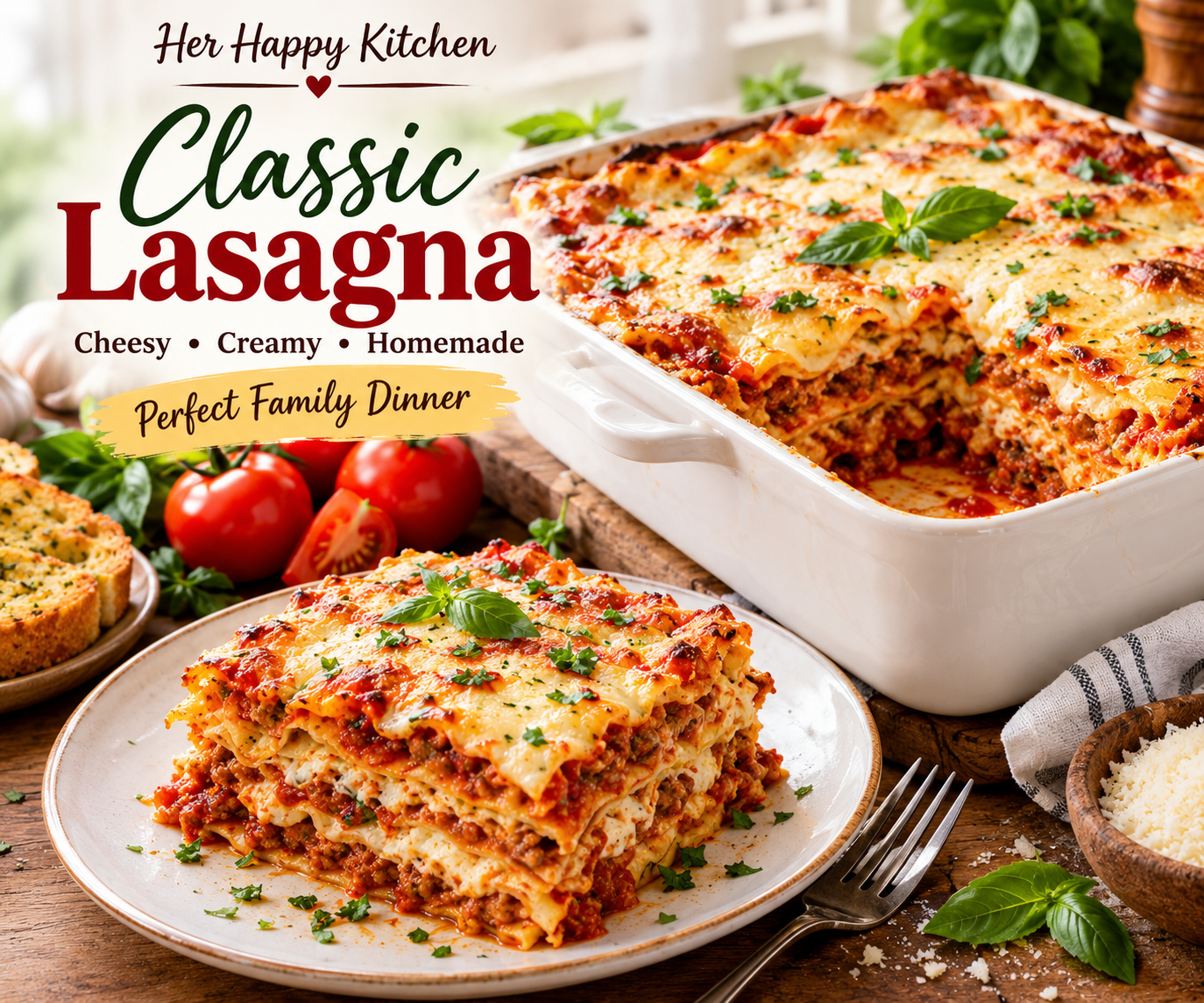
introduction
This homemade lasagna is perfect for family dinners, Sunday meals, holidays, gatherings, potlucks, and special occasions. The recipe includes detailed instructions for preparing the sauce, cheese filling, layering the lasagna, baking it perfectly, resting it before slicing, and serving it beautifully.
Looking for the ultimate comforting family dinner? This Classic Lasagna Recipe is made with tender lasagna sheets, rich homemade meat sauce, creamy cheese filling, mozzarella, Parmesan, and delicious Italian-inspired seasonings. Every layer comes together to create a hearty, cheesy, flavorful lasagna with a beautifully golden top.
Whether you are making lasagna for the first time or looking for a dependable homemade version, this detailed recipe will guide you through every step.
Her Happy Kitchen
INTRODUCTION
Few homemade meals are as comforting and satisfying as a warm dish of Classic Lasagna.
When the oven door opens and the aroma of tomato sauce, herbs, melted cheese, and baked pasta fills the kitchen, it immediately feels like a special family meal.
Lasagna is one of those recipes that can turn an ordinary dinner into something memorable. It combines several simple ingredients into layers of rich flavor and comforting texture.
Tender pasta sheets are layered with a savory tomato-based meat sauce, creamy cheese filling, mozzarella, and Parmesan. Everything is baked together until bubbling around the edges and beautifully golden on top.
The best part about homemade lasagna is that it can be prepared ahead of time. You can assemble the dish earlier, refrigerate it, and bake it when you are ready.
It is also a wonderful recipe for feeding a family because one large baking dish can provide several generous servings.
At Her Happy Kitchen, we believe that good food does not have to be complicated. With the right ingredients and a little patience, you can make restaurant-style comfort food right in your own kitchen.
This Classic Lasagna Recipe is designed to be rich, cheesy, flavorful, and satisfying while still being practical enough for a family dinner.
WHAT IS LASAGNA?
Lasagna is a layered baked pasta dish traditionally associated with Italian cuisine.
Instead of mixing all the ingredients together, lasagna is assembled in layers.
A typical lasagna includes pasta sheets, tomato-based sauce, cheese, and often a meat filling.
The assembled layers are baked together so the flavors combine while the cheese melts into a delicious golden topping.
The result is a dish with different textures in every bite.
You get tender pasta, savory sauce, creamy cheese, and melted mozzarella together.
WHY CLASSIC LASAGNA IS SO POPULAR
Lasagna has remained a favorite comfort food for generations because it brings together flavors that work naturally well together.
Tomatoes provide acidity and freshness.
Meat provides savory richness.
Herbs add aroma.
Cheese contributes creaminess and saltiness.
Pasta provides a soft, satisfying base.
When everything is baked together, the individual ingredients become one comforting dish.
Lasagna is also incredibly versatile.
You can make it with beef, chicken, vegetables, spinach, mushrooms, or a combination of ingredients.
You can make it extra cheesy or keep it lighter.
You can prepare a traditional-style version or create your own family variation.
WHY YOU WILL LOVE THIS RECIPE
There are many reasons to add this Classic Lasagna Recipe to your regular dinner collection.
First, it is incredibly comforting.
A warm serving of lasagna is perfect for cool evenings, family dinners, and weekends when you want something hearty.
Second, it is great for sharing.
One large baking dish can feed several people, making lasagna especially useful for family gatherings.
Third, it can be prepared ahead.
You can assemble the lasagna, cover it, refrigerate it, and bake it later.
Fourth, leftovers can be delicious.
The flavors often become even more blended after resting overnight.
Finally, the recipe can easily be customized.
You can add vegetables, change the cheese combination, use different herbs, or prepare a meat-free version.
THE MAIN COMPONENTS OF LASAGNA
A classic homemade lasagna can be divided into four main components.
- Pasta sheets
These create the structure of the lasagna.
- Tomato meat sauce
This provides the main savory flavor.
- Creamy cheese layer
This adds richness and softness.
- Mozzarella and Parmesan
These create the melted, cheesy top and extra flavor.
Each component is important.
If the sauce is too dry, the lasagna can become dry.
If there is too much sauce, the layers can become difficult to hold together.
If the cheese mixture is too thin, it may disappear into the other layers.
Balance is the key.
INGREDIENTS FOR CLASSIC LASAGNA
For the meat sauce:
- 1 tablespoon olive oil
- 1 medium onion, finely chopped
- 4 cloves garlic, minced
- 1 pound ground beef
- 1 can crushed tomatoes
- 1 can tomato sauce
- 2 tablespoons tomato paste
- 1 teaspoon dried oregano
- 1 teaspoon dried basil
- ½ teaspoon dried thyme
- 1 teaspoon salt
- ½ teaspoon black pepper
- ½ teaspoon sugar, optional
- ½ cup water or broth
For the cheese filling:
- 15 ounces ricotta cheese
- 1 large egg
- ½ cup grated Parmesan cheese
- 1 teaspoon dried Italian seasoning
- ½ teaspoon salt
- ¼ teaspoon black pepper
For assembling:
- 12 lasagna noodles
- 3 cups shredded mozzarella cheese
- ½ cup grated Parmesan cheese
Optional garnish:
- Fresh basil
- Fresh parsley
- Extra Parmesan
WHY EACH INGREDIENT MATTERS
OLIVE OIL
Olive oil is used to cook the onion and garlic.
It also adds a subtle richness to the sauce.
ONION
Onion creates a sweet and savory base for the meat sauce.
Cooking the onion slowly allows its natural sweetness to develop.
GARLIC
Garlic gives the sauce a strong, aromatic flavor.
Fresh garlic is ideal for this recipe.
GROUND BEEF
Ground beef creates the hearty savory filling.
Choose a moderately lean ground beef so the sauce is flavorful without becoming excessively greasy.
CRUSHED TOMATOES
Crushed tomatoes provide the main tomato flavor.
They also give the sauce enough moisture for the lasagna.
TOMATO SAUCE
Tomato sauce helps create a smooth consistency.
Combining tomato sauce with crushed tomatoes gives the meat sauce a balanced texture.
TOMATO PASTE
Tomato paste adds concentrated tomato flavor.
It also helps give the sauce a deeper color and richer consistency.
OREGANO
Oregano adds a classic Italian-inspired herbal note.
BASIL
Basil adds a slightly sweet and aromatic flavor.
THYME
Thyme contributes warmth and depth.
SALT
Salt brings out the flavors of the meat, tomatoes, cheese, and herbs.
BLACK PEPPER
Black pepper adds mild heat and balances the richness.
SUGAR
A small amount of sugar is optional.
It can help balance the acidity of tomatoes if the sauce tastes particularly sharp.
RICOTTA CHEESE
Ricotta creates a soft and creamy layer.
It adds richness without making the lasagna sauce itself too heavy.
EGG
Egg helps bind the ricotta mixture.
PARMESAN
Parmesan contributes salty, nutty flavor.
MOZZARELLA
Mozzarella provides the classic melted cheese topping.
LASAGNA NOODLES
The noodles provide structure between the sauce and cheese layers.
CHOOSING LASAGNA NOODLES
There are several types of lasagna noodles available.
Traditional dried noodles are reliable and easy to find.
Oven-ready noodles are convenient because they can be used without traditional boiling.
Fresh lasagna sheets provide a softer texture.
For this recipe, standard dried lasagna noodles work very well.
PREPARING THE MEAT SAUCE
The meat sauce is one of the most important parts of the recipe.
A flavorful sauce makes the entire lasagna taste better.
Start by heating olive oil in a large pot or deep skillet over medium heat.
Add the chopped onion.
Cook for several minutes until the onion becomes soft and translucent.
Do not rush this step.
Allowing the onion to cook properly creates a better flavor base.
ADDING GARLIC
Once the onion has softened, add minced garlic.
Cook briefly.
Garlic can burn quickly, so avoid cooking it for too long over high heat.
You want it fragrant rather than dark brown.
COOKING THE GROUND BEEF
Add the ground beef to the pan.
Use a wooden spoon or spatula to break it into small pieces.
Cook until the beef is browned and no longer raw.
Stir regularly so it cooks evenly.
If there is a large amount of excess grease, carefully drain some of it.
ADDING TOMATO PASTE
Add tomato paste to the browned meat.
Stir it into the mixture.
Allow it to cook briefly.
This helps develop the tomato flavor and creates a richer sauce.
ADDING THE TOMATOES
Pour in the crushed tomatoes and tomato sauce.
Stir everything together.
Add water or broth.
The sauce should be thick but still have enough moisture.
Remember that some of this liquid will be absorbed by the pasta during baking.
ADDING HERBS
Add oregano, basil, and thyme.
Season with salt and black pepper.
Stir well.
Allow the sauce to simmer gently.
WHY SIMMERING MATTERS
Simmering gives the ingredients time to combine.
The tomatoes become richer.
The meat absorbs the sauce.
The herbs release their aroma.
The sauce becomes thicker.
A slow simmer can make a noticeable difference in the final flavor.
Do not boil the sauce aggressively.
A gentle simmer is enough.
HOW THICK SHOULD THE SAUCE BE?
Lasagna sauce should not be watery.
However, it should also not be extremely dry.
The ideal sauce is thick enough to coat a spoon but loose enough to spread easily.
If the sauce becomes too thick, add a small amount of water or broth.
If it is too thin, simmer it uncovered for a little longer.
TASTING THE SAUCE
Before assembling the lasagna, taste the sauce.
Check the salt.
Check the herbs.
Check the acidity.
If the tomatoes taste particularly sharp, a very small amount of sugar can balance them.
Do not add too much sugar.
The sauce should still taste savory.
PREPARING THE CHEESE FILLING
While the sauce simmers, prepare the ricotta mixture.
Add ricotta cheese to a bowl.
Add one egg.
Add Parmesan.
Add Italian seasoning.
Add salt and black pepper.
Mix until combined.
The mixture should be creamy and spreadable.
WHY ADD AN EGG TO RICOTTA?
The egg helps bind the cheese filling as the lasagna bakes.
It helps the ricotta layer hold together instead of remaining too loose.
DO YOU NEED TO USE RICOTTA?
Ricotta is traditional in many American-style lasagna recipes, but it is not the only option.
Some recipes use cottage cheese.
Others use a béchamel or white sauce.
You can choose based on the texture you prefer.
RICOTTA VS COTTAGE CHEESE
Ricotta is smooth, creamy, and slightly rich.
Cottage cheese has a more textured consistency and can make the lasagna slightly lighter.
If using cottage cheese, you can blend it briefly if you prefer a smoother filling.
PREPARING THE LASAGNA NOODLES
If using traditional dried lasagna noodles, cook them according to the package instructions.
Bring a large pot of salted water to a boil.
Add the noodles.
Cook until they are flexible and just tender.
Avoid overcooking them.
They will continue cooking in the oven.
DRAINING THE NOODLES
Drain the noodles carefully.
Lay them separately on a tray or lightly greased surface so they do not stick together.
You can also place parchment between layers if needed.
WHY NOODLES SHOULD NOT BE OVERCOOKED
Overcooked noodles can become fragile.
They may tear while layering.
They can also create a softer, mushier lasagna.
Cook them until just tender.
USING OVEN-READY NOODLES
If using oven-ready noodles, follow the package instructions.
They are designed to absorb moisture from the sauce during baking.
Because of this, make sure your sauce contains enough moisture.
Do not use an excessively dry sauce with oven-ready noodles.
CHOOSING THE BAKING DISH
A 9×13-inch baking dish works well for a family-sized lasagna.
Glass, ceramic, or metal baking dishes can all work.
Make sure the dish is deep enough to hold several layers.
GREASING THE DISH
Lightly grease the baking dish.
This helps prevent the edges from sticking.
You can use olive oil, butter, or cooking spray.
FIRST LAYER OF SAUCE
Before adding noodles, spread a thin layer of meat sauce across the bottom of the dish.
This is important.
The sauce creates moisture underneath the noodles and helps prevent sticking.
Do not use a huge amount.
A thin layer is enough.
ADDING THE FIRST NOODLE LAYER
Place the cooked lasagna noodles over the sauce.
Arrange them so they cover most of the dish.
If necessary, slightly overlap the noodles.
Do not worry if the noodles are not perfectly shaped.
THE FIRST CHEESE LAYER
Spread part of the ricotta mixture over the noodles.
Use the back of a spoon or spatula.
Try to distribute the mixture evenly.
Do not press too hard.
ADDING MOZZARELLA
Sprinkle mozzarella over the ricotta.
Use enough to create a visible cheese layer without using all the cheese at once.
Remember that you still need mozzarella for the top.
ADDING MORE MEAT SAUCE
Spoon another layer of meat sauce over the cheese.
Spread it gently.
Try to cover the majority of the surface.
REPEATING THE LAYERS
Continue building the lasagna.
A typical sequence is:
Sauce
Noodles
Ricotta mixture
Mozzarella
Meat sauce
Noodles
Ricotta mixture
Mozzarella
Meat sauce
Noodles
Final sauce
Mozzarella
Parmesan
The exact number of layers depends on the depth of your dish.
WHY LAYERING MATTERS
Even layers help every serving contain a little of everything.
You want the final slice to include pasta, sauce, cheese, and melted mozzarella.
If one layer is too thick while another is too thin, the final texture may be uneven.
THE FINAL TOP LAYER
Finish with noodles or sauce depending on your preferred method.
A generous layer of sauce followed by mozzarella and Parmesan creates a beautiful golden top.
Make sure the noodles are not exposed without sauce because uncovered pasta can become dry and hard.
ADDING PARMESAN ON TOP
Sprinkle Parmesan over the mozzarella.
Parmesan browns beautifully and adds a salty, nutty flavor.
You can also add a small amount of dried Italian seasoning.
COVERING THE LASAGNA
Cover the baking dish loosely with aluminum foil.
This helps prevent the cheese from browning too quickly while the center heats.
Try not to let the foil press directly into the cheese.
You can lightly grease the foil if desired to reduce sticking.
BAKING THE LASAGNA
Preheat the oven to 375°F (190°C).
Bake the covered lasagna first.
Then remove the foil near the end so the cheese can brown.
The lasagna should be bubbling around the edges.
The center should be hot.
The cheese should be melted and golden.
WHY BAKE COVERED FIRST?
Covering the lasagna helps retain moisture.
It allows the interior to heat without causing the top cheese to burn too early.
Removing the foil near the end allows the cheese to develop a beautiful golden color.
HOW TO KNOW WHEN LASAGNA IS DONE
Look for bubbling around the edges.
The cheese should be completely melted.
The center should be hot.
The top should have golden areas.
If the top is browning too quickly, cover it again loosely with foil.
RESTING THE LASAGNA
This is one of the most important steps.
Do not immediately cut the lasagna after removing it from the oven.
Let it rest for approximately 15–20 minutes.
Resting allows the layers to settle.
The sauce thickens slightly.
The cheese cools enough to hold the layers together.
This makes slicing much easier.
WHY LASAGNA FALLS APART
Lasagna can fall apart when it is cut immediately after baking.
It may also fall apart if there is too much sauce or if the cheese layers are extremely hot.
Resting solves much of this problem.
Use a sharp knife or spatula to cut and serve.
HOW TO GET CLEAN LASAGNA SLICES
Allow the lasagna to rest.
Use a sharp knife.
Cut straight down through all the layers.
Use a wide spatula to lift each serving.
The first piece may not look perfect.
That is normal.
Later slices are often easier to remove.
CLASSIC LASAGNA FLAVOR PROFILE
A great lasagna should have several flavors working together.
The tomato sauce should be savory and slightly tangy.
The beef should add richness.
The herbs should provide aroma.
The ricotta should be creamy.
The mozzarella should be mild and stretchy.
The Parmesan should add salty depth.
The pasta should provide a neutral base that ties everything together.
WHEN TO MAKE LASAGNA
Lasagna is perfect for:
Family dinners
Sunday lunch
Weekend meals
Holiday gatherings
Birthday dinners
Potlucks
Dinner parties
Meal preparation
Freezer meals
Leftover meals
It is especially useful when you need a dish that can feed several people.
MAKE-AHEAD LASAGNA
One of the biggest advantages of lasagna is that you can prepare it ahead.
Assemble the complete dish.
Cover it tightly.
Place it in the refrigerator.
When ready to bake, allow it to sit out briefly while the oven preheats.
Because a cold lasagna may take longer to heat through, check the center before serving.
Do not leave perishable food at room temperature for extended periods.
FREEZER-FRIENDLY LASAGNA
Lasagna can also be frozen.
For best results, allow the assembled dish to cool appropriately before freezing if it has already been cooked.
Wrap it very well.
Use a freezer-safe container.
Label it with the date.
Thaw safely in the refrigerator when possible.
Reheat until the center is hot.
LEFTOVER LASAGNA
Leftover lasagna can be stored in the refrigerator in a covered container.
Use clean utensils when serving.
Reheat individual portions until thoroughly hot.
Leftover lasagna can make an easy next-day lunch or dinner.
WHY LEFTOVER LASAGNA CAN TASTE EVEN BETTER
As lasagna rests, the sauce and herbs have additional time to mingle.
The pasta absorbs some of the sauce.
The cheese becomes more integrated into the layers.
This can create a deeply flavorful leftover meal.
HOW TO REHEAT LASAGNA
For individual servings, the microwave is convenient.
Place a serving on a microwave-safe plate.
Cover loosely to help retain moisture.
Heat until hot throughout.
For larger portions, use the oven.
Cover the lasagna with foil and warm it gently until heated through.
Remove the foil near the end if you want the top to become slightly crisp again.
CLASSIC LASAGNA WITH EXTRA CHEESE
If you love a very cheesy lasagna, increase the mozzarella slightly.
You can also add extra Parmesan between layers.
However, balance is important.
Too much cheese can make the dish excessively heavy and greasy.
VEGETABLE LASAGNA
For a meat-free variation, replace the ground beef with vegetables.
Good choices include:
Spinach
Zucchini
Mushrooms
Bell peppers
Carrots
Eggplant
Broccoli
A combination of vegetables can create a flavorful vegetarian lasagna.
SPINACH LASAGNA
Spinach pairs especially well with ricotta.
Cook the spinach and remove excess moisture.
Mix it into the ricotta filling.
This creates a creamy green layer with a mild vegetable flavor.
MUSHROOM LASAGNA
Mushrooms provide a rich savory flavor.
Slice them and sauté them before adding them to the lasagna.
Avoid adding raw mushrooms directly in large quantities because they release water during cooking.
CHICKEN LASAGNA
Cooked shredded chicken can replace the beef.
A creamy white sauce can also be used instead of traditional tomato sauce.
Chicken, spinach, ricotta, mozzarella, and Parmesan make a delicious combination.
BEEF AND SAUSAGE LASAGNA
For deeper savory flavor, some cooks combine ground beef with Italian-style sausage.
If using sausage, be mindful of the salt level because sausage can already be seasoned.
LASAGNA WITH WHITE SAUCE
A creamy béchamel-style sauce can be used in place of or alongside tomato sauce.
This creates a richer and creamier lasagna.
It works particularly well with spinach, chicken, mushrooms, and other vegetables.
LASAGNA WITH FRESH HERBS
Fresh basil and parsley can brighten the final dish.
Add fresh herbs after baking rather than cooking all of them for a long time.
A few fresh basil leaves on top make the finished lasagna look beautiful.
COMMON LASAGNA MISTAKES
Using too little sauce.
Overcooking the noodles.
Using too much filling in each layer.
Not seasoning the sauce.
Not allowing the lasagna to rest.
Baking uncovered for the entire time.
Cutting immediately after baking.
Using an overly watery vegetable filling.
Using too much cheese without balancing the sauce.
HOW TO AVOID DRY LASAGNA
Make sure the sauce is not too thick.
Use enough sauce between the layers.
Cover the dish during the first part of baking.
Do not overbake.
Make sure the pasta has enough moisture.
HOW TO AVOID WATERY LASAGNA
Do not use excessively watery sauce.
Drain cooked vegetables well.
Do not add large amounts of uncooked watery vegetables.
Allow the lasagna to rest after baking.
If using cottage cheese, drain excess liquid if necessary.
HOW TO MAKE LASAGNA MORE FLAVORFUL
Season each component properly.
Do not rely on cheese alone for flavor.
Cook the onions until soft.
Brown the meat properly.
Allow the tomato sauce to simmer.
Use fresh garlic.
Use quality herbs.
Taste the sauce before assembling.
This creates much deeper flavor.
HOW TO MAKE AHEAD FOR A FAMILY DINNER
Prepare the meat sauce.
Prepare the cheese mixture.
Cook the noodles.
Assemble the lasagna.
Cover and refrigerate.
Bake when needed.
This method can make dinner preparation much easier.
You can do most of the work earlier and simply bake the dish before serving.
SERVING CLASSIC LASAGNA
Serve lasagna warm.
Cut into generous squares.
Add fresh basil or parsley.
Sprinkle Parmesan over each serving if desired.
A simple green salad makes a refreshing side dish.
Garlic bread is another popular accompaniment.
You can also serve roasted vegetables.
BEST SIDE DISHES FOR LASAGNA
Garlic bread
Green salad
Roasted vegetables
Steamed broccoli
Sautéed green beans
Caprese salad
Roasted potatoes
Fresh tomato salad
A simple vegetable side can balance the richness of the lasagna.
LASAGNA AND GARLIC BREAD
The combination of lasagna and garlic bread is classic.
Crispy garlic bread is perfect for scooping up extra sauce.
For a complete family dinner, serve warm garlic bread alongside the lasagna.
LASAGNA AND SALAD
A fresh salad adds crunch and brightness.
Use lettuce, cucumber, tomatoes, carrots, and a simple dressing.
The fresh vegetables provide contrast to the warm cheesy lasagna.
LASAGNA FOR A DINNER PARTY
Lasagna is a useful dinner-party dish because much of the preparation can be done ahead.
Prepare the lasagna earlier.
Keep it refrigerated safely.
Bake it shortly before serving.
Allow it to rest.
Then slice and serve.
This gives you more time to focus on your guests.
LASAGNA FOR A HOLIDAY TABLE
For a holiday meal, lasagna can be served as a hearty main course.
Add a large salad, garlic bread, and roasted vegetables.
Finish with a simple dessert.
The result is a comforting meal that can feed a group.
FOOD PHOTOGRAPHY TIPS FOR HER HAPPY KITCHEN
For the Her Happy Kitchen website, photograph the lasagna while it is still warm but settled enough to slice.
Place the baking dish on a wooden table.
Add a plated slice in the foreground.
Show the layers clearly.
Include a little Parmesan, fresh basil, tomatoes, and garlic bread around the dish.
Use warm natural light.
A close-up photograph of the melted cheese and layered interior can make the recipe especially appealing.
PINNING THE RECIPE
For Pinterest, use a vertical image.
Recommended text:
HER HAPPY KITCHEN
CLASSIC LASAGNA
Cheesy • Creamy • Homemade
Perfect Family Dinner
SAVE THIS RECIPE
A photograph showing a golden cheesy lasagna with one serving removed can immediately communicate the recipe.
RECIPE PREVIEW
This Classic Lasagna combines tender pasta sheets with rich homemade meat sauce, creamy ricotta filling, mozzarella, and Parmesan.
It is baked until bubbling and golden, then rested before slicing.
The result is a hearty and comforting family dinner.
FINAL THOUGHTS FOR PART 1
Classic Lasagna is more than just a pasta recipe.
It is a complete comfort-food experience built from simple ingredients and careful layering.
The most important parts are preparing a flavorful sauce, creating a creamy cheese filling, using properly cooked noodles, building balanced layers, and giving the finished lasagna enough time to rest.
Once you understand these basic techniques, you can easily customize the recipe to suit your family.
You can make it meatier, cheesier, vegetarian, chicken-based, spicy, or extra creamy.
The possibilities are almost endless.
For a classic family dinner, however, this traditional combination of tomato meat sauce, ricotta, mozzarella, Parmesan, and pasta remains a favorite.
Serve it with garlic bread and a fresh salad for a complete meal.
Most importantly, take your time.
Good lasagna is not about rushing.
It is about building layers of flavor and allowing the oven to bring everything together.
Her Happy Kitchen ❤️
DETAILED RECIPE CARD
Recipe Name:
Classic Lasagna Recipe
Cuisine:
Italian-American
Category:
Dinner / Main Course
Prep Time:
40 minutes
Cook Time:
50–60 minutes
Resting Time:
15–20 minutes
Total Time:
Approximately 1 hour 50 minutes
Servings:
8–10 servings
INGREDIENTS
FOR THE MEAT SAUCE
1 tablespoon olive oil
1 medium onion, finely chopped
4 cloves garlic, minced
1 pound ground beef
1 can crushed tomatoes
1 can tomato sauce
2 tablespoons tomato paste
1 teaspoon dried oregano
1 teaspoon dried basil
½ teaspoon dried thyme
1 teaspoon salt
½ teaspoon black pepper
½ teaspoon sugar, optional
½ cup water or beef broth
FOR THE CHEESE FILLING
15 ounces ricotta cheese
1 large egg
½ cup grated Parmesan cheese
1 teaspoon Italian seasoning
½ teaspoon salt
¼ teaspoon black pepper
FOR THE LASAGNA
12 lasagna noodles
3 cups shredded mozzarella cheese
½ cup grated Parmesan cheese
FOR GARNISH
Fresh basil
Fresh parsley
Extra Parmesan cheese
DETAILED STEP-BY-STEP INSTRUCTIONS
STEP 1: PREPARE YOUR INGREDIENTS
Before beginning, gather all the ingredients.
Chop the onion.
Mince the garlic.
Measure the herbs.
Prepare the tomato products.
Measure the cheeses.
This makes the cooking process much easier.
STEP 2: PREPARE THE MEAT SAUCE
Place a large deep skillet or pot over medium heat.
Add olive oil.
Once the oil is warm, add the chopped onion.
Cook for approximately 4–5 minutes.
The onion should become soft and translucent.
Do not rush this step.
Well-cooked onion creates a flavorful base for the sauce.
STEP 3: ADD THE GARLIC
Add minced garlic.
Stir continuously for about 30–60 seconds.
The garlic should become fragrant.
Avoid browning it too much because burnt garlic can taste bitter.
STEP 4: ADD THE GROUND BEEF
Add the ground beef.
Use a wooden spoon to break it into small pieces.
Cook until the beef is completely browned.
Continue stirring so the meat cooks evenly.
If there is excessive grease, carefully drain some of it.
STEP 5: ADD TOMATO PASTE
Add tomato paste.
Stir it thoroughly into the cooked beef.
Cook for about 1–2 minutes.
This helps intensify the tomato flavor.
STEP 6: ADD CRUSHED TOMATOES
Pour in the crushed tomatoes.
Stir well.
Scrape the bottom of the pan gently if any browned meat is stuck there.
Those browned bits can contribute additional flavor.
STEP 7: ADD TOMATO SAUCE
Pour in the tomato sauce.
Mix everything together.
The sauce should now have a rich red color.
STEP 8: ADD WATER OR BROTH
Add approximately ½ cup water or broth.
This gives the sauce enough moisture for the lasagna noodles.
If using oven-ready noodles, maintaining sufficient moisture is especially important.
STEP 9: SEASON THE SAUCE
Add:
Oregano
Basil
Thyme
Salt
Black pepper
Optional sugar
Stir thoroughly.
STEP 10: SIMMER THE SAUCE
Reduce the heat to low.
Allow the sauce to simmer for approximately 20–30 minutes.
Stir occasionally.
Do not let it boil aggressively.
A gentle simmer allows the flavors to develop.
STEP 11: CHECK THE SAUCE
Taste the sauce.
Adjust salt and pepper if needed.
If the sauce tastes too acidic, a very small amount of sugar can help balance it.
If it is too thick, add a little water.
If it is too thin, simmer uncovered for a few more minutes.
The finished sauce should be rich and spoonable.
STEP 12: PREPARE THE CHEESE FILLING
While the sauce is simmering, prepare the ricotta mixture.
Place ricotta cheese in a mixing bowl.
Add the egg.
Add Parmesan cheese.
Add Italian seasoning.
Add salt and black pepper.
Mix until creamy and well combined.
Do not overmix.
STEP 13: PREPARE THE NOODLES
Bring a large pot of salted water to a boil.
Add lasagna noodles.
Cook according to the package instructions.
Cook until they are flexible and just tender.
Do not overcook.
STEP 14: DRAIN THE NOODLES
Drain the noodles carefully.
Place them separately on a tray.
Avoid piling them directly on top of each other because they can stick.
If necessary, separate them with parchment paper.
STEP 15: PREPARE THE BAKING DISH
Preheat the oven to:
375°F / 190°C
Lightly grease a 9×13-inch baking dish.
A deep baking dish is especially useful because it gives you enough room for multiple layers.
STEP 16: ADD THE FIRST SAUCE LAYER
Spread a thin layer of meat sauce over the bottom of the dish.
This prevents the noodles from sticking directly to the bottom.
It also provides moisture.
STEP 17: ADD NOODLES
Place a layer of lasagna noodles over the sauce.
Arrange them side by side.
Slightly overlap them if necessary.
STEP 18: ADD RICOTTA
Spread part of the ricotta mixture over the noodles.
Use a spoon or spatula.
Spread gently.
STEP 19: ADD MOZZARELLA
Sprinkle mozzarella cheese over the ricotta.
Do not use all the mozzarella yet.
Save enough for the final topping.
STEP 20: ADD MEAT SAUCE
Spoon another layer of meat sauce over the cheese.
Spread it evenly.
STEP 21: REPEAT
Continue layering:
Noodles
Ricotta mixture
Mozzarella
Meat sauce
Repeat until the ingredients are used.
Try to keep each layer relatively even.
STEP 22: FINISH THE TOP
Finish with sauce.
Then add a generous layer of mozzarella.
Sprinkle Parmesan over the top.
The cheese should cover most of the surface.
STEP 23: COVER THE DISH
Cover the baking dish loosely with aluminum foil.
Try not to let the foil press directly against the cheese.
STEP 24: BAKE
Place the covered lasagna in the preheated oven.
Bake for approximately 25–30 minutes.
STEP 25: REMOVE THE FOIL
Carefully remove the foil.
Return the lasagna to the oven.
Continue baking for approximately 15–20 minutes.
The cheese should melt completely and become golden in spots.
STEP 26: CHECK THE EDGES
The edges should be bubbling.
This is a good indication that the sauce is hot.
If the top is becoming too dark before the center is hot, cover it loosely again with foil.
STEP 27: REST THE LASAGNA
Remove the lasagna from the oven.
Allow it to rest for 15–20 minutes.
This step should not be skipped.
The resting period allows the layers to settle and makes slicing much easier.
STEP 28: GARNISH
Before serving, sprinkle fresh chopped parsley or basil over the top.
Add a little freshly grated Parmesan if desired.
STEP 29: SLICE
Use a sharp knife.
Cut the lasagna into squares or rectangles.
Use a wide spatula to lift each portion.
The first slice may be slightly less neat than the following slices.
That is completely normal.
STEP 30: SERVE
Serve the lasagna warm.
Pair it with garlic bread, a fresh green salad, or roasted vegetables.
HOW TO CREATE PERFECT LASAGNA LAYERS
Good layering is one of the most important parts of making lasagna.
Each layer should contain enough ingredients to provide flavor but not so much that the lasagna becomes unstable.
Avoid creating extremely thick layers of ricotta.
Spread the cheese mixture thinly and evenly.
Use enough sauce to keep the pasta moist.
Save enough mozzarella for the top.
WHY THE TOP LAYER MATTERS
The top layer creates the visual appeal of the lasagna.
Golden melted mozzarella combined with Parmesan creates a beautiful finish.
The top should be cheesy without becoming burnt.
A little browning adds flavor and texture.
HOW TO GET EXTRA-GOLDEN CHEESE
For a more golden top, remove the foil during the final stage of baking.
Watch the lasagna carefully.
If your oven has a strong top heating element, the cheese can brown quickly.
Do not walk away during the final few minutes.
LASAGNA WITH A CRISPY CHEESE EDGE
Some people love the crispy edges of baked lasagna.
The corners and sides can become slightly crisp while the center remains soft and creamy.
If you want more crispy edges, use a suitable baking dish that allows the sauce and cheese to come into contact with the sides.
However, do not allow the edges to become completely dry.
HOW TO MAKE THE SAUCE RICHER
You can deepen the flavor of the meat sauce by allowing the onions to cook slowly.
You can also add:
Finely chopped carrots
Finely chopped celery
Mushrooms
Roasted red peppers
Fresh basil
A small amount of red pepper flakes
These additions can create more complex flavor.
SPICY LASAGNA
For a spicy version, add a small amount of red pepper flakes to the meat sauce.
You can also use a spicy sausage instead of some of the ground beef.
Adjust the amount according to your preference.
CREAMY LASAGNA
For an extra creamy lasagna, add a thin layer of béchamel sauce between some of the pasta layers.
This creates a richer texture.
Do not add too much because the dish can become overly heavy.
WHITE CHICKEN LASAGNA
A white chicken lasagna is a delicious alternative to traditional tomato-based lasagna.
Use shredded cooked chicken.
Add spinach if desired.
Use ricotta, mozzarella, Parmesan, and a creamy white sauce.
This version has a completely different flavor profile while maintaining the classic layered structure.
VEGETABLE LASAGNA
Vegetable lasagna is an excellent meat-free option.
You can use:
Zucchini
Spinach
Mushrooms
Bell peppers
Eggplant
Carrots
Broccoli
Make sure vegetables are cooked and excess moisture is removed before layering.
WHY VEGETABLES CAN MAKE LASAGNA WATERY
Many vegetables contain a large amount of water.
During baking, that water is released.
If you add too many watery vegetables without cooking them first, the lasagna can become loose.
Sauté or roast vegetables first.
Allow them to cool slightly.
Drain excess moisture.
Then use them in the layers.
SPINACH AND RICOTTA LASAGNA
Spinach and ricotta make a classic combination.
Cook spinach until wilted.
Drain it thoroughly.
Squeeze out excess moisture.
Chop it and mix it into the ricotta filling.
This creates a creamy spinach layer.
MUSHROOM LASAGNA
Mushrooms should be sautéed before being added.
Cook them over medium-high heat until their moisture evaporates.
Season lightly.
Allow them to cool.
Then layer them with the sauce and cheese.
CHICKEN AND SPINACH LASAGNA
Use shredded cooked chicken with spinach and ricotta.
A creamy white sauce works particularly well.
Mozzarella and Parmesan complete the dish.
This is a hearty alternative for people who prefer chicken over beef.
MEATLESS CLASSIC LASAGNA
For a simple meatless version, use extra tomato sauce and vegetables.
Mushrooms and spinach are particularly useful because they provide texture and savory flavor.
You can also add roasted zucchini or eggplant.
LASAGNA WITH COTTAGE CHEESE
If ricotta is unavailable, cottage cheese can be used.
For a smoother texture, blend the cottage cheese briefly.
Drain excess liquid if necessary.
Mix it with egg and Parmesan.
Then use it in the same way as ricotta.
LASAGNA WITH EXTRA PARMESAN
Parmesan can be sprinkled between layers as well as on top.
Use it moderately because Parmesan is naturally salty.
LASAGNA WITH FRESH MOZZARELLA
Fresh mozzarella can provide a soft, creamy texture.
However, fresh mozzarella contains more moisture than shredded low-moisture mozzarella.
Drain it well before using.
Use moderate amounts to avoid excess liquid.
HOW TO MAKE LASAGNA AHEAD OF TIME
Prepare the sauce.
Prepare the cheese mixture.
Cook the noodles.
Assemble the lasagna.
Cover it tightly.
Refrigerate safely.
Bake when needed.
This method is excellent for busy days.
You can prepare the lasagna earlier and simply bake it around dinner time.
CAN YOU ASSEMBLE LASAGNA THE NIGHT BEFORE?
Yes.
Prepare the complete dish.
Cover it properly.
Refrigerate it.
Bake the following day.
Because the dish will be cold, it may need additional baking time.
Make sure the center is hot before serving.
HOW TO FREEZE UNBAKED LASAGNA
Assemble the lasagna in a freezer-safe dish.
Cover it very well.
Label it with the date.
Freeze it promptly.
For best results, thaw it safely in the refrigerator before baking.
HOW TO FREEZE BAKED LASAGNA
Allow baked lasagna to cool appropriately.
Divide it into portions if desired.
Wrap individual servings tightly.
Place them in freezer-safe containers.
This makes reheating convenient.
HOW LONG CAN LASAGNA BE STORED?
Storage time depends on handling and temperature.
Keep leftovers refrigerated promptly.
Use clean containers.
For longer storage, freezing is a good option.
Always check the food before eating and discard it if there are signs of spoilage.
HOW TO REHEAT LASAGNA WITHOUT DRYING IT
Cover the serving loosely while reheating.
This helps retain moisture.
If using an oven, cover the dish with foil.
If using a microwave, cover the portion with a microwave-safe cover.
Avoid excessive reheating.
HEATING LASAGNA IN THE OVEN
Preheat the oven to a moderate temperature.
Place lasagna in an oven-safe dish.
Cover with foil.
Heat until the center is hot.
Remove the foil during the final few minutes if you want the cheese to become slightly crisp.
HEATING LASAGNA IN THE MICROWAVE
Place one portion on a microwave-safe plate.
Cover it.
Heat in short intervals.
Check the center between intervals.
Continue until thoroughly hot.
Allow it to rest briefly before eating.
HOW TO KEEP LASAGNA FROM BECOMING DRY
Use enough sauce.
Cover during most of the baking time.
Do not overbake.
Store leftovers properly.
Add a small amount of sauce before reheating if necessary.
HOW TO KEEP LASAGNA FROM BECOMING WATERY
Use a thick but moist sauce.
Drain vegetables.
Do not add excessive liquid.
Cook mushrooms and spinach before layering.
Allow the finished lasagna to rest before slicing.
TROUBLESHOOTING
MY LASAGNA IS WATERY
Possible reasons include:
Too much sauce
Watery vegetables
Excess liquid in ricotta or cottage cheese
Undercooking
Not resting the lasagna
Allow the dish to rest longer.
For future batches, reduce excess moisture before assembling.
MY LASAGNA IS DRY
Possible reasons:
Too little sauce
Overcooked noodles
Overbaking
Too little moisture
Make sure the sauce is spread generously enough between layers.
MY CHEESE BURNS BEFORE THE LASAGNA IS DONE
Cover the dish with foil during most of the baking time.
Remove the foil only near the end.
MY NOODLES ARE HARD
If using traditional noodles, they may not have been cooked enough.
If using oven-ready noodles, there may not have been enough sauce or moisture.
MY LASAGNA FALLS APART
Allow it to rest.
Avoid excessive sauce.
Avoid extremely thick cheese layers.
Use a sharp knife and wide spatula.
MY LASAGNA IS TOO SALTY
Several ingredients can contribute salt:
Parmesan
Mozzarella
Ricotta
Salted sauce
Seasonings
Taste the sauce before assembling.
Use salt carefully.
MY LASAGNA TASTES BLAND
Season each component.
Do not forget herbs.
Brown the meat properly.
Cook the onion and garlic.
Taste the sauce before layering.
Use Parmesan for additional depth.
MY SAUCE IS TOO ACIDIC
Tomatoes naturally contain acidity.
A very small amount of sugar can help balance the flavor.
You can also simmer the sauce longer.
MY MEAT SAUCE IS TOO THICK
Add a small amount of water or broth.
Stir well.
Do not make it watery.
MY MEAT SAUCE IS TOO THIN
Simmer uncovered.
Allow some moisture to evaporate.
Continue until the sauce becomes thick enough to spread.
BEST HERBS FOR LASAGNA
Oregano
Basil
Thyme
Parsley
Italian seasoning
Fresh basil is especially good as a finishing herb.
CAN YOU ADD GARLIC POWDER?
Yes.
However, fresh garlic generally provides a stronger and fresher flavor.
CAN YOU ADD RED PEPPER FLAKES?
Yes.
A small amount adds gentle heat.
CAN YOU ADD ITALIAN SAUSAGE?
Yes.
Italian sausage can be combined with ground beef.
Adjust seasoning because sausage may already contain salt and herbs.
CAN YOU USE GROUND TURKEY?
Yes.
Ground turkey can replace beef.
Because turkey is generally leaner, the sauce may benefit from additional olive oil or flavorful ingredients.
CAN YOU USE GROUND CHICKEN?
Yes.
Ground chicken can also be used.
Season it well because chicken has a milder flavor than beef.
LASAGNA FOR CHILDREN AND FAMILY MEALS
For a family meal, keep the sauce mild.
Avoid excessive chili or strong spices if serving people who prefer mild flavors.
You can also make a vegetable-filled version.
Cut the lasagna into manageable portions.
LASAGNA FOR POTLUCKS
Lasagna is convenient for potlucks because it can be prepared in a large baking dish.
Allow it to rest before transporting.
Keep food at a safe temperature during transport.
If possible, transport it in an insulated food container.
LASAGNA FOR SUNDAY DINNER
Sunday is a perfect time for a comforting lasagna dinner.
Prepare the sauce earlier.
Assemble the dish.
Bake before dinner.
Serve with garlic bread and salad.
Finish with a simple dessert.
This creates a complete homemade meal.
LASAGNA FOR SPECIAL OCCASIONS
For birthdays, family celebrations, holidays, or gatherings, lasagna can be served as a hearty main course.
Decorate the top with fresh basil.
Serve individual portions neatly.
Add freshly grated Parmesan at the table.
HOW TO MAKE A RESTAURANT-STYLE PRESENTATION
Let the lasagna rest.
Cut clean portions.
Use a wide serving spatula.
Place one portion in the center of a plate.
Add a small basil leaf.
Sprinkle Parmesan.
Serve garlic bread on the side.
Keep the plate simple so the lasagna remains the main focus.
NUTRITIONAL CONSIDERATIONS
Lasagna contains carbohydrates from pasta, protein from meat and cheese, and fat from cheese and other ingredients.
The exact nutritional values depend on the ingredients and portion size.
For a balanced meal, serve it with vegetables or salad.
You can also adjust the recipe by using leaner meat, adding vegetables, or modifying the cheese quantities.
HOW TO MAKE A LIGHTER LASAGNA
Use lean ground meat.
Add vegetables.
Use moderate amounts of cheese.
Use part-skim mozzarella.
Serve with a large fresh salad.
Keep portions reasonable.
HOW TO MAKE LASAGNA MORE HEARTY
Use a generous amount of meat sauce.
Add mushrooms.
Use extra vegetables.
Serve with garlic bread.
Add a side salad.
CLASSIC LASAGNA RECIPE CARD
INGREDIENTS
For the sauce:
1 tablespoon olive oil
1 medium onion
4 garlic cloves
1 pound ground beef
1 can crushed tomatoes
1 can tomato sauce
2 tablespoons tomato paste
1 teaspoon oregano
1 teaspoon basil
½ teaspoon thyme
1 teaspoon salt
½ teaspoon black pepper
½ teaspoon sugar, optional
½ cup water or broth
For the cheese filling:
15 ounces ricotta
1 egg
½ cup Parmesan
1 teaspoon Italian seasoning
½ teaspoon salt
¼ teaspoon pepper
For assembly:
12 lasagna noodles
3 cups mozzarella
½ cup Parmesan
METHOD
- Heat olive oil.
- Cook onion until soft.
- Add garlic.
- Add ground beef.
- Brown the beef thoroughly.
- Drain excess grease if necessary.
- Add tomato paste.
- Add crushed tomatoes.
- Add tomato sauce.
- Add water or broth.
- Add herbs and seasonings.
- Simmer for 20–30 minutes.
- Prepare the ricotta mixture.
- Cook the lasagna noodles according to package instructions.
- Preheat oven to 375°F (190°C).
- Grease a 9×13-inch baking dish.
- Spread sauce on the bottom.
- Add noodles.
- Add ricotta mixture.
- Add mozzarella.
- Add meat sauce.
- Repeat the layers.
- Finish with sauce, mozzarella, and Parmesan.
- Cover with foil.
- Bake for 25–30 minutes.
- Remove foil.
- Bake another 15–20 minutes.
- Remove from oven.
- Rest for 15–20 minutes.
- Garnish with fresh herbs.
- Slice.
- Serve warm.
FREQUENTLY ASKED QUESTIONS
WHAT IS THE BEST CHEESE FOR LASAGNA?
Ricotta, mozzarella, and Parmesan make a classic combination.
CAN I USE COTTAGE CHEESE INSTEAD OF RICOTTA?
Yes. Cottage cheese can be used as an alternative.
CAN I MAKE LASAGNA WITHOUT MEAT?
Yes. Replace the meat with vegetables such as spinach, mushrooms, zucchini, or eggplant.
CAN I USE OVEN-READY NOODLES?
Yes. Follow the package instructions and make sure your sauce contains enough moisture.
DO I HAVE TO BOIL LASAGNA NOODLES?
Traditional dried noodles generally need cooking first. Oven-ready noodles are designed to be used without traditional boiling.
WHY DOES MY LASAGNA FALL APART?
It may need more resting time, or there may be too much sauce or filling.
HOW LONG SHOULD LASAGNA REST?
Approximately 15–20 minutes is a useful resting period.
CAN I MAKE LASAGNA AHEAD?
Yes. Assemble it ahead and refrigerate it safely before baking.
CAN I FREEZE LASAGNA?
Yes. Both baked and unbaked lasagna can be frozen when properly packaged.
WHAT SHOULD I SERVE WITH LASAGNA?
Garlic bread, green salad, roasted vegetables, steamed broccoli, or a simple tomato salad.
CAN I ADD VEGETABLES?
Absolutely.
CAN I MAKE CHICKEN LASAGNA?
Yes. Replace beef with cooked chicken and consider using a creamy white sauce.
CAN I MAKE LASAGNA SPICY?
Yes. Add red pepper flakes or spicy sausage.
CAN I ADD MORE CHEESE?
Yes, but balance the amount so the dish does not become excessively heavy.
CAN I USE FRESH BASIL?
Yes. Fresh basil is especially good as a garnish.
CAN I PREPARE THE SAUCE IN ADVANCE?
Yes. The sauce can be prepared ahead and refrigerated safely.
CAN I USE LEFTOVER MEAT?
Yes. Cooked leftover meat can be incorporated into the sauce if it has been stored safely.
CAN I USE LEFTOVER VEGETABLES?
Yes. Cooked vegetables can be layered into the lasagna.
HOW DO I KNOW THE LASAGNA IS READY?
The edges should be bubbling, the cheese should be melted, and the center should be hot.
WHY SHOULD I COVER LASAGNA WITH FOIL?
Covering helps retain moisture and prevents the cheese from browning too quickly.
WHEN SHOULD I REMOVE THE FOIL?
Remove it during the final stage so the cheese can become golden.
CAN I USE A GLASS BAKING DISH?
Yes. Glass baking dishes can work well for lasagna.
CAN I USE A METAL PAN?
Yes. Metal baking pans are also suitable.
HOW DO I STOP CHEESE FROM STICKING TO FOIL?
Lightly grease the underside of the foil before covering the lasagna.
CAN I ADD MUSHROOMS?
Yes. Sauté them first to remove excess moisture.
CAN I ADD SPINACH?
Yes. Cook and drain spinach thoroughly before adding it.
CAN I ADD ZUCCHINI?
Yes, but cook it first because zucchini releases water.
CAN I ADD BELL PEPPERS?
Yes. Sautéed bell peppers can add sweetness and color.
CAN I ADD CARROTS?
Finely diced carrots can be cooked with the sauce.
CAN I ADD CELERY?
Yes. Celery can be cooked with onion as part of the sauce base.
CAN I MAKE A SMALLER LASAGNA?
Yes. Reduce the ingredients proportionally and use a smaller baking dish.
CAN I DOUBLE THE RECIPE?
Yes. Use a larger dish or two baking dishes rather than creating an extremely deep lasagna.
CAN I MAKE MINI LASAGNAS?
Yes. Individual baking dishes can be used for small portions.
FINAL SERVING IDEA
For the perfect family dinner, serve a generous slice of Classic Lasagna with warm garlic bread and a fresh green salad.
Add fresh basil and Parmesan on top.
A simple dessert such as fruit, cookies, or a light cake can finish the meal.
This combination is comforting, filling, and perfect for sharing.
SEO TITLE
Classic Lasagna Recipe – Cheesy, Creamy & Perfect for a Family Dinner
META DESCRIPTION
Learn how to make Classic Lasagna with rich meat sauce, creamy ricotta, mozzarella, Parmesan, and tender pasta layers. An easy homemade comfort-food dinner perfect for family meals and gatherings.
SUGGESTED URL SLUG
classic-lasagna-recipe
PRIMARY SEO KEYWORD
Classic Lasagna Recipe
SECONDARY SEO KEYWORDS
Lasagna Recipe
Classic Lasagna
Easy Lasagna Recipe
Homemade Lasagna
Cheesy Lasagna
Italian Lasagna Recipe
Lasagna Dinner Recipe
Beef Lasagna
Easy Family Dinner
Comfort Food Recipe
Cheesy Pasta Recipe
Homemade Italian Dinner
Baked Lasagna
Lasagna with Ricotta
Lasagna with Mozzarella
Family Dinner Ideas
Sunday Dinner Recipe
Make Ahead Lasagna
Freezer Lasagna
Easy Pasta Dinner
Her Happy Kitchen
SHORT DESCRIPTION
This Classic Lasagna Recipe features tender pasta sheets layered with rich homemade beef and tomato sauce, creamy ricotta, melted mozzarella, and Parmesan. Baked until bubbling and golden, it is the perfect comforting family dinner.
PINTEREST TITLE
Classic Lasagna Recipe – Cheesy, Creamy & Perfect Family Dinner
PINTEREST DESCRIPTION
Craving a comforting homemade dinner? 🍝🧀 This Classic Lasagna is layered with tender pasta, rich homemade meat sauce, creamy ricotta, mozzarella and Parmesan, then baked until bubbling and golden. Perfect for Sunday dinner, family meals, holidays, gatherings and cozy nights at home. Save this easy homemade lasagna recipe and make a delicious Italian-inspired dinner for your family!
Her Happy Kitchen ❤️
PINTEREST TAGS
Classic Lasagna
Lasagna Recipe
Easy Lasagna Recipe
Homemade Lasagna
Cheesy Lasagna
Beef Lasagna
Italian Lasagna
Lasagna Dinner
Pasta Dinner
Easy Family Dinner
Comfort Food
Family Dinner Recipes
Sunday Dinner Ideas
Homemade Italian Food
Baked Pasta Recipe
Cheesy Pasta Recipe
Ricotta Lasagna
Mozzarella Lasagna
Easy Pasta Recipes
Dinner Ideas
Holiday Dinner Recipes
Potluck Recipes
Make Ahead Dinner
Freezer Meals
Cozy Dinner Recipes
Her Happy Kitchen
IMAGE ALT TEXT
Classic homemade lasagna layered with beef tomato sauce, creamy ricotta, mozzarella and Parmesan cheese.
IMAGE FILE NAME
classic-lasagna-recipe-her-happy-kitchen.jpg
FINAL THOUGHTS
Classic Lasagna is a recipe that brings comfort, flavor, and togetherness to the dinner table.
It may take a little more preparation than a quick pasta dish, but every layer is worth the effort.
The rich tomato meat sauce brings savory flavor.
The ricotta creates a creamy middle.
The mozzarella melts beautifully.
Parmesan adds depth.
The pasta holds everything together.
When baked together, these simple ingredients become a warm and satisfying meal that is perfect for sharing.
The most important tips are to prepare a flavorful sauce, avoid watery ingredients, cook the noodles properly, create balanced layers, cover the lasagna during most of the baking process, and let the finished dish rest before slicing.
Once you become comfortable with the basic recipe, you can easily create your own version.
Try spinach and ricotta.
Try mushrooms and vegetables.
Try chicken and white sauce.
Try extra mozzarella.
Try spicy meat sauce.
Or keep it completely classic.
Whatever variation you choose, homemade lasagna is a wonderful way to bring everyone together around the table.
At Her Happy Kitchen, simple homemade food is all about creating meals that are delicious, comforting, and worth sharing.
This Classic Lasagna Recipe is exactly that.
Prepare the sauce.
Build the layers.
Bake until golden.
Let it rest.
Slice.
Serve.
And enjoy every cheesy, comforting bite.
Her Happy Kitchen ❤️