 Her Happy Kitchen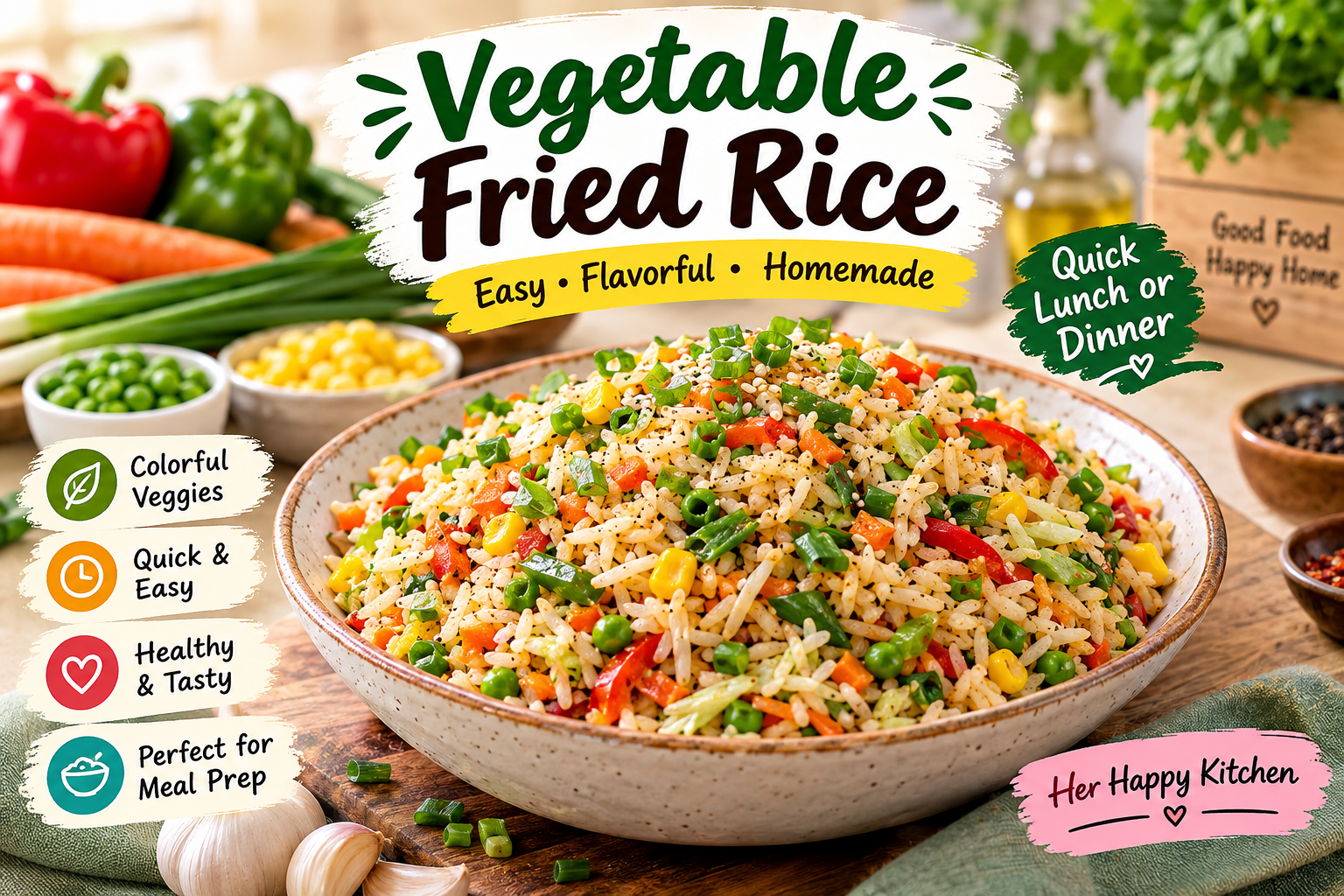
INTRODUCED
Vegetable Fried Rice is one of those simple homemade recipes that can turn everyday ingredients into a delicious and satisfying meal. 🍚🥕🥦 With fluffy rice, colorful vegetables, garlic, spring onions and flavorful seasonings, this easy fried rice is perfect for lunch, dinner, meal prep or a quick weekend meal.
The best thing about homemade Vegetable Fried Rice is that you can customize it according to the vegetables and ingredients you already have at home. Carrots, capsicum, peas, corn, beans and cabbage all work beautifully in this recipe. You can also adjust the seasoning to make it mild or spicy.
This recipe is quick, beginner-friendly and doesn’t require complicated cooking techniques. The key to delicious fried rice is using properly cooked rice, high heat and adding the ingredients in the right order.
If you love easy homemade meals that are colorful, flavorful and satisfying, this Vegetable Fried Rice recipe is definitely worth saving.
- WHY YOU’LL LOVE THIS VEGETABLE FRIED RICE
There are many reasons to make this recipe at home.
It is:
- Easy to prepare
- Quick and convenient
- Full of colorful vegetables
- Great for lunch or dinner
- Perfect for using leftover rice
- Customizable
- Family-friendly
- Excellent for meal prep
- Easy to serve with other dishes
- Delicious even with simple ingredients
The combination of fluffy rice, crunchy vegetables, garlic and savory seasonings creates a wonderful balance of texture and flavor.
- INGREDIENTS YOU’LL NEED
For homemade Vegetable Fried Rice, you don’t need a long list of ingredients.
Main ingredients:
- Cooked rice
- Carrot
- Capsicum
- Green peas
- Sweet corn
- Cabbage
- Spring onion
- Garlic
- Cooking oil
Seasonings:
- Soy sauce
- Black pepper
- Salt
- Red chili flakes or chili sauce, optional
- Vinegar, optional
For garnish:
- Chopped spring onion
- Fresh coriander, optional
- Sesame seeds, optional
You can change the vegetables according to what is available in your kitchen.
- CHOOSING THE RIGHT RICE
Rice is the most important ingredient in fried rice, so choosing the right type can make a big difference.
Long-grain rice works particularly well because the grains remain separate after cooking.
Basmati rice is another excellent option. It gives the fried rice a light aroma and fluffy texture.
You can also use other varieties of rice, but try to avoid rice that becomes extremely soft or sticky after cooking.
- USING LEFTOVER RICE
Leftover rice is perfect for fried rice.
When cooked rice is refrigerated, it becomes firmer and loses some moisture. This makes it easier to stir-fry without turning the dish mushy.
If you have leftover plain rice from lunch or dinner, store it properly in the refrigerator and use it to prepare fried rice later.
- HOW TO COOK RICE FOR FRIED RICE
If you don’t have leftover rice, you can cook fresh rice.
Wash the rice properly and cook it until the grains are tender but still separate.
Avoid overcooking the rice.
Once cooked, spread the rice on a large plate or tray and allow it to cool.
This helps excess moisture escape.
For best results, the rice should be completely cool before stir-frying.
- PREPARING THE VEGETABLES
Wash all vegetables thoroughly before cutting them.
Cut carrots, capsicum, cabbage and other vegetables into small, thin pieces.
Keeping the vegetables similar in size helps them cook more evenly.
Don’t make the vegetables too large because fried rice cooks quickly.
Small pieces also make every spoonful more flavorful because you get a little rice and vegetable in every bite.
- PREPARING GARLIC
Fresh garlic gives Vegetable Fried Rice a wonderful aroma.
Finely chop the garlic instead of leaving large pieces.
When the garlic is added to hot oil, it releases its natural fragrance and gives the entire dish a delicious base flavor.
Be careful not to burn the garlic because burnt garlic can make the fried rice bitter.
- PREPARING SPRING ONIONS
Separate the white and green portions of spring onions.
The white portion can be added while cooking because it provides a mild onion flavor.
The green portion is best used toward the end as a garnish.
This gives the finished fried rice a fresh aroma and attractive appearance.
- HEATING THE PAN
Use a large wok or wide frying pan.
A wide cooking surface makes it easier to stir the rice and vegetables.
Heat the pan properly before adding the oil.
Fried rice is best cooked over medium-high to high heat because quick cooking helps maintain the texture of the vegetables.
- ADDING THE OIL
Add a small amount of cooking oil to the hot pan.
Swirl the oil around so that the cooking surface is lightly coated.
You don’t need excessive oil.
The goal is to lightly coat the ingredients while allowing the vegetables and rice to remain flavorful rather than greasy.
- COOKING THE GARLIC
Add chopped garlic to the hot oil.
Stir quickly.
Cook only until the garlic becomes fragrant.
Don’t wait until it becomes dark brown.
Fresh garlic cooks quickly, especially in a hot wok.
- ADDING THE VEGETABLES
Add the harder vegetables first.
Start with carrots and beans if you’re using them.
Stir-fry them for a short time before adding softer vegetables.
Then add capsicum, peas, corn and cabbage.
Keep stirring so the vegetables cook evenly.
- KEEPING VEGETABLES CRISP
One of the best things about fried rice is the contrast between fluffy rice and slightly crunchy vegetables.
Avoid cooking the vegetables until they become completely soft.
They should remain colorful and have a little bite.
This makes the fried rice feel fresher and more enjoyable.
- ADDING SPRING ONION WHITES
Add the white part of the spring onions after the vegetables have started cooking.
Stir well.
The spring onion adds a mild savory flavor that works beautifully with garlic and soy sauce.
- ADDING COOKED RICE
Once the vegetables are cooked, add the cooled rice.
Gently break up any large rice clumps before adding it to the pan.
Don’t crush the rice while stirring.
Use a spatula to lift and toss the rice gently.
- MIXING THE RICE
Mix the rice with the vegetables carefully.
Make sure the vegetables are distributed throughout the rice.
Avoid stirring too aggressively because that can break the rice grains.
The goal is to keep the grains separate and fluffy.
- ADDING SOY SAUCE
Add soy sauce according to your taste.
Soy sauce gives the fried rice its classic savory flavor and adds a beautiful color.
Don’t add too much at once.
You can always add a little more later.
Too much soy sauce can make the dish overly salty and overpower the natural flavor of the vegetables.
- ADDING BLACK PEPPER
Freshly ground black pepper adds warmth and a slightly spicy aroma.
Add it after the soy sauce and mix well.
You can adjust the amount depending on how spicy you like your fried rice.
- ADDING VINEGAR
A small amount of vinegar can brighten the flavor of fried rice.
It adds a subtle tanginess that balances the savory seasonings.
Use it carefully.
A little is enough.
- ADDING CHILI
If you enjoy spicy food, you can add chili flakes or a small amount of chili sauce.
For a milder version, simply skip it.
This recipe is easy to customize, so you can make it suitable for your taste.
- TOSSING EVERYTHING TOGETHER
Now toss the rice, vegetables and seasonings together.
Keep the pan hot and continue stirring for a short time.
The ingredients should become evenly coated with the seasonings.
At this stage, the kitchen will be filled with the delicious aroma of garlic, vegetables and toasted rice.
- CHECKING THE SEASONING
Taste a small amount before turning off the heat.
Check the salt, pepper and overall flavor.
Remember that soy sauce already contains salt, so additional salt may not be necessary.
Adjust only if needed.
- FINISHING WITH SPRING ONION GREENS
Turn off the heat and add chopped spring onion greens.
Mix gently.
The fresh green onions add color, freshness and a light onion flavor.
- OPTIONAL SESAME SEEDS
For extra texture and presentation, sprinkle a few sesame seeds over the finished fried rice.
This is completely optional but makes the dish look attractive.
- RESTING THE FRIED RICE
Allow the fried rice to sit for a minute or two before serving.
This gives the flavors a moment to settle.
There is no need for a long resting time.
Fried rice is best served warm.
- HOW TO SERVE VEGETABLE FRIED RICE
Vegetable Fried Rice can be served on its own as a complete meal.
You can also serve it with:
- Vegetable Manchurian
- Chili paneer
- Stir-fried vegetables
- Homemade soup
- Crispy vegetables
- Tofu
- Fresh salad
- Cucumber slices
- Steamed vegetables
For a simple dinner, a bowl of fried rice with a light vegetable soup makes a comforting combination.
- MAKING FRIED RICE EXTRA COLORFUL
Color makes food more attractive.
Use a mixture of green, orange, yellow and white vegetables.
Carrots provide orange color.
Capsicum provides green color.
Sweet corn provides yellow color.
Cabbage and rice create a beautiful light base.
Spring onions add a fresh green finish.
- ADDING GREEN PEAS
Green peas add sweetness and texture.
Fresh or frozen peas can be used.
If using frozen peas, you don’t necessarily need to thaw them completely before cooking.
Add them along with the other vegetables and cook until tender.
- ADDING SWEET CORN
Sweet corn gives the fried rice a naturally sweet flavor.
It also adds bright yellow color.
You can use fresh, frozen or cooked corn depending on what you have available.
- ADDING CAPSICUM
Capsicum is one of the best vegetables for fried rice.
It cooks quickly and adds a slight crunch.
Green, red or yellow capsicum can be used.
Using multiple colors of capsicum makes the fried rice even more attractive.
- ADDING CARROTS
Carrots provide natural sweetness and a pleasant crunch.
Cut them into thin strips or very small cubes.
Thinly sliced carrots cook quickly and blend nicely with the rice.
- ADDING CABBAGE
Finely sliced cabbage works very well in fried rice.
It becomes slightly tender while still retaining some texture.
Don’t add excessive cabbage because it can release moisture and make the rice softer.
- ADDING BEANS
French beans can add another layer of crunch.
Cut them into small pieces.
Add them early enough to allow them to cook properly.
- USING MUSHROOMS
Mushrooms can also be added for a richer, earthy flavor.
Slice them thinly.
Cook them before adding the rice so that some of their moisture evaporates.
This helps prevent watery fried rice.
- ADDING BROCCOLI
Small broccoli florets can make the fried rice more nutritious and colorful.
Cut the florets into very small pieces so they cook quickly.
You can lightly steam them first if necessary.
- ADDING SPINACH
Finely chopped spinach can be used for a green vegetable variation.
Add it toward the end because spinach cooks very quickly.
Use only enough to complement the rice without making it watery.
- ADDING ONIONS
Finely chopped onion can be used along with spring onions.
Cook the onion until slightly soft before adding the other vegetables.
It adds sweetness and depth to the flavor.
- GARLIC AND GINGER FLAVOR
A little fresh ginger along with garlic can give the fried rice a warm, aromatic flavor.
Finely chop or grate the ginger.
Use a moderate amount so that it doesn’t overpower the vegetables.
- MAKING SPICY VEGETABLE FRIED RICE
For a spicy version, add:
- Chili flakes
- Green chili
- Chili sauce
- Black pepper
You can use one or combine a few.
Add gradually and taste as you go.
- MAKING MILD FRIED RICE
For a mild family-friendly version, keep the seasoning simple.
Use:
- Garlic
- Soy sauce
- A little black pepper
- Vegetables
- Spring onions
Skip strong chili sauces and excessive chili flakes.
- MAKING RESTAURANT-STYLE FRIED RICE
Restaurant-style fried rice is mainly about technique.
Use a hot pan.
Use cooled rice.
Avoid overcrowding the pan.
Cut vegetables into small pieces.
Cook quickly.
Use seasonings carefully.
Most importantly, don’t overcook the rice.
These simple steps can make homemade fried rice taste much better.
- COMMON MISTAKE: USING HOT, WET RICE
One of the biggest mistakes is adding freshly cooked, steaming-hot rice directly to the pan.
The extra moisture can make the rice sticky.
Instead, allow the rice to cool completely before stir-frying.
- COMMON MISTAKE: OVERCOOKING VEGETABLES
Vegetables don’t need a long cooking time.
Overcooked vegetables lose their crunch and color.
Quick stir-frying gives better texture.
- COMMON MISTAKE: ADDING TOO MUCH SAUCE
Adding too much soy sauce or other sauces can make fried rice salty and wet.
Start with a small amount.
Mix.
Taste.
Then add more only if necessary.
- COMMON MISTAKE: OVERCROWDING THE PAN
If you are making a large quantity, don’t overcrowd a small pan.
When too many ingredients are added at once, they may steam instead of stir-frying.
For a large batch, cook in portions if necessary.
- COMMON MISTAKE: STIRRING TOO ROUGHLY
Rice grains can break if stirred aggressively.
Use a spatula and gently lift the rice from the bottom.
Toss rather than crushing the grains.
- HOW TO KEEP RICE FLUFFY
To keep rice fluffy:
- Don’t overcook it
- Cool it properly
- Use a wide pan
- Avoid excess sauce
- Stir gently
- Cook over high heat
- Don’t overcrowd the pan
These simple habits make a noticeable difference.
- HOW TO MAKE IT A COMPLETE MEAL
Vegetable Fried Rice can easily become a complete meal.
Add a variety of vegetables for different textures and flavors.
You can serve it with soup or a simple side salad.
For a more filling meal, you can pair it with tofu, paneer or another protein-rich side.
- FRIED RICE FOR QUICK LUNCH
This recipe is excellent for busy lunch days.
If cooked rice and chopped vegetables are already prepared, the dish can come together very quickly.
Prepare the ingredients in advance and keep them ready in separate containers.
When you’re hungry, simply heat the pan and start cooking.
- FRIED RICE FOR DINNER
For dinner, Vegetable Fried Rice is an easy alternative to complicated meals.
Serve it hot in bowls and garnish with spring onions.
Add a simple soup or vegetable side dish if desired.
It makes a cozy and colorful homemade dinner.
- MEAL PREP IDEA
You can prepare the vegetables ahead of time.
Wash and chop them.
Store them in airtight containers in the refrigerator.
You can also prepare rice in advance and refrigerate it properly.
When it’s time to cook, most of the preparation is already done.
- LUNCHBOX IDEA
Vegetable Fried Rice can also be packed as a lunch.
Allow it to cool slightly before packing.
Use a clean, airtight lunchbox.
Add a small portion of cucumber or another suitable side if desired.
The colorful vegetables make the meal visually appealing.
- PARTY SERVING IDEA
For a family gathering or casual party, fried rice can be prepared in a larger quantity.
Serve it in a large bowl or serving dish.
Garnish with spring onion greens and sesame seeds.
Keep the presentation simple and clean.
- KIDS-FRIENDLY VERSION
For children who prefer mild flavors, reduce spicy ingredients.
Use colorful vegetables such as:
- Carrots
- Corn
- Peas
- Capsicum
Cut the vegetables into small pieces and keep the seasoning mild.
The natural sweetness of corn and carrots can make the dish more appealing.
- USING DIFFERENT VEGETABLE COMBINATIONS
You don’t have to use exactly the same vegetables every time.
Try combinations such as:
Carrot + peas + corn
Capsicum + cabbage + carrot
Broccoli + corn + peas
Mushroom + capsicum + cabbage
Beans + carrot + peas
This makes the recipe flexible and prevents it from becoming boring.
- GARLIC VEGETABLE FRIED RICE
For extra garlic flavor, increase the amount of fresh garlic slightly.
You can also add a little garlic powder at the end.
Fresh garlic provides the main aroma, while garlic powder gives a more concentrated flavor.
- HERB VEGETABLE FRIED RICE
Although fried rice traditionally focuses on Asian-inspired seasonings, you can experiment with herbs.
A small amount of fresh coriander can work beautifully.
Add it at the end rather than cooking it for a long time.
- LEMON VEGETABLE FRIED RICE
For a fresh variation, add a small squeeze of lemon juice just before serving.
The acidity can brighten the savory flavor.
Don’t use too much lemon because it can overpower the other ingredients.
- SESAME VEGETABLE FRIED RICE
Sesame seeds can add a subtle nutty flavor and pleasant texture.
Toast them lightly if desired.
Sprinkle them over the finished dish.
- FINAL TEXTURE CHECK
Before serving, check the rice.
It should be:
- Fluffy
- Separate
- Moist but not wet
- Lightly coated with seasoning
- Mixed with colorful vegetables
The vegetables should remain slightly crisp rather than completely soft.
- FINAL FLAVOR CHECK
A balanced Vegetable Fried Rice should have:
Savory flavor from soy sauce
Aromatic flavor from garlic
Freshness from spring onions
Natural sweetness from vegetables
Warmth from black pepper
Optional heat from chili
A subtle tang from vinegar or lemon
All these flavors should work together rather than one ingredient overpowering everything else.
- PRESENTATION
Presentation can make a simple homemade dish look special.
Serve the fried rice in a clean white bowl.
Add a small amount of spring onion greens on top.
Sprinkle a few sesame seeds.
You can place a few colorful vegetables around the bowl for food photography.
- FOOD PHOTOGRAPHY IDEA
For a beautiful food-blog photograph, place the fried rice in a simple ceramic bowl.
Use a wooden table or neutral background.
Add small bowls of colorful vegetables around the main dish.
Include spring onions, carrots and capsicum as visual ingredients.
A close-up photograph can show the separate rice grains and colorful vegetables clearly.
- BLOG IMAGE IDEA
For the Her Happy Kitchen feature image, the main focus should be a beautiful bowl of colorful Vegetable Fried Rice.
The image can include:
- Fluffy fried rice
- Carrots
- Peas
- Corn
- Capsicum
- Spring onions
- Garlic
- A warm kitchen background
Suggested text on the image:
“VEGETABLE FRIED RICE”
“Easy • Flavorful • Homemade”
“Quick & Delicious Meal”
“Her Happy Kitchen”
- PINTEREST IDEA
For Pinterest, a vertical image works well.
Use the main bowl of fried rice as the hero image.
Place the recipe title at the top and a few short benefits around the image.
Suggested Pinterest text:
“Vegetable Fried Rice”
“Easy & Flavorful”
“Quick Homemade Meal”
“Colorful • Fresh • Delicious”
“Her Happy Kitchen”
- SEO KEYWORDS
Useful keywords for this recipe include:
- Vegetable Fried Rice
- Vegetable Fried Rice Recipe
- Easy Fried Rice Recipe
- Homemade Fried Rice
- Veg Fried Rice
- Easy Vegetable Rice
- Quick Dinner Recipe
- Quick Lunch Recipe
- Rice Recipes
- Easy Vegetarian Recipes
- Homemade Chinese-Inspired Rice
- Vegetable Rice Recipe
Use these naturally throughout the article instead of repeating the same keyword excessively.
- WHY HOMEMADE FRIED RICE IS SPECIAL
Homemade fried rice gives you complete control over the ingredients.
You can choose fresh vegetables.
You can adjust the salt.
You can control the spice level.
You can use the rice you already have.
You can make a small portion or a large family-sized batch.
Most importantly, you can enjoy a warm homemade meal without complicated preparation.
- SIMPLE PREPARATION CHECKLIST
Before starting, make sure you have:
✓ Cooked and cooled rice
✓ Chopped vegetables
✓ Chopped garlic
✓ Spring onions
✓ Cooking oil
✓ Soy sauce
✓ Black pepper
✓ Optional chili
✓ Optional vinegar
Once everything is prepared, the cooking process becomes very quick.
- BEGINNER-FRIENDLY COOKING TIP
If you’re new to making fried rice, prepare everything before turning on the stove.
Fried rice cooks quickly, so you don’t want to stop cooking to chop vegetables or search for seasonings.
Keep all ingredients beside the pan.
This makes cooking easier and more organized.
- HOW TO MAKE FRIED RICE TASTE FRESH
Use fresh vegetables whenever possible.
Don’t overcook them.
Add spring onion greens at the end.
A small amount of lemon juice can also add freshness.
Fresh ingredients and quick cooking are the easiest ways to keep the flavor bright.
- HOW TO MAKE IT MORE FLAVORFUL
Flavor comes from layers.
Start with garlic.
Build flavor with vegetables.
Add soy sauce carefully.
Add black pepper.
Finish with spring onions.
Optional chili and vinegar can add extra depth.
The secret is balance rather than simply adding more seasoning.
- FINAL THOUGHTS
Vegetable Fried Rice is proof that simple ingredients can create an incredibly satisfying homemade meal.
With fluffy rice, crunchy vegetables, aromatic garlic, spring onions and balanced seasoning, this recipe is easy enough for a weekday meal and attractive enough for a family gathering.
Once you learn the basic technique, you can create many different versions using whatever vegetables you have available.
Keep the rice cool, keep the pan hot, cook the vegetables quickly and season gradually.
That simple method will help you make delicious fried rice again and again.
Her Happy Kitchen ❤️
- THE SECRET TO PERFECT VEGETABLE FRIED RICE
A delicious fried rice is not only about the ingredients. The cooking technique also plays a major role.
The most important things to remember are:
- Use cooled rice
- Keep the pan hot
- Prepare ingredients before cooking
- Don’t overcrowd the pan
- Cook vegetables quickly
- Add sauces gradually
- Stir gently
- Taste before serving
When these simple steps are followed, even a basic bowl of rice can taste incredibly flavorful.
- HOW TO PREPARE RICE A DAY BEFORE
If you know you’ll be making fried rice the next day, cook the rice in advance.
Allow it to cool properly.
Spread it on a large plate or tray so that steam can escape.
Once cooled, place it in a clean airtight container and refrigerate it.
The next day, the rice will be firmer and easier to stir-fry.
- BREAKING RICE CLUMPS
Refrigerated rice can sometimes stick together.
Before adding it to the wok, gently separate the larger clumps with clean hands or a fork.
Don’t mash the rice.
The goal is simply to loosen the grains.
This makes stir-frying much easier.
- THE IMPORTANCE OF HIGH HEAT
High heat helps vegetables cook quickly while maintaining their texture.
It also allows the rice to heat through without sitting in the pan for too long.
However, high heat requires attention.
Keep stirring and don’t leave the pan unattended.
- WHEN TO REDUCE THE HEAT
If the garlic starts browning too quickly or the ingredients begin sticking, reduce the heat slightly.
The pan should remain hot, but the food shouldn’t burn.
Good fried rice comes from controlled heat rather than simply using the highest possible temperature.
- USING A WOK
A wok is excellent for fried rice because its shape allows you to move ingredients around easily.
The curved sides also make tossing convenient.
However, a wide frying pan can work perfectly well at home.
The most important thing is having enough cooking space.
- USING A NON-STICK PAN
A non-stick pan can make fried rice easier for beginners.
It reduces sticking and makes gentle stirring easier.
Use a suitable heat level according to your cookware instructions.
- USING A CAST-IRON PAN
A well-heated cast-iron pan can also create excellent fried rice.
It retains heat well and gives vegetables a beautiful seared quality.
Because cast iron stays hot, keep an eye on the garlic and sauces to prevent burning.
- MAKING A LARGE BATCH
If you’re cooking for many people, avoid putting a huge amount of rice into a small pan.
The rice may become crowded and steam instead of frying.
Cooking in two batches can produce a much better texture.
- SMALL-BATCH FRIED RICE
For one or two servings, use a medium or large pan rather than a tiny one.
You need enough space to move the rice around.
Small batches are often easier to cook evenly.
- ADDING VEGETABLES IN THE RIGHT ORDER
Hard vegetables should generally go in first.
Carrots and beans need more cooking time.
Capsicum and cabbage can follow.
Peas and corn can be added according to their cooking state.
This simple order helps every vegetable reach the right texture.
- WHY VEGETABLES SHOULD NOT BE TOO WET
Excess water can make fried rice soggy.
After washing vegetables, drain them properly.
If you’re using frozen vegetables, avoid adding large amounts of ice or excess water to the pan.
Dry ingredients help create better stir-fried texture.
- USING FROZEN VEGETABLES
Frozen peas, corn and mixed vegetables can be convenient.
They save preparation time and work well in fried rice.
Add them directly or thaw them according to the product instructions.
Avoid adding excessive water.
- USING FRESH VEGETABLES
Fresh vegetables provide excellent crunch and color.
Choose vegetables that look fresh and firm.
Wash them thoroughly and cut them into small pieces.
Fresh vegetables can make the final dish feel bright and colorful.
- ADDING TOFU
For a more filling vegetarian meal, tofu can be added.
Cut firm tofu into small cubes.
Lightly cook it separately until it develops a pleasant golden surface.
Then add it to the fried rice near the end.
- ADDING PANEER
Paneer can also be used for a fusion-style fried rice.
Cut paneer into small cubes.
Lightly sauté the cubes before mixing them with the rice.
This creates a satisfying combination of soft paneer and flavorful vegetables.
- MAKING CORN & CARROT FRIED RICE
For a naturally sweet variation, use extra corn and carrot.
The sweetness of these vegetables pairs nicely with savory soy sauce and garlic.
This version is especially suitable for people who prefer mild flavors.
- MAKING MUSHROOM FRIED RICE
Mushroom fried rice has a rich and earthy flavor.
Slice mushrooms thinly.
Cook them over medium-high heat until their moisture reduces.
Then add the other vegetables and continue with the recipe.
- MAKING BROCCOLI FRIED RICE
Cut broccoli into very small florets.
Cook them until just tender.
Avoid overcooking them.
The slight crunch of broccoli works beautifully with fluffy rice.
- MAKING CABBAGE FRIED RICE
Cabbage gives fried rice a pleasant texture.
Slice it very thinly.
Add it after harder vegetables have started cooking.
Cook quickly so that it stays slightly crisp.
- MAKING CAPSICUM FRIED RICE
Capsicum adds color and a fresh crunch.
You can use green capsicum alone or combine green, red and yellow varieties.
Different colors create a beautiful restaurant-style appearance.
- GARLIC BUTTER FRIED RICE
For a fusion version, a small amount of butter can be added with the garlic.
Allow the butter to melt gently.
Add garlic and continue with the vegetables.
This creates a richer aroma and slightly buttery flavor.
- GINGER GARLIC FRIED RICE
Ginger and garlic together create a wonderfully aromatic base.
Finely chop both ingredients.
Cook them briefly in hot oil before adding the vegetables.
Be careful not to burn them.
- CHILI GARLIC FRIED RICE
For a spicy variation, add chopped green chili and chili flakes.
You can also use a small amount of chili sauce.
Adjust the heat according to your preference.
- PEPPER FRIED RICE
If you love the flavor of black pepper, make pepper the main seasoning.
Use freshly ground black pepper and add it toward the end.
The warm pepper aroma pairs especially well with garlic and vegetables.
- LEMON PEPPER FRIED RICE
A small amount of lemon juice combined with black pepper can create a bright and fresh variation.
Add the lemon near the end.
This version works particularly well for a light lunch.
- HERB & GARLIC FRIED RICE
For a different flavor profile, add a small amount of fresh coriander or spring onion greens.
Fresh herbs should be added near the end.
They provide aroma without becoming overcooked.
- HOW TO MAKE FRIED RICE LESS GREASY
Use only enough oil to coat the cooking surface and ingredients.
If the rice feels oily, don’t add additional oil.
A hot pan allows the ingredients to cook efficiently with a moderate amount of oil.
- HOW TO FIX DRY FRIED RICE
If the fried rice seems too dry, don’t immediately add a large amount of sauce.
Instead, add a very small amount of seasoning or a few drops of oil and toss gently.
Taste after mixing.
The rice should remain fluffy rather than wet.
- HOW TO FIX SALTY FRIED RICE
If the dish becomes too salty, adding more unsalted cooked rice and vegetables can help balance the flavor.
Avoid adding more soy sauce.
A larger quantity of plain ingredients can reduce the intensity of the seasoning.
- HOW TO FIX BLAND FRIED RICE
If the rice tastes bland, check the seasoning gradually.
A small amount of soy sauce, black pepper or another suitable seasoning may help.
Don’t add everything at once.
Taste after every adjustment.
- HOW TO FIX SOGGY FRIED RICE
Soggy fried rice usually contains too much moisture.
If possible, spread the rice out in the pan and cook briefly over appropriate heat while stirring gently.
Avoid adding more sauce.
Next time, use better-drained vegetables and properly cooled rice.
- HOW TO FIX STICKY RICE
Sticky rice can happen when the rice contains too much moisture or is overcooked.
For the current batch, spread the rice gently across the hot pan and avoid adding liquid.
For future batches, cook the rice until just tender and cool it properly before stir-frying.
- HOW TO STORE LEFTOVER FRIED RICE
Allow leftovers to cool appropriately before placing them in a clean airtight container.
Refrigerate promptly.
Use a refrigerator that is operating at a safe temperature.
For best quality, consume leftovers within a short period rather than storing them for too long.
- REHEATING LEFTOVER FRIED RICE
Reheat only the amount you plan to eat.
A pan can help restore some of the original texture.
Add a tiny amount of oil if necessary.
Heat thoroughly and stir evenly.
- MICROWAVE REHEATING
Fried rice can also be reheated in a microwave-safe container.
Cover it loosely according to microwave-safe practices.
Heat until thoroughly hot, stirring if needed.
Avoid repeatedly reheating the same batch.
- MAKING FRIED RICE AHEAD
You can prepare the components ahead of time.
Cook and cool the rice.
Chop the vegetables.
Prepare garlic and spring onions.
Keep everything properly refrigerated until cooking time.
This makes the final preparation much faster.
- FREEZER-FRIENDLY PREPARATION
Cooked fried rice can be frozen in appropriate airtight containers.
Divide it into meal-sized portions.
Allow it to cool appropriately before freezing.
Label containers with the date.
When reheating, make sure the food becomes thoroughly hot.
- PORTIONING FOR MEAL PREP
Individual containers are useful for meal prep.
Divide the fried rice into portions rather than repeatedly opening one large container.
This makes serving convenient and helps reduce unnecessary handling.
- VEGETABLE FRIED RICE WITH SOUP
A warm bowl of vegetable soup pairs beautifully with fried rice.
You can serve tomato soup, clear vegetable soup or another mild homemade soup.
The combination makes a comforting lunch or dinner.
- FRIED RICE WITH SALAD
A simple fresh salad can balance the warm rice.
Try cucumber, carrot, cabbage or lettuce.
Keep the salad lightly seasoned so it doesn’t compete with the fried rice.
- FRIED RICE WITH STIR-FRIED VEGETABLES
For a vegetable-packed meal, serve fried rice with another small portion of stir-fried vegetables.
Use different vegetables from those already present in the rice.
This creates more variety in texture and flavor.
- FRIED RICE BOWL
For an attractive serving idea, place fried rice in a bowl and top it with spring onion greens.
Add sesame seeds if desired.
Place a few colorful vegetables around the side.
A simple bowl can look very appealing with thoughtful presentation.
- LAYERED LUNCH BOWL
You can create a simple lunch bowl with:
- Vegetable Fried Rice
- Cucumber
- Carrot
- Steamed broccoli
- Tofu or paneer
Keep each component separate for a colorful presentation.
- FRIED RICE FOR WEEKEND LUNCH
Weekend cooking is a great opportunity to make a larger batch.
Prepare vegetables together and involve family members in simple preparation tasks when appropriate.
Serve the rice fresh and warm.
- FRIED RICE FOR FAMILY DINNER
For family dinner, place the fried rice in a large serving bowl.
Add a separate side dish such as soup, vegetables or tofu.
This creates a relaxed homemade meal where everyone can serve themselves.
- MAKING IT LOOK RESTAURANT-STYLE
Presentation doesn’t need to be complicated.
Use a clean plate.
Shape the rice neatly.
Add spring onion greens.
Sprinkle a few sesame seeds.
Keep the edges of the plate clean.
These small details can make homemade fried rice look much more polished.
- FOOD BLOG PHOTOGRAPHY TIP
Take one close-up photograph showing the rice grains and vegetables.
Then take another wider photograph showing the entire serving setup.
Natural-looking light usually helps reveal the colors and textures of the food.
- PINTEREST PHOTO COMPOSITION
For a Pinterest pin, use a vertical composition.
Place the finished fried rice in the center or lower section.
Keep enough clear space at the top for the recipe title.
Suggested text:
VEGETABLE FRIED RICE
Easy • Flavorful • Homemade
Quick Lunch or Dinner
Her Happy Kitchen
- BLOG FEATURE IMAGE TEXT
A feature image could include:
“VEGETABLE FRIED RICE”
“Easy • Flavorful • Delicious”
“Quick Homemade Meal”
“Colorful Veggies + Fluffy Rice”
“Her Happy Kitchen”
- SEO TITLE IDEA
Vegetable Fried Rice Recipe – Easy, Flavorful & Quick Homemade Meal
This title clearly tells readers what the recipe is and highlights its main benefits.
- META DESCRIPTION IDEA
Easy Vegetable Fried Rice made with fluffy rice, colorful vegetables, garlic and savory seasonings. A quick homemade lunch or dinner recipe that’s simple, flavorful and customizable.
- PINTEREST TITLE IDEA
Easy Vegetable Fried Rice Recipe – Flavorful, Colorful & Quick
- PINTEREST DESCRIPTION IDEA
Looking for an easy homemade meal? 🍚🥕 Try this flavorful Vegetable Fried Rice made with fluffy rice, colorful vegetables, garlic and savory seasonings. Perfect for a quick lunch, easy dinner or meal prep. Save this simple rice recipe and try it at home! ❤️
Her Happy Kitchen
- PINTEREST KEYWORDS
vegetable fried rice, vegetable fried rice recipe, easy fried rice, veg fried rice, homemade fried rice, quick rice recipe, easy lunch recipe, easy dinner recipe, vegetarian recipes, rice recipes, vegetable rice, quick meal ideas, homemade meals, family dinner ideas, easy vegetarian dinner
- RECIPE SCALING
The recipe can easily be adjusted for different serving sizes.
For a small batch, use less rice and fewer vegetables.
For a family batch, increase the ingredients while keeping the pan large enough.
If making a very large quantity, cook in multiple batches for better texture.
- KEEPING THE RECIPE FLEXIBLE
Don’t worry if you don’t have every vegetable listed.
Fried rice is naturally flexible.
Use what you have available while keeping the main structure of the recipe the same:
Rice + vegetables + aromatics + seasoning.
- BEST VEGETABLE COMBINATION
A balanced combination can include:
Carrot for sweetness
Capsicum for crunch
Peas for softness
Corn for sweetness
Cabbage for texture
Spring onion for freshness
This creates a colorful and flavorful bowl.
- SIMPLE FIVE-INGREDIENT STYLE
If you want an extremely simple version, focus on:
- Cooked rice
- Mixed vegetables
- Garlic
- Soy sauce
- Spring onion
Even with only these ingredients, you can create a tasty meal.
- PANTRY-FRIENDLY VERSION
When fresh vegetables are limited, frozen mixed vegetables can be useful.
Keep rice, soy sauce, black pepper and frozen vegetables available for a quick meal.
This can become a convenient option on busy days.
- BUDGET-FRIENDLY MEAL
Vegetable Fried Rice can be made with affordable everyday ingredients.
You don’t need expensive ingredients to create a flavorful meal.
Use seasonal vegetables and leftover rice whenever appropriate.
- REDUCING FOOD WASTE
Fried rice is an excellent way to use suitable leftover cooked rice and small quantities of vegetables.
Instead of allowing usable vegetables to sit unused, chop them and combine them into a colorful meal.
Always store leftovers safely and use them while they are still suitable to eat.
- SEASONAL VEGETABLE VERSION
Change the vegetables according to the season.
This keeps the recipe interesting throughout the year.
Different seasonal vegetables can create completely different flavor combinations.
- SPRING ONION FINISH
Never underestimate the importance of a fresh garnish.
A handful of chopped spring onion greens can make the dish look brighter and add a fresh aroma.
Add them just before serving.
- ADDING A LITTLE CRUNCH
For extra texture, sprinkle:
- Sesame seeds
- Roasted peanuts
- Cashews
Use only a small amount so the toppings complement rather than overpower the rice.
- PEANUT FRIED RICE
Roasted peanuts can add a pleasant crunch to fried rice.
Add them toward the end so they remain crunchy.
This creates a fun texture contrast between soft rice and crisp peanuts.
- CASHEW FRIED RICE
Lightly toasted cashews can create a richer variation.
Add them at the end.
They work particularly well with vegetables and mild seasonings.
- FAMILY CUSTOMIZATION
One family member may prefer mild flavors while another may enjoy spice.
Instead of making the entire batch very spicy, keep the main fried rice mild.
Serve chili sauce or chili flakes separately for those who want extra heat.
- MAKING THE MEAL MORE COLORFUL
Food becomes more inviting when different colors are visible.
Combine green vegetables with orange carrots and yellow corn.
Finish with green spring onions.
The result is naturally attractive without needing complicated decoration.
- EASY DINNER ROUTINE
For a simple dinner routine:
Step 1: Prepare cooled rice.
Step 2: Chop vegetables.
Step 3: Heat the pan.
Step 4: Cook garlic.
Step 5: Stir-fry vegetables.
Step 6: Add rice.
Step 7: Add seasonings.
Step 8: Toss everything together.
Step 9: Garnish.
Step 10: Serve warm.
- QUICK COOKING CHECKLIST
Before cooking:
✓ Rice is cooled
✓ Vegetables are chopped
✓ Garlic is ready
✓ Spring onions are prepared
✓ Sauces are measured
✓ Pan is ready
This preparation makes the cooking process smooth.
- BEGINNER COOKING LESSON
The most useful lesson from fried rice is learning to prepare everything before cooking.
Professional-style cooking often feels fast because ingredients are prepared in advance.
Once everything is ready, the actual cooking becomes simple.
- WHY TIMING MATTERS
Different ingredients cook at different speeds.
Garlic cooks quickly.
Carrots need more time.
Capsicum needs only a short cooking period.
Rice only needs to heat and absorb the seasoning.
Understanding this timing helps you avoid overcooking.
- FINAL RECIPE CARD
VEGETABLE FRIED RICE
Prep Time: About 15 minutes
Cooking Time: About 10–15 minutes
Servings: Approximately 2–4, depending on portion size
INGREDIENTS:
- Cooked and cooled rice
- Carrot
- Capsicum
- Green peas
- Sweet corn
- Cabbage
- Spring onion
- Garlic
- Cooking oil
- Soy sauce
- Black pepper
- Salt, as needed
- Chili flakes or chili sauce, optional
- Vinegar, optional
- Sesame seeds, optional
METHOD:
- Prepare cooked rice and cool it completely.
- Chop all vegetables into small pieces.
- Heat a large wok or frying pan.
- Add oil.
- Add chopped garlic and sauté briefly until fragrant.
- Add harder vegetables first.
- Add the remaining vegetables and stir-fry quickly.
- Add cooled rice.
- Toss gently to combine.
- Add soy sauce and black pepper.
- Add optional chili and vinegar.
- Mix everything thoroughly.
- Taste and adjust seasoning.
- Add spring onion greens.
- Sprinkle sesame seeds if desired.
- Serve warm.
- FINAL SUCCESS CHECKLIST
For delicious Vegetable Fried Rice:
✓ Use cooled rice
✓ Keep vegetables slightly crisp
✓ Use a hot pan
✓ Don’t add too much sauce
✓ Don’t overcrowd the pan
✓ Stir gently
✓ Season gradually
✓ Taste before serving
✓ Garnish with fresh spring onions
- FINAL CONCLUSION
Vegetable Fried Rice is an easy, flexible and delicious recipe that deserves a place in every home kitchen.
It uses simple ingredients, cooks quickly and can be customized in countless ways.
Whether you’re preparing a quick weekday lunch, family dinner, weekend meal or using suitable leftovers, this recipe gives you a practical way to create something delicious without complicated preparation.
The secret is simple: use good rice, fresh vegetables, balanced seasoning and the right cooking technique.
Once you master these basics, you can create your own signature fried rice using different vegetables, toppings and flavors.
From a simple garlic-and-vegetable version to spicy, mushroom, paneer, tofu or nutty variations, there are endless possibilities.
So the next time you have cooked rice waiting in the refrigerator, turn it into a colorful, flavorful bowl of homemade Vegetable Fried Rice.
Simple ingredients.
Easy cooking.
Big flavor.
Her Happy Kitchen ❤️
- MAKING VEGETABLE FRIED RICE MORE AROMATIC
Aromatic ingredients can completely change the flavor of simple fried rice.
Fresh garlic is the main ingredient, but you can also experiment with a little ginger, spring onion and freshly ground black pepper.
Add these ingredients at the right stage so their fragrance remains fresh and noticeable.
- GARLIC-INFUSED OIL
For an extra-garlic version, gently cook chopped garlic in the oil before adding vegetables.
The oil absorbs the garlic aroma and spreads it throughout the rice.
Keep the garlic lightly golden rather than dark brown to avoid bitterness.
- ADDING GREEN CHILI
Green chili can provide fresh heat.
Slice it thinly and add it with the garlic or vegetables.
For a milder version, remove the seeds and use a smaller quantity.
- USING CHILI SAUCE
A small amount of chili sauce can give the fried rice a stronger spicy flavor.
Add it gradually because different sauces can have different levels of heat and saltiness.
Always taste before adding extra soy sauce.
- SWEET & SPICY FRIED RICE
A small amount of sweet corn can naturally balance spicy ingredients.
For a stronger sweet-and-spicy flavor, you can use a tiny amount of a suitable sweet sauce along with chili sauce.
Keep the balance subtle so the dish still tastes like vegetable fried rice.
- ADDING AROMATIC HERBS
Fresh coriander can be used as a finishing garnish.
Add it after turning off the heat.
This gives the rice a fresh aroma without cooking the herbs too much.
- ROASTED GARLIC VARIATION
Roasted garlic has a softer and sweeter flavor than raw garlic.
You can prepare roasted garlic separately and mix a small amount into the finished fried rice.
This creates a unique fusion-style version.
- GARLIC AND BUTTER VERSION
For a richer fusion variation, add a small amount of butter toward the end.
Let it melt and coat the rice gently.
Garlic and butter together create a warm and comforting aroma.
- SESAME OIL FINISH
A few drops of toasted sesame oil can provide a strong nutty aroma.
Use it as a finishing ingredient rather than using a large quantity.
A little goes a long way.
- WHY LESS SAUCE CAN BE BETTER
Fried rice should not taste like it is covered in sauce.
The seasoning should lightly coat the rice while allowing the vegetables and garlic to remain noticeable.
Using less sauce often produces a cleaner and more balanced flavor.
- BALANCING SOY SAUCE
Soy sauce contributes saltiness, color and savory flavor.
Because its intensity varies between brands, add it gradually.
Taste before adding more.
- ADDING WHITE PEPPER
White pepper can provide a slightly different flavor from black pepper.
Use a small amount if you enjoy its aroma.
It can be especially nice in a simple vegetable fried rice.
- MAKING A COLORFUL PARTY PLATTER
For a gathering, serve the fried rice in a large shallow serving dish.
Garnish the top with spring onions, sesame seeds and a few colorful vegetables.
Keep the presentation neat and simple.
- INDIVIDUAL SERVING BOWLS
For a more polished presentation, portion the rice into individual bowls.
Press the rice gently into a small bowl and carefully turn it onto a plate.
Add spring onion greens on top.
This creates a neat mound of fried rice.
- SERVING WITH DIPS
Some people enjoy fried rice with a small amount of sauce on the side.
You can serve suitable chili sauce or another preferred dip separately.
Keeping the sauce on the side lets everyone adjust the flavor according to their preference.
- CUCUMBER SIDE
Fresh cucumber slices can provide a cool contrast to warm fried rice.
Serve them simply or with a light seasoning.
They also add freshness to the meal.
- CARROT & CUCUMBER SALAD
A simple salad made with carrot and cucumber can be served alongside fried rice.
Cut both into thin strips.
Keep the dressing light so the salad doesn’t overpower the main dish.
- SIMPLE VEGETABLE SOUP
A light vegetable soup is another excellent pairing.
The warm soup and flavorful fried rice make a satisfying combination.
This is especially nice for a cozy evening meal.
- TOMATO SOUP PAIRING
Tomato soup can also be served with fried rice.
The slight tanginess of tomato pairs nicely with savory rice.
Keep the soup moderately seasoned.
- MAKING A COMPLETE VEGETARIAN MEAL
A complete vegetarian meal can include:
- Vegetable Fried Rice
- Tofu or paneer
- Fresh salad
- Vegetable soup
This creates variety in texture and flavor.
- ADDING TOFU CUBES
Firm tofu can be cut into small cubes and lightly cooked before adding to the rice.
The tofu absorbs some of the seasoning and makes the dish more substantial.
- CRISPY TOFU TOPPING
For extra texture, cook tofu pieces until lightly crisp.
Place them on top of the finished fried rice rather than mixing everything together.
This gives each serving a nice contrast.
- PANEER VEGETABLE FRIED RICE
Paneer can be used for a delicious fusion recipe.
Lightly sauté small paneer cubes and add them near the end.
The combination of vegetables, rice and paneer makes a filling meal.
- MUSHROOM & CORN FRIED RICE
Mushrooms and sweet corn make a flavorful combination.
The earthy mushrooms balance the natural sweetness of corn.
Add black pepper and spring onions for extra aroma.
- BROCCOLI & CARROT FRIED RICE
Broccoli and carrot create a colorful combination.
Cut broccoli into small florets and carrots into thin pieces.
Cook both quickly so they retain some texture.
- PEAS & CAPSICUM FRIED RICE
Green peas and capsicum create a simple, colorful variation.
Capsicum provides crunch while peas provide softness and mild sweetness.
Finish with spring onion greens.
- CABBAGE & CARROT FRIED RICE
Cabbage and carrot are affordable vegetables that work particularly well together.
Slice both thinly.
Stir-fry quickly and avoid adding excess water.
- FIVE-VEGETABLE FRIED RICE
For a colorful version, combine five vegetables such as:
- Carrot
- Capsicum
- Peas
- Corn
- Cabbage
The mixture creates different colors and textures in every serving.
- USING SEASONAL VEGETABLES
Don’t limit yourself to a fixed vegetable list.
Seasonal vegetables can be used when suitable.
This makes the recipe more economical and gives you new combinations throughout the year.
- FRIED RICE WITH LEFTOVER VEGETABLES
Small amounts of already-cooked vegetables can sometimes be incorporated into fried rice.
Make sure they have been stored safely and are still suitable to eat.
Add them near the end so they don’t become overcooked.
- BREAKFAST FRIED RICE
Although fried rice is commonly served for lunch or dinner, it can also make a hearty breakfast in some households.
Use a mild seasoning and plenty of vegetables.
Serve a smaller portion according to your appetite.
- WEEKEND BRUNCH IDEA
For a weekend brunch, serve vegetable fried rice with fresh fruit or a simple salad.
Add tofu or paneer if you want another component.
Keep the meal relaxed and colorful.
- FRIED RICE PICNIC IDEA
For an outdoor meal, fried rice can be packed in a clean insulated food container when appropriate.
Keep hot or cold foods at safe temperatures and avoid leaving cooked rice at room temperature for extended periods.
- TRAVEL FOOD CONSIDERATIONS
Cooked rice dishes require careful food storage.
If you are carrying fried rice away from home, use suitable food-safe containers and temperature control.
Don’t keep cooked rice at unsafe temperatures for long periods.
- FOOD SAFETY
Cooked rice and vegetables should be handled carefully.
Wash hands and utensils before preparation.
Store leftovers promptly.
Keep refrigerated foods cold and reheat leftovers thoroughly.
When in doubt about whether a leftover is still safe, it’s better not to eat it.
- KEEPING THE KITCHEN ORGANIZED
Before cooking, place ingredients in separate bowls.
Keep sauces together.
Keep chopped vegetables close to the stove.
This makes the cooking process faster and reduces the chance of forgetting an ingredient.
- PREPARING INGREDIENTS IN ADVANCE
You can chop vegetables several hours ahead if they are stored properly in the refrigerator.
Garlic and spring onions can also be prepared in advance.
This makes the actual cooking process much easier.
- MAKING A WEEKLY MEAL PLAN
Vegetable Fried Rice can be included in a simple weekly meal plan.
Prepare rice on one day and use a suitable portion for fried rice later.
Pair it with different vegetables or sides to keep meals interesting.
- USING DIFFERENT RICE TYPES
You can experiment with different rice varieties.
Long-grain rice usually gives separate grains.
Basmati provides fragrance.
Brown rice can create a heartier texture.
The cooking method may need adjustment depending on the rice variety.
- BROWN RICE FRIED RICE
Cooked brown rice can be used for a more textured version.
Because brown rice has a firmer bite, it can work especially well with crunchy vegetables.
Allow it to cool before stir-frying.
- BASMATI FRIED RICE
Basmati rice produces long, aromatic grains.
Cook it carefully so the grains remain separate.
Cool completely before using it for fried rice.
- RICE GRAIN SEPARATION
The ideal fried rice has individual grains rather than large sticky clumps.
Proper rice cooking and cooling are the two most important factors.
Gentle tossing during stir-frying also helps maintain separation.
- HOW TO PREVENT RICE FROM BREAKING
Use a wide spatula.
Lift and fold the rice instead of pressing down on it.
Avoid excessive stirring.
This keeps the grains attractive and intact.
- USING A LARGE SPOON
If you don’t have a wok spatula, a large flat cooking spoon can work.
Use it gently to move rice from the bottom toward the top.
- COOKING IN BATCHES
When making a large quantity, divide the ingredients into smaller batches.
This allows each batch to cook properly.
Combine the finished batches at the end if needed.
- WHY BATCH COOKING HELPS
Crowded pans trap moisture.
Smaller batches allow vegetables and rice to contact the hot cooking surface more effectively.
The result is usually better texture and more even seasoning.
- KEEPING VEGETABLES BRIGHT
Quick cooking helps vegetables maintain their natural color.
Avoid cooking them for too long.
A hot pan and short cooking time are helpful.
- NOT OVERLOADING WITH VEGETABLES
Vegetables are important, but too many can overwhelm the rice.
Aim for a good balance between rice and vegetables.
This also helps prevent excess moisture.
- USING THE RIGHT AMOUNT OF RICE
If you add too much rice, the vegetables and seasoning may become difficult to distribute.
If you add too little rice, the dish can become more like a vegetable stir-fry.
A balanced ratio creates the best result.
- TASTING DURING COOKING
Taste a small amount after adding the main seasonings.
This helps you understand whether more pepper, soy sauce or another seasoning is needed.
Always adjust gradually.
- DON’T RELY ONLY ON COLOR
Dark-colored fried rice isn’t necessarily more flavorful.
Adding too much soy sauce simply to make the rice darker can make it excessively salty.
Focus on taste and texture rather than color alone.
- THE PERFECT FRIED RICE BITE
A great bite should contain:
- Fluffy rice
- Slightly crunchy vegetable
- Garlic aroma
- Savory seasoning
- Fresh spring onion
- A little pepper
When these elements come together, the dish feels balanced and satisfying.
- MAKING THE RECIPE MORE ELEGANT
For a special dinner, use a simple white serving plate.
Place the fried rice neatly in the center.
Add a small garnish of spring onions and sesame seeds.
Avoid excessive decoration.
- FAMILY-STYLE SERVING
For casual family meals, place the fried rice in a large bowl.
Let everyone serve themselves.
Add sauces separately so each person can customize their portion.
- SINGLE-SERVE PRESENTATION
For individual plates, use a small bowl as a mold.
Fill it with fried rice.
Press very gently.
Turn it onto the serving plate.
Garnish with spring onion greens.
- MAKING THE TOPPING ATTRACTIVE
A small amount of garnish is enough.
Try:
- Spring onion greens
- Sesame seeds
- Coriander
- Thin carrot strips
Choose one or two rather than using everything together.
- FOOD BLOG CLOSE-UP
A close-up photograph should show the individual rice grains.
Include colorful vegetables in the frame.
Use a shallow depth of field if your camera allows it.
This can make the food look warm and inviting.
- OVERHEAD FOOD PHOTO
An overhead photo can show the full serving arrangement.
Place the fried rice in the center.
Arrange small bowls of vegetables or sauces around it.
Keep the composition clean.
- SIDE-ANGLE PHOTO
A 45-degree angle can show both the height of the rice and the colorful toppings.
This is useful when you want the dish to look abundant.
- PINTEREST PIN DESIGN
A Pinterest pin should immediately communicate what the recipe is.
Suggested headline:
“VEGETABLE FRIED RICE”
Supporting text:
“Easy • Flavorful • Homemade”
Additional small text:
“Quick Lunch or Dinner”
Branding:
“Her Happy Kitchen”
- PINTEREST DESCRIPTION STYLE
Keep the description useful and natural.
Mention the main ingredients, the convenience of the recipe and suitable occasions such as lunch or dinner.
Avoid stuffing the description with repeated keywords.
- BLOG INTRODUCTION STYLE
A strong recipe introduction should tell readers why the recipe is useful.
For this recipe, focus on:
- Simple ingredients
- Quick preparation
- Colorful vegetables
- Flexible variations
- Great use for cooled rice
- INTERNAL BLOG CONTENT IDEAS
You can connect this recipe with related food content such as:
- Easy vegetable recipes
- Quick lunch ideas
- Homemade dinner recipes
- Rice recipes
- Vegetarian meal ideas
- Soup recipes
- Meal-prep recipes
- RECIPE CARD BENEFIT
A recipe card makes the most important information easy to find.
Include:
- Ingredients
- Preparation
- Cooking steps
- Serving suggestions
- Storage information
- Helpful tips
- BEGINNER-FRIENDLY RECIPE WRITING
Explain unfamiliar cooking steps in simple language.
Instead of assuming readers know what stir-frying means, explain that the ingredients are cooked quickly over relatively high heat while being moved around the pan.
- KEEPING THE RECIPE ACCESSIBLE
A good homemade recipe should not require special equipment.
A large frying pan can replace a wok.
Basic vegetables can replace specialty ingredients.
Simple seasonings can create excellent results.
- MAKING THE RECIPE YOUR OWN
Once you understand the basic method, you can create your own combination.
Change the vegetables.
Adjust the spice.
Try different toppings.
Use different rice varieties.
The basic technique remains the same.
- SIMPLE FLAVOR FORMULA
A useful formula is:
Rice + vegetables + garlic + savory seasoning + fresh garnish.
Once you understand this combination, you can experiment confidently.
- TEXTURE FORMULA
For good texture, aim for:
Soft fluffy rice + slightly crisp vegetables + optional crunchy topping.
This combination creates more interest in every bite.
- COLOR FORMULA
For an attractive bowl, combine at least three different vegetable colors.
For example:
Orange carrot + green peas + yellow corn.
Add spring onion greens for a fresh finish.
- FLAVOR BALANCE FORMULA
Think about four basic elements:
Savory + aromatic + fresh + optional spicy.
You don’t need a huge amount of seasoning when these elements are balanced.
- SIMPLE DINNER FORMULA
For a complete easy dinner:
Vegetable Fried Rice + light soup + fresh salad.
This combination is simple, colorful and satisfying.
- QUICK LUNCH FORMULA
For lunch:
Vegetable Fried Rice + cucumber + carrot + preferred side.
Keep the meal simple and easy to prepare.
- WEEKEND SPECIAL FORMULA
For a weekend meal:
Vegetable Fried Rice + paneer or tofu + soup + salad.
This creates a more substantial spread without requiring complicated dishes.
- LEFTOVER RICE TRANSFORMATION
One of the biggest advantages of fried rice is that plain cooked rice can become an entirely different meal.
With vegetables, garlic and seasoning, yesterday’s rice can become a colorful new dish.
- REDUCING KITCHEN WASTE
Use suitable leftover vegetables in small quantities.
A little carrot, a handful of peas or some remaining capsicum can all contribute to the dish.
Store ingredients properly and use them before they spoil.
- KEEPING THE RECIPE AFFORDABLE
Choose vegetables that are locally available and in season.
You don’t need expensive sauces or specialty vegetables.
Simple ingredients can create excellent flavor.
- QUICK PREP STRATEGY
For a very efficient cooking routine:
Prepare rice first.
While it cools, chop vegetables.
Measure sauces.
Prepare garnish.
Then start cooking.
This keeps the entire process organized.
- FAMILY COOKING IDEA
Older family members can help with cooking while younger children can assist with simple safe tasks such as arranging ingredients, washing produce with supervision, or setting the table.
Keeping everyone involved can make meal preparation enjoyable.
- MAKING FRIED RICE FOR GUESTS
If guests are coming, prepare all vegetables before they arrive.
Cook the fried rice close to serving time.
Freshly cooked fried rice generally has the best texture and aroma.
- SERVING HOT FOOD
Serve the fried rice while it is warm.
Don’t leave cooked food sitting out for long periods.
If serving at a gathering, keep food at appropriate safe temperatures.
- FINAL PREPARATION CHECK
Before serving, ask:
Is the rice fluffy?
Are the vegetables colorful?
Is the seasoning balanced?
Is the dish too salty?
Is there enough garlic?
Does it need fresh garnish?
This quick check can improve the final result.
- FINAL PRESENTATION CHECK
Wipe any sauce or rice from the edges of the plate.
Add a small amount of garnish.
Serve in a clean bowl or plate.
Simple presentation often looks the most appetizing.
- RECIPE SUCCESS GUIDE
If your fried rice is:
Too salty → add more unsalted rice or vegetables.
Too dry → adjust gently with a small amount of seasoning or oil.
Too wet → cook briefly while stirring to reduce excess moisture.
Too bland → adjust seasoning gradually.
Too soft → use firmer, properly cooled rice next time.
- THE MOST IMPORTANT SECRET
The biggest secret is preparation.
Have everything ready before the pan becomes hot.
Once cooking starts, the process moves quickly.
Good preparation leads to better timing, better texture and less stress.
- WHAT MAKES THIS RECIPE SPECIAL
This recipe doesn’t depend on one exact vegetable combination.
Its strength is flexibility.
You can make it with what you already have while keeping the same basic technique.
- A RECIPE FOR EVERYDAY LIFE
Some recipes are complicated and reserved for special occasions.
Vegetable Fried Rice is different.
It can become an everyday kitchen recipe because it is practical, customizable and easy to prepare.
- PERFECT FOR BUSY DAYS
When you have limited time, prepared rice and chopped vegetables can turn into dinner quickly.
This makes the recipe especially useful for busy weekdays.
- PERFECT FOR LAZY WEEKENDS
On a relaxed weekend, you can take more time with presentation.
Add paneer, tofu, mushrooms or extra vegetables.
Serve with soup and salad for a complete homemade meal.
- PERFECT FOR FAMILY MEALS
Because the spice level and vegetables can be adjusted, the recipe can be customized for different preferences.
Keep the main batch mild and offer spicy sauces separately if needed.
- PERFECT FOR RECIPE COLLECTIONS
This recipe fits naturally into collections such as:
- Easy Rice Recipes
- Quick Vegetarian Meals
- Weeknight Dinner Ideas
- Lunch Recipes
- Family-Friendly Recipes
- Homemade Asian-Inspired Recipes
- FINAL THOUGHTS
Vegetable Fried Rice is more than just a quick rice dish.
It is a flexible cooking method that allows you to combine simple ingredients into a satisfying homemade meal.
Once you understand the basics of rice preparation, vegetable timing, heat control and seasoning, you can create countless variations.
Keep your rice fluffy.
Keep your vegetables colorful.
Use seasoning carefully.
Finish with something fresh.
And most importantly, cook with confidence.
A simple bowl of Vegetable Fried Rice can become a delicious family favorite with just a few everyday ingredients.
Her Happy Kitchen ❤️
- MAKING VEGETABLE FRIED RICE EXTRA DELICIOUS
A great Vegetable Fried Rice doesn’t need complicated ingredients. The secret is using fresh aromatics, properly cooked rice, colorful vegetables and balanced seasoning.
Every ingredient should complement the others.
The rice provides the base, vegetables provide color and texture, garlic provides aroma, and seasonings bring everything together.
- THE RIGHT AMOUNT OF GARLIC
Garlic is one of the key flavors in fried rice.
Use enough to make the dish aromatic, but avoid adding so much that it becomes overpowering.
Freshly chopped garlic usually gives the best homemade flavor.
- USING FRESH SPRING ONIONS
Spring onions are excellent for finishing fried rice.
The green portion adds freshness and color.
The white portion can be cooked with the vegetables for a deeper onion flavor.
Together they create a balanced result.
- ADDING AROMATIC GINGER
A little fresh ginger can add warmth to the recipe.
Finely chop or grate it and cook it briefly with the garlic.
Because ginger has a strong flavor, a small amount is usually enough.
- MAKING A GARLIC-GINGER BASE
Garlic and ginger together create a flavorful foundation.
Heat the oil, add both ingredients and stir briefly until fragrant.
Immediately continue with the vegetables so the aromatics don’t burn.
- USING CRUSHED PEPPER
Crushed black pepper gives the fried rice a pleasant warmth.
Freshly ground pepper usually has a stronger aroma than pre-ground pepper.
Add it gradually and adjust according to taste.
- ADDING A LITTLE ACIDITY
A small amount of vinegar or lemon juice can brighten the flavor.
The acidity should be subtle.
You want the rice to taste fresh, not sour.
- BALANCING SAVORY FLAVOR
Soy sauce provides savory depth.
If the dish becomes too salty, don’t add more sauce.
Instead, balance it with additional plain rice or vegetables.
- MAKING A LIGHTER VERSION
For a lighter-tasting version, use moderate oil and keep sauces minimal.
Let the vegetables and garlic provide most of the flavor.
This produces a clean and fresh fried rice.
- MAKING A RICHER VERSION
For a richer fusion-style version, a small amount of butter can be added near the end.
You can also include toasted nuts or paneer.
These additions make the dish more substantial.
- CRISPY VEGETABLE TOPPING
For extra texture, lightly sauté a few thin vegetable strips separately.
Use them as a topping just before serving.
This creates a beautiful contrast with the soft rice.
- TOASTED SESAME TOPPING
Lightly toasted sesame seeds can add a pleasant nutty aroma.
Sprinkle a small amount over the finished dish.
They also make the presentation more attractive.
- NUTTY FRIED RICE
Roasted peanuts or cashews can be added toward the end.
Their crunch contrasts nicely with the soft rice and vegetables.
Keep the quantity moderate.
- COLORFUL VEGETABLE TOPPING
Thin strips of red and yellow capsicum can be lightly cooked and placed on top.
The bright colors make the dish look festive.
- MAKING A SIMPLE GARNISH
You don’t need a complicated garnish.
A small handful of spring onion greens is enough.
Add sesame seeds if desired.
Simple garnishes often look more natural.
- SERVING IN A WHITE BOWL
A white bowl can make colorful vegetables stand out.
Place the rice neatly in the center.
Add a small garnish on top.
This is especially useful for food photography.
- SERVING ON A DARK PLATE
A dark plate can create a different visual effect.
The bright vegetables become more noticeable.
Choose a simple plate without excessive patterns.
- RICE MOUND PRESENTATION
For a restaurant-style presentation, place the rice into a small bowl.
Press gently.
Turn the bowl onto a plate.
Lift the bowl carefully.
Finish with spring onion greens.
- FAMILY-STYLE PRESENTATION
For everyday meals, place the fried rice in a large serving bowl.
Add garnish just before bringing it to the table.
This creates a warm family-style presentation.
- MAKING A COMPLETE DINNER TABLE
A simple dinner table can include:
- Vegetable Fried Rice
- Clear vegetable soup
- Cucumber salad
- Paneer or tofu
- A suitable sauce on the side
You don’t need many dishes.
A few complementary items are enough.
- EASY WEEKDAY DINNER
On a busy weekday, keep the meal simple.
Serve fried rice with a quick soup or fresh cucumber.
This saves time while still creating a satisfying dinner.
- WEEKEND FAMILY MEAL
For weekends, you can make a larger batch and add extra vegetables.
Serve the rice in a large bowl and let everyone choose their preferred side dish.
- SPECIAL OCCASION VERSION
For a special occasion, add colorful vegetables and attractive garnishes.
You can also serve the rice alongside paneer, tofu or other suitable vegetarian dishes.
The presentation can make a simple recipe feel special.
- MAKING FRIED RICE FOR A CROWD
When cooking for a crowd, prepare all ingredients in advance.
Use a large cooking surface or cook in batches.
Avoid putting too much rice into the pan at once.
- LARGE-BATCH SEASONING
When making a large batch, don’t simply multiply sauces and add everything at once.
Add seasoning gradually.
Mix well.
Taste.
Then adjust.
This helps prevent over-seasoning.
- KEEPING LARGE BATCHES FLUFFY
Large quantities of rice need enough cooking space.
If possible, cook in multiple batches.
Combine the finished rice afterward.
This gives better texture than overcrowding one pan.
- MAKING A QUICK SINGLE SERVING
For one serving, use a small portion of cooled rice and a handful of vegetables.
Keep the seasoning light.
The same basic technique works for a small portion.
- MAKING A FAMILY-SIZED BATCH
For a family meal, increase rice and vegetables proportionally.
Use a wide pan.
Cook the vegetables in batches if needed.
This keeps the final texture much better.
- PREPARATION BEFORE GUESTS ARRIVE
If guests are coming, prepare the ingredients early.
Chop vegetables.
Prepare garlic.
Measure sauces.
Keep cooked rice chilled appropriately.
Then cook the fried rice closer to serving time.
- WHY FRESHLY COOKED FRIED RICE IS BEST
Freshly cooked fried rice usually has the best aroma and texture.
The vegetables remain more vibrant and the rice feels lighter.
Serve soon after cooking whenever practical.
- LEFTOVER FRIED RICE IDEAS
Suitable leftover fried rice can be used as a base for another meal.
You can serve it with fresh vegetables or tofu.
Always store and reheat leftovers safely.
- TURNING LEFTOVERS INTO A NEW MEAL
Instead of eating the same meal repeatedly, serve leftover fried rice with a fresh side.
A new salad or soup can make the meal feel different.
- SAFE STORAGE REMINDER
Cooked rice should be handled carefully.
Refrigerate leftovers promptly in clean containers.
Avoid leaving cooked rice at room temperature for extended periods.
When reheating, heat thoroughly.
- PORTIONING LEFTOVERS
Divide leftovers into individual containers.
This makes reheating easier and reduces repeated handling.
Use clean utensils and containers.
- FREEZING SMALL PORTIONS
If freezing is appropriate for your preparation, divide the fried rice into meal-sized portions.
Seal containers well.
Label them with the date.
Use suitable food-storage practices.
- REHEATING FOR BEST TEXTURE
A frying pan can help restore some of the texture of refrigerated fried rice.
Heat thoroughly while gently tossing.
Avoid adding too much oil.
- REHEATING WITHOUT DRYING
If the rice becomes dry during reheating, a small amount of moisture can sometimes help.
Use only a little and heat thoroughly.
The goal is to warm the rice without making it soggy.
- MAKING A CRISPY RICE VARIATION
You can allow a small portion of rice to sit briefly against the hot pan without excessive stirring.
This can create lightly toasted edges.
Be careful not to burn the rice.
- TOASTED GARLIC FRIED RICE
For a stronger garlic flavor, lightly toast some finely chopped garlic separately.
Use it as a finishing topping.
This creates a pleasant aroma and subtle crunch.
- SPRING ONION GARNISH
Slice spring onions thinly.
Scatter them over the rice just before serving.
The green color gives the dish a fresh appearance.
- CORIANDER GARNISH
Fresh coriander can also be used in a fusion-style version.
Chop it finely.
Add only a small amount so that the flavor remains balanced.
- LEMON WEDGE SERVING
A small lemon wedge can be served on the side.
Anyone who enjoys extra freshness can squeeze a little over their own portion.
- CHILI SAUCE ON THE SIDE
Instead of making the entire batch spicy, serve chili sauce separately.
This lets everyone customize their own serving.
- CUSTOMIZABLE FAMILY MEAL
Customization is one of the biggest advantages of homemade fried rice.
One person can prefer mild flavor.
Another can add chili.
Someone else can add lemon.
Everyone can adjust their own plate.
- VEGETABLE FRIED RICE FOR BEGINNERS
This recipe is a great way to learn basic stir-frying.
It teaches:
- Heat control
- Ingredient timing
- Seasoning
- Knife preparation
- Gentle stirring
- Food presentation
Once these skills are comfortable, many other stir-fry recipes become easier.
- LEARNING HEAT CONTROL
If the pan is too cool, ingredients may release moisture and become soft.
If it is too hot and unattended, garlic can burn.
The goal is strong but controlled heat with continuous attention.
- LEARNING INGREDIENT TIMING
Hard vegetables go in earlier.
Soft vegetables go in later.
Rice comes after the vegetables have started cooking.
Fresh garnishes are added at the end.
This sequence helps preserve texture.
- LEARNING SEASONING CONTROL
Start with a small amount of seasoning.
Mix.
Taste.
Adjust.
This is better than adding a large quantity immediately.
- LEARNING TEXTURE
Good fried rice has contrast.
The rice should be fluffy.
Vegetables should retain some bite.
Optional toppings can provide crunch.
Texture is just as important as flavor.
- LEARNING PRESENTATION
A simple garnish and clean plate can make homemade food look more appealing.
You don’t need professional equipment.
Good lighting and a clean composition can make a big difference.
- EASY RECIPE FOR FOOD BLOG READERS
Vegetable Fried Rice is ideal for a food blog because readers can easily understand the basic method and customize it.
The recipe is approachable and practical for everyday cooking.
- HER HAPPY KITCHEN STYLE
For Her Happy Kitchen, this recipe can be presented as a simple homemade meal that combines colorful vegetables, fluffy rice and easy seasonings.
The focus should remain on practical cooking and delicious results.
- RECIPE BLOG PHOTO SET
A useful blog photo collection can include:
- Finished bowl
- Close-up of rice
- Chopped vegetables
- Garlic and spring onions
- Cooking process
- Final serving
- Garnished plate
These images help readers understand the recipe visually.
- PINTEREST PIN TEXT
A Pinterest graphic can use short, readable text:
VEGETABLE FRIED RICE
Easy & Flavorful
Quick Homemade Meal
Colorful Veggies
Perfect for Lunch & Dinner
Her Happy Kitchen
- PINTEREST SEARCH KEYWORDS
Useful Pinterest keywords include:
vegetable fried rice recipe
easy fried rice
veg fried rice
homemade fried rice
quick lunch recipe
easy dinner recipe
vegetarian rice recipe
quick meal ideas
rice dinner recipes
vegetable recipes
homemade meals
family dinner ideas
- SEO DESCRIPTION
This easy Vegetable Fried Rice recipe combines fluffy cooked rice, colorful vegetables, garlic, spring onions and savory seasonings for a quick homemade lunch or dinner.
- SHORT RECIPE SUMMARY
Vegetable Fried Rice is a quick and customizable dish made with cooked rice, fresh vegetables, garlic, spring onions and simple seasonings.
It is perfect for lunch, dinner, meal prep or a convenient way to use suitable leftover rice.
- FINAL INGREDIENT REMINDER
Before cooking, prepare:
- Cooked cooled rice
- Carrots
- Capsicum
- Peas
- Corn
- Cabbage
- Garlic
- Spring onions
- Oil
- Soy sauce
- Black pepper
- Optional chili
- Optional vinegar
Having everything ready makes cooking much easier.
- FINAL COOKING METHOD
Heat the pan.
Add oil.
Cook garlic briefly.
Add vegetables.
Stir-fry quickly.
Add cooled rice.
Add seasonings.
Toss gently.
Taste and adjust.
Finish with spring onions.
Serve warm.
- FINAL SUCCESS FORMULA
For consistently good Vegetable Fried Rice, remember:
COOLED RICE + HOT PAN + FRESH VEGETABLES + GARLIC + BALANCED SEASONING + GENTLE TOSSING
These six simple elements can help you create a delicious homemade fried rice.
- FINAL TROUBLESHOOTING GUIDE
If your rice is sticky, focus on using properly cooked and cooled rice next time.
If vegetables are too soft, reduce their cooking time.
If the dish is too salty, add plain rice or vegetables.
If it tastes bland, adjust seasoning gradually.
If it is watery, reduce excess moisture and avoid overcrowding the pan.
- FINAL SERVING IDEA
Serve the fried rice warm in a clean bowl.
Add spring onion greens.
Sprinkle a few sesame seeds.
Place cucumber slices or a light salad on the side.
Keep sauces separate.
This creates a simple but attractive homemade meal.
- FINAL FOOD BLOG CONCLUSION
Vegetable Fried Rice is one of the easiest recipes to customize.
You can change the vegetables, adjust the spice, experiment with toppings and create different versions using the same basic cooking method.
The most important thing is not following a complicated formula.
It is understanding the ingredients and cooking them at the right time.
Use properly cooled rice.
Keep the pan hot.
Cook vegetables quickly.
Add sauces carefully.
Finish with fresh garnish.
With these simple techniques, you can turn ordinary ingredients into a colorful and satisfying homemade meal.
- FINAL RECIPE CARD
VEGETABLE FRIED RICE
INGREDIENTS:
- 3–4 cups cooked and cooled rice
- 1 small carrot, finely chopped
- 1/2 capsicum, chopped
- 1/4 cup green peas
- 1/4 cup sweet corn
- 1/2 cup finely sliced cabbage
- 3–4 garlic cloves, finely chopped
- 2 spring onions, chopped
- 1–2 tablespoons cooking oil
- 1–2 tablespoons soy sauce
- Black pepper to taste
- Salt only if needed
- Chili flakes or chili sauce, optional
- 1 teaspoon vinegar, optional
- Sesame seeds, optional
METHOD:
- Cook the rice until tender but not overly soft.
- Spread it on a plate or tray and cool completely.
- Prepare all vegetables and aromatics.
- Heat a large wok or frying pan.
- Add oil.
- Add garlic and cook briefly until fragrant.
- Add carrots and other harder vegetables.
- Add capsicum, peas, corn and cabbage.
- Stir-fry quickly while keeping the vegetables slightly crisp.
- Add cooled rice.
- Toss gently so the rice doesn’t break.
- Add soy sauce and black pepper.
- Add chili or vinegar if desired.
- Mix thoroughly.
- Taste and adjust the seasoning.
- Turn off the heat.
- Add spring onion greens.
- Sprinkle sesame seeds if desired.
- Serve warm.
- FINAL TIPS
- Always cool rice before stir-frying.
- Don’t overcrowd the pan.
- Don’t add too much sauce.
- Keep vegetables slightly crisp.
- Prepare ingredients before cooking.
- Add seasoning gradually.
- Stir gently.
- Finish with fresh spring onions.
- Serve warm for the best texture.
- FINAL WORDS
A good homemade recipe doesn’t have to be complicated.
Vegetable Fried Rice proves that everyday ingredients can become something delicious with the right technique.
Whether you prepare it for a quick lunch, family dinner, weekend meal or meal-prep plan, this recipe gives you plenty of flexibility.
Keep experimenting with vegetables and flavors while maintaining the basic balance of rice, vegetables, aromatics and seasoning.
Make it your own, serve it fresh and enjoy every flavorful bite.
Her Happy Kitchen ❤️