 Her Happy Kitchen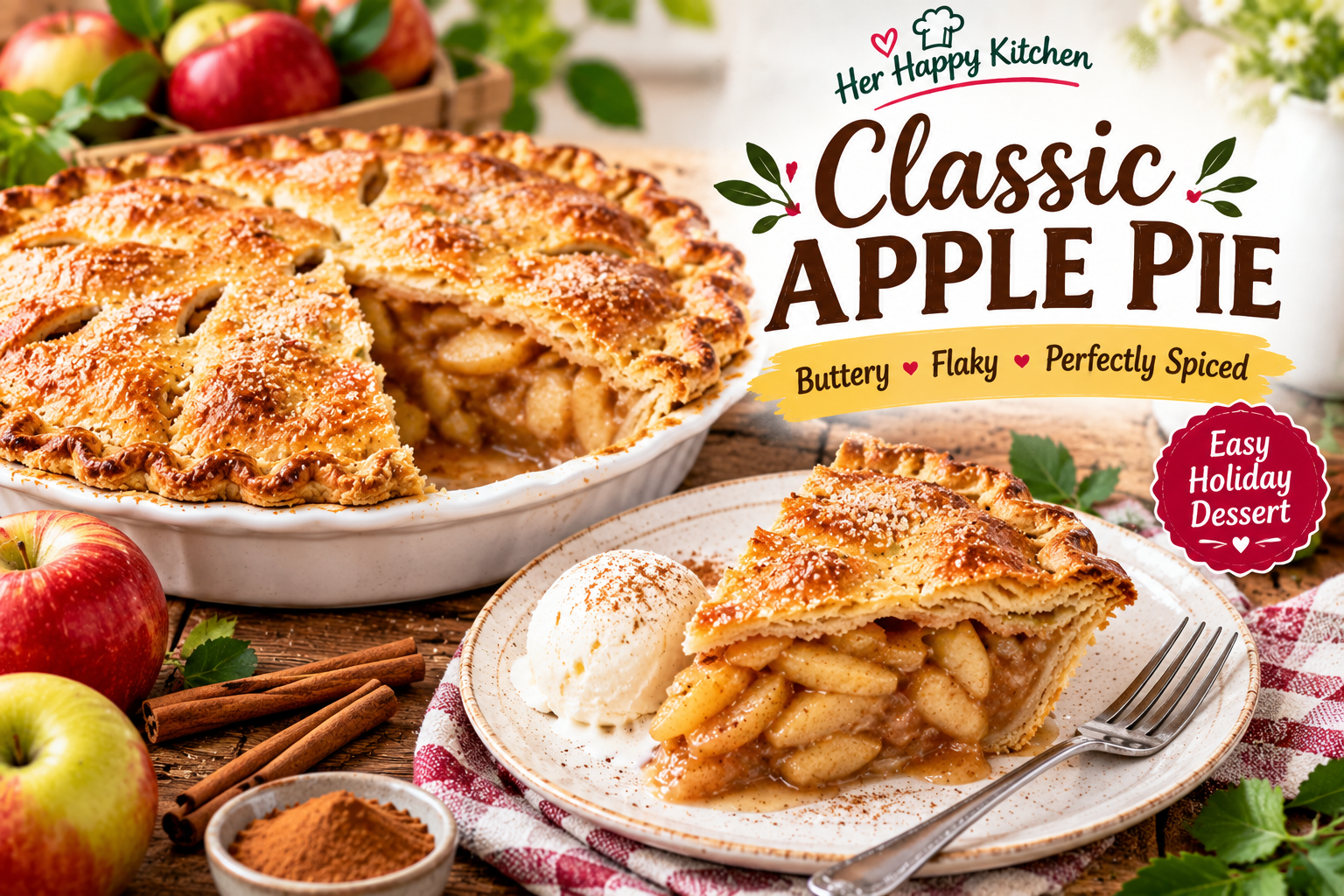
Introduction
There is something truly special about a homemade Classic Apple Pie. The combination of tender cinnamon-spiced apples, buttery flaky crust and sweet aromatic filling makes this traditional dessert perfect for family dinners, holidays, Thanksgiving, fall gatherings and cozy weekend baking.
A classic apple pie does not need complicated ingredients or fancy equipment. With fresh apples, warm spices, sugar, butter and a homemade or ready-made pie crust, you can create a beautiful dessert that looks impressive and tastes wonderfully comforting.
The best part about homemade apple pie is the contrast between the golden, crisp pastry and the soft apple filling inside. When served warm with a scoop of vanilla ice cream, every bite becomes even more delicious.
This Classic Apple Pie Recipe is designed to be simple enough for home bakers while still giving you that traditional American bakery-style result.
Whether you are making apple pie for Thanksgiving, a holiday dinner, a Sunday family meal or simply because you have fresh apples at home, this recipe is a wonderful choice.
Welcome to Her Happy Kitchen, where simple ingredients come together to create delicious homemade food.
1. Why You Will Love This Classic Apple Pie
There are many reasons to keep a traditional apple pie recipe in your recipe collection.
First, it uses simple ingredients that are easy to find.
Second, the filling can be prepared quickly.
Third, you can use homemade pie crust or your favorite store-bought crust.
Fourth, the warm combination of apples and cinnamon creates an irresistible aroma while the pie bakes.
And finally, apple pie is one of those desserts that feels perfect for almost every occasion.
You can serve it warm after dinner, bring it to a family gathering, make it for Thanksgiving or enjoy a slice with tea or coffee.
This recipe gives you:
- Tender and flavorful apple filling
- Warm cinnamon flavor
- Buttery flaky crust
- Beautiful golden-brown top
- Simple ingredients
- Easy preparation
- Perfect holiday dessert
- Wonderful homemade flavor
2. What Makes a Great Apple Pie?
A great apple pie is all about balance.
The apples should become tender without completely losing their texture.
The filling should be sweet but not overwhelmingly sugary.
The spices should complement the apples instead of covering their natural flavor.
And the crust should be golden, flaky and buttery.
One of the biggest secrets is choosing apples that hold their shape during baking. Using a mixture of sweet and slightly tart apples can also create a more interesting flavor.
The filling should not be too watery. Nobody wants a pie where the filling turns into a thin liquid and makes the bottom crust soggy.
That is why preparing the filling carefully and allowing the finished pie to cool before slicing are both important steps.
3. Ingredients for Classic Apple Pie
For the apple filling:
- 6 medium apples
- ½ cup granulated sugar
- ¼ cup brown sugar
- 2 tablespoons all-purpose flour
- 1 teaspoon ground cinnamon
- ¼ teaspoon ground nutmeg
- ¼ teaspoon salt
- 1 tablespoon lemon juice
- 1 teaspoon vanilla extract
- 2 tablespoons butter
For the pie crust:
- 2½ cups all-purpose flour
- 1 tablespoon granulated sugar
- ½ teaspoon salt
- 1 cup cold unsalted butter, cubed
- 6–8 tablespoons ice-cold water
For the egg wash:
- 1 egg
- 1 tablespoon water
Optional topping:
- A little coarse sugar for sprinkling
4. Best Apples for Apple Pie
Choosing the right apples can make a big difference.
Some apples become very soft during baking, while others hold their shape better.
Good choices include:
- Granny Smith
- Honeycrisp
- Pink Lady
- Braeburn
- Golden Delicious
- Fuji
Granny Smith apples are especially popular because they have a pleasant tartness that balances the sweetness of the filling.
Honeycrisp apples provide natural sweetness and a lovely texture.
You can also combine two different varieties.
For example, Granny Smith and Honeycrisp together create a delicious balance between tart and sweet flavors.
5. Can You Use Only One Type of Apple?
Yes.
You do not have to mix different varieties.
If you have one variety available, you can absolutely make the pie using it.
The most important thing is to choose apples that are fresh and suitable for baking.
If your apples are naturally very sweet, you may prefer to slightly reduce the added sugar.
If your apples are quite tart, the original amount of sugar can provide a nice balance.
6. Preparing the Apples
Start by washing the apples thoroughly.
Peel the apples if you prefer a smooth filling.
You can leave the peel on if you like a more rustic texture, but peeling generally gives the classic apple pie filling a softer consistency.
After peeling, remove the cores.
Cut the apples into relatively even slices.
Try not to make some pieces extremely thin and others very thick.
Even slices help the apples cook more evenly.
Place the sliced apples in a large mixing bowl.
Add lemon juice and gently toss.
The lemon juice adds brightness and also helps prevent the apples from browning too quickly while you prepare the rest of the filling.
7. Making the Apple Pie Filling
Add the granulated sugar and brown sugar to the apples.
Then add:
- Cinnamon
- Nutmeg
- Salt
- Flour
Gently toss everything together.
Add vanilla extract and mix again.
The flour is important because it helps thicken the natural juices released by the apples during baking.
Do not worry if the mixture looks a little dry at first.
As the apples heat up in the oven, they release their natural juices.
The sugar dissolves and combines with those juices, while the flour helps create a thicker, delicious filling.
8. Why Add Lemon Juice?
Lemon juice adds a small amount of acidity that helps balance the sweetness.
It also gives the filling a brighter flavor.
You do not need a lot.
One tablespoon is generally enough for this recipe.
The goal is not to make the filling taste strongly of lemon.
Instead, it should simply make the apple flavor taste fresher and more balanced.
9. Preparing the Homemade Pie Crust
If you want to make your crust from scratch, begin by combining the flour, sugar and salt in a large bowl.
Add the cold cubed butter.
Using a pastry cutter or your fingertips, work the butter into the flour until the mixture resembles coarse crumbs.
Do not completely blend the butter into the flour.
Small pieces of butter are important for creating a flaky crust.
When the dough bakes, the butter melts and creates layers in the pastry.
10. Adding Ice Water
Gradually add ice-cold water.
Start with a few tablespoons.
Mix gently.
Continue adding water only until the dough begins to come together.
You do not want the dough to become wet or sticky.
Too much water can make the crust tough.
The dough should hold together when pressed but should not feel overly soft.
11. Chilling the Dough
Divide the dough into two portions.
Shape each portion into a flat disk.
Wrap the dough and refrigerate it for at least 30 minutes.
Chilling is an important step.
Cold butter helps create a flaky crust.
It also makes the dough easier to roll.
If the dough becomes too warm while you are working with it, place it back in the refrigerator for a few minutes.
12. Rolling the Bottom Crust
Lightly flour your work surface.
Place one chilled dough disk on the surface.
Roll it gently from the center outward.
Rotate the dough occasionally so that it does not stick.
Continue rolling until the dough is large enough to fit into your pie dish with some extra dough around the edges.
Carefully transfer the dough into the pie dish.
Press it gently into the bottom and sides.
Do not stretch the dough aggressively.
Stretching can cause the crust to shrink while baking.
13. Filling the Pie
Pour the prepared apple mixture into the crust.
Arrange the apples so they are evenly distributed.
You may notice that the apples create a small mound.
That is completely normal.
Apples shrink during baking, so a slightly higher filling before baking helps create a beautiful finished pie.
Dot the top of the apple filling with small pieces of butter.
The butter melts into the filling and adds richness.
14. Adding the Top Crust
Roll out the second dough disk.
Carefully place it over the apples.
Press the edges together with the bottom crust.
Trim any excessive dough around the outside.
Crimp the edges using your fingers or a fork.
This not only seals the pie but also gives it a beautiful traditional appearance.
15. Creating Vents
Do not forget to cut vents into the top crust.
Use a sharp knife to make several small cuts.
These openings allow steam to escape while the pie bakes.
Without vents, steam can become trapped underneath the crust and may cause the filling to bubble over or the crust to become uneven.
You can simply make small slits.
Or, if you want a decorative pie, you can create a simple pattern.
16. Making the Egg Wash
Whisk one egg with one tablespoon of water.
Brush this mixture gently over the top crust.
Egg wash gives the pie a beautiful golden-brown appearance.
For an extra decorative finish, sprinkle a small amount of coarse sugar over the crust.
This creates a subtle crunch and adds a beautiful sparkle.
17. Baking the Apple Pie
Preheat your oven to 425°F (220°C).
Place the prepared pie on a baking sheet.
The baking sheet is useful because it can catch any filling that bubbles over during baking.
Bake the pie at the higher temperature initially to help the crust begin browning.
After the initial baking period, reduce the oven temperature to 375°F (190°C).
Continue baking until the crust is deeply golden and the filling is bubbling.
The exact baking time can vary depending on your oven, pie dish and apple variety.
18. How Do You Know When Apple Pie Is Done?
A properly baked apple pie should have a golden-brown crust.
You should also see the filling bubbling through the vents.
The apples should be tender when tested with a thin knife.
The crust should look fully baked rather than pale or doughy.
If the top crust is becoming dark too quickly but the filling still needs time, loosely cover the top with aluminum foil.
This protects the crust while allowing the pie to continue baking.
19. Why You Should Let Apple Pie Cool
One of the hardest parts of making apple pie is waiting before slicing it.
But cooling is extremely important.
When the pie comes out of the oven, the filling is very hot and loose.
As it cools, the filling thickens.
If you cut the pie immediately, the filling may spread across the plate.
Allow the pie to cool for at least 2 hours before slicing for the cleanest pieces.
If you want to serve it warm, you can gently reheat individual slices later.
20. The Perfect Apple Pie Texture
A great apple pie should have several textures in one bite.
The crust should be crisp and flaky.
The apples should be tender but not completely mushy.
The filling should be thick and glossy.
The cinnamon should provide warm spice without overpowering the apples.
A little vanilla adds depth.
Butter makes the filling rich.
Lemon juice keeps the sweetness balanced.
Together, these simple ingredients create a classic dessert.
21. Serving Classic Apple Pie
Apple pie can be served in many ways.
The classic option is a warm slice with vanilla ice cream.
You can also serve it with:
- Whipped cream
- Caramel sauce
- Powdered sugar
- Greek yogurt
- Cinnamon cream
- Vanilla custard
- A drizzle of maple syrup
For a traditional American dessert table, warm apple pie with vanilla ice cream is especially popular.
The warm pie slowly melts the cold ice cream, creating a creamy contrast with the buttery crust.
22. Apple Pie with Vanilla Ice Cream
Place a warm slice of apple pie on a dessert plate.
Add one scoop of vanilla ice cream on top or beside the slice.
The cold ice cream begins melting over the warm crust.
Add a tiny sprinkle of cinnamon if desired.
You can also drizzle a little caramel sauce over the top.
This simple presentation makes homemade apple pie feel like a restaurant-style dessert.
23. How to Prevent a Soggy Bottom Crust
A soggy bottom is one of the most common problems with fruit pies.
Fortunately, there are several ways to reduce the risk.
First, make sure the oven is properly preheated.
Second, avoid adding excessive liquid to the filling.
Third, use enough thickener.
Fourth, place the pie on a lower oven rack if appropriate for your oven.
A preheated baking sheet or pizza stone can also help provide strong bottom heat.
Most importantly, allow the filling to bake and bubble properly.
24. How to Prevent a Runny Apple Pie
The filling becomes runny when there is too much liquid and not enough thickening.
Flour helps absorb some of the apple juices.
You can also use cornstarch if you prefer.
Another important factor is cooling.
A pie can appear slightly loose when it is extremely hot.
After cooling, the filling becomes much more stable.
Do not judge the final consistency immediately after removing the pie from the oven.
25. How to Prevent Burnt Edges
The edges of a pie crust often brown faster than the center.
If the edges become dark before the pie is finished, cover them with strips of aluminum foil or use a pie crust shield.
Do this carefully and avoid covering the entire pie too early.
You want the center crust to continue browning.
26. Can You Make Apple Pie Ahead of Time?
Yes.
Apple pie is an excellent make-ahead dessert.
You can bake it several hours before serving.
In fact, allowing the pie to cool properly often makes it easier to slice.
For a holiday meal, you can prepare the pie earlier in the day and serve it later.
You can also reheat individual slices before serving.
27. How to Store Apple Pie
Allow the pie to cool completely.
Cover it loosely with foil or plastic wrap.
For short-term storage, follow the food-safety guidance appropriate for your filling and kitchen conditions.
If you are unsure, refrigerating the pie is the safer choice.
When stored properly, apple pie can be enjoyed for several days.
Always check the appearance, smell and condition of leftovers before eating.
28. How to Reheat Apple Pie
To reheat a slice, place it in a preheated oven or toaster oven until warm.
This helps restore some of the crust’s crispness.
Microwaving is faster, but the crust may become softer.
If you use a microwave, heat the slice in short intervals.
Do not overheat it.
29. Can You Freeze Apple Pie?
Yes, apple pie can be frozen.
A fully baked pie should be cooled completely before freezing.
Wrap it well to protect it from freezer air.
When you are ready to serve it, thaw and reheat it according to the storage method you are using.
You can also prepare an unbaked pie for freezing, provided it is wrapped and handled properly.
30. Classic Apple Pie for Thanksgiving
Apple pie is a wonderful Thanksgiving dessert.
A Thanksgiving table often includes several dishes, and apple pie provides a sweet ending to the meal.
The warm cinnamon aroma also fits beautifully with the flavors of fall.
You can prepare the pie in advance so that you have less work to do on the day of the gathering.
Serve slices with vanilla ice cream or whipped cream.
31. Apple Pie for Christmas
Although apple pie is strongly associated with fall, it also works beautifully during Christmas.
You can make a decorative crust using small pastry shapes.
Cut leaves, stars or other simple shapes from extra dough.
Place them over the top crust.
Brush with egg wash and bake until golden.
This creates a festive dessert without requiring complicated decorating skills.
32. Easy Apple Pie Variation
If you want a quicker version, use refrigerated pie crust.
You can still make the apple filling from scratch.
This saves preparation time while keeping the homemade flavor.
Store-bought crust is especially useful when you are cooking several dishes for a holiday gathering.
33. Caramel Apple Pie
For a caramel variation, add a small drizzle of caramel sauce over the baked pie before serving.
You can also serve caramel sauce alongside each slice.
The combination of apples, cinnamon and caramel creates a rich dessert flavor.
Be careful not to add too much sauce because the apple pie is already naturally sweet.
34. Dutch Apple Pie Variation
A Dutch-style apple pie often uses a crumb topping instead of a traditional pastry top.
The topping can be made with:
- Flour
- Butter
- Brown sugar
- Cinnamon
- Oats, if desired
The result is a crunchy topping over soft cinnamon apples.
It is a delicious alternative to the classic double-crust pie.
35. Apple Crumble Pie
For another variation, replace the traditional top crust with a simple crumble mixture.
Combine flour, oats, brown sugar and cold butter.
Sprinkle it over the apple filling.
Bake until the topping becomes golden.
This version has a wonderful crunchy texture and is especially delicious served warm.
36. Mini Apple Pies
Mini apple pies are perfect for parties.
Use small pie dishes or cut circles from rolled pie dough.
Add a small amount of apple filling.
Cover with another piece of dough.
Seal the edges and add a small vent.
Bake until golden.
Mini pies are easy to serve because each guest gets an individual dessert.
37. Apple Pie Bites
You can also make small apple pie bites using pastry squares.
Place a small amount of apple filling in the center.
Fold the dough over and seal the edges.
Brush with egg wash.
Bake until golden.
These are excellent for parties, dessert tables and casual gatherings.
38. Common Apple Pie Mistakes
Mistake 1: Using warm butter
Warm butter can make the crust difficult to work with.
Use cold butter.
Mistake 2: Adding too much water
Too much water can create a tough crust.
Add only enough water to bring the dough together.
Mistake 3: Cutting apples unevenly
Very thick pieces may remain firm while thin pieces become overly soft.
Try to keep the slices similar in size.
Mistake 4: Skipping vents
Steam needs a way to escape.
Always add vents to a double-crust pie.
Mistake 5: Cutting immediately
The filling needs time to set.
Let the pie cool before slicing.
39. Tips for the Flakiest Pie Crust
Keep your butter cold.
Use ice-cold water.
Do not overwork the dough.
Chill the dough before rolling.
Chill the assembled pie if the dough becomes warm.
Bake in a properly preheated oven.
These small steps can make a noticeable difference in the final crust.
40. Why Cold Butter Matters
Cold butter creates small pockets within the dough.
During baking, the water in the butter turns into steam.
That steam helps separate layers of dough.
This contributes to a flaky texture.
If the butter becomes too warm before baking, it can blend into the flour instead of creating those distinct layers.
That is why keeping the dough cool is important.
41. How to Make the Crust More Flavorful
A basic butter crust already tastes delicious.
For additional flavor, you can add a small amount of:
- Cinnamon
- Vanilla sugar
- Orange zest
- Lemon zest
However, keep the flavor subtle.
The apples should remain the star of the dessert.
42. Apple Pie Spice
Instead of using only cinnamon, you can create a homemade apple pie spice blend.
A simple blend can include:
- Cinnamon
- Nutmeg
- Ginger
- Allspice
Store the mixture in an airtight container.
Use a small amount in the apple filling.
This creates a warm and aromatic flavor.
43. Adding Brown Sugar
Brown sugar adds a deeper caramel-like flavor.
It also works beautifully with cinnamon and apples.
Using a combination of white and brown sugar creates more complexity than using only one type.
If you prefer a lighter pie, you can adjust the amount of brown sugar.
44. Adding Vanilla
Vanilla extract may seem like a small ingredient, but it adds depth to the filling.
It does not need to dominate.
One teaspoon is enough to give the apples a warmer, more rounded flavor.
45. Adding Butter to the Filling
Small pieces of butter placed over the apples before adding the top crust melt during baking.
The butter adds richness and helps create a smooth, flavorful filling.
It also pairs beautifully with cinnamon and brown sugar.
46. Can You Add Raisins?
Yes.
If you enjoy raisins, you can add a small amount to the apple filling.
Raisins provide extra sweetness and chewiness.
However, classic apple pie does not require raisins.
Keep the amount moderate so the apples remain the main ingredient.
47. Can You Add Nuts?
Chopped pecans or walnuts can be added for extra texture.
Use a small amount so the filling does not become too crowded.
Nuts are especially good in Dutch-style or crumble-topped apple pies.
48. Apple Pie with Pecans
For a delicious variation, add chopped pecans to the filling or crumble topping.
The buttery nuts complement the apples and cinnamon.
This version is especially nice for fall gatherings.
49. Apple Pie with Cheddar
Some traditional American apple pie lovers enjoy serving apple pie with cheddar cheese.
The salty, savory cheese creates an interesting contrast with sweet apples.
You can serve a thin slice of sharp cheddar alongside warm apple pie.
It is an optional variation, but it can be fun to try.
50. Best Way to Slice Apple Pie
Use a sharp knife.
Allow the pie to cool.
Cut directly through the crust with a gentle sawing motion.
Avoid pressing down too hard because that can crush the flaky pastry.
Use a pie server or flat spatula to lift the slice.
For clean slices, allow the pie to cool longer.
For a warm, softer slice, serve it while slightly warm.
51. Perfect Apple Pie for Family Dinner
A homemade apple pie is more than just a dessert.
It is a comforting recipe that can become part of family traditions.
Children can help wash and arrange apples.
Older family members can help with rolling and decorating the crust.
Everyone can gather around the table after dinner and enjoy warm slices together.
That is what makes homemade food special.
52. Simple Apple Pie Meal Planning
If you are planning a large dinner, prepare the pie first.
The pie can cool while you work on other dishes.
You can prepare the crust earlier.
You can also slice the apples and prepare the filling shortly before assembling the pie.
Planning ahead makes holiday cooking much less stressful.
53. Apple Pie Photography Tips for Your Food Blog
For Her Happy Kitchen, an apple pie photo should highlight the golden crust and beautiful apple filling.
Place the pie on a rustic wooden table.
Add a few fresh apples around the dish.
Include cinnamon sticks, a small bowl of sugar and fresh herbs or warm kitchen props.
Slice one piece and place it on a separate plate.
A scoop of vanilla ice cream beside the slice can make the image even more inviting.
Use soft natural lighting.
Avoid making the background too busy.
The pie should remain the main focus.
54. Pinterest-Friendly Apple Pie Presentation
For Pinterest, use a vertical image.
Place the whole pie in the lower or middle section.
Show one slice separately so the apple filling is visible.
Add clear text such as:
“CLASSIC APPLE PIE”
“BUTTERY • FLAKY • DELICIOUS”
“EASY HOLIDAY DESSERT”
“HER HAPPY KITCHEN”
The text should be large enough to read easily on a phone.
55. Nutrition Note
Apple pie is a dessert and should be enjoyed as part of a balanced eating pattern.
The exact nutritional values depend on the ingredients, portion size and type of crust used.
Using more or less sugar, butter or serving it with ice cream will also change the overall nutritional content.
For accurate nutrition information, calculate the values using the exact ingredients and brands used in your kitchen.
56. Frequently Asked Questions
Can I use store-bought pie crust?
Yes. Store-bought pie crust can save time and still produce a delicious apple pie.
Do I have to peel the apples?
No. Peeling is optional, although peeled apples create a more traditional smooth filling.
What apples are best?
Granny Smith, Honeycrisp, Pink Lady, Braeburn and Golden Delicious are all good options.
Why is my apple pie watery?
The apples may have released a lot of liquid, or the pie may not have baked long enough. Proper thickening and cooling also help.
Why is my crust not flaky?
The butter may have become too warm, or the dough may have been overworked.
Can I prepare apple pie ahead of time?
Yes. Apple pie is an excellent make-ahead dessert.
Can I freeze apple pie?
Yes. Properly wrapped apple pie can be frozen for later use.
Can I make apple pie without nutmeg?
Absolutely. Cinnamon alone works very well.
Can I use brown sugar instead of white sugar?
Yes. You can use brown sugar for a deeper caramel-like flavor.
Can I add walnuts?
Yes. Chopped walnuts or pecans can add wonderful texture.
57. Final Recipe Summary
This Classic Apple Pie Recipe is a simple and comforting dessert made with fresh apples, cinnamon, brown sugar, butter and a flaky golden crust.
The apples become tender and flavorful while baking, creating a warm filling beneath the buttery pastry.
For the best results, use fresh baking apples, keep your butter cold, avoid overworking the crust and allow the finished pie to cool before slicing.
Serve it warm with vanilla ice cream, whipped cream or caramel sauce.
It is perfect for Thanksgiving, Christmas, fall gatherings, Sunday dinners, family celebrations and cozy evenings at home.
58. Classic Apple Pie Recipe Card
Recipe Name:
Classic Apple Pie
Prep Time:
30 minutes
Chilling Time:
30 minutes
Bake Time:
Approximately 50–65 minutes, depending on oven and pie
Servings:
8 slices
Category:
Dessert
Cuisine:
American
Ingredients:
For Filling:
6 medium apples
½ cup granulated sugar
¼ cup brown sugar
2 tablespoons all-purpose flour
1 teaspoon cinnamon
¼ teaspoon nutmeg
¼ teaspoon salt
1 tablespoon lemon juice
1 teaspoon vanilla extract
2 tablespoons butter
For Crust:
2½ cups all-purpose flour
1 tablespoon sugar
½ teaspoon salt
1 cup cold unsalted butter
6–8 tablespoons ice water
Egg Wash:
1 egg
1 tablespoon water
Instructions:
- Wash, peel and slice the apples.
- Toss apples with lemon juice.
- Add sugar, brown sugar, flour, cinnamon, nutmeg and salt.
- Add vanilla and mix gently.
- Prepare the pie dough by combining flour, sugar and salt.
- Cut cold butter into the flour mixture.
- Add ice water gradually until the dough comes together.
- Chill the dough for at least 30 minutes.
- Roll out one dough portion and place it into a pie dish.
- Add the apple filling.
- Dot the filling with butter.
- Roll out the second dough portion and place it over the filling.
- Seal and crimp the edges.
- Cut several vents in the top.
- Brush with egg wash.
- Sprinkle with coarse sugar if desired.
- Bake in a preheated oven.
- Reduce the temperature after the initial baking period.
- Continue baking until the crust is golden and the filling is bubbling.
- Cool before slicing.
- Serve warm with vanilla ice cream or your favorite topping.
59. Final Tips for Perfect Apple Pie
Use firm baking apples.
Keep your butter cold.
Do not overwork the dough.
Do not add excessive water.
Use enough thickener for the apple filling.
Do not skip the vents.
Watch the crust during baking.
Cover the edges if they brown too quickly.
Allow the pie to cool before cutting.
Serve with vanilla ice cream for a classic dessert experience.
60. Conclusion
Classic Apple Pie is one of those timeless recipes that never goes out of style.
With a golden flaky crust, tender cinnamon-spiced apples and a delicious buttery filling, it brings warmth and comfort to any table.
You do not need complicated ingredients or professional baking equipment.
A little patience, fresh apples and a good pie crust are enough to create a beautiful homemade dessert.
Whether you are preparing it for Thanksgiving, Christmas, a family dinner or simply a cozy weekend treat, this apple pie is sure to become a recipe you return to again and again.
Make it, slice it, serve it warm and enjoy every comforting bite.
CLASSIC APPLE PIE RECIPE – BUTTERY, FLAKY & PERFECTLY SPICED
61. Choosing Fresh Apples for the Best Pie
The quality of the apples has a major effect on the final taste and texture of your apple pie.
Whenever possible, choose apples that feel firm when gently pressed. Avoid apples that are extremely soft, bruised or damaged.
Fresh apples provide better flavor and usually hold their texture more successfully during baking.
For an especially flavorful pie, you can combine two varieties.
A tart apple such as Granny Smith can provide brightness, while a naturally sweeter apple such as Honeycrisp can add sweetness and a pleasant texture.
This combination creates a filling with more depth than using only one type of apple.
However, there is no need to make your recipe complicated. One good baking apple can still produce a delicious homemade pie.
62. How Many Apples Do You Need?
For a standard 9-inch pie, approximately 6 medium apples generally provide enough filling.
The exact amount depends on the size of the apples and how thickly you slice them.
Apples shrink as they bake because they lose some of their water.
For this reason, the filling may look quite high when you first assemble the pie.
Do not worry.
After baking, the apples settle down and the filling becomes more compact.
If you are using unusually large apples, you may need fewer.
If your apples are small, you may need additional apples.
The important thing is to fill the pie generously without allowing the apples to rise so high that the top crust cannot be sealed properly.
63. Should Apples Be Sliced Thin or Thick?
Medium-thin slices are generally ideal.
Very thin slices can become soft quickly and may lose their shape.
Very thick slices can remain firm while the crust is already fully browned.
Try to cut the apples into slices of similar thickness.
This allows them to cook at approximately the same rate.
Uniform slices also make the pie easier to eat because each bite contains a pleasant mixture of tender apple and pastry.
64. Do You Need to Cook Apples Before Baking?
Traditional apple pie can be made using raw sliced apples.
The apples cook inside the crust as the pie bakes.
Some bakers prefer to cook the apples briefly before assembling the pie because this can help control the filling volume and texture.
However, pre-cooking is not essential for this recipe.
If you use fresh apples, slice them evenly and season them properly.
The oven will do most of the work.
65. Why Apples Shrink During Baking
Apples naturally contain water.
As they heat, some of this moisture is released.
The apple pieces soften and become smaller.
This is why an apple pie can look very full before baking but have a slightly lower filling after baking.
The natural juices combine with the sugar, butter and spices to create a flavorful syrup.
The flour helps thicken those juices.
This process is what gives apple pie its classic soft, glossy filling.
66. How to Avoid a Large Gap Under the Crust
A gap between the top crust and apple filling can occur because apples shrink during baking.
One way to reduce this is to arrange the apple slices fairly tightly in the pie dish.
Do not simply pour the apples into the crust and leave large empty spaces.
Arrange them evenly.
You can gently press them down as you add them.
Do not crush them.
The goal is simply to create a reasonably compact filling.
67. The Importance of Flour in the Filling
All-purpose flour helps thicken the apple juices.
As the pie heats, the apples release liquid.
The flour absorbs some of that liquid and helps create a thicker filling.
Without enough thickener, the pie may become excessively runny.
Too much flour, however, can make the filling taste slightly heavy.
That is why a moderate amount is ideal.
68. Cornstarch Instead of Flour
If you prefer, you can use cornstarch instead of flour.
Cornstarch provides strong thickening power.
Use it carefully because a small amount can be enough.
Mix the cornstarch thoroughly with the sugar and apples so that it does not form lumps.
Both flour and cornstarch can work well.
The choice is mostly a matter of preference and what you have available.
69. Apple Pie Without a Top Crust
You do not have to make a double-crust apple pie.
You can create an open apple pie with the apples exposed on top.
For this version, arrange the apples beautifully and add small pieces of butter over them.
You can sprinkle a little sugar and cinnamon over the top.
Bake until the apples are tender and the crust is golden.
This version is especially attractive when you want the apples to be the visual focus.
70. Lattice Apple Pie
A lattice crust is one of the most beautiful ways to decorate apple pie.
Roll out the second dough portion.
Cut it into long strips.
Place several strips across the filling.
Then weave additional strips in the opposite direction.
Press the edges into the bottom crust.
Brush the lattice with egg wash.
As the pie bakes, the golden pastry forms a beautiful pattern.
A lattice crust also allows steam to escape naturally.
71. Easy Lattice Method
You do not need perfect pastry skills to make a lattice.
Cut strips of similar width.
Place half of them in one direction.
Fold alternate strips back.
Place a strip across the pie.
Return the folded strips to their original position.
Repeat with the remaining strips.
Do not worry if the pattern is not perfectly symmetrical.
A homemade pie is supposed to have a warm, handmade appearance.
72. Decorative Leaf Crust
Extra pastry dough can be used to create decorative leaves.
Roll the dough thinly.
Cut small leaf shapes using a knife or cookie cutter.
Use the tip of a knife to make small lines resembling leaf veins.
Arrange the leaves around the top of the pie.
Brush them with egg wash.
This creates a beautiful fall-inspired apple pie that works especially well for Thanksgiving.
73. Apple-Shaped Pie Decorations
If you want a playful design, use a small apple-shaped cookie cutter.
Cut several shapes from leftover dough.
Place them over the crust.
Keep enough open space for steam to escape.
You can arrange the shapes around the center or along the edges.
Simple decorations can make a homemade pie look special without requiring advanced pastry techniques.
74. How to Make a Golden Crust
Egg wash is one of the easiest ways to create a golden crust.
Whisk one egg with a tablespoon of water.
Brush a thin layer over the pastry.
Do not flood the crust with egg wash.
A light coating is enough.
You can sprinkle coarse sugar over the egg wash for a slightly crunchy finish.
The combination creates a beautiful golden-brown appearance.
75. Milk Wash Instead of Egg Wash
If you do not want to use egg, you can brush the crust with milk.
Milk can help the surface brown slightly.
The result may not be exactly the same as an egg-washed crust, but it can still look attractive.
You can also simply brush the pastry lightly with cream if preferred.
76. Why the Oven Must Be Preheated
A properly preheated oven is important for pie baking.
The butter in the crust needs to remain cold until the dough enters a hot environment.
A hot oven helps the crust begin baking immediately.
If the oven is still heating when you put the pie inside, the butter may melt too slowly and the pastry can lose some of its flaky structure.
Always allow the oven to reach the required temperature before baking.
77. Using a Baking Sheet Under the Pie
Place the pie dish on a baking sheet before putting it in the oven.
This serves two purposes.
First, it makes the pie easier to move.
Second, if some apple filling bubbles over, it lands on the baking sheet instead of directly on the oven floor.
This makes cleanup much easier.
The baking sheet also provides a stable surface for the pie dish.
78. Best Oven Rack Position
For many ovens, the lower-middle portion of the oven works well for fruit pies.
This helps the bottom crust receive enough heat while the top continues browning.
However, every oven behaves differently.
If your oven tends to brown the top quickly, use a slightly lower rack.
If the bottom crust often remains pale, stronger bottom heat may help.
Learning how your own oven behaves is one of the most useful baking skills.
79. Why Apple Pie Should Bake Until Bubbling
The filling needs to reach a temperature where the juices become properly thickened.
Visible bubbling through the crust vents is a useful sign that the filling is hot and actively cooking.
Do not remove the pie simply because the crust looks golden.
The center of the filling may still need additional time.
If necessary, protect the crust with foil and continue baking.
80. Protecting the Crust During Baking
If the edges or top begin browning too quickly, loosely cover the pie with aluminum foil.
Do not press the foil directly onto the pastry.
Create a loose cover.
This slows down browning while allowing the filling to continue cooking.
You can remove the foil near the end of baking if you want the crust to deepen in color.
81. Why Resting the Pie Matters
Resting is one of the most important steps.
The filling is extremely hot immediately after baking.
As it cools, the juices become thicker.
The butter also settles into the filling.
Cutting too early can cause the filling to run out.
Waiting requires patience, but the result is worth it.
For neat slices, allow the pie to cool for about 2 hours.
82. Warm Versus Hot Apple Pie
Apple pie does not have to be served immediately after baking.
A warm slice is often more enjoyable than an extremely hot slice because the filling has had time to stabilize.
If the pie has cooled completely, gently reheat an individual slice.
Serve it warm with ice cream.
This gives you the comforting temperature contrast without making the filling excessively liquid.
83. How to Make Apple Pie Less Sweet
If you prefer desserts with moderate sweetness, reduce the sugar slightly.
The exact amount depends on the apples.
Very sweet apples require less added sugar.
Tart apples can handle more.
Taste the raw apple mixture before adding it to the crust, keeping in mind that the final flavor changes during baking.
Do not taste raw flour or other uncooked ingredients unnecessarily.
Instead, use the natural sweetness of the apples as your guide.
84. How to Make Apple Pie More Spicy
If you love warm spices, increase the cinnamon slightly.
You can also add a small pinch of:
- Ground ginger
- Allspice
- Cardamom
- Clove
Be careful with strong spices such as clove.
A small amount can provide plenty of flavor.
The apples should remain the main taste.
85. Cinnamon and Apple Flavor
Cinnamon is one of the most recognizable flavors associated with apple pie.
It adds warmth without overwhelming the fruit.
Freshly ground cinnamon can have a particularly fragrant aroma.
However, ordinary ground cinnamon works perfectly well.
For the best balance, mix the cinnamon thoroughly with the sugar and flour before combining it with the apples.
This helps distribute the spice evenly.
86. Adding Orange Zest
A small amount of orange zest can give apple pie a bright citrus aroma.
Finely grate only the colored outer part of the orange peel.
Avoid adding large amounts of the white pith because it can taste bitter.
Orange zest is optional.
The traditional recipe does not require it.
87. Adding Lemon Zest
Lemon zest is another optional flavor addition.
A small amount can make the apples taste brighter.
It pairs naturally with lemon juice.
Again, use it sparingly.
You want the apple flavor to remain dominant.
88. Apple Pie with Maple Syrup
For a fall-inspired variation, replace a small portion of the sugar with maple syrup.
Maple syrup provides a warm caramel-like flavor.
Because it adds liquid, do not replace all the sugar with syrup.
A small amount is enough to create a noticeable flavor difference.
Maple syrup also pairs beautifully with pecans.
89. Apple Pie with Honey
Honey can also be used as an optional sweetener.
Choose a mild-flavored honey so that it does not overpower the apples.
Because honey is liquid, use it carefully.
Too much extra liquid can affect the filling consistency.
For a classic pie, regular sugar remains the simplest option.
90. Apple Pie with Cranberries
For a festive variation, add a small amount of cranberries to the apple filling.
Cranberries provide tartness and a beautiful color.
This version works particularly well during Thanksgiving and Christmas.
The sweetness of the apples balances the tart cranberries.
Keep the cranberry quantity moderate so that the filling remains primarily apple-based.
91. Apple and Pear Pie
Pears can be combined with apples for a softer, sweeter variation.
Choose firm pears that can withstand baking.
Slice the pears similarly to the apples.
Use a mixture of apples and pears rather than replacing all the apples.
The result is a delicate fruit filling with a slightly different texture.
92. Apple and Peach Pie
During peach season, a small amount of sliced peach can be added to an apple pie.
Choose firm ripe peaches.
Because peaches release additional juice, adjust the thickener if necessary.
This variation is especially good during summer.
93. Apple and Blueberry Pie
Blueberries can also be combined with apples.
The blueberries provide color and a juicy berry flavor.
Use fresh or properly prepared frozen blueberries.
Because berries release liquid, make sure the filling contains enough thickener.
The result is a beautiful purple-golden fruit filling.
94. Gluten-Free Apple Pie Option
If you need a gluten-free version, use a certified gluten-free pie crust and a gluten-free thickener such as cornstarch.
Check ingredient labels carefully if the pie is being prepared for someone with a medical gluten-related condition.
Avoid cross-contact with regular wheat flour.
The apple filling itself can be naturally gluten-free when prepared with an appropriate thickener.
95. Dairy-Free Apple Pie Option
For a dairy-free version, use a suitable dairy-free butter alternative in the crust and filling.
Make sure the pie crust ingredients are also dairy-free.
The apple filling can remain very flavorful without traditional butter.
Choose a neutral-tasting alternative so the apples and spices remain prominent.
96. Vegan Apple Pie
A vegan apple pie can be made by using plant-based butter and a suitable egg-wash alternative.
For example, the crust can be brushed lightly with plant-based milk.
Always check that every ingredient is suitable for a vegan diet.
The apple filling itself can be made with fruit, sugar, spices and plant-based fat.
97. Egg-Free Apple Pie
The traditional filling does not require eggs.
The egg is used primarily for brushing the crust.
You can simply skip the egg wash or use milk or plant-based milk instead.
The crust may be slightly less glossy, but the pie can still be delicious.
98. Making Apple Pie in a Glass Dish
A glass pie dish can work well.
One advantage is that you can sometimes observe the bottom and sides of the crust as they bake.
However, glass heats differently from metal.
Follow the temperature recommendations for your specific dish and oven.
Avoid sudden temperature changes with glass bakeware.
99. Making Apple Pie in a Metal Pan
Metal pie pans often provide strong heat transfer.
They can be particularly useful for getting a well-baked bottom crust.
If using a dark metal pan, monitor browning because darker surfaces can sometimes brown pastry more quickly.
Always adjust according to your oven.
100. Ceramic Pie Dish
Ceramic pie dishes are beautiful for serving.
They retain heat well and can make a pie look especially attractive on a holiday table.
Because ceramic dishes can behave differently from metal pans, baking time may vary.
Watch the visual signs of doneness rather than relying only on the clock.
101. Homemade Pie Crust Versus Store-Bought
Homemade crust gives you control over ingredients and texture.
It can produce a wonderfully flaky pastry.
Store-bought crust saves time and can be very convenient.
There is nothing wrong with using a prepared crust when you want to make dessert quickly.
The apple filling remains the main flavor component.
For busy holidays, a prepared crust can make the recipe much easier.
102. How to Roll Pie Dough Without Cracking
Let chilled dough sit at room temperature briefly if it is extremely firm.
Do not leave it out for too long.
Lightly flour the surface and rolling pin.
Roll gently from the center outward.
Rotate the dough regularly.
If the edges crack, press them together gently.
Do not force the rolling pin aggressively.
103. What If the Dough Is Too Sticky?
If the dough feels sticky, place it back in the refrigerator.
You can lightly flour the work surface and rolling pin.
Avoid adding excessive flour because too much can make the crust dense.
Chilling is often the easiest solution.
Cold dough is easier to handle.
104. What If the Dough Is Too Dry?
If the dough refuses to come together, add a tiny amount of ice water.
Add it gradually.
Do not pour in a large amount at once.
The dough should come together when pressed.
It does not need to become smooth like bread dough.
A slightly rough-looking pastry dough can bake beautifully.
105. How to Keep the Crust Flaky
The main principles are:
Keep butter cold.
Use ice water.
Work quickly.
Do not overmix.
Do not knead the dough.
Chill the dough before rolling.
Chill the assembled pie if needed.
Bake in a properly heated oven.
These steps help preserve the butter layers that create flaky pastry.
106. Understanding Pie Dough
Pie dough is different from bread dough.
Bread dough is kneaded to develop gluten.
Pie dough should not be kneaded extensively.
The goal is to combine the ingredients while keeping the butter distributed through the flour.
Overworking the dough can produce a tougher crust.
Handle it gently.
107. How Much Flour Should You Use While Rolling?
Use enough flour to prevent sticking.
Do not cover the work surface with a thick layer of flour.
Too much flour can be incorporated into the dough and affect its texture.
A light dusting is usually sufficient.
Rotate the dough regularly to make sure it is not sticking underneath.
108. Can Pie Dough Be Made Ahead?
Yes.
Pie dough can be prepared ahead and refrigerated.
Wrap it tightly to prevent it from drying out.
When ready to use, allow it to soften slightly if necessary.
This can make holiday baking much easier.
You can prepare the dough in advance and focus on the filling later.
109. Preparing Apple Pie for a Dinner Party
If you are hosting a dinner party, apple pie is a practical dessert because it can be prepared ahead.
Bake it several hours before guests arrive.
Allow it to cool.
Keep it covered appropriately.
Before dessert, warm individual slices.
Serve with vanilla ice cream.
This allows you to focus on your guests rather than preparing dessert at the last minute.
110. Apple Pie for a Family Gathering
For a family gathering, consider making two pies if you expect many guests.
One pie generally provides about eight slices, depending on portion size.
You can make one classic version and one variation such as Dutch apple pie.
This gives guests a choice without requiring completely different desserts.
111. Apple Pie for Thanksgiving Dinner
Thanksgiving is an ideal occasion for classic apple pie.
The warm spices and baked fruit fit naturally with the season.
You can decorate the top crust with leaves or small stars.
Serve the pie after the main meal.
A scoop of vanilla ice cream provides a simple and familiar accompaniment.
112. Apple Pie for Christmas Dinner
For Christmas, you can make the pie more festive with decorative pastry shapes.
Small stars, snowflakes or leaves can be placed on top.
You can also add a small amount of cinnamon to the crust decoration.
Keep the design simple so that the pie remains elegant.
113. Apple Pie for Sunday Dinner
You do not need a holiday to make apple pie.
A Sunday family meal is a perfect opportunity.
Prepare the pie in the afternoon.
Let it cool while dinner is served.
Warm slices afterward.
The aroma of baked apples and cinnamon creates a comforting ending to a family meal.
114. Apple Pie for a Bake Sale
If you are preparing apple pie for a bake sale, consider making smaller pies.
Mini pies are easy for customers to purchase individually.
Make sure all ingredients are clearly identified.
If the baked goods are being sold publicly, follow applicable food-handling and labeling requirements.
115. Apple Pie for a Potluck
Apple pie travels well when handled carefully.
Allow it to cool completely before transporting.
Use a secure pie carrier or cover.
Bring whipped cream or ice cream separately if desired.
A simple pie is often a popular choice at potluck meals because it appeals to many different tastes.
116. How to Transport Apple Pie
Cool the pie completely.
Place it in a stable pie container.
Keep it level during transportation.
Avoid placing heavy items on top.
If the pie will be transported for a longer period, follow appropriate food-safety practices.
For best presentation, wait to slice it until you reach your destination.
117. How to Make the Pie Look Professional
Presentation does not require complicated techniques.
Focus on:
- Even crust edges
- Golden color
- Clean pie dish
- Attractive slice
- Simple garnish
Place one slice on a clean dessert plate.
Add a small scoop of vanilla ice cream.
Sprinkle a tiny amount of cinnamon.
Keep the plate uncluttered.
Simple presentation often looks more elegant than excessive decoration.
118. Apple Pie Garnishing Ideas
You can garnish apple pie with:
- Fresh mint
- Cinnamon dust
- Powdered sugar
- Caramel drizzle
- Whipped cream
- Vanilla ice cream
- Thin apple slices
Choose one or two.
The goal is to complement the pie rather than cover it.
119. Caramel Sauce for Apple Pie
A warm caramel sauce pairs naturally with baked apples.
You can drizzle a small amount over the slice.
You can also place caramel sauce in a small serving bowl so guests can add their own.
The combination of caramel, cinnamon and apples creates a rich fall dessert.
120. Homemade Whipped Cream
Whipped cream is another easy topping.
Whip cold heavy cream until soft peaks form.
Add a little sugar and vanilla if desired.
Do not overwhip.
Serve a spoonful alongside warm apple pie.
121. Vanilla Ice Cream Pairing
Vanilla ice cream remains one of the simplest and most popular apple pie toppings.
Its creamy texture contrasts beautifully with the warm apples.
You can serve the ice cream directly on the slice or beside it.
If the pie is warm, the ice cream will begin melting into the crust.
That creates a delicious combination of temperatures and textures.
122. Coffee and Apple Pie
Apple pie pairs nicely with coffee.
A simple cup of coffee balances the sweetness of the dessert.
You can also serve tea.
Black tea, chai-style tea or mild herbal tea can work well with cinnamon-spiced desserts.
123. Apple Pie and Tea
For an afternoon dessert, serve a small slice of apple pie with tea.
The warm spices complement tea beautifully.
This makes a lovely weekend snack or casual dessert.
Keep the portion comfortable and enjoy the dessert slowly.
124. How to Store Leftover Apple Pie
Once the pie has cooled, cover it appropriately.
For longer storage, refrigeration may be preferable.
Place individual slices in airtight containers if desired.
Label the container with the date so you can keep track of how long it has been stored.
Follow food-safety guidance for leftovers.
125. How to Reheat Multiple Slices
If you need to reheat several slices, place them on a baking tray.
Warm them gently in the oven.
Avoid overheating.
The goal is to warm the filling while helping the crust regain some crispness.
Serve immediately after reheating.
126. Why Microwaving Can Soften the Crust
Microwaves heat moisture quickly.
That moisture can make pastry soft.
For this reason, the microwave is convenient but does not usually provide the same crisp crust as an oven.
If you want the best texture, use an oven or toaster oven.
127. Apple Pie Leftover Breakfast
Some people enjoy a small slice of leftover apple pie with breakfast.
If you choose to do this, store the pie safely and reheat it properly if desired.
You can serve it with plain yogurt for a different combination.
Apple pie is versatile enough to become a snack as well as a dessert.
128. Apple Pie Filling as a Separate Dessert
The apple filling can also be used without a traditional pie crust.
Cook the seasoned apples in a pan until tender.
Serve them warm over:
- Pancakes
- Waffles
- Oatmeal
- French toast
- Ice cream
This is an easy way to enjoy apple-pie flavors without making a full pie.
129. Apple Pie Pancake Topping
Prepare the apple mixture with cinnamon and a little sugar.
Cook until tender.
Spoon the warm apples over pancakes.
Add a small amount of maple syrup.
This creates a breakfast inspired by classic apple pie.
130. Apple Pie Oatmeal
Cook oatmeal normally.
Top it with warm cinnamon apples.
Add a small amount of chopped nuts if desired.
This combination brings the flavors of apple pie into a simple breakfast.
131. Apple Pie French Toast
Cinnamon apples can also be served over French toast.
The sweet fruit and warm spices complement the buttery toast.
A small amount of maple syrup can be added.
This is especially delicious during cool weather.
132. Apple Pie Ice Cream Topping
Warm apple filling can be spooned over vanilla ice cream.
Add a little caramel sauce.
This creates a quick dessert when you do not have time to bake a complete pie.
It also makes excellent use of leftover cooked apples.
133. Apple Pie Yogurt Parfait
Layer plain or vanilla yogurt with cinnamon apples and granola.
Add a small amount of chopped nuts.
This is not the same as traditional apple pie, but it uses similar flavors in a different way.
134. Apple Pie Bread Pudding
Leftover bread can be combined with cinnamon apples to create a comforting bread pudding.
The apples provide sweetness and moisture.
Serve the pudding warm with a little vanilla sauce.
This is another creative way to use leftover apples.
135. Apple Pie Crumble Cups
Make individual dessert cups using baked cinnamon apples and crumble topping.
Layer the apples and crumble mixture in small oven-safe dishes.
Bake until golden.
Serve warm with ice cream.
These individual portions are excellent for gatherings.
136. How to Make Apple Pie More Rustic
A rustic apple pie does not require perfect edges.
Roll the dough into a large circle.
Place the apple filling in the center.
Fold the dough edges loosely toward the middle, leaving the center open.
Brush the pastry with egg wash.
Bake until golden.
This is sometimes called a rustic galette-style dessert.
137. Apple Galette
An apple galette is an easier alternative to traditional pie.
There is no need for a pie dish.
Roll out the pastry on a baking sheet.
Arrange the apples in the center.
Leave a border around the edges.
Fold the border over the apples.
Bake until golden.
The result is rustic, beautiful and delicious.
138. Difference Between Pie and Galette
A traditional apple pie has filling enclosed inside a pie crust.
A galette has an open center with the pastry folded around the fruit.
Both use similar ingredients.
The main difference is shape and presentation.
If you are nervous about making perfect pie edges, a galette can be a more forgiving option.
139. Apple Pie with Crumble Topping
For a crumble topping, combine flour, brown sugar, oats and cold butter.
Rub the mixture together until coarse crumbs form.
Spread it over the apples.
Bake until golden.
The topping becomes crisp while the apples remain soft.
This variation is particularly good when you enjoy contrasting textures.
140. How to Make a Crunchy Crumble
Do not make the crumble mixture too wet.
You want visible crumbs rather than a smooth dough.
Cold butter helps create a crumbly texture.
Oats can add extra crunch.
A small amount of cinnamon makes the topping more aromatic.
141. Apple Pie with Oats
Oats can be used in the crumble topping.
Old-fashioned rolled oats provide a pleasant texture.
Avoid adding excessive oats because they can make the topping dry.
Balance them with butter, flour and brown sugar.
142. Apple Pie with Walnuts
Chopped walnuts can be mixed into a crumble topping.
They provide crunch and a slightly earthy flavor.
Toast them lightly beforehand if desired, but allow them to cool before adding them.
Do not use nuts if serving someone with a relevant allergy.
143. Apple Pie with Pecans
Pecans are especially good with brown sugar and cinnamon.
Add chopped pecans to the crumble topping or serve them alongside the finished pie.
A small amount provides plenty of flavor and texture.
144. Making Individual Apple Pies
Individual pies can be made in ramekins.
Prepare the apple filling.
Divide it among small oven-safe dishes.
Top each with pastry.
Brush with egg wash.
Bake until golden and bubbling.
Allow them to cool before serving because the filling will be extremely hot.
145. Mini Apple Pie Baking Tips
Do not overfill the dishes.
Leave enough room for bubbling.
Cut small vents in each pastry top.
Place the ramekins on a baking sheet.
Monitor the crust because small pies can brown faster than a large pie.
146. Apple Hand Pies
Hand pies are small pastries filled with apple mixture.
They can be made using circles or rectangles of pie dough.
Place filling in the center.
Fold the dough over.
Press and crimp the edges.
Brush with egg wash.
Bake until golden.
Allow them to cool before serving.
147. Apple Turnovers
Puff pastry can be used to make quick apple turnovers.
Place cinnamon apples in the center of pastry squares.
Fold diagonally.
Seal the edges.
Brush with egg wash.
Bake until puffed and golden.
This is different from traditional apple pie but uses the same comforting flavor combination.
148. Apple Pie Filling for Puff Pastry
A small amount of thick apple filling works well with puff pastry.
Make sure the filling is not excessively wet.
Too much liquid can prevent puff pastry from becoming crisp.
Cool the filling slightly before placing it on the pastry.
149. Apple Pie Breakfast Pastries
Leftover apple filling can be used inside puff pastry for breakfast pastries.
Add a small amount of filling.
Fold and seal.
Bake until golden.
Serve with tea or coffee.
This is a simple way to transform leftovers into another treat.
150. How to Keep Apple Filling Flavorful
Do not overpower the apples with spices.
Use enough cinnamon to create warmth.
Add a little lemon juice for balance.
Use vanilla for depth.
Add butter for richness.
Use the correct amount of sugar.
Simple ingredients can create excellent flavor when balanced properly.
151. Tasting the Filling Before Baking
You can taste the apple mixture before adding it to the crust to check the balance of sugar and spices.
Remember that the flavor will change slightly during baking.
Do not taste raw flour-containing mixtures in large quantities.
The purpose is simply to check the fruit and seasoning balance.
152. Why Different Apples Taste Different
Apples vary in sweetness, acidity, moisture and firmness.
That is why the same recipe can taste slightly different each time.
A tart apple creates a sharper filling.
A sweet apple creates a softer, sweeter flavor.
A firm apple holds its shape better.
Understanding these differences allows you to adjust the recipe naturally.
153. Adjusting Sugar Based on Apples
If your apples are very sweet, reduce the sugar slightly.
If they are strongly tart, you may prefer the full amount.
Do not make large changes the first time you prepare the recipe.
Start with the recommended quantity.
After making the pie once, you can adjust it according to your taste.
154. Apple Pie for Beginners
Apple pie may look complicated, but the basic process is straightforward.
Prepare the dough.
Prepare the apples.
Fill the crust.
Add the top crust.
Vent the top.
Brush with egg wash.
Bake.
Cool.
Serve.
The most important skills are keeping the pastry cold and allowing enough time for the pie to cool after baking.
155. Beginner-Friendly Shortcut
If you are making apple pie for the first time, use a good-quality prepared pie crust.
Focus your attention on the filling.
Once you become comfortable with the recipe, try making your own pastry.
This approach allows you to learn one part of the recipe at a time.
156. Apple Pie Baking Schedule
If serving the pie after dinner, you can begin several hours beforehand.
Prepare the dough.
Chill it.
Prepare the filling.
Assemble the pie.
Bake it.
Allow it to cool.
Prepare dinner.
Serve the pie after the meal.
Planning the steps in advance prevents last-minute rushing.
157. One-Day Holiday Baking Plan
Morning:
Prepare the pie dough.
Refrigerate it.
Afternoon:
Prepare the apple filling.
Assemble and bake the pie.
Later:
Allow it to cool.
Before dessert:
Warm individual slices.
Serve with ice cream.
This simple schedule can make holiday cooking easier.
158. How to Make Two Apple Pies
If doubling the recipe, prepare enough apples, crust and filling ingredients for two standard pies.
Do not automatically double every spice without considering taste.
You can scale the ingredients carefully.
If your oven cannot fit two pies comfortably, bake them separately.
Good airflow around the pies helps them bake evenly.
159. Apple Pie for a Large Crowd
For a large gathering, consider making mini pies or hand pies.
They are easier to portion.
Guests can take one without requiring someone to cut the main pie.
Individual pies also make dessert service easier.
If making a large number, work in batches and keep unused dough chilled.
160. Keeping Dough Cold During Large Batches
When making several pies, work with one portion of dough at a time.
Keep the remaining dough refrigerated.
If your kitchen is warm, return rolled dough to the refrigerator whenever it becomes soft.
Cold pastry is easier to handle and usually produces better texture.
161. Apple Pie Baking Temperature Guide
A commonly used method is to begin at a higher temperature, around 425°F (220°C), and then reduce the oven to approximately 375°F (190°C).
The initial heat helps the pastry begin baking strongly.
The lower temperature allows the apples to cook while reducing the risk of excessive crust browning.
Your oven may require adjustments.
Always watch the pie rather than depending only on a fixed time.
162. Why Oven Temperatures Can Vary
Home ovens do not always heat exactly to the number displayed.
Some ovens have hot spots.
Some brown food faster.
An oven thermometer can help you understand the actual temperature if you frequently bake.
If your pies repeatedly brown too quickly or remain underbaked, learning your oven’s behavior can help you adjust your baking position and time.
163. Signs of an Underbaked Apple Pie
An underbaked pie may have:
- Pale crust
- Firm apples
- Little bubbling
- Doughy bottom
- Thin filling
If the crust is already brown, protect it with foil and continue baking until the filling is properly cooked.
164. Signs of an Overbaked Apple Pie
An overbaked pie may have:
- Very dark crust
- Dry apples
- Excessively thick filling
- Burnt edges
Careful monitoring during the final part of baking can help prevent this.
165. How to Fix a Dark Crust
If the crust is dark but the pie is not finished, cover it loosely with foil.
Continue baking at the appropriate temperature.
This allows the filling to continue cooking without exposing the crust to as much direct heat.
166. How to Fix a Pale Crust
If the filling is cooked but the crust remains pale, continue baking for a short period while monitoring carefully.
You can also move the pie slightly higher in the oven if appropriate.
Do not increase the temperature dramatically because the filling and crust can burn quickly.
167. Why Apple Pie Can Bubble Over
Apples release liquid during baking.
If the pie is filled very high, the liquid may bubble through the vents or edges.
This is another reason to place the pie on a baking sheet.
A small amount of bubbling is completely normal.
168. Cleaning Apple Pie Filling from the Baking Sheet
If filling spills onto the baking sheet, allow the sheet to cool.
Do not touch hot sugar or syrup because it can cause burns.
Once cooled, soak the baking sheet as appropriate for the material.
Using parchment paper underneath the pie can also make cleanup easier.
169. Apple Pie Aroma
One of the best parts of baking apple pie is the aroma.
As apples, cinnamon, butter and sugar heat together, the kitchen fills with a warm fragrance.
This is one reason apple pie is such a popular fall dessert.
The smell itself can make a simple family dinner feel special.
170. Making Apple Pie Part of a Tradition
Recipes often become family traditions.
You might make the same apple pie every Thanksgiving.
You might prepare it for birthdays.
You might bake it every autumn when fresh apples become available.
Write down any changes you make to the recipe.
Over time, you can create your own family version.
171. Creating Your Signature Apple Pie
A signature apple pie might include your favorite apple combination, spice blend or topping.
Maybe you prefer extra cinnamon.
Maybe you love pecans.
Maybe you prefer a lattice crust.
Maybe you like caramel sauce.
Start with the classic recipe and make small adjustments.
That is how a familiar recipe becomes your own.
172. Apple Pie and Family Baking
Apple pie is also a fun recipe for family baking.
One person can prepare the apples.
Another can roll the dough.
Someone else can decorate the crust.
Everyone can help serve dessert.
Always supervise younger cooks around knives, hot ovens and hot baking dishes.
173. Safe Apple Preparation
Wash apples before preparing them.
Use a stable cutting board.
Use an appropriate kitchen knife carefully.
Keep fingers away from the blade.
If you are not comfortable using a sharp knife, ask an adult or experienced cook for help.
Kitchen safety is more important than speed.
174. Safe Oven Practices
Always use oven mitts when handling hot bakeware.
Do not touch the pie dish with bare hands after baking.
Remember that the filling can remain extremely hot even after the pie has been removed from the oven.
Keep the pie away from the edge of counters and tables.
Allow it to cool in a safe location.
175. Why Apple Pie Is a Classic American Dessert
Apple pie has become strongly associated with American food culture.
It appears in family celebrations, holiday meals, diners, bakeries and home kitchens.
The recipe has evolved over generations and exists in many variations.
There is no single way to make apple pie.
Different families have their own crusts, spices, apples and toppings.
176. Traditional Flavor Versus Modern Variations
The traditional version focuses on apples, cinnamon, sugar and pastry.
Modern versions may include:
- Caramel
- Pecans
- Cranberries
- Maple
- Oats
- Cheddar
- Pears
The classic recipe remains a reliable starting point.
Once you understand the basic balance, variations become easier.
177. Why Simple Recipes Often Work Best
Apple pie does not require dozens of ingredients.
The main ingredients each have a clear purpose.
Apples provide fruit flavor.
Sugar provides sweetness.
Cinnamon adds warmth.
Lemon adds brightness.
Butter adds richness.
Flour thickens the juices.
Pastry provides texture.
When these ingredients are balanced, the result can be extremely satisfying.
178. Ingredient Substitution Guide
If you do not have brown sugar, you can use additional granulated sugar.
If you do not have nutmeg, you can leave it out.
If you do not have vanilla, the pie can still be delicious.
If you do not want to make homemade crust, use prepared crust.
If you do not have egg, use an alternative wash or skip it.
The recipe is flexible.
179. What Not to Substitute
Be careful when replacing major ingredients.
Changing the type of flour in the crust can significantly affect texture.
Replacing butter with a liquid oil can change the pastry structure.
Adding excessive liquid to the filling can create a runny pie.
When making substitutions, change one thing at a time so you understand the effect.
180. How to Make the Recipe More Convenient
Prepare the pie dough ahead.
Use prepared crust.
Slice apples using an apple slicer if available.
Prepare the spice mixture in advance.
Measure ingredients before beginning.
These small preparations can make the baking process smoother.
181. Mise en Place for Apple Pie
Before starting, place all ingredients on the counter.
Prepare:
- Apples
- Flour
- Sugar
- Brown sugar
- Cinnamon
- Nutmeg
- Salt
- Lemon
- Vanilla
- Butter
- Pie dough ingredients
This makes it easier to follow the recipe and reduces the chance of forgetting an ingredient.
182. Measuring Flour Correctly
For baking, measuring flour accurately is important.
If using measuring cups, avoid pressing flour down tightly.
Spoon flour into the cup and level the top.
Too much flour can make the crust dry.
A kitchen scale provides even greater accuracy.
183. Measuring Sugar
Sugar is generally easier to measure than flour.
Use the amount specified in the recipe.
If you are adjusting sweetness based on apple variety, make only moderate changes.
The goal is to balance the fruit rather than overwhelm it.
184. Measuring Spices
Small differences in spice quantities can noticeably affect a dessert.
Measure cinnamon and nutmeg carefully.
If you love cinnamon, you can increase it slightly.
However, strong spices should be used thoughtfully.
185. Using Fresh Lemon Juice
Fresh lemon juice provides a clean, bright flavor.
It is preferable when available.
Remove seeds before adding the juice to the apples.
A small amount is enough.
186. Using Vanilla Extract
Use real vanilla extract or your preferred vanilla flavoring.
Add it after the dry ingredients have been mixed with the apples.
Vanilla enhances the overall aroma.
187. Apple Pie Without Vanilla
If you do not have vanilla, do not worry.
The apples and cinnamon will still provide plenty of flavor.
Vanilla is helpful but not essential.
188. Apple Pie Without Nutmeg
Nutmeg is also optional.
Cinnamon can carry the main spice profile.
If you do not enjoy nutmeg, simply leave it out.
189. Apple Pie Without Brown Sugar
You can make the pie using only granulated sugar.
Brown sugar gives a deeper flavor, but it is not essential.
The apples, cinnamon and butter still create a delicious filling.
190. Apple Pie with Less Butter
You can reduce the butter slightly, but remember that butter contributes richness.
It also adds flavor to the crust.
If changing the crust, be aware that reducing fat can make pastry less tender and flaky.
191. Making the Recipe for Children
Children can help with safe tasks such as:
- Washing apples
- Measuring sugar
- Mixing spices
- Brushing a safe pastry decoration
- Sprinkling coarse sugar
Adults should handle sharp knives and the hot oven.
192. Apple Pie as a Cooking Lesson
This recipe teaches several useful kitchen skills.
You learn:
- Measuring
- Knife safety
- Dough preparation
- Temperature control
- Baking
- Food presentation
- Portioning
- Storage
It is therefore a useful recipe for anyone learning to bake.
193. How to Develop Baking Confidence
Do not expect the first pie to look perfect.
The crust may have uneven edges.
The filling may be slightly softer than expected.
The decoration may not be symmetrical.
That is normal.
Each time you bake, you learn something about your oven, dough and ingredients.
194. Keeping Notes After Baking
After making the recipe, write down:
- Which apples you used
- How much sugar you preferred
- Baking time
- Oven temperature
- Crust texture
- Filling texture
These notes can help you improve the recipe the next time.
195. How Weather Can Affect Pie Dough
Warm kitchens can make butter soften quickly.
Cold kitchens can make dough difficult to roll.
Humidity can also affect flour and pastry.
If the dough becomes too soft, chill it.
If it becomes very firm, allow it to sit briefly before rolling.
Learning to adjust to your kitchen environment is part of baking.
196. Apple Pie in Different Seasons
Fall is the most obvious season for apple pie, but it can be made year-round.
Fresh apples are available in many places throughout the year.
You can also use different apple varieties depending on the season.
Summer apple pies can be served with ice cream.
Winter versions pair nicely with warm caramel or whipped cream.
197. Fall Apple Pie Table Setting
For a fall gathering, place the pie on a wooden serving board.
Add a few whole apples nearby.
Use warm-colored napkins.
Add cinnamon sticks as decorative elements.
Keep food-safe decorations separate from the pie.
A simple rustic setting works beautifully.
198. Thanksgiving Dessert Table
Apple pie can be placed alongside other desserts such as:
- Pumpkin pie
- Pecan pie
- Cheesecake
- Cookies
- Fruit crumble
Cut the apple pie into even slices.
Keep toppings separate so guests can choose what they prefer.
199. Apple Pie and Pumpkin Pie
Apple pie and pumpkin pie have different textures and flavors.
Apple pie is fruit-forward with cinnamon-spiced filling.
Pumpkin pie has a smooth custard-like texture with warm spices.
Serving both gives guests two classic choices.
200. Apple Pie and Pecan Pie
Pecan pie is richer and nuttier.
Apple pie is lighter and fruitier.
A dessert table with both provides a pleasant variety.
201. Building a Cozy Dessert Menu
A simple dessert menu can include:
Classic Apple Pie
Vanilla Ice Cream
Whipped Cream
Caramel Sauce
Coffee
Tea
This keeps the focus on the main dessert without creating too much work.
202. Apple Pie Portioning
A standard pie can usually be cut into eight slices.
For a larger dessert table, smaller slices may be appropriate.
Use a sharp knife.
Wipe the knife between cuts if you want especially clean presentation.
203. How to Get Clean Slices
Allow the pie to cool properly.
Use a sharp knife.
Cut slowly through the crust.
Lift the slice using a pie server.
If the first slice is difficult to remove, do not worry.
The first piece is often the hardest.
204. Why the First Slice Can Break
The first slice has no neighboring pieces supporting it.
The crust can break slightly as it is removed.
Once the first slice is out, the remaining slices can often be easier to serve.
Do not judge the entire pie by the first slice.
205. Apple Pie for Food Photography
For a beautiful food photograph, cut one slice and place it in front of the whole pie.
Make sure the filling is visible.
Add a scoop of ice cream if desired.
Use natural light from the side.
Keep the background softly blurred.
Use a warm wooden table or neutral surface.
This creates an inviting homemade appearance.
206. Pinterest Pin Text Ideas
A Pinterest image can use text such as:
CLASSIC APPLE PIE
Buttery • Flaky • Delicious
Easy Holiday Dessert
Perfect for Thanksgiving
Homemade Apple Pie
Her Happy Kitchen
Keep the wording short and readable.
207. Blog Feature Image Idea
For the Her Happy Kitchen website, a wide feature image can show:
A golden apple pie in a ceramic dish
One slice on a dessert plate
Fresh apples
Cinnamon sticks
A scoop of vanilla ice cream
Warm natural lighting
Rustic kitchen styling
Branding:
Her Happy Kitchen
Main title:
Classic Apple Pie
Subtitle:
Buttery • Flaky • Perfectly Spiced
208. Suggested Image Alt Text
Classic homemade apple pie with cinnamon-spiced apples, golden flaky crust and vanilla ice cream.
209. Suggested Image Filename
classic-apple-pie-her-happy-kitchen.jpg
210. SEO Title
Classic Apple Pie Recipe – Buttery, Flaky & Perfectly Spiced
211. Meta Description
Learn how to make Classic Apple Pie with tender cinnamon-spiced apples and a golden flaky crust. A cozy homemade dessert perfect for Thanksgiving, holidays and family dinners.
212. Suggested URL Slug
classic-apple-pie-recipe
213. Primary SEO Keyword
Classic Apple Pie Recipe
214. Secondary SEO Keywords
Apple Pie Recipe
Homemade Apple Pie
Easy Apple Pie
Classic Apple Pie
American Apple Pie
Apple Dessert Recipe
Easy Holiday Dessert
Thanksgiving Apple Pie
Fall Dessert Recipe
Cinnamon Apple Pie
Flaky Apple Pie Crust
Homemade Pie Recipe
215. Pinterest SEO Description
Classic Apple Pie is the ultimate cozy homemade dessert! 🍎🥧 This easy recipe features tender cinnamon-spiced apples, a buttery flaky crust and a golden-brown finish. Perfect for Thanksgiving, Christmas, fall gatherings, Sunday dinners and family celebrations. Save this classic apple dessert recipe and make it at home!
Her Happy Kitchen
216. Pinterest Keyword Ideas
Classic Apple Pie
Apple Pie Recipe
Homemade Apple Pie
Easy Apple Dessert
Fall Dessert
Thanksgiving Dessert
Christmas Dessert
American Dessert
Apple Recipes
Cinnamon Apple Pie
Homemade Pie
Holiday Baking
Easy Baking Recipes
Cozy Dessert
Family Dessert
217. Recipe Card for Easy Copying
CLASSIC APPLE PIE
Prep Time: 30 minutes
Chill Time: 30 minutes
Bake Time: Approximately 50–65 minutes
Servings: 8
Cuisine: American
Category: Dessert
INGREDIENTS
6 medium apples
½ cup granulated sugar
¼ cup brown sugar
2 tablespoons all-purpose flour
1 teaspoon ground cinnamon
¼ teaspoon ground nutmeg
¼ teaspoon salt
1 tablespoon lemon juice
1 teaspoon vanilla extract
2 tablespoons butter
For the crust:
2½ cups all-purpose flour
1 tablespoon sugar
½ teaspoon salt
1 cup cold unsalted butter
6–8 tablespoons ice-cold water
For egg wash:
1 egg
1 tablespoon water
INSTRUCTIONS
- Preheat the oven to 425°F (220°C).
- Wash, peel, core and slice the apples.
- Toss the apples with lemon juice.
- Add granulated sugar, brown sugar, flour, cinnamon, nutmeg and salt.
- Add vanilla extract and gently mix.
- Prepare the pie dough by combining flour, sugar and salt.
- Cut cold butter into the flour mixture until coarse crumbs form.
- Gradually add ice water until the dough comes together.
- Divide the dough into two portions.
- Chill the dough for at least 30 minutes.
- Roll out the first dough portion.
- Place it into a 9-inch pie dish.
- Add the apple filling.
- Dot the filling with butter.
- Roll out the second dough portion.
- Place it over the filling.
- Seal and crimp the edges.
- Cut vents into the top crust.
- Whisk egg with water.
- Brush the crust lightly with egg wash.
- Sprinkle with coarse sugar if desired.
- Bake in the preheated oven.
- Reduce the temperature to 375°F (190°C) after the initial baking period.
- Continue baking until the crust is golden and the filling is bubbling.
- Cover the edges with foil if they brown too quickly.
- Remove from the oven.
- Allow the pie to cool for at least 2 hours before slicing.
- Serve warm with vanilla ice cream, whipped cream or caramel sauce.
218. Frequently Asked Questions – Detailed
What is the best apple for apple pie?
There is no single required apple.
Granny Smith, Honeycrisp, Pink Lady, Braeburn and Golden Delicious are popular choices.
Using a mixture can create a more complex flavor.
Should apples be peeled?
Peeling is optional.
Peeled apples create a smoother and more traditional filling.
Unpeeled apples provide additional texture and a rustic appearance.
Why does my apple pie have a watery filling?
The apples may have released a large amount of juice.
The filling may also need more thickener or additional baking time.
Most importantly, allow the pie to cool before judging the final texture.
How long should apple pie cool?
For cleaner slices, approximately two hours is helpful.
The filling thickens as it cools.
Can apple pie be refrigerated?
Yes.
Store leftovers properly covered.
Refrigeration can be useful for longer storage.
Can apple pie be frozen?
Yes.
Cool it completely and wrap it carefully to protect it from freezer air.
Can I use prepared pie crust?
Absolutely.
Prepared crust is a convenient shortcut.
Can I use only Granny Smith apples?
Yes.
Granny Smith apples create a pleasantly tart pie.
You may want to balance them with enough sugar.
Can I make apple pie without nutmeg?
Yes.
Cinnamon alone is enough for a classic flavor.
Can I add caramel?
Yes.
Caramel can be drizzled over the finished pie or served separately.
Can I make mini apple pies?
Yes.
Mini pies are excellent for parties and gatherings.
Can I make apple pie ahead of time?
Yes.
It is one of the easiest desserts to prepare ahead.
219. Troubleshooting Guide
Problem: The crust is tough.
Possible reasons:
- Dough was overworked.
- Too much water was added.
- Too much flour was incorporated during rolling.
Solution:
Handle the dough gently and use only enough water to bring it together.
Problem: The crust is soggy.
Possible reasons:
- Filling contained excessive liquid.
- Pie was not baked long enough.
- Bottom heat was insufficient.
Solution:
Use appropriate thickener and make sure the pie is thoroughly baked.
Problem: The filling is too runny.
Possible reasons:
- Apples released lots of juice.
- Not enough thickener.
- Pie was sliced too soon.
Solution:
Allow the pie to cool completely before judging.
Problem: The apples are too firm.
Possible reasons:
- Apples were sliced too thickly.
- Pie needed more baking time.
Solution:
Cut apples more evenly and continue baking while protecting the crust if necessary.
Problem: The crust is too dark.
Possible reason:
The pastry browned before the filling finished cooking.
Solution:
Cover the crust loosely with foil.
Problem: The crust is pale.
Possible reason:
The pie may need additional baking time.
Solution:
Continue baking while monitoring carefully.
Problem: The dough keeps cracking.
Possible reasons:
- Dough is too cold.
- Dough is too dry.
Solution:
Allow it to soften slightly or add a tiny amount of ice water if necessary.
Problem: Dough is too sticky.
Possible reasons:
- Butter became too warm.
- Too much liquid was added.
Solution:
Chill the dough before rolling.
220. Expert Tips for Better Apple Pie
Use a combination of apple varieties.
Keep the butter cold.
Do not overwork the dough.
Chill the dough.
Do not skip the vents.
Use a baking sheet underneath.
Watch the crust carefully.
Allow the filling to bubble.
Cool the pie before slicing.
Serve with vanilla ice cream.
These simple techniques can make a noticeable difference.
221. Final Thoughts
A Classic Apple Pie is one of the most comforting desserts you can make at home.
It combines simple ingredients with traditional baking techniques to create something that feels special without being unnecessarily complicated.
The buttery crust provides a crisp and flaky texture.
The apples become tender and fragrant.
Cinnamon adds warmth.
Brown sugar adds depth.
Lemon juice balances the sweetness.
Vanilla brings everything together.
And when the pie is served warm with vanilla ice cream, the result is a dessert that feels perfect for a cozy evening.
Whether you are baking for Thanksgiving, Christmas, a Sunday family dinner, a fall gathering or simply because you have a basket of apples waiting in the kitchen, this recipe is worth keeping.
The most important thing is not making the pie look perfectly professional.
The best apple pie is one that brings people together around the table.
So gather your apples, prepare your pastry and fill your kitchen with the wonderful aroma of cinnamon and baked fruit.
Bake slowly, let the pie cool properly and enjoy every slice.
❤️ Made with love at Her Happy Kitchen.