 Her Happy Kitchen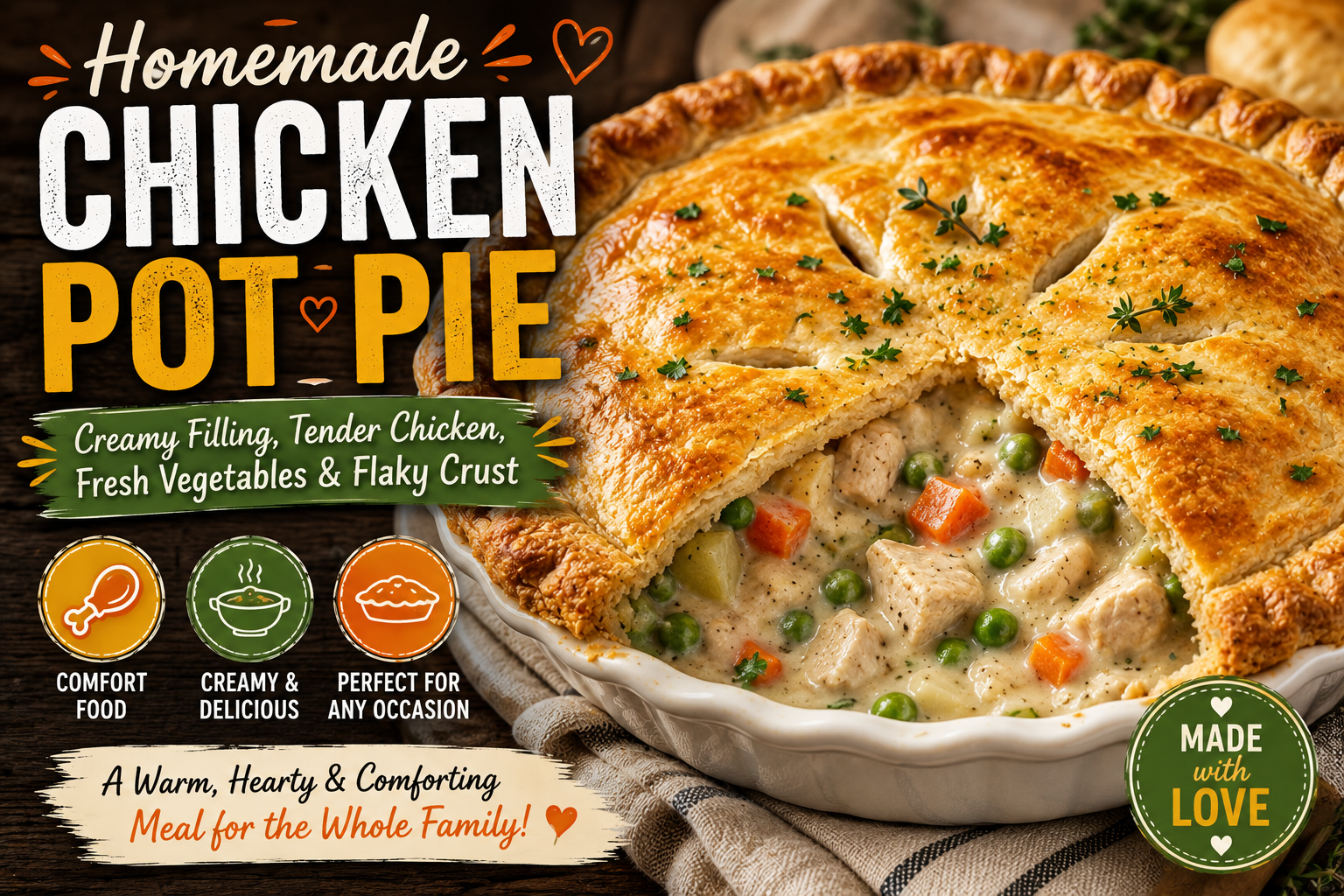
INTRODUCTION
There are some homemade meals that instantly create a feeling of comfort, warmth, and togetherness, and Chicken Pot Pie is one of those timeless recipes. With tender pieces of chicken, colorful vegetables, a creamy savory filling, and a beautiful golden crust, Chicken Pot Pie brings together everything people love about a cozy homemade dinner.
A good Chicken Pot Pie is more than simply chicken and vegetables covered with pastry. It is a complete combination of textures and flavors. The creamy filling provides richness, the vegetables add freshness and color, the chicken makes the dish hearty, and the golden crust adds a deliciously crisp contrast.
This recipe is perfect for family dinners, weekend meals, cozy evenings, gatherings, and special occasions when you want to prepare something that feels homemade and satisfying.
The wonderful thing about Chicken Pot Pie is that it can also be customized. You can use your favorite vegetables, adjust the herbs and seasonings, make the filling thicker or lighter according to preference, and choose a homemade or convenient pastry crust.
The basic idea remains simple: prepare a flavorful chicken and vegetable filling, place it inside a suitable pie dish, cover it with pastry, and bake until the crust becomes beautifully golden and the filling is hot and creamy.
WHY CHICKEN POT PIE IS SO SPECIAL
Chicken Pot Pie has a unique combination of comforting flavors.
The chicken provides a savory and satisfying base.
Vegetables add natural sweetness, color, and texture.
The creamy sauce brings everything together.
The pastry creates a crisp and buttery contrast.
When served warm, the combination feels especially comforting.
It is the kind of dish that can make an ordinary dinner feel a little more special.
CHOOSING THE CHICKEN
Chicken breast can be used for this recipe because it is easy to cut into small pieces and has a mild flavor.
Chicken thighs can also be suitable if you prefer darker meat and a richer texture.
The chicken should be cooked properly before being incorporated into the filling if the recipe calls for pre-cooked chicken.
Leftover cooked chicken can also be useful, provided it has been stored safely and is still suitable for consumption.
CUTTING THE CHICKEN
If using chicken breast, cut it into small, reasonably uniform pieces.
Similar-sized pieces cook more evenly.
Avoid making the pieces extremely large because they may not blend comfortably with the vegetables and sauce.
Small pieces are particularly convenient for a pie because every spoonful can contain chicken, vegetables, sauce, and crust.
COOKING THE CHICKEN
The chicken can be cooked using a suitable method before preparing the filling.
It can be sautéed, baked, poached, or prepared according to your preferred safe cooking method.
The most important thing is that the chicken is thoroughly cooked before it is used.
A food thermometer can help verify that poultry has reached a safe internal temperature.
Do not rely only on appearance.
PREPARING THE VEGETABLES
Classic Chicken Pot Pie often includes vegetables such as carrots, peas, and celery.
These vegetables provide different textures and flavors.
Carrots add mild sweetness.
Peas add freshness and color.
Celery provides a pleasant savory aroma and slight crunch.
You can also experiment with other suitable vegetables depending on your preference.
POTATOES
Potatoes can make the filling more hearty.
Cut them into small pieces so they cook evenly.
If using potatoes, make sure they become tender without turning completely mushy.
They should remain pleasant in the creamy filling.
MUSHROOMS
Mushrooms can add an earthy and savory flavor.
They can be sautéed before being added to the filling.
Mushrooms also pair naturally with creamy sauces.
If you enjoy mushrooms, they can be a wonderful addition to a homemade Chicken Pot Pie.
CORN
Corn can add sweetness and texture.
It works particularly well with chicken and creamy sauces.
Fresh, frozen, or properly prepared canned corn can be used according to the recipe.
THE IMPORTANCE OF A GOOD FILLING
The filling is the heart of Chicken Pot Pie.
It should be creamy but not excessively runny.
It should contain enough chicken and vegetables to make every serving satisfying.
The seasoning should be balanced.
The sauce should coat the ingredients rather than completely overwhelm them.
A good filling should hold together when served while still being soft and comforting.
BUILDING THE CREAMY SAUCE
The sauce can be made using a simple combination of butter or another suitable cooking fat, flour, and milk or another appropriate liquid.
This creates a creamy base that coats the chicken and vegetables.
Seasonings and herbs can then be added to develop the flavor.
The sauce should be cooked carefully so the flour loses its raw taste and the mixture becomes smooth.
STARTING WITH A FLAVORFUL BASE
Begin by gently cooking suitable aromatics such as onion and celery.
This helps create the foundation of flavor.
Cook them until they become tender and fragrant.
Avoid browning them excessively if you want a lighter-colored creamy filling.
ADDING GARLIC
Garlic can add additional savory depth.
Use fresh garlic or a suitable garlic seasoning.
A moderate amount is generally enough.
Garlic should complement the chicken and vegetables rather than dominate them.
ADDING FLOUR
Flour helps thicken the sauce.
It should be mixed thoroughly with the cooking fat and vegetables.
Cook it briefly according to the recipe.
This creates a base that can later be combined with the liquid.
Avoid adding the liquid too quickly if you want a smooth sauce.
ADDING THE LIQUID
Milk, broth, or a combination can be used depending on the recipe.
Add the liquid gradually while stirring.
This can help prevent lumps.
Continue stirring until the mixture begins to thicken.
The final consistency should be creamy enough to coat the chicken and vegetables.
USING CHICKEN BROTH
Chicken broth can add savory flavor to the sauce.
A combination of broth and milk can create a balanced filling.
The broth contributes depth, while the milk provides creaminess.
You can adjust the ratio according to your desired flavor and texture.
SEASONING THE SAUCE
Salt and black pepper are essential starting points.
Additional herbs can include thyme, parsley, rosemary, or other suitable herbs.
A small amount of garlic or onion seasoning can also enhance the flavor.
Season gradually.
Remember that broth and cooked chicken may already contain salt.
THE ROLE OF HERBS
Herbs can make the filling smell and taste more aromatic.
Thyme is particularly suitable for creamy chicken dishes.
Parsley can provide a fresh note.
Rosemary can add a stronger herbal character.
Use herbs according to your taste.
Fresh herbs can be added toward the end for brightness.
Dried herbs can be added earlier so they have time to release their flavor.
COMBINING THE CHICKEN AND VEGETABLES
Once the sauce reaches the desired consistency, add the cooked chicken and prepared vegetables.
Stir gently.
Everything should become coated with the creamy sauce.
Avoid over-stirring if the vegetables are already tender.
You want the ingredients to remain recognizable rather than turning into a mash.
CHECKING THE FILLING CONSISTENCY
The filling should be thick enough that it does not behave like soup.
At the same time, it should not be so thick that it becomes dry.
Remember that the filling may thicken slightly as it cools.
It should also be hot when placed into the pie dish if the recipe calls for that method.
PREPARING THE PIE CRUST
The crust is one of the most exciting parts of Chicken Pot Pie.
A golden, flaky crust provides contrast to the creamy filling.
You can use homemade pastry or a suitable ready-made pastry depending on your time and preference.
The crust should be handled gently.
Overworking pastry can affect its texture.
HOMEMADE PASTRY
A simple pastry can be prepared using flour, butter, salt, and cold water.
The butter should remain relatively cold during preparation.
Cold butter can help create flaky layers when the pastry is baked.
Add water gradually.
Use only enough liquid to bring the dough together.
Avoid kneading it excessively.
RESTING THE DOUGH
After preparing homemade pastry, allow it to rest according to the recipe.
Resting can help the dough become easier to roll.
It can also reduce excessive elasticity.
Keep the dough appropriately chilled if needed.
ROLLING THE PASTRY
Roll the pastry on a lightly floured surface.
Try to create an even thickness.
The pastry should be large enough to cover the pie dish with a little extra around the edges.
Avoid rolling it too thin because it may tear.
Avoid making it excessively thick because it may become heavy.
PLACING THE CRUST
Once the filling is ready and placed into a suitable pie dish, carefully position the pastry over the top.
Press the edges gently around the rim.
Trim excessive pastry if necessary.
Create a neat edge.
A decorative edge can make the pie look especially inviting.
CREATING VENTS
Small openings should be made in the top crust.
These vents allow steam to escape during baking.
Without suitable vents, steam can build up beneath the pastry.
Use a sharp knife to make a few small openings.
You can create simple slits or a small decorative pattern.
ADDING AN EGG WASH
An egg wash can help create a beautiful golden finish.
A suitable beaten egg mixture can be brushed lightly over the pastry.
Apply it evenly.
Avoid letting excessive egg wash collect around the edges because it may affect browning.
If you prefer not to use egg, another suitable glaze can be considered depending on the recipe.
WHY THE CRUST TURNS GOLDEN
The golden color develops during baking through browning reactions.
The pastry becomes crisp as moisture evaporates and the fats in the dough help create its texture.
Proper oven temperature is important.
If the temperature is too low, the crust may remain pale and soft.
If it is too high, the top may brown too quickly.
PREHEATING THE OVEN
Always preheat the oven according to the recipe.
A properly heated oven helps the pastry begin cooking immediately.
It also contributes to even browning.
Do not assume the oven has reached the correct temperature simply because it has been turned on.
Allow it to preheat appropriately.
CHOOSING THE RIGHT PIE DISH
A suitable pie dish should be deep enough to hold the filling comfortably.
Avoid filling the dish all the way to the very top.
Leave a little space so the filling does not bubble excessively over the edges.
Ceramic, glass, or another suitable oven-safe dish can be used according to the recipe.
BAKING THE PIE
Place the prepared pie into the preheated oven.
Bake according to the recipe instructions.
The crust should become golden and crisp.
The filling should be hot and bubbling appropriately.
Watch the crust toward the end of baking.
If the top browns too quickly, suitable protection can be used according to safe baking practices.
LET THE PIE REST
One of the most important steps is allowing the Chicken Pot Pie to rest after baking.
The filling will be extremely hot immediately after coming out of the oven.
Resting allows the sauce to settle and thicken slightly.
It also makes the pie easier to serve.
Cutting into it immediately can cause the filling to flow out rapidly.
A short resting period can make a noticeable difference.
THE FIRST SLICE
Once the pie has rested, use a suitable knife to cut through the crust.
The top should provide a gentle crisp texture.
Underneath, the creamy chicken and vegetable filling should be visible.
Serve carefully with a suitable spoon or spatula.
Each serving should ideally contain chicken, vegetables, creamy sauce, and crust.
SERVING CHICKEN POT PIE
Chicken Pot Pie can be served on its own because it already contains chicken, vegetables, sauce, and pastry.
However, a simple side can complement it.
A fresh green salad can provide contrast.
Steamed vegetables can add freshness.
A light soup may also work, although the pie itself is already hearty.
For a cozy dinner, simple sides are often best.
PAIRING WITH A GREEN SALAD
A crisp salad can balance the richness of the pie.
Use lettuce, cucumber, tomatoes, carrots, or other suitable vegetables.
A light dressing can provide acidity.
This contrast can make the overall meal feel more balanced.
PAIRING WITH ROASTED VEGETABLES
Roasted vegetables can complement the savory flavors of Chicken Pot Pie.
Choose vegetables according to preference.
Keep their seasoning relatively simple so they do not compete with the creamy filling.
PAIRING WITH STEAMED VEGETABLES
Steamed broccoli, green beans, carrots, or other suitable vegetables can make an easy side.
They add color and freshness to the plate.
CHICKEN POT PIE FOR FAMILY DINNER
This recipe works beautifully as a family dinner.
Prepare one large pie.
Allow it to rest after baking.
Serve generous portions with a simple salad or vegetables.
The warm and creamy filling makes the meal especially comforting.
CHICKEN POT PIE FOR WEEKEND MEALS
A weekend is a perfect time to prepare a homemade pie because you can enjoy the process.
You can make the pastry from scratch.
You can prepare a flavorful filling.
You can decorate the crust.
You can serve it fresh from the oven.
The process can turn a normal meal into a special occasion.
MAKING MINI CHICKEN POT PIES
Instead of making one large pie, you can prepare individual portions using suitable oven-safe dishes.
Divide the filling among the dishes.
Cover each with pastry.
Add small vents.
Bake until golden and thoroughly heated.
Mini pies can be especially attractive for gatherings.
PREPARING THE FILLING AHEAD
The filling can sometimes be prepared ahead of time according to safe food-storage practices.
Allow it to cool appropriately.
Store it in a suitable covered container under refrigeration.
When ready to assemble the pie, make sure the filling is handled safely.
If the filling is very cold, baking time may differ from a freshly prepared filling.
Always make sure the finished pie reaches a safe serving temperature.
MAKING THE PASTRY AHEAD
Homemade pastry can often be prepared ahead.
Wrap it appropriately and keep it refrigerated.
When ready to use it, allow it to become workable without leaving it at room temperature for an excessive period.
Cold pastry can be easier to handle and can help produce a flaky crust.
FREEZING CHICKEN POT PIE
Chicken Pot Pie can be suitable for freezing when prepared and packaged correctly.
If freezing an unbaked pie, use freezer-safe materials.
Label it with the date.
Follow appropriate thawing and cooking instructions.
If freezing leftovers, divide them into suitable portions.
Reheat thoroughly before serving.
REHEATING LEFTOVER PIE
An oven is often useful for reheating Chicken Pot Pie because it can help warm the filling while maintaining some crispness in the crust.
A microwave can heat the filling quickly but may soften the pastry.
Whichever method you use, make sure the center is heated thoroughly.
Do not repeatedly reheat the same portion.
STORING LEFTOVERS SAFELY
After serving, refrigerate leftovers promptly in suitable food-safe containers.
Do not leave cooked chicken and dairy-based filling at room temperature for extended periods.
Keep track of storage time and follow standard food-safety recommendations.
When in doubt about whether a leftover is still safe, it is better not to consume it.
COMMON MISTAKE: RUNNY FILLING
A runny filling can make the pie difficult to serve.
This can happen if there is too much liquid or if the thickening mixture has not been cooked sufficiently.
Allow the sauce to reach an appropriate consistency before adding the final ingredients.
Remember that the filling will continue to thicken slightly as it cools.
COMMON MISTAKE: TOO-THICK FILLING
A filling that is too thick can become heavy.
If necessary, adjust the consistency with a suitable amount of broth or milk.
Add liquid gradually.
The goal is a creamy sauce that coats the ingredients.
COMMON MISTAKE: SOGGY CRUST
A soggy crust can result from excessive moisture in the filling.
Allowing the filling to become too watery can make it difficult for the bottom pastry to become crisp.
A properly thickened filling is important.
Using the correct oven temperature also matters.
COMMON MISTAKE: BURNT TOP
If the pastry becomes too dark before the filling is properly heated, the oven temperature may be too high or the crust may need temporary protection.
Monitor the pie during the final stage of baking.
The goal is a golden crust rather than an overly dark one.
COMMON MISTAKE: TOUGH PASTRY
Overworking pastry can make it less tender.
Mix the dough only until it comes together.
Keep the butter appropriately cold.
Use cold water when the recipe calls for it.
Rest the dough before rolling.
COMMON MISTAKE: TEARING THE PASTRY
Pastry can tear if it is rolled too thin or handled roughly.
Roll it evenly.
Lift it carefully.
If a small tear occurs, it can often be gently repaired before baking.
COMMON MISTAKE: OVERFILLING THE DISH
Do not fill the pie dish excessively.
The filling can bubble during baking.
Leave some space around the top.
This reduces the chance of overflow.
COMMON MISTAKE: FORGETTING STEAM VENTS
Steam needs a way to escape.
Small openings in the crust are useful.
They also add a simple decorative touch.
ADDING CHEESE
Cheese can be included in some Chicken Pot Pie variations.
A small amount of a suitable cheese can add richness.
However, too much cheese may make the filling excessively heavy.
Use it according to preference.
CREAMY CHICKEN POT PIE
For an especially creamy version, use a suitable amount of milk or cream in the sauce.
Keep the sauce thick enough to support the filling.
Season it carefully.
A creamy filling paired with flaky pastry creates a particularly comforting combination.
HERB CHICKEN POT PIE
Add thyme, parsley, or other suitable herbs.
The herbs can give the filling a more aromatic character.
Fresh herbs can be used toward the end.
Dried herbs can be incorporated earlier.
GARLIC CHICKEN POT PIE
Garlic can add extra savory depth.
Use a moderate amount.
It should support the flavor of the chicken rather than overwhelm it.
MUSHROOM CHICKEN POT PIE
Mushrooms can provide an earthy flavor.
Sauté them first so excess moisture is reduced.
Then combine them with the chicken and creamy sauce.
VEGETABLE-RICH CHICKEN POT PIE
You can increase the amount of vegetables for a more colorful filling.
Carrots, peas, celery, potatoes, corn, mushrooms, and other suitable vegetables can be combined.
Make sure the vegetables are prepared so they reach the desired tenderness during cooking.
THE IMPORTANCE OF BALANCE
A great Chicken Pot Pie is about balance.
Too much sauce can make the filling watery.
Too little sauce can make it dry.
Too many vegetables can overwhelm the chicken.
Too little chicken can make the pie feel incomplete.
Too much pastry can make the dish heavy.
The goal is to create a harmonious combination of all the components.
WHY CHICKEN POT PIE FEELS LIKE COMFORT FOOD
Comfort food often combines familiar ingredients with warm textures and rich aromas.
Chicken Pot Pie does exactly that.
The smell of baked pastry fills the kitchen.
The creamy filling creates a warm and satisfying texture.
The chicken provides a familiar savory flavor.
The vegetables add color and freshness.
The golden crust adds crunch.
Together, these elements create a meal that feels comforting from the first bite.
CREATING A BEAUTIFUL PRESENTATION
Presentation does not need to be complicated.
A golden crust already makes the pie attractive.
You can create decorative pastry shapes using leftover dough.
Small leaves, stars, or simple strips can be placed on top.
Do not cover the entire surface with decorations because steam still needs a way to escape.
A few simple details can make a big difference.
ADDING A DECORATIVE EDGE
Use your fingers or a suitable utensil to create a neat edge around the pie.
The edge can be simple or slightly decorative.
Make sure it remains securely attached to the dish.
A good seal helps keep the filling inside while baking.
CREATING PASTRY DECORATIONS
If you have extra pastry, cut out small shapes.
Place them carefully on the crust.
Brush the surface lightly with egg wash if desired.
Keep the design simple.
The main purpose is to make the pie look inviting while allowing it to bake properly.
THE AROMA OF A FRESHLY BAKED PIE
One of the best parts of making Chicken Pot Pie is the aroma that fills the kitchen.
The buttery pastry begins to brown.
The savory filling becomes hot.
The herbs release their fragrance.
The combination creates an inviting smell that signals dinner is almost ready.
WAITING BEFORE SERVING
Although the aroma can make you want to cut into the pie immediately, waiting briefly is worth it.
The filling needs time to settle.
This makes serving easier.
The crust also becomes slightly firmer.
A little patience can improve the final presentation.
MAKING THE RECIPE YOUR OWN
Recipes are guidelines, and Chicken Pot Pie is especially easy to customize.
You can change the vegetables.
You can use different herbs.
You can adjust the creaminess.
You can add cheese.
You can make one large pie.
You can make individual pies.
You can use homemade pastry.
You can use a suitable ready-made crust.
This flexibility makes Chicken Pot Pie a wonderful recipe to keep in your cooking collection.
A SIMPLE CLASSIC VERSION
For a classic version, use chicken, carrots, peas, celery, onion, a creamy sauce, and a golden pastry crust.
Season with salt, black pepper, and thyme.
Keep the flavors balanced.
This simple combination is comforting and dependable.
A RICHER VERSION
For a richer pie, use a creamy sauce with suitable butter and milk or cream.
Add mushrooms and herbs.
Finish with a flaky pastry crust.
This version is particularly satisfying during cooler evenings.
A LIGHTER VERSION
For a lighter-feeling version, use plenty of vegetables and a moderate amount of creamy sauce.
A fresh salad can be served alongside it.
The pastry remains the comforting highlight without making every part of the meal heavy.
MINI PIES FOR SPECIAL OCCASIONS
Individual Chicken Pot Pies can look beautiful when served to guests.
Use small oven-safe dishes.
Fill them with the prepared mixture.
Cover each with pastry.
Decorate lightly.
Bake until golden.
Allow them to cool slightly before serving.
The individual presentation makes the meal feel special.
CHICKEN POT PIE AS A MAKE-AHEAD DINNER
One reason this recipe is useful is that parts of it can be prepared ahead.
The chicken can be cooked.
The vegetables can be prepared.
The sauce can be made.
The pastry can be prepared.
When dinner time arrives, assembly can be quicker.
Always follow safe food-storage practices when preparing components ahead.
SERVING WITH SAUCE
Chicken Pot Pie generally does not need an additional sauce because the filling is already creamy.
However, a light herb-based accompaniment can be served if desired.
Avoid adding too much extra liquid because it may make the meal overly rich.
SERVING WITH FRESH HERBS
A small amount of fresh parsley or another suitable herb can brighten the appearance.
Add it after baking.
Fresh herbs can provide a pleasant contrast to the creamy filling.
THE IDEAL DINNER EXPERIENCE
Imagine bringing a golden Chicken Pot Pie to the table.
The pastry is crisp.
The filling is warm and creamy.
The chicken is tender.
The vegetables add color.
The herbs provide aroma.
A fresh salad sits alongside it.
This is the kind of meal that turns dinner into a comforting experience.
FINAL THOUGHTS
Chicken Pot Pie is a beautiful example of how simple ingredients can come together to create something deeply comforting.
You do not need complicated techniques to make a delicious pie.
Start with properly prepared chicken.
Choose vegetables you enjoy.
Create a flavorful creamy sauce.
Season everything carefully.
Prepare a suitable pastry crust.
Cover the filling.
Create steam vents.
Brush the crust if desired.
Bake until beautifully golden.
Allow the pie to rest.
Then serve it warm.
The result is a satisfying homemade dinner with layers of texture and flavor.
The creamy filling and crisp crust provide the main contrast.
The chicken makes it hearty.
The vegetables bring freshness.
The herbs provide aroma.
The pastry creates that unmistakable golden finish.
Once you become comfortable with the basic recipe, you can experiment with your own combinations.
Try different vegetables.
Change the herbs.
Add mushrooms.
Include a little cheese.
Prepare individual pies.
Create decorative pastry.
Experiment with different side dishes.
The possibilities are endless.
Chicken Pot Pie can be a simple weekday dinner or a special weekend meal.
It can be prepared as one large family pie or several individual portions.
It can be customized for different tastes.
It can become a recipe that your family looks forward to.
Most importantly, it is a recipe that brings together the best parts of homemade cooking: warmth, flavor, comfort, and the satisfaction of creating something from scratch.
Serve it warm.
Share it with family.
Enjoy the golden crust.
Scoop into the creamy filling.
And make your own delicious Chicken Pot Pie tradition. 🥘❤️
🥘 CHICKEN POT PIE — A COMPLETE GUIDE TO CREAMY FILLING, FLAKY CRUST, PERFECT BAKING & DELICIOUS SERVING IDEAS
Chicken Pot Pie is one of those recipes that can be prepared in many different ways while still keeping its comforting character. Once you understand the basic technique, you can make the recipe according to your own taste, available ingredients, and preferred cooking style.
The most important part of a great Chicken Pot Pie is creating harmony between the filling and the crust. The filling should be creamy, flavorful, and thick enough to sit comfortably beneath the pastry. The crust should be golden, crisp, and flaky. Neither part should overpower the other.
A successful pie begins before the oven is turned on. Choosing the right chicken, preparing vegetables properly, seasoning the filling, making a smooth sauce, and handling pastry carefully all contribute to the final result.
UNDERSTANDING THE BASIC STRUCTURE
A traditional Chicken Pot Pie can be thought of as four main components.
The first is chicken.
The second is vegetables.
The third is a creamy savory sauce.
The fourth is pastry.
Each component has its own purpose.
Chicken provides the hearty center of the dish.
Vegetables provide color, flavor, and texture.
The sauce brings everything together.
The pastry creates the crisp golden topping.
When these four components are balanced, the result can be incredibly satisfying.
PREPARING THE CHICKEN FOR THE BEST TEXTURE
Chicken should be cut into manageable pieces before being added to the filling.
Small pieces work particularly well because they distribute throughout the pie.
You want enough chicken in every serving without having huge chunks that make the pie difficult to scoop.
If using chicken breast, cut the meat into reasonably uniform pieces.
If using chicken thighs, remove any unwanted excess and cut them into similar-sized pieces.
Cook the chicken thoroughly using a suitable method.
Once cooked, allow it to cool enough to handle safely before cutting or shredding if necessary.
USING SHREDDED CHICKEN
Shredded chicken can create a slightly different texture from diced chicken.
It distributes easily through the creamy filling.
It can also be a convenient option when using leftover cooked chicken.
Shred the chicken into medium-sized pieces rather than extremely fine strands.
This allows the chicken to remain noticeable in each serving.
USING LEFTOVER ROAST CHICKEN
Leftover roast chicken can be excellent in Chicken Pot Pie.
It already has cooked flavor and can save preparation time.
Remove bones and skin where appropriate.
Cut or shred the meat into suitable pieces.
Make sure the leftovers have been stored safely and are still suitable for consumption.
USING ROTISSERIE-STYLE CHICKEN
Prepared cooked chicken can also be used if it has been stored safely.
This is particularly convenient when you want to make the pie without cooking raw chicken separately.
Check the seasoning of the chicken before adding more salt to the filling.
Some prepared chicken can already be well seasoned.
CHOOSING VEGETABLES
Classic vegetables include carrots, peas, celery, and onions.
However, Chicken Pot Pie does not have to stop there.
You can include potatoes, corn, mushrooms, green beans, or other suitable vegetables.
The key is to consider cooking time.
Vegetables that require longer cooking should be prepared appropriately before being incorporated into the filling.
CARROTS
Carrots provide natural sweetness and a beautiful color.
Cut them into small, even pieces.
They should become tender during preparation without turning mushy.
If using larger carrot pieces, they may require additional cooking time.
CELERY
Celery provides a savory aromatic flavor.
It can be cooked together with onion at the beginning of the filling.
This creates a flavorful base for the creamy sauce.
PEAS
Peas add a bright green color.
Frozen peas can be convenient because they require little preparation.
They can usually be added toward the later stage of cooking so they retain their texture and color.
POTATOES
Potatoes make the filling more substantial.
Cut them into small pieces.
Cook until tender before incorporating them into the final filling.
Avoid overcooking because potatoes can break apart and make the sauce excessively thick.
CORN
Corn can add sweetness and a pleasant bite.
It pairs well with chicken and creamy sauce.
Use fresh, frozen, or properly prepared canned corn according to your recipe.
MUSHROOMS
Mushrooms provide earthy flavor.
Because mushrooms release moisture during cooking, sautéing them first can be helpful.
Allow some of the moisture to evaporate before adding them to the filling.
This helps prevent the sauce from becoming too watery.
GREEN BEANS
Small pieces of green beans can add color and texture.
Cook them appropriately before adding them to the filling.
They should be tender but still retain some structure.
THE AROMATIC BASE
Onion, celery, and garlic can form the aromatic foundation.
Gently cooking these ingredients allows their flavors to develop.
The goal is to soften them and release their aroma.
Avoid burning the garlic.
Burnt garlic can create a bitter flavor.
COOKING THE ONION
Cook chopped onion over moderate heat with suitable cooking fat.
Stir occasionally.
The onion should become soft and fragrant.
For a classic light-colored filling, avoid excessive browning.
A lightly cooked onion works well with the creamy sauce.
ADDING CELERY
Add celery along with or shortly after the onion.
Cook until it begins to soften.
The combination creates a savory foundation.
ADDING GARLIC
Garlic can be added after the onion and celery have softened.
Cook briefly.
Garlic does not need a long cooking time.
Watch carefully so it does not burn.
BUILDING THE SAUCE
The creamy sauce is one of the defining features of Chicken Pot Pie.
A common method begins with butter or another suitable fat and flour.
The flour thickens the liquid.
The liquid can be milk, broth, or a combination.
Seasonings and herbs then develop the flavor.
CREATING A SMOOTH ROUX
A mixture of fat and flour is often used as a thickening base.
Stir the flour into the melted fat.
Cook briefly while stirring.
This helps remove the raw flour taste.
The mixture should remain smooth.
ADDING LIQUID GRADUALLY
Pour the liquid gradually while stirring continuously.
This helps create a smooth sauce.
If liquid is added too quickly without stirring, lumps may develop.
Continue stirring until the mixture begins to thicken.
THE RIGHT SAUCE CONSISTENCY
The sauce should be thick enough to coat the back of a spoon.
It should not be watery.
It should not be so thick that it becomes paste-like.
Remember that the filling will continue to change slightly during baking and cooling.
A creamy, spoonable consistency is ideal.
USING MILK
Milk creates a creamy and mild sauce.
It allows the chicken and vegetables to remain the focus.
Whole milk can provide richer texture, while other suitable milk options can also work depending on the recipe.
USING BROTH
Chicken broth adds savory depth.
It can be used alone or combined with milk.
A mixture of broth and milk often creates a balanced sauce.
USING CREAM
Cream can make the filling richer.
Use it according to preference.
If using cream, consider reducing other rich ingredients so the overall dish remains balanced.
SEASONING THE FILLING
Seasoning should be gradual.
Salt and black pepper are the basic foundation.
Thyme is a classic herb for chicken dishes.
Parsley can add freshness.
A little garlic and onion seasoning can provide additional depth.
Avoid adding excessive salt early if the broth or chicken is already seasoned.
TASTING THE SAUCE
If the ingredients are safe to taste at that stage, check the sauce before adding the chicken and vegetables.
This allows you to adjust seasoning.
The sauce should taste flavorful but not overwhelmingly salty.
Remember that the pastry also contributes flavor.
ADDING HERBS
Herbs can be added according to the desired flavor profile.
Thyme provides a warm herbal character.
Parsley adds freshness.
Rosemary has a stronger aroma and should be used moderately.
Sage can also work in certain variations.
Choose herbs that complement rather than overpower the chicken.
COMBINING THE FILLING
Once the sauce is ready, combine the chicken and vegetables.
Stir gently.
Everything should become coated with the creamy sauce.
Avoid crushing the vegetables.
The filling should contain recognizable pieces.
ALLOWING THE FILLING TO COOL
Depending on the assembly method, allowing the filling to cool somewhat before adding pastry can be helpful.
Extremely hot filling can produce excess steam beneath the crust.
That steam may affect pastry texture.
If preparing ahead, cool and refrigerate the filling safely.
PREPARING HOMEMADE PASTRY
A homemade pastry crust can make the pie especially satisfying.
A basic pastry generally uses flour, cold butter, salt, and cold water.
The key is keeping the butter cold and avoiding excessive handling.
COLD BUTTER
Cold butter is important for flaky pastry.
When the pastry bakes, the butter creates layers and contributes to a crisp texture.
If the butter becomes completely soft while preparing the dough, the pastry may become harder to handle.
Keep ingredients appropriately chilled.
MIXING THE DOUGH
Combine flour and salt.
Cut or rub cold butter into the flour until the mixture resembles coarse crumbs with some small pieces of butter remaining.
Do not mix until completely smooth.
Those small pieces can help create flaky texture.
ADDING COLD WATER
Add cold water gradually.
Use just enough to bring the dough together.
Do not add excessive water.
Too much water can make the pastry less tender.
FORMING THE DOUGH
Gather the dough gently.
Do not knead it like bread.
Press it together until it forms a workable disk.
Wrap it appropriately and chill it before rolling.
WHY RESTING MATTERS
Resting gives the dough time to relax.
This can make rolling easier.
It can also reduce shrinking during baking.
Keep the pastry chilled according to the recipe.
ROLLING THE DOUGH
Lightly flour the work surface.
Roll the dough evenly.
Turn it occasionally so it does not stick.
Avoid adding too much flour because excessive flour can make the pastry dry.
ROLLING TO THE RIGHT THICKNESS
The crust should be thick enough to remain sturdy but thin enough to become crisp.
An overly thin crust may tear.
An excessively thick crust can become heavy.
Aim for an even layer across the surface.
TRANSFERRING THE PASTRY
Once rolled, carefully transfer the pastry to the pie dish.
You can gently fold it before moving it if necessary.
Avoid pulling or stretching the dough.
Stretching can cause it to shrink during baking.
FITTING THE CRUST
Gently place the pastry over the filling.
Allow it to sit naturally.
Do not press it aggressively into the filling.
Press the edges around the rim of the dish to create a seal.
TRIMMING THE EDGES
Trim away excessive pastry.
Leave enough around the rim to create a secure edge.
You can use the extra dough for decorations.
CREATING A DECORATIVE EDGE
A simple crimped edge can make the pie look beautiful.
Use your fingers or a suitable utensil.
The edge does not need to be perfect.
A homemade appearance can be part of the charm.
ADDING STEAM VENTS
Use a knife to create a few openings in the crust.
These allow steam to escape.
The openings can be simple slits.
You can also create a decorative pattern.
Do not completely seal the top without providing a way for steam to escape.
EGG WASH
A light egg wash can give the pastry a glossy golden finish.
Beat an egg appropriately and brush a thin layer over the crust.
Do not saturate the pastry.
Too much liquid can affect the texture.
ALTERNATIVES TO EGG WASH
If you do not want to use egg, a suitable alternative glaze can be used according to the recipe.
The purpose is mainly to encourage browning and provide an attractive finish.
BAKING THE PIE
Place the pie into a properly preheated oven.
Bake according to the recipe instructions.
The crust should become golden.
The filling should be hot.
You may see gentle bubbling around the edges.
That is a sign that the filling is heating through.
MONITORING THE CRUST
Keep an eye on the pie during the final stage.
Every oven behaves slightly differently.
If the top is browning too quickly, use an appropriate oven-safe method to protect it while allowing the filling to continue heating.
Do not open the oven repeatedly because this can affect temperature.
THE ROLE OF OVEN TEMPERATURE
Temperature influences both pastry texture and filling.
A sufficiently hot oven helps the crust become crisp.
A temperature that is too high can brown the pastry before the filling is properly heated.
Follow the recipe’s recommended temperature.
If using a different dish size or a refrigerated filling, cooking time may need adjustment.
USING A GLASS DISH
If using a glass baking dish, follow the manufacturer’s recommendations regarding oven temperature and preheating.
Avoid sudden temperature changes that could damage glass cookware.
USING A CERAMIC DISH
Ceramic pie dishes are commonly used for pot pies.
They can hold heat well.
Always use an oven-safe dish.
Allow the finished dish to cool appropriately before placing it on a cold or wet surface if the cookware instructions advise against sudden temperature changes.
USING A METAL DISH
Metal dishes can transfer heat efficiently.
They may help the crust brown well.
Cooking times can vary depending on the material and thickness of the dish.
WHY THE FILLING BUBBLES
As the filling heats, moisture and steam move through the sauce.
Small bubbles around the edges can appear.
This is normal.
However, excessive bubbling that causes filling to overflow can indicate that the dish is too full.
Leave appropriate space.
RESTING AFTER BAKING
Resting is essential.
The filling will be extremely hot.
Give the pie enough time to cool slightly.
The sauce also becomes thicker as it rests.
This makes serving easier.
CUTTING THE PIE
Use a suitable knife to cut through the crust.
Then use a serving spoon or spatula to lift the portion.
Do not worry if the first serving is slightly less neat than the later ones.
The creamy filling can naturally move as it is served.
SERVING THE PIE WARM
Chicken Pot Pie is especially comforting when served warm.
The crust is crisp.
The filling is creamy.
The aroma is inviting.
The chicken and vegetables are tender.
This is when the dish is at its most comforting.
ADDING A FRESH GARNISH
A little fresh parsley can brighten the appearance.
Fresh thyme leaves can also be used.
Do not add too much garnish.
The golden crust and creamy filling should remain the focus.
CLASSIC SIDE DISHES
A fresh salad is one of the easiest sides.
Roasted vegetables can also work.
Steamed green vegetables can provide contrast.
A simple fruit or vegetable side may be enough.
Because the pie is already hearty, sides do not need to be complicated.
GREEN SALAD
A simple green salad can contain lettuce, cucumber, tomato, and a light dressing.
The crisp vegetables contrast with the creamy filling.
This can make the overall meal feel more balanced.
ROASTED VEGETABLES
Roasted carrots, broccoli, cauliflower, or other suitable vegetables can accompany the pie.
Keep seasoning simple.
The pie already contains many flavors.
STEAMED GREEN BEANS
Green beans can provide freshness and color.
Steam until tender but not overly soft.
Serve simply.
POTATO SIDE
Because Chicken Pot Pie may already contain potatoes or pastry, an additional potato side may make the meal quite rich.
If you choose one, keep the portion and seasoning simple.
MINI CHICKEN POT PIES
Individual pot pies are an attractive alternative to one large pie.
Prepare the filling as usual.
Divide it among suitable oven-safe dishes.
Cover each dish with pastry.
Create vents.
Brush with egg wash if desired.
Bake until golden and thoroughly heated.
MINI PIES FOR FAMILY DINNER
Individual portions can make serving easier.
Everyone receives their own golden pastry top.
They can be served with salad or vegetables.
Make sure the dishes are handled safely because they may remain very hot after baking.
MINI PIES FOR GATHERINGS
Mini pies can be suitable for casual gatherings.
Prepare several small portions.
Keep the filling and pastry balanced.
Serve them warm using safe food-handling practices.
CHICKEN POT PIE WITH PUFF PASTRY
Puff pastry can create a lighter, layered crust.
It can be placed over the filling and baked until beautifully golden.
Handle puff pastry according to package or recipe instructions.
Keep it chilled until ready to use when appropriate.
CHICKEN POT PIE WITH BISCUIT TOPPING
Instead of pastry, some versions use biscuit dough.
The result is different but still comforting.
The biscuit topping becomes golden and tender.
It absorbs some of the aroma from the creamy filling.
CHICKEN POT PIE WITH PHYLLO-STYLE TOPPING
Thin pastry sheets can create a very crisp topping.
Brush layers appropriately with suitable fat.
Arrange them over the filling.
Bake until golden and crisp.
This version has a lighter, more delicate texture.
CREAMY MUSHROOM VERSION
Add sautéed mushrooms to the chicken filling.
Their earthy flavor works well with thyme and creamy sauce.
Make sure excess moisture from the mushrooms is reduced before adding them.
CHICKEN AND CORN POT PIE
Corn adds natural sweetness.
Combine it with chicken, peas, carrots, and creamy sauce.
This can create a colorful filling.
CHICKEN AND POTATO POT PIE
Potatoes can make the filling especially hearty.
Use small pieces.
Cook them until tender before adding them to the final mixture.
CHICKEN AND HERB POT PIE
A stronger herb profile can change the character of the pie.
Use thyme, parsley, and a small amount of rosemary.
The herbs should remain balanced.
GARLIC HERB CHICKEN POT PIE
Garlic and herbs can create a rich savory aroma.
Use garlic carefully.
Too much garlic can overpower the delicate creamy sauce.
CHEESY CHICKEN POT PIE
A moderate amount of cheese can be incorporated into the filling.
Choose a cheese that melts suitably.
Do not add so much that the sauce becomes excessively heavy.
SPICY CHICKEN POT PIE
For a slightly spicy variation, use a modest amount of chili seasoning.
The goal is warmth rather than overwhelming heat.
Serve with a cooling side such as a suitable yogurt-based salad if desired.
LEMON HERB VARIATION
A little lemon zest can add brightness.
Use it sparingly.
A small amount of acidity can help balance a rich creamy filling.
Avoid adding too much liquid lemon juice directly to the sauce unless the recipe specifically calls for it.
CREATING A RICHER SAUCE
For a richer sauce, use a combination of broth and milk with a suitable amount of butter.
You can add a small amount of cream.
Balance is important.
A sauce that is too rich can make the entire pie feel heavy.
CREATING A LIGHTER SAUCE
Use more broth and less cream.
Increase the vegetables.
Keep the pastry portion moderate.
The dish can still be creamy while feeling somewhat lighter.
THE IMPORTANCE OF THICKENING
The sauce must be thick enough before the pie goes into the oven.
If the filling is too thin, the pastry may become soggy.
If it is too thick, the finished pie may feel dry.
Adjust gradually.
THE SAUCE CONTINUES TO CHANGE
Remember that the sauce will continue to thicken during baking and resting.
Do not over-thicken it on the stovetop.
A slightly loose but creamy sauce may become perfect after baking.
USING FROZEN VEGETABLES
Frozen peas, corn, carrots, and mixed vegetables can be convenient.
They can save preparation time.
Add them according to their cooking requirements.
Avoid adding large amounts of frozen vegetables directly if they release excessive water into the sauce.
THAWING FROZEN VEGETABLES
Some vegetables can be added directly from frozen.
Others may benefit from partial thawing.
Follow the recipe’s instructions.
If thawed vegetables release water, drain them appropriately.
USING FRESH VEGETABLES
Fresh vegetables can provide excellent texture.
Cut them uniformly.
Cook them appropriately before combining with the sauce.
The goal is tenderness without mushiness.
BALANCING VEGETABLE TEXTURES
Not every vegetable should have exactly the same texture.
Carrots can remain slightly firm.
Peas can stay tender.
Celery can provide gentle bite.
Potatoes can be soft.
This variety makes the filling more interesting.
THE ROLE OF SALT
Salt brings out the flavors of chicken, vegetables, and herbs.
Add it gradually.
Taste the sauce before adding more.
Remember that broth, butter, cheese, and prepared chicken may contain salt.
THE ROLE OF BLACK PEPPER
Black pepper provides mild warmth and savory character.
Freshly ground pepper can provide a stronger aroma.
Use according to preference.
THE ROLE OF THYME
Thyme pairs particularly well with chicken.
It can be used fresh or dried.
A moderate amount is enough.
THE ROLE OF PARSLEY
Parsley provides a fresh herbal note.
It can be added toward the end of cooking.
It can also be sprinkled over the finished pie.
THE ROLE OF ROSEMARY
Rosemary has a stronger flavor.
Use it carefully.
A small amount can add depth without dominating the dish.
CREATING A SAVORY AROMA
The aroma of Chicken Pot Pie develops from several components.
Onion.
Celery.
Garlic.
Chicken.
Herbs.
Butter or other cooking fat.
Creamy sauce.
Golden pastry.
Together they create a comforting smell.
WHY HOMEMADE PIE FEELS SPECIAL
A homemade Chicken Pot Pie requires several steps.
You prepare the filling.
You prepare the crust.
You assemble everything.
You bake it.
The result feels special because you can see the work that went into it.
This is one reason traditional comfort-food recipes remain popular.
MAKING THE RECIPE FOR A WEEKEND
A weekend can be an excellent opportunity to prepare a homemade pastry.
You can take your time.
You can make the filling carefully.
You can decorate the crust.
You can serve it with a fresh salad.
The entire meal can become a relaxed family experience.
MAKING THE RECIPE FOR A COZY EVENING
On a cool evening, a warm Chicken Pot Pie can be especially comforting.
The golden crust and creamy filling create a satisfying combination.
Serve it with a simple side.
Keep the rest of the meal uncomplicated.
MAKING THE RECIPE FOR GUESTS
If serving guests, consider preparing individual pies or one large decorative pie.
Prepare some components ahead.
Set the table before baking.
Serve the pie after it has rested.
This allows you to enjoy the meal rather than spending all your time in the kitchen.
PREPARING THE FILLING AHEAD
The filling can often be prepared ahead of time.
Cool it appropriately.
Store it in a suitable covered container under refrigeration.
When ready to assemble, handle it safely.
If the filling is chilled, allow for appropriate baking time so the center becomes thoroughly hot.
PREPARING THE PASTRY AHEAD
Pastry can often be prepared in advance.
Keep it wrapped and refrigerated.
This can make final assembly easier.
When ready to use it, roll it while appropriately chilled but workable.
FREEZING THE PIE
Chicken Pot Pie can be frozen when prepared with suitable freezer-safe methods.
Individual pies can be convenient for freezing.
Label containers with dates.
Follow safe thawing and reheating practices.
Do not assume that a frozen pie can always be cooked for exactly the same amount of time as a fresh pie.
CHECKING A FROZEN PIE
A frozen pie may require different cooking conditions.
The center needs to become thoroughly hot.
The pastry should become golden without burning.
Monitor carefully.
If necessary, protect the crust while allowing the center to continue heating.
REHEATING LEFTOVERS
Reheat leftovers thoroughly.
An oven can help maintain more of the crust’s texture.
A microwave can be convenient but may soften pastry.
If using a microwave, heat in suitable intervals and check the center.
FOOD SAFETY
Chicken Pot Pie contains poultry and often dairy, so safe handling is essential.
Keep ingredients refrigerated when required.
Cook chicken thoroughly.
Avoid cross-contamination.
Refrigerate leftovers promptly.
Reheat thoroughly.
Do not leave the pie at room temperature for extended periods.
RAW CHICKEN HANDLING
Wash hands thoroughly after handling raw chicken.
Clean cutting boards and utensils.
Keep raw poultry away from ready-to-eat foods.
Do not wash raw chicken because splashing can spread bacteria around the kitchen.
COOKING CHICKEN SAFELY
Use a food thermometer to check the thickest part.
Poultry should reach the recommended safe internal temperature.
This is more reliable than judging doneness by color alone.
SAFE LEFTOVER STORAGE
Store leftovers in suitable covered containers.
Refrigerate promptly.
Use them within the recommended food-safety timeframe.
When reheating, make sure the center becomes properly hot.
THE BEST WAY TO SERVE LEFTOVER PIE
Cut a portion and reheat it gently.
An oven or suitable air fryer can help restore some crispness to the pastry.
Avoid overheating.
The filling should be hot while the crust remains pleasant.
TURNING LEFTOVERS INTO A NEW MEAL
Leftover Chicken Pot Pie can be served with a fresh salad.
You can also pair it with roasted vegetables.
If only the filling remains, it can be served over toast or another suitable base.
This reduces food waste while creating variety.
TROUBLESHOOTING A RUNNY FILLING
If the filling is runny, check the amount of liquid.
Make sure the thickening base was cooked properly.
Allow the sauce to simmer gently according to the recipe.
Do not add large amounts of flour directly into hot liquid because this can create lumps.
If additional thickener is needed, use an appropriate method.
TROUBLESHOOTING A THICK FILLING
If the sauce is too thick, gradually add a suitable amount of broth or milk.
Stir gently.
Do not add too much at once.
The consistency should be creamy and spoonable.
TROUBLESHOOTING A SOGGY CRUST
A soggy crust can be caused by watery filling, insufficient baking, or trapped steam.
Make sure the filling has an appropriate consistency.
Use steam vents.
Bake in a properly preheated oven.
Allow the finished pie to rest uncovered.
TROUBLESHOOTING A DRY FILLING
A dry filling may contain too little sauce or may have been cooked too long.
Add enough liquid during preparation.
Avoid excessive cooking after the sauce has thickened.
Remember that the filling continues cooking in the oven.
TROUBLESHOOTING TOUGH PASTRY
If pastry becomes tough, it may have been overworked.
Avoid excessive kneading.
Use cold ingredients.
Handle the dough gently.
Do not add excessive flour during rolling.
TROUBLESHOOTING SHRINKING PASTRY
Pastry may shrink when it is stretched during assembly or not rested sufficiently.
Allow the dough to rest.
Avoid pulling it across the dish.
Place it gently over the filling.
TROUBLESHOOTING PALE PASTRY
A pale crust may result from insufficient baking or lack of a suitable glaze.
Make sure the oven is properly preheated.
A light egg wash can encourage browning.
Follow the recipe’s baking temperature.
TROUBLESHOOTING BURNT PASTRY
If the top becomes too dark, the temperature may be too high or the pie may need protection during the final stage.
Monitor the oven.
Use appropriate oven-safe protection when necessary.
WHY THE PIE MAY OVERFLOW
Overflow can happen when the dish is too full.
The creamy filling expands and bubbles during baking.
Leave some space between the filling and the top edge.
This also helps prevent sauce from running onto the oven floor.
WHY STEAM MATTERS
The filling contains moisture.
As it heats, steam forms.
The pastry needs small openings to allow steam to escape.
This helps reduce pressure beneath the crust.
WHY THE CRUST NEEDS TO STAY COLD
Cold pastry tends to be easier to manage and can produce a better texture.
Warm pastry can become soft and difficult to shape.
If your kitchen is warm, work efficiently and chill the dough when needed.
CREATING A FLAKY CRUST
Flakiness comes from layers of fat and flour.
Avoid completely blending the butter into the flour.
Small pieces of butter can help create layers during baking.
Cold water also helps keep the dough manageable.
THE IMPORTANCE OF RESTING PASTRY
Resting is not a step to skip casually.
It can make the dough easier to roll.
It may also help reduce shrinking.
Give the dough adequate time to rest under suitable refrigeration.
MAKING THE CRUST BEAUTIFUL
A golden crust already looks attractive.
You can add simple decorative cuts.
Small pastry leaves or shapes can create a homemade appearance.
Keep the design practical.
Do not cover every steam vent.
THE PERFECT GOLDEN FINISH
A light glaze helps create a glossy surface.
Bake until the crust reaches a pleasant golden color.
The goal is crisp and golden rather than excessively dark.
SERVING WITH HERBS
A small amount of parsley can be sprinkled over the finished pie.
It adds color.
Fresh thyme can also work.
Keep garnish minimal.
THE FIRST SERVING
The first scoop should reveal the contrast between the pastry and creamy filling.
Break through the crisp crust.
Spoon out the chicken and vegetables.
Serve while warm.
This is the moment when all the preparation comes together.
CREATING A COMPLETE DINNER
A complete meal can include:
Chicken Pot Pie.
Fresh green salad.
Roasted or steamed vegetables.
A simple beverage.
You do not need many sides.
The pie is already substantial.
CREATING A SPECIAL WEEKEND MEAL
For a special weekend dinner, make homemade pastry.
Prepare a rich but balanced filling.
Decorate the crust.
Serve the pie with a fresh salad.
Take time to enjoy the meal.
CREATING A SIMPLE WEEKNIGHT VERSION
For a quicker version, use cooked chicken and a convenient pastry crust.
Use frozen vegetables.
Prepare a simple creamy sauce.
Assemble and bake.
This can significantly reduce preparation time while keeping the comforting character of the dish.
WHY CONVENIENCE INGREDIENTS CAN BE USEFUL
Not every homemade meal has to be made entirely from scratch.
Using prepared pastry or cooked chicken can save time.
The important thing is safe handling and choosing ingredients that fit your needs.
Homemade cooking can still involve convenient components.
BUILDING YOUR OWN VERSION
Once you understand the basic structure, start experimenting.
Choose your chicken.
Choose three or four vegetables.
Select herbs.
Create a creamy sauce.
Choose a crust.
Bake.
Taste and adjust next time.
This process can help you create your own signature version.
KEEPING THE FLAVOR BALANCED
A creamy filling needs enough seasoning.
But too much seasoning can overpower the delicate sauce.
Taste gradually.
Add salt carefully.
Use herbs thoughtfully.
Let the chicken and vegetables remain recognizable.
THE ROLE OF CONTRAST
The appeal of Chicken Pot Pie comes partly from contrast.
Crispy crust versus creamy filling.
Tender chicken versus soft vegetables.
Savory sauce versus naturally sweet carrots and peas.
Golden pastry versus colorful vegetables.
These contrasts make each bite interesting.
WHY TEXTURE MATTERS
Texture is just as important as flavor.
A completely soft pie may feel one-dimensional.
A crisp crust gives the dish character.
Vegetables should retain some structure.
Chicken should remain tender.
The sauce should be smooth.
This combination creates a satisfying eating experience.
CREATING A FAMILY FAVORITE
A recipe becomes a family favorite when it is repeated, adapted, and remembered.
Maybe one person loves extra peas.
Someone else prefers mushrooms.
Another person wants more crust.
Homemade Chicken Pot Pie can be adjusted to accommodate different preferences.
MAKE IT YOUR OWN
There is no requirement to follow one exact combination forever.
Experiment with herbs.
Try different vegetables.
Change the pastry.
Make individual portions.
Add a small amount of cheese.
Try a different cooking method.
Keep the elements you enjoy most.
FINAL RECIPE PHILOSOPHY
The best Chicken Pot Pie is not necessarily the most complicated one.
It is the one where each component is prepared thoughtfully.
The chicken is tender.
The vegetables are flavorful.
The sauce is creamy.
The crust is golden.
The seasoning is balanced.
The presentation is inviting.
And the meal is enjoyed while warm.
Chicken Pot Pie demonstrates how ordinary ingredients can become something memorable when they are combined carefully.
The process begins with simple ingredients.
Chicken.
Vegetables.
Flour.
Butter or another suitable cooking fat.
Milk or broth.
Herbs.
Pastry.
Yet the final result can feel far more special than the individual ingredients suggest.
That is the beauty of comfort food.
It does not need complicated ingredients.
It needs care.
When preparing your next Chicken Pot Pie, take your time with the filling.
Do not rush the sauce.
Make sure the vegetables are prepared properly.
Season gradually.
Handle the pastry gently.
Create steam vents.
Bake until golden.
Allow the pie to rest.
Then serve it with a simple side.
The result can be a warm, creamy, golden dish that is perfect for sharing.
Chicken Pot Pie can be adapted for different seasons.
In warmer months, use lighter vegetables and serve it with a crisp salad.
In cooler months, make a rich creamy filling and serve it with warm roasted vegetables.
For family dinners, make one large pie.
For individual servings, prepare mini pies.
For busy days, use cooked chicken and convenient pastry.
For weekends, make the pastry from scratch.
The recipe can change while the basic comfort remains.
A well-prepared Chicken Pot Pie can also become a useful meal-preparation recipe.
The filling can be prepared ahead.
The pastry can be chilled.
The pie can be assembled when convenient.
Leftovers can be reheated.
Individual portions can be stored appropriately.
This flexibility makes the dish practical as well as delicious.
Remember that food safety should always come first.
Handle raw chicken carefully.
Keep perishable ingredients refrigerated.
Avoid cross-contamination.
Cook poultry thoroughly.
Store leftovers promptly.
Reheat food properly.
Good cooking is not only about taste.
It is also about safe preparation.
Once the safety basics are understood, the creative part becomes much more enjoyable.
You can focus on flavor.
You can choose your favorite vegetables.
You can experiment with herbs.
You can design the crust.
You can create sauces and sides.
You can make the recipe your own.
The final result should be a pie that looks inviting when it reaches the table.
A golden crust.
A warm aroma.
A creamy filling.
Colorful vegetables.
Tender chicken.
Fresh herbs.
A simple side salad.
It is a combination that can make an ordinary dinner feel special.
Chicken Pot Pie is also a reminder that homemade meals do not need to be perfect.
Your crust may have an uneven edge.
Your vegetables may not all be exactly the same size.
Your decorative pastry may look homemade.
That is okay.
The charm of homemade food comes from the care behind it.
Every time you prepare the recipe, you can improve something.
Maybe next time you will roll the pastry more evenly.
Maybe you will add more thyme.
Maybe you will use mushrooms.
Maybe you will make mini pies.
Maybe you will discover your favorite combination of vegetables.
Cooking is a process of learning.
And Chicken Pot Pie gives you plenty of room to experiment.
So prepare it with patience.
Enjoy the aroma as it bakes.
Wait while the crust turns golden.
Allow the filling to settle.
Then bring the pie to the table.
Break through the crisp pastry.
Scoop into the creamy chicken and vegetables.
Serve it warm.
Share it with the people around you.
And enjoy the comfort of a homemade meal.
Whether you make a traditional version, a cheesy version, a mushroom version, a herb-filled version, a vegetable-rich version, or your own creative variation, the heart of the recipe remains the same.
Chicken.
Vegetables.
Creamy sauce.
Golden crust.
Simple ingredients.
Comforting flavor.
Homemade care.
That combination is what makes Chicken Pot Pie such a timeless favorite.
With the right preparation, you can create a pie that is creamy without being watery, rich without being overwhelming, crisp without being dry, and hearty without being complicated.
The goal is not simply to follow instructions.
The goal is to understand why each step matters.
When you understand that, you can confidently adapt the recipe to your own kitchen.
And that is what makes a recipe truly useful.
A good Chicken Pot Pie recipe should leave you with more than a delicious dinner.
It should give you techniques you can use again.
How to prepare chicken.
How to cook vegetables.
How to build a creamy sauce.
How to thicken a filling.
How to handle pastry.
How to create a golden crust.
How to balance textures.
How to serve comfort food beautifully.
These skills can become part of your everyday cooking.
So the next time you see a Chicken Pot Pie recipe, remember that the dish is built around balance.
Keep the filling creamy.
Keep the chicken tender.
Keep the vegetables colorful.
Keep the seasoning balanced.
Keep the pastry cold while preparing it.
Keep the crust golden.
Keep the food safe.
And most importantly, keep the cooking enjoyable.
A homemade Chicken Pot Pie can be simple enough for a regular dinner and special enough for a weekend gathering.
It can be prepared in a large dish for the whole family.
It can be made into individual portions.
It can use fresh vegetables.
It can use convenient frozen vegetables.
It can use homemade pastry.
It can use a suitable ready-made crust.
It can be rich.
It can be lighter.
It can be traditional.
It can be completely your own.
That versatility is one of the greatest strengths of this recipe.
The next time you want something warm, comforting, and homemade, Chicken Pot Pie is a wonderful choice.
Gather your ingredients.
Prepare your chicken.
Chop your vegetables.
Build your sauce.
Season carefully.
Prepare your pastry.
Assemble the pie.
Create steam vents.
Brush the crust if desired.
Bake until golden.
Let it rest.
Serve warm.
And enjoy.
The result is a comforting homemade meal with a beautiful combination of textures, colors, and flavors.
The creamy filling brings warmth.
The chicken makes it satisfying.
The vegetables bring freshness.
The herbs add aroma.
The pastry provides crunch.
Together, they create a dish that can easily become part of your regular recipe collection.
And once you have made it successfully, you can start experimenting.
Try new vegetables.
Try new herbs.
Try different crusts.
Try mini pies.
Try a cheesy variation.
Try a mushroom variation.
Try a spicy variation.
Try your own signature combination.
The possibilities are wide.
That is the joy of cooking.
A recipe gives you the foundation.
Your own choices give it personality.
Chicken Pot Pie is a perfect example of this idea.
It begins as a simple combination of chicken, vegetables, sauce, and pastry.
But with careful preparation, it becomes a warm and memorable homemade meal.
So take your time, cook safely, experiment confidently, and enjoy every part of the process.
🥘❤️ A golden Chicken Pot Pie shared around the table is more than just dinner—it is a comforting homemade experience.